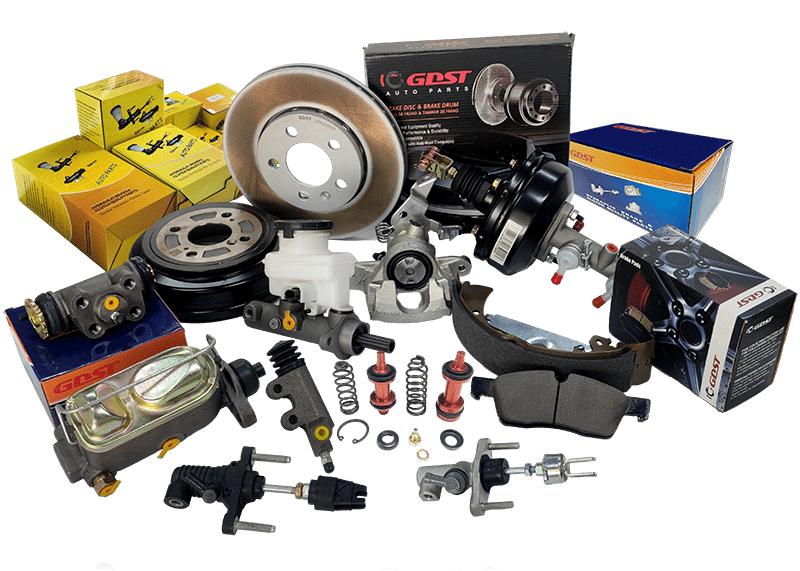
Brake disc size is often treated as a simple measurement, but I regularly see buyers face wrong-fit risks after matching only the outer diameter. That mistake can lead to delayed orders, customer complaints, and warranty exposure. I use a complete fitment review—rather than one measurement—to confirm the correct disc for each vehicle application.
To identify the right brake disc size, I verify the vehicle application, axle position, OE or catalog reference, outer diameter, thickness, disc height, centre bore, and bolt pattern. I also check engine, trim, drivetrain, and brake-system differences. Physical measurement helps confirm the result, but I do not use a worn disc measurement alone as the final ordering basis.
When I handle fitment confirmations for automotive parts brands, importers, wholesalers, and distributors, I usually start with the application data before discussing dimensions. The measurement still matters, but it becomes useful only when I connect it to the vehicle configuration and the correct part reference. The sections below explain the checks I use to reduce wrong-fit orders.
Why Is Brake Disc Size a Complete Fitment Decision?
A buyer who focuses only on outer diameter can quickly narrow the selection to the wrong product. The disc may appear similar but still fail to match the caliper, hub, wheel position, or mounting system. I therefore treat brake disc size as a complete fitment decision involving several technical dimensions and application details.
The correct brake disc size depends on more than outer diameter. I verify the disc’s thickness, height, centre bore, bolt pattern, axle position, and vehicle-specific application. I also compare these details with OE information or reliable catalog data before I recommend a product for ordering.
Which Measurements Matter?
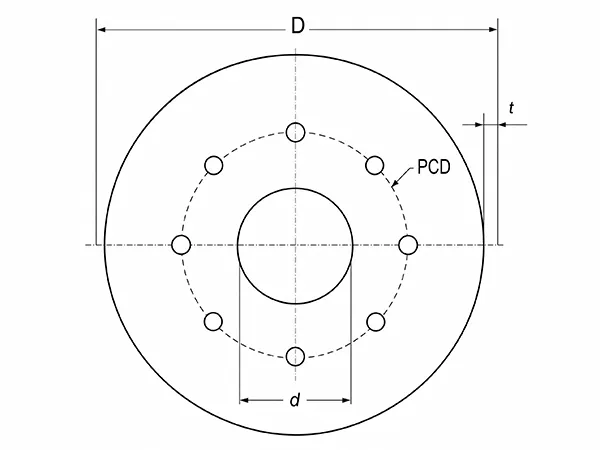
When I review a brake disc drawing or catalog listing, I normally look for the following specifications:
| Specification | What it describes | Why I check it |
|---|---|---|
| Outer diameter | The overall diameter of the disc | It affects caliper and wheel-space compatibility |
| Disc thickness | The nominal friction ring thickness | It must match the caliper and braking system design |
| Overall height | The distance from the mounting face to the disc position | It affects alignment inside the caliper |
| Centre bore | The diameter of the hub locating hole | It must fit the vehicle hub correctly |
| Bolt pattern | Number and spacing of mounting holes | It must match the hub or wheel carrier |
| Minimum thickness | The manufacturer’s service limit | It indicates when a used disc requires replacement |
| Axle position | Front or rear application | Front and rear systems usually use different parts |
| Ventilation design | Solid or vented construction | It forms part of the original braking specification |
I do not assume that two discs are interchangeable because they share an outer diameter.1 A small difference in thickness or overall height can affect the relationship between the disc and caliper. A different centre bore can prevent correct hub location, while a different bolt pattern can make installation impossible.
Why Does Axle Position Matter?
The front and rear axles often use different brake disc designs.2 The front axle may carry a different proportion of braking demand, while the rear axle may use a different caliper, parking-brake arrangement, or disc construction. Some vehicles also use a disc with an integrated drum section for the parking brake.3
When a customer asks me for “the brake disc for a particular model,” I ask whether the requirement is for the front or rear axle. I also ask for the OE number or a complete catalog reference. This simple question often exposes missing information before the buyer places an order.
Why Can Similar-Looking Discs Still Be Incorrect?
Aftermarket brake discs can look almost identical in product photographs. However, visual similarity does not prove compatibility. The following differences can create a wrong-fit situation:
- A slightly different disc thickness
- A different number of mounting holes
- A centre bore that is too large or too small
- A different overall height
- A solid disc instead of a vented disc
- A separate parking-brake drum versus an integrated drum design
- A front application listed incorrectly as a rear application
- A model-specific braking package
I once handled a fitment discussion in which the customer had selected a disc using the diameter shown in an online listing. The diameter looked correct, but the customer had not confirmed the axle or OE reference. I requested the vehicle application details and found that more than one brake configuration was listed for that model range. The final selection required a catalog cross-check rather than a simple diameter match.
For procurement teams, this matters because an incorrect dimension can affect more than one vehicle. A single wrong catalog mapping can create a batch-level problem. Before approving a purchase order, I recommend checking the complete dimensional drawing, application list, and reference number together.
Is the Vehicle Year and Model Enough to Identify Brake Disc Size?
Vehicle year and model provide a starting point, but they do not always identify one brake disc size. I often find several brake configurations within the same model generation. Engine output, trim level, body style, drivetrain, production period, and factory braking package can all change the correct part.4
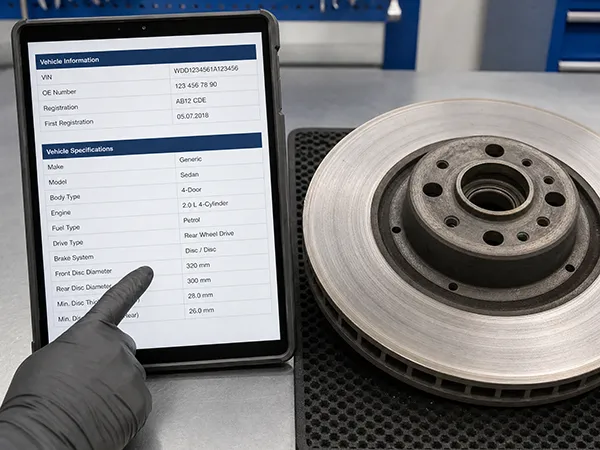
I do not use the vehicle year and model as the only ordering basis when multiple configurations exist. I ask for a VIN, OE number, registration details, complete catalog application data, or verified technical specifications. These references help separate similar vehicle versions and reduce selection errors.
What Vehicle Details Should I Collect?
I use a structured information checklist when a customer requests brake disc fitment confirmation:
- Vehicle make and model
- Model year or production date
- Engine type or engine code
- Body version
- Drivetrain, such as front-wheel drive or all-wheel drive
- Front or rear axle
- Brake package or performance package, if applicable
- VIN or registration information
- OE part number
- Existing disc dimensions, used only as supporting information
Not every market provides all these details in the same format. However, even one additional reference can make the selection more reliable. For example, an OE number may connect the vehicle to a specific catalog application, while a VIN can help identify the original factory configuration.5
Why Do Engine and Trim Affect the Disc?
Manufacturers may use different braking systems within one model family. A higher-output engine, heavier body version, or different equipment package may use a different caliper and disc assembly. A four-wheel-drive version may also have different axle or hub specifications from a two-wheel-drive version.
I do not assume that a facelifted model uses exactly the same brake parts as the earlier version. Production changes can also occur during a model year.6 Catalog data may list a date range, chassis code, or additional restriction. I check those details instead of treating the model name as a complete technical description.
How Can Buyers Control Catalog Errors?
Catalog data is valuable, but I still recommend a second check for high-volume procurement. Buyers can use the following process:
- Compare at least one OE reference with the aftermarket part number.
- Confirm the front or rear axle.
- Review the manufacturer’s dimensional drawing.
- Check whether the catalog lists engine, body, or drivetrain restrictions.
- Ask the supplier to confirm the application in writing.
- Request a sample or technical drawing for uncertain applications.
- Keep the approved fitment record with the purchase order.
A written confirmation creates a clearer communication trail between the buyer and supplier. It does not replace professional vehicle evaluation, but it helps both parties identify what information supported the selection.
In my supplier-side work, the most useful customer questions are often very specific: “Does this part number apply to the front axle only?” “Does the listing include both engine versions?” “Is this dimension based on the new disc?” These questions show that the buyer is checking the application rather than simply comparing prices.
For importers and distributors, accurate fitment data also supports inventory planning. A part with broad vehicle coverage may be commercially attractive, but the coverage still needs to be correct. Incorrect application data can increase returns, create workshop delays, and damage confidence in the brand.
How Do I Measure an Existing Brake Disc Correctly?
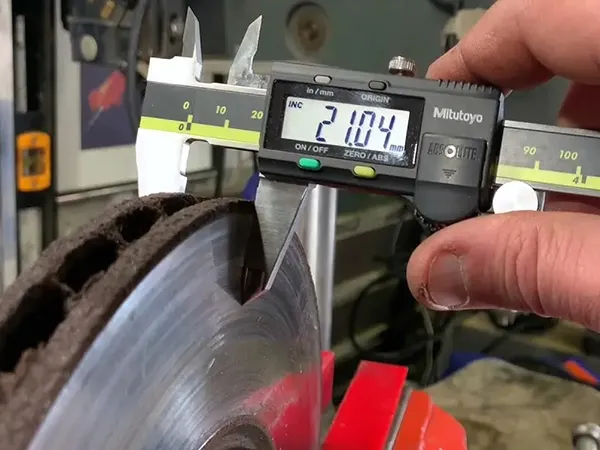
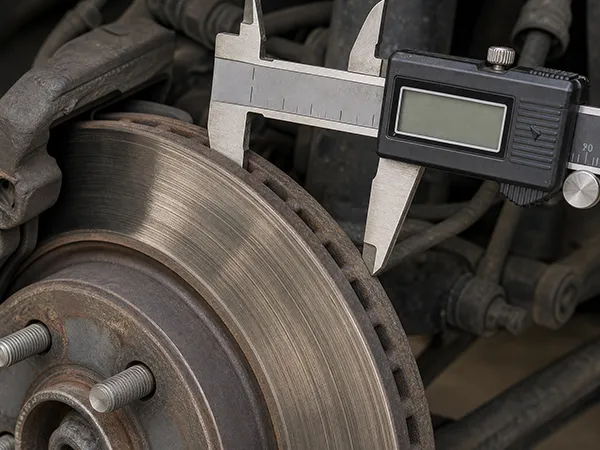
Measuring an existing brake disc can help verify a suspected application, but I treat it as a cross-check rather than the final ordering basis. Wear, corrosion, rust on the hub area, restricted access, and measuring-tool error can all produce misleading results.7 I compare the measurement with OE or catalog data before confirming an order.
To measure a brake disc, I first identify the axle and remove sources of interference where appropriate. I measure the main dimensions with suitable tools, record the results carefully, and compare them with reliable application information. I never assume that a worn or damaged disc still represents its original nominal specification.
Which Tools Do I Need?
The tool depends on the dimension I need to inspect. I may use:
- A steel rule or tape measure for approximate outer diameter
- Vernier calipers for centre bore and accessible dimensions
- A micrometer for friction-ring thickness
- A depth gauge for selected height measurements
- A bolt-pattern gauge or careful hole-spacing method
- A flat reference surface for checking measurement consistency
- A clean cloth and suitable cleaning method for removing loose corrosion
A ruler can provide a rough diameter, but it may not deliver enough precision for a purchasing decision. A micrometer is more appropriate for disc thickness, especially when I need to distinguish between close specifications.
How Do I Measure Outer Diameter?
I measure across the widest part of the disc from one outer edge to the opposite edge. I keep the measuring tool aligned through the centre rather than measuring at an angle. If the disc has corrosion or a damaged edge, I note that condition because the visible edge may not represent the original diameter accurately.
The outer diameter is useful, but it does not identify the complete disc. I record it together with:
- Nominal thickness
- Overall height
- Centre bore
- Number of mounting holes
- Bolt-circle information
- Front or rear position
- Solid or vented construction
How Do I Measure Thickness?
I measure the friction ring away from the outer lip and away from heavily corroded or damaged areas. A used disc can develop a wear ridge, so measuring on that ridge may give an inaccurate result. I take readings at more than one position when possible and record whether the result appears to be a nominal thickness or a worn-service measurement.
I also distinguish between nominal thickness and minimum service thickness.8 Nominal thickness describes the new part specification. Minimum thickness describes the limit established for a particular braking system. These values are not interchangeable, and I do not use a service-limit marking as the new replacement specification.
How Do I Measure Height and Centre Bore?
Overall height can be difficult to measure accurately while the disc remains on the vehicle. The hub face, rust, backing plate, and caliper can restrict access. I use a suitable reference surface and a depth-measuring method when the disc is removed. I record the method because inconsistent reference points can create a misleading result.
For the centre bore, I measure the diameter of the central locating hole as accurately as possible. Corrosion can reduce the apparent opening, while dirt can make it appear smaller or irregular. I clean the relevant area carefully and avoid forcing a tool against damaged metal.
Why Should I Not Order From Measurement Alone?
An old disc may already be the wrong part. It may have been installed during a previous repair, listed incorrectly by a seller, or modified by corrosion and wear. A measurement can confirm that a suspected part is close to the expected specification, but it cannot independently prove that the part belongs on the vehicle.
I use this verification sequence:
- Collect the vehicle and axle details.
- Find the OE or catalog reference.
- Review the listed technical dimensions.
- Measure the existing disc if access is practical.
- Compare the measured values with the reference data.
- Resolve differences with the supplier or a qualified technician.
- Approve the part only after the main details agree.
A qualified professional should evaluate uncertain applications, especially when the vehicle has modified suspension, non-original wheels, upgraded calipers, or an unusual braking package. Brake system decisions can affect safety, so measurement should support—not replace—technical judgment.9
Is a Larger Brake Disc Automatically Better?
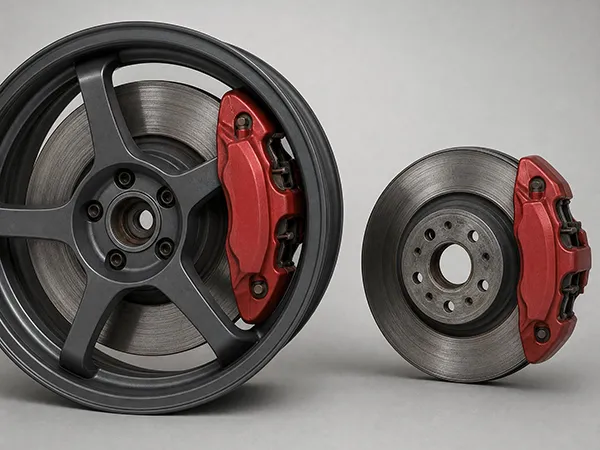
A larger brake disc is not automatically better or safer for a vehicle.10 I evaluate whether the disc is engineered and approved for the complete braking system, including the caliper, carrier, hub, wheel clearance, ABS-related components, and intended application. Without suitable engineering information and test data, I do not make performance claims based on size alone.
A larger diameter may be part of a different braking package, but it can also create clearance and compatibility problems. I do not recommend treating a larger disc as a universal upgrade.
What Must Match in a Brake Upgrade?
When a buyer asks about a different brake disc size, I look beyond the disc itself. The complete system may require compatibility among:
- Disc outer diameter
- Disc thickness
- Caliper type
- Caliper mounting position
- Caliper carrier
- Hub and wheel bearing arrangement
- Wheel diameter and internal spoke clearance
- Brake hose and ABS sensor routing
- Parking-brake mechanism
- Vehicle control systems
- Approved application and intended use
A larger disc may not fit inside the original wheel.11 It may also place the friction surface outside the caliper’s working area. A thicker disc may not fit between the pads, while a different height may cause the disc to sit off-centre.
What About Drilled or Slotted Discs?
Drilled, slotted, coated, and other disc designs should also be evaluated as complete product specifications. I do not claim that a drilled or slotted disc automatically improves braking performance in every vehicle or driving condition.12 The result depends on design, materials, installation, pad compatibility, thermal conditions, and validated testing.
For procurement purposes, I recommend that buyers ask the supplier for clear product information:
- Intended vehicle applications
- Material and manufacturing specifications
- Dimensional drawing
- Surface-treatment information
- Balancing and run-out inspection method
- Applicable quality documents
- Installation and use limitations
- Relevant test or approval documentation
Buyers should verify certifications and approvals directly through current documents. A supplier’s general statement does not replace checking whether the exact product, market, and application are covered.
When Is a Different Disc Appropriate?
A different brake disc may be appropriate when the vehicle manufacturer specifies it, when a qualified brake-system engineer designs the conversion, or when the replacement part is listed for that complete application. I would not approve a size change simply because the vehicle owner wants more braking capacity.
For aftermarket brands and distributors, this distinction protects both product quality and customer communication. A catalog should clearly separate:
- Direct replacement parts
- Vehicle-specific alternative parts
- Approved performance applications
- Custom or engineered solutions
- Parts requiring additional hardware or professional installation
I have found that customers make better decisions when the supplier explains what the product is designed to replace. Clear application boundaries are more useful than broad claims about improved braking.
If a customer is considering a modified braking system, I recommend qualified professional evaluation. The evaluator should consider the vehicle’s full braking package, wheel clearance, control systems, intended use, and applicable local requirements. I can support product and fitment information from the manufacturing side, but I do not replace a vehicle engineer or testing laboratory.
How Can Procurement Teams Confirm Brake Disc Size Before Ordering?
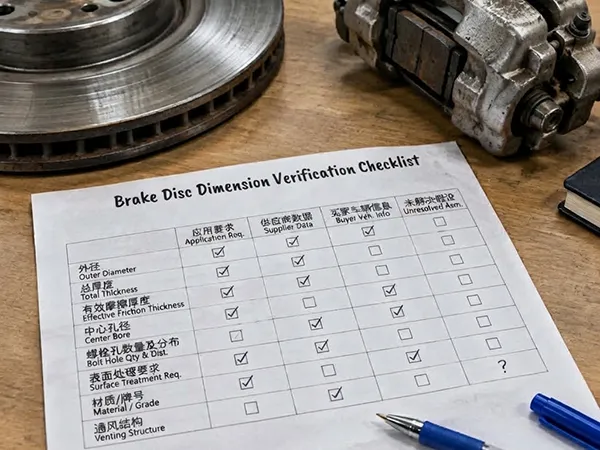
Procurement teams can reduce wrong-fit orders by using a documented confirmation process. I recommend combining application data, OE references, technical dimensions, supplier confirmation, and sample inspection. This approach takes more time than matching a single number, but it can reduce returns, customer complaints, and inventory risk.
Before I confirm a brake disc order, I compare the requested application against the supplier’s technical data and the buyer’s vehicle information. I also record unresolved assumptions so that nobody treats an unverified catalog match as a confirmed fitment.
What Should a Buyer Ask a Supplier?
I suggest asking the supplier these questions:
- What is the exact aftermarket part number?
- Which OE number does the part replace?
- Does the part fit the front or rear axle?
- What vehicle configurations are included or excluded?
- What are the new disc’s nominal dimensions?
- Is the disc solid, vented, drilled, slotted, or coated?
- Does the product require additional hardware?
- What quality-control checks are completed?
- Which certification or approval documents apply to this exact product?
- Can the supplier provide a drawing, catalog page, or sample?
These questions help buyers evaluate the product and the supplier at the same time. A supplier that can provide consistent technical information is easier to manage across multiple purchase orders.
What Quality Checks Support Fitment?
A manufacturing supplier may use several inspections to control product consistency. I commonly explain the relevance of checks such as:
- Dimensional inspection
- Hardness testing
- Run-out testing
- Balance testing
- Coating adhesion testing
- Salt-spray testing for applicable surface treatments
- High-temperature performance testing where applicable
- Final appearance and packaging inspection
The exact inspection plan depends on the product and customer requirement. Buyers should request relevant records and verify the scope of any quality-management certification or product approval. They should also confirm that the documentation applies to the manufacturing site and product being purchased.
At GDST Auto Parts, I can discuss OE-based product development, application coverage, private-label requirements, packaging, and manufacturing controls with aftermarket customers. Our business context includes production across brake disc categories such as standard, coated, drilled, and slotted products. However, I still expect each application to be confirmed through the appropriate technical data rather than through a general product description.
What Should a Purchase Order Include?
A clear purchase order can prevent later confusion. I recommend including:
- Supplier part number
- Customer or private-label part number
- OE reference
- Vehicle application
- Axle position
- Confirmed dimensions
- Quantity
- Packaging requirements
- Label information
- Required documents
- Sample-approval status
- Any exclusions or fitment limitations
I also recommend saving the supplier’s written fitment confirmation with the purchase-order record. This practice helps procurement, quality, warehouse, and sales teams use the same information.
For larger programs, buyers can request a fitment matrix. The matrix may include the vehicle model, production period, engine, body type, axle, OE number, aftermarket number, and dimensional data. I find this especially useful when a distributor is expanding from a small product range to thousands of applications.
A Practical Confirmation Workflow
I use the following workflow as a general procurement guide:
- Start with the vehicle application. I collect model, year, engine, body, drivetrain, and axle details.
- Find an authoritative reference. I use the OE number, VIN, or trusted catalog application.
- Review the complete dimensions. I check more than outer diameter.
- Measure the existing part if necessary. I treat the result as supporting evidence.
- Ask the supplier to confirm discrepancies. I do not guess when data conflicts.
- Review product and quality documentation. I check the scope and current status.
- Approve a sample for uncertain applications. I use inspection before mass ordering.
- Record the final fitment decision. I connect the approval to the purchase order and product label.
This process helps a buyer distinguish a true fitment confirmation from a rough product search. It also gives the supplier a clear basis for answering technical questions.
Frequently Asked Questions
Can I identify the correct brake disc size by measuring the outer diameter?
No. Outer diameter is only one part of brake disc fitment. I also check thickness, overall height, centre bore, bolt pattern, construction, axle position, OE reference, and vehicle configuration. I use outer diameter as a supporting measurement, not as the sole ordering criterion.
What information should I provide when asking for a replacement brake disc?
I recommend providing the vehicle make, model, year, engine, body version, drivetrain, front or rear axle, VIN where available, and OE part number. A photograph and measurements of the existing disc can also help, but I still ask the supplier to verify the application against catalog or OE data.
Can the same vehicle model use different brake disc sizes?
Yes. Different engines, trims, body styles, drivetrains, production periods, and braking packages can use different discs. The front and rear axles can also require different specifications. I therefore avoid treating one model year as proof of a single brake disc size.
Is a larger brake disc a better replacement?
Not automatically. A larger disc must match the caliper, carrier, hub, wheel clearance, control systems, and approved vehicle application. Without complete engineering information and suitable test data, I do not assume that a larger, drilled, or slotted disc will improve braking performance.
Should I use the old disc’s measurements to place an order?
I use the old disc’s measurements as a verification step. Wear, corrosion, poor access, and a previously incorrect replacement can affect the result. I cross-check the measurements with an OE number, VIN, reliable catalog data, or a qualified professional’s evaluation before ordering.
Conclusion
I treat brake disc size as a complete fitment decision, not a single diameter measurement. The correct selection requires confirmation of the axle, vehicle configuration, OE or catalog reference, thickness, height, centre bore, bolt pattern, and related braking-system details. Physical measurement can support the process, but it should not replace authoritative application data. For reliable aftermarket sourcing, contact GDST Auto Parts with your vehicle coverage, OE references, dimensional requirements, and branding needs so I can help your team review the appropriate manufacturing and fitment options.
"NIU FSAE Brake Rotor Design & Flywheel-Based Test Stand ...", https://huskiecommons.lib.niu.edu/cgi/viewcontent.cgi?article=2619&context=studentengagement-honorscapstones. Brake-system engineering literature treats rotor diameter, thickness, offset, and mounting geometry as interdependent design parameters, so a shared outer diameter does not by itself establish component interchangeability. Evidence role: mechanism; source type: paper. Supports: The source should explain why rotor diameter must be evaluated together with thickness, offset, mounting, and caliper geometry.. Scope note: This supports the general engineering principle but does not verify the fitment of any particular vehicle or aftermarket part number. ↩
"How Do Car Braking Systems Work?", https://www.uti.edu/blog/automotive/braking-systems. Automotive braking references describe front and rear axles as having different load distributions and, frequently, different caliper, rotor, and parking-brake arrangements; this supports axle-specific fitment checks. Evidence role: mechanism; source type: education. Supports: The source should describe how axle-specific braking loads and parking-brake arrangements lead to different front and rear brake hardware.. Scope note: The word 'often' is context-dependent, and the source would not establish that every vehicle uses different front and rear discs. ↩
"What Are Air Brakes and How Do They Work", https://www.uti.edu/blog/diesel/air-brakes. Automotive braking references describe drum-in-hat assemblies in which a drum surface is incorporated into the rear rotor and operated by the parking-brake mechanism. Evidence role: definition; source type: encyclopedia. Supports: The source should define the drum-in-hat or integrated-drum arrangement and explain that the drum surface is used by the parking-brake mechanism.. Scope note: This design is used only on some vehicle applications and does not indicate that a particular disc is compatible with a particular vehicle. ↩
"Disc brake", https://en.wikipedia.org/wiki/Disc_brake. Vehicle-service and parts-application documentation commonly distinguishes brake components by engine, drivetrain, production period, and factory braking package, supporting the need to verify configuration rather than rely on the model name alone. Evidence role: general_support; source type: institution. Supports: The source should document configuration-dependent brake-system variations within a model range, such as differences by engine, drivetrain, production date, or performance package.. Scope note: Application rules vary by manufacturer and market, so this evidence supports the general fitment principle rather than a universal list of required vehicle details. ↩
"NHTSA Product Information Catalog and Vehicle Listing - Home", https://www.nhtsa.gov/cars/rules/manufacture/. Official vehicle-identification guidance explains that a VIN uniquely identifies a vehicle and can be decoded with associated records to distinguish specified model and configuration attributes. Evidence role: definition; source type: government. Supports: The source should explain the identifying information associated with VINs and their use in distinguishing vehicle variants.. Scope note: A VIN generally reflects recorded or factory information and may not reveal later modifications, replacement parts, or all brake-option details. ↩
"brake noise/judder/pedal feel diagnosis and repair", https://static.nhtsa.gov/odi/tsbs/2023/MC-10233827-0001.pdf. Manufacturer service and application records document production-date boundaries and running changes in vehicle components, showing why model-year labels alone may not identify a single brake-disc specification. Evidence role: historical_context; source type: institution. Supports: The source should provide evidence that manufacturers introduce running changes or date-bounded component applications during a model-year production period.. Scope note: Such changes are manufacturer- and model-specific; the evidence supports checking production dates but does not show that every model year contains a brake-system change. ↩
"Corrosion Stiction in Automotive Braking Systems - PMC - NIH", https://pmc.ncbi.nlm.nih.gov/articles/PMC10224365/. Brake-component inspection literature identifies surface deterioration, nonrepresentative reference points, access constraints, and instrument uncertainty as sources of error in dimensional measurements of used rotors. Evidence role: mechanism; source type: research. Supports: The source should discuss how wear, corrosion, inaccessible reference surfaces, and instrument uncertainty affect brake-disc dimensional measurements.. Scope note: The magnitude of error depends on the disc condition, measurement method, and instrument; the evidence does not establish a single correction factor. ↩
"19VAC30-70-80. Service brakes. - Virginia Law", https://law.lis.virginia.gov/admincode/title19/agency30/chapter70/section80/. Brake-maintenance and inspection guidance distinguishes the nominal thickness specified for a new disc from the minimum permissible thickness for a worn disc; these values serve different replacement and service-limit functions. Evidence role: definition; source type: government. Supports: The source should define the new-component specification and the service limit for a used brake disc, and distinguish their maintenance purposes.. Scope note: The applicable minimum value is vehicle- and manufacturer-specific, so a general definition cannot substitute for the exact specification. ↩
"Amendments to Brake System Maintenance and Inspection ...", https://www.federalregister.gov/documents/2026/08/31/2026-17784/amendments-to-brake-system-maintenance-and-inspection-requirements. Vehicle-safety regulations and inspection guidance classify braking systems as safety-critical and require conformity of their components and operation, supporting the use of measurement as evidence within a broader technical assessment. Evidence role: expert_consensus; source type: government. Supports: The source should establish that braking-system components are safety-critical and that compliance depends on system-level specifications and proper inspection.. Scope note: Regulatory requirements differ by jurisdiction and do not prescribe the article's exact procurement workflow. ↩
"(PDF) Heat Transfer Analysis of Automotive Disc Brakes", https://www.academia.edu/99438811/Heat_Transfer_Analysis_of_Automotive_Disc_Brakes. Vehicle-braking research treats rotor diameter as one variable in a system that includes caliper force, friction materials, thermal capacity, wheel clearance, and control behavior; therefore, greater diameter alone is not proof of improved safety or performance. Evidence role: mechanism; source type: paper. Supports: The source should explain how disc size interacts with calipers, pad area, thermal behavior, wheel clearance, and the rest of the vehicle braking system.. Scope note: Specific larger-disc conversions may improve performance when engineered and validated for a particular vehicle, which this general evidence does not assess. ↩
"How to Upgrade to 1LE brakes", https://www.eecis.udel.edu/~davis/z28/DanBurk1LEbrake.html. Brake-upgrade engineering guidance identifies wheel-barrel and spoke clearance as geometric constraints that must be checked when rotor diameter or caliper dimensions increase. Evidence role: mechanism; source type: education. Supports: The source should explain the radial and lateral clearance constraints governing rotor and caliper fitment within a wheel.. Scope note: Clearance depends on the exact wheel, rotor, caliper, and mounting arrangement, so the source cannot validate a universal minimum wheel size. ↩
"Drilled vs. Slotted Brake Rotors: Performance Comparison", https://pedalcommander.com/blogs/garage/drilled-vs-slotted-brake-rotors-which-performs-better. Comparative brake-rotor studies report that the effects of drilling and slotting depend on rotor material, pad compatibility, thermal conditions, and test configuration rather than producing a uniform performance benefit. Evidence role: general_support; source type: paper. Supports: The source should compare drilled, slotted, and plain rotor designs under defined braking conditions and report how outcomes depend on materials, pads, temperature, and test procedures.. Scope note: Results from laboratory or vehicle-specific tests cannot establish performance for every product, vehicle, road condition, or driving style. ↩