
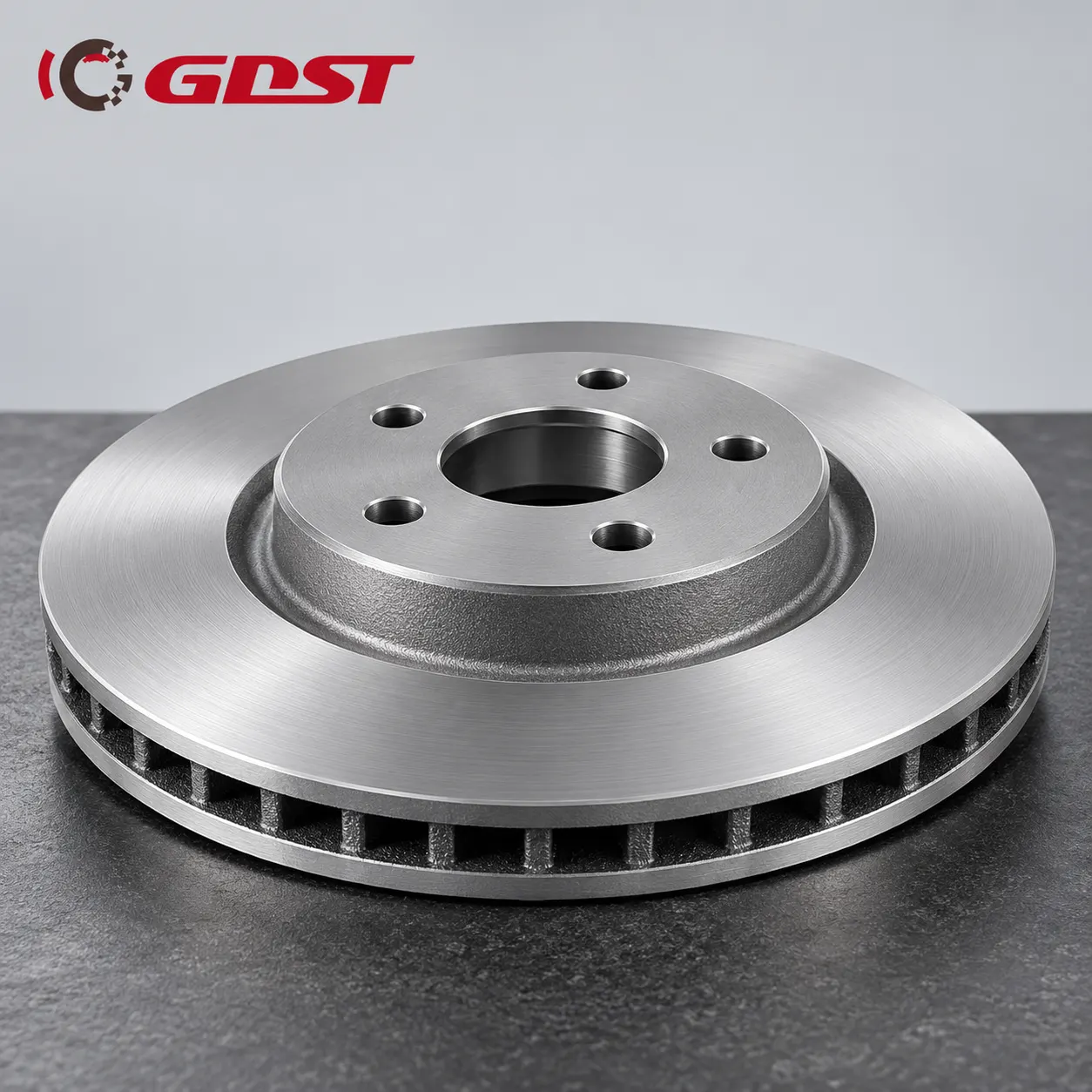
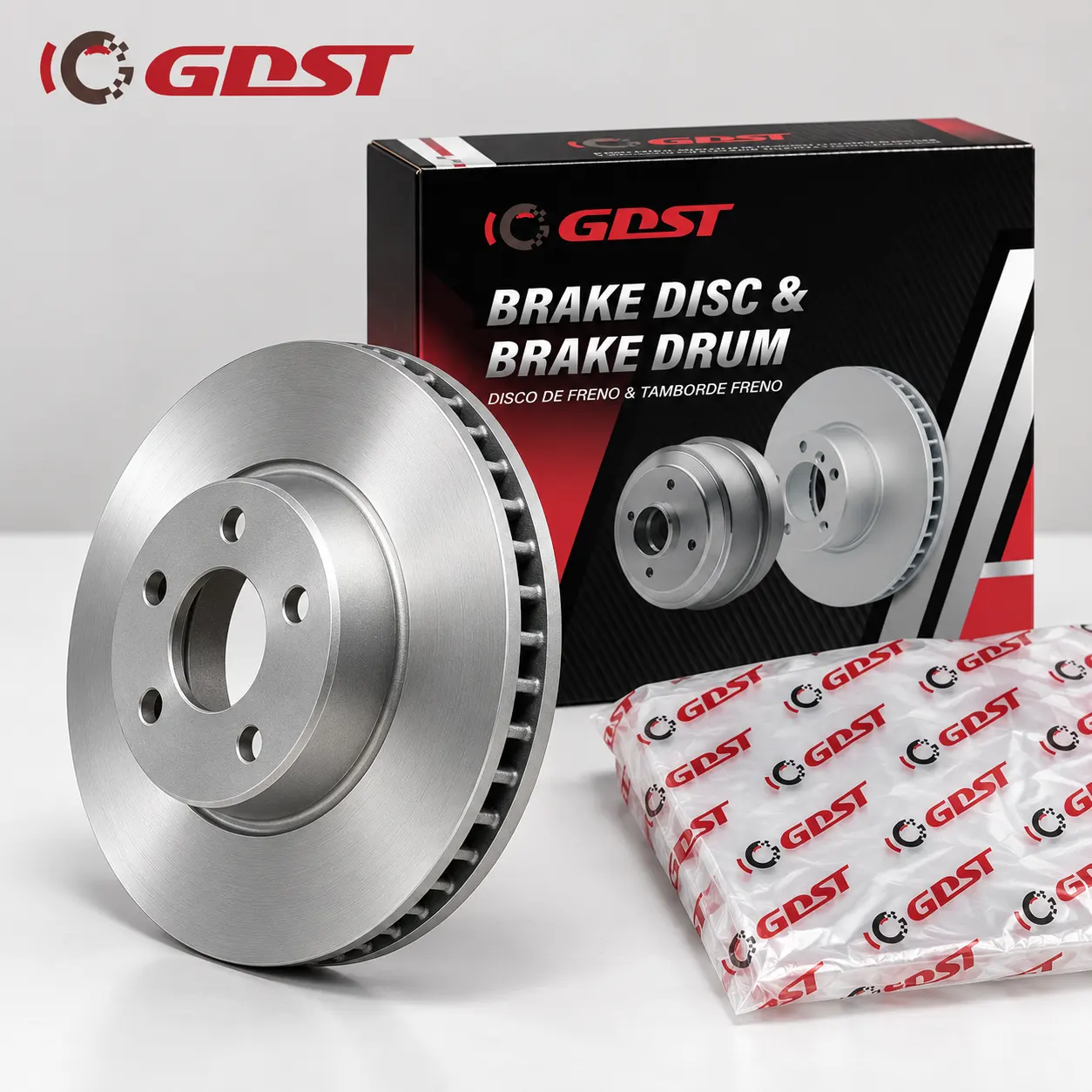
Grey Cast Iron Brake Discs | Brake Disc Casting | OEM & Aftermarket Supply | Custom Brake Rotor Solutions
Looking for a reliable cast iron brake disc manufacturer and supplier in China?
Wuhu GDST Auto Parts Co., Ltd provides grey cast iron brake discs and automotive brake rotors for aftermarket distributors, automotive parts importers, wholesalers, and private-label brands worldwide.
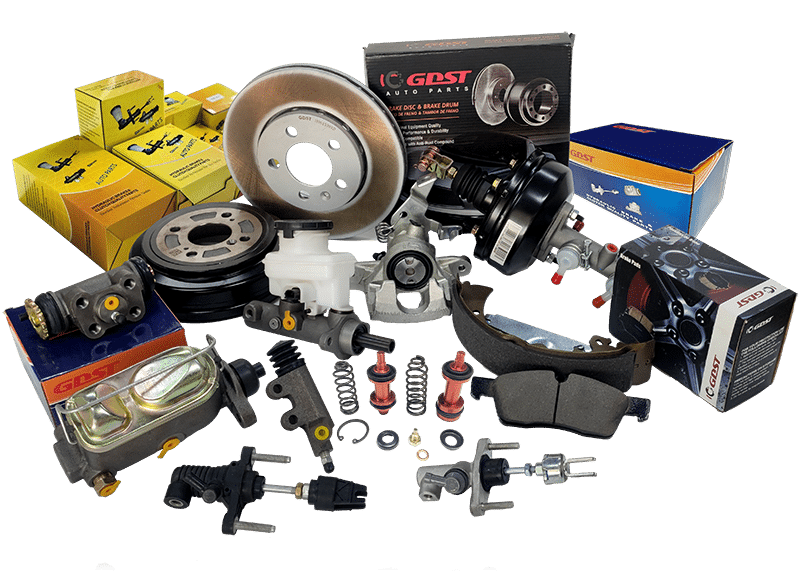
With more than 2,000 brake disc references, our product range covers a variety of passenger cars, SUVs, light commercial vehicles, and heavy-duty trucks.
Through our automotive parts manufacturing and partner-factory network, we coordinate material requirements, brake disc casting, precision machining, quality inspection, and international order fulfillment.
Whether you are sourcing standard aftermarket replacement brake discs or evaluating a custom grey cast iron brake disc project, GDST can help review your OEM references, technical specifications, and purchasing requirements.
GDST Cast Iron Brake Disc Supply Highlights
• 2,000+ Brake Disc References — Extensive coverage for international aftermarket applications.
• Grey Cast Iron Solutions — Material selection and specifications according to product requirements.
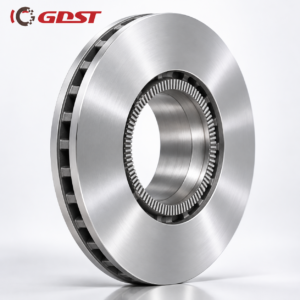
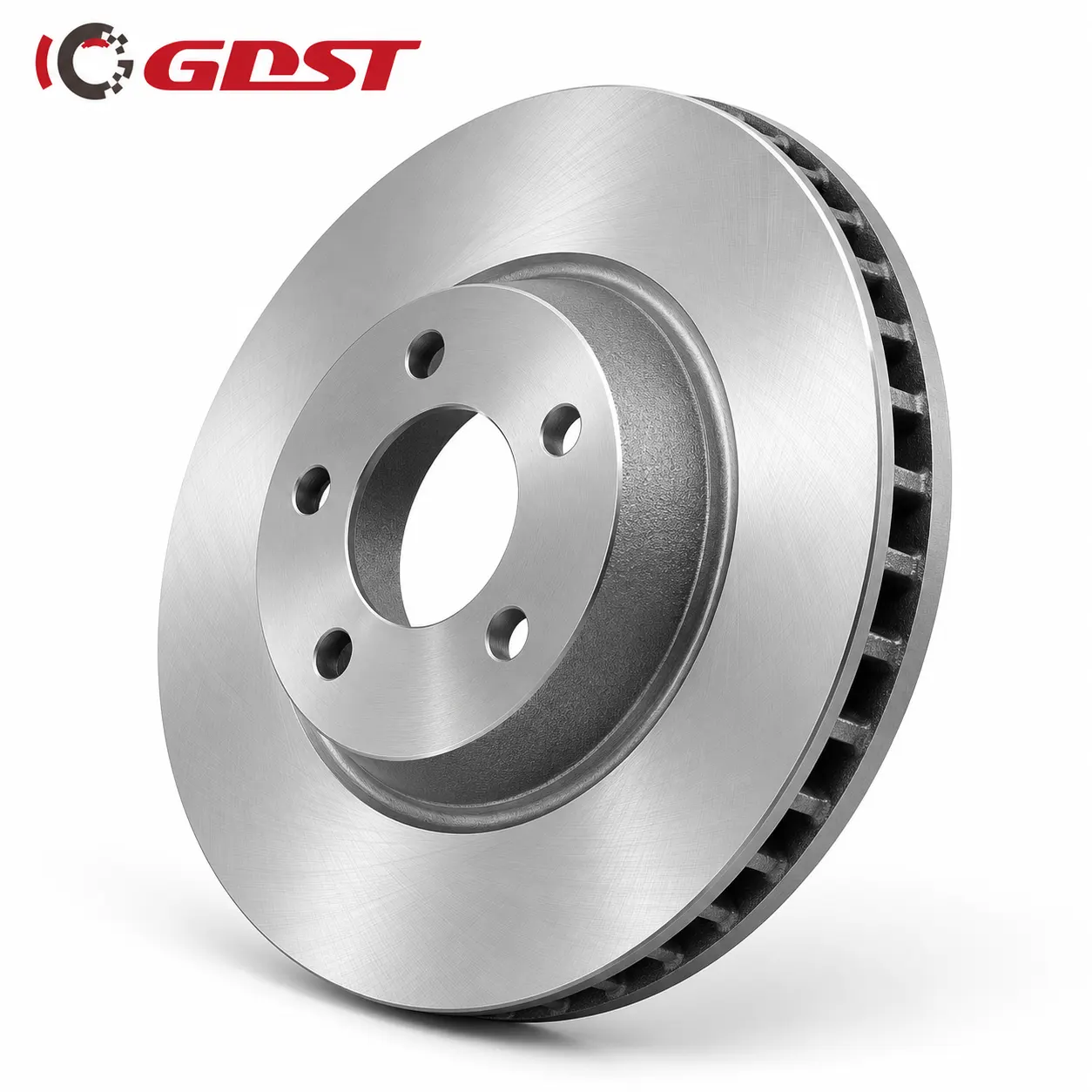
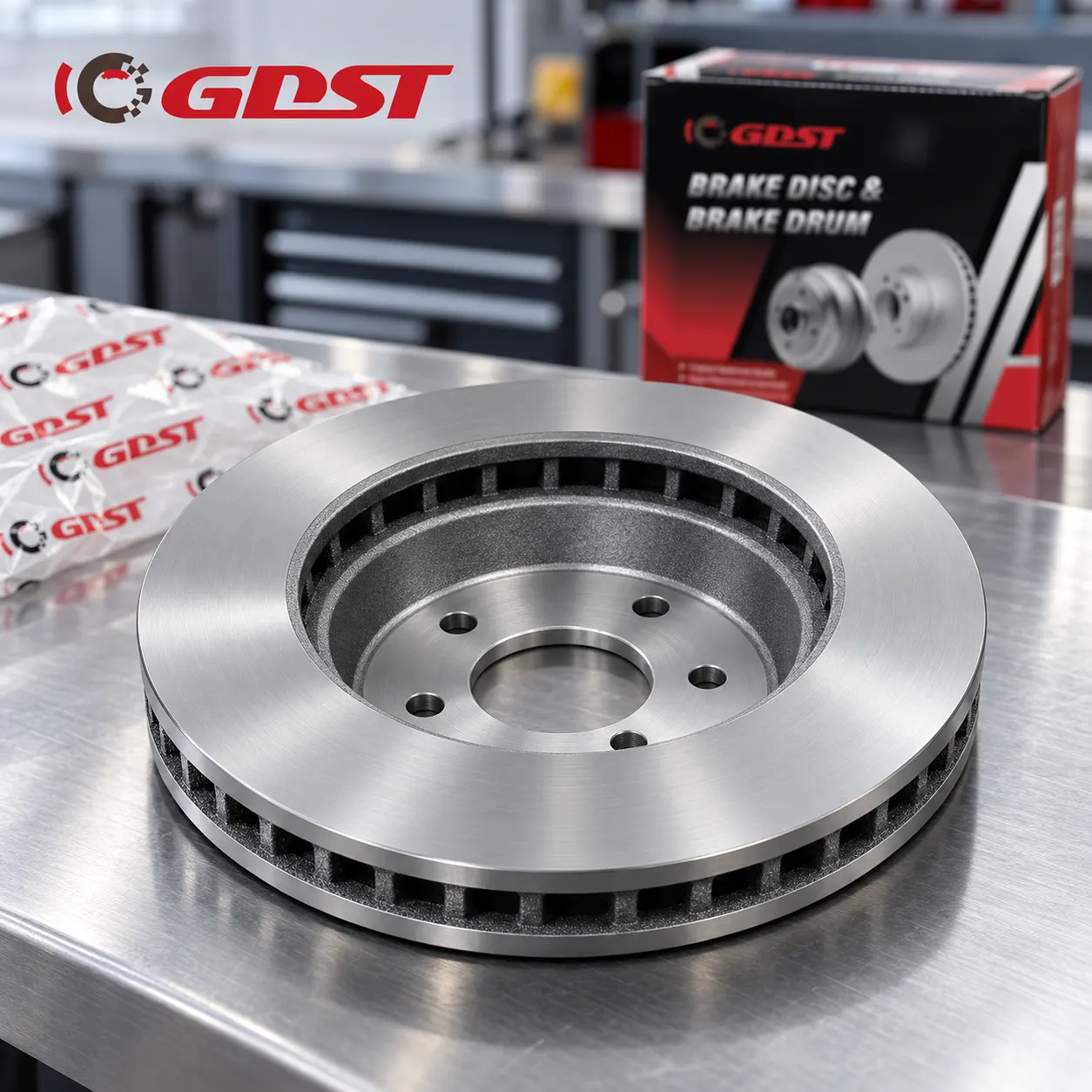
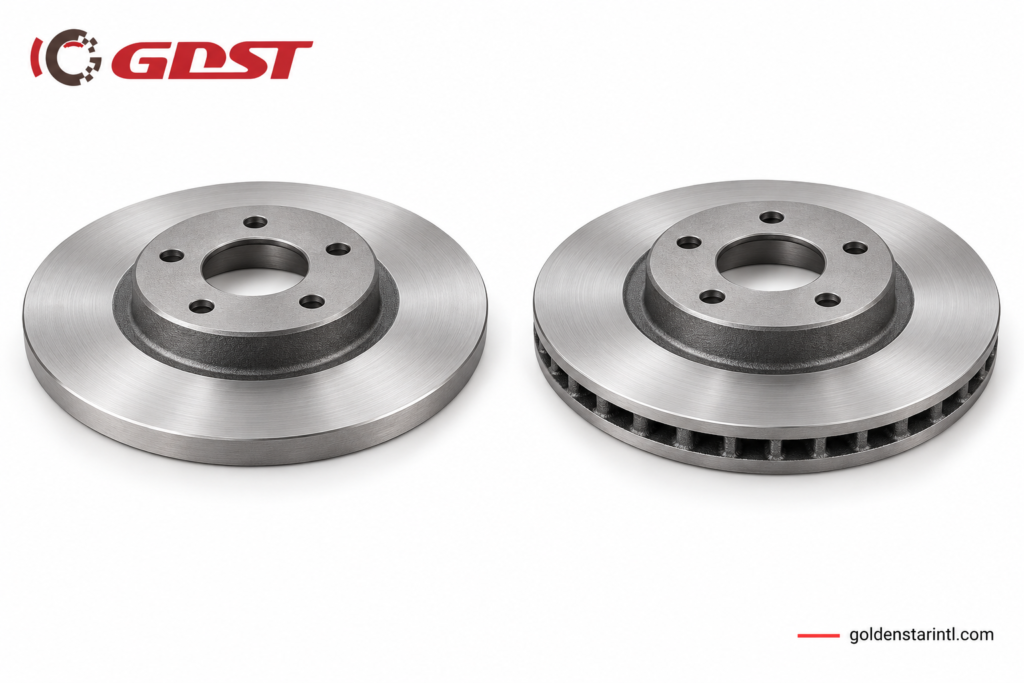
• Solid & Vented Brake Discs — Multiple rotor configurations for passenger and commercial vehicles.
• Factory Inspection Evidence — Material composition, hardness, and dimensional inspection records.
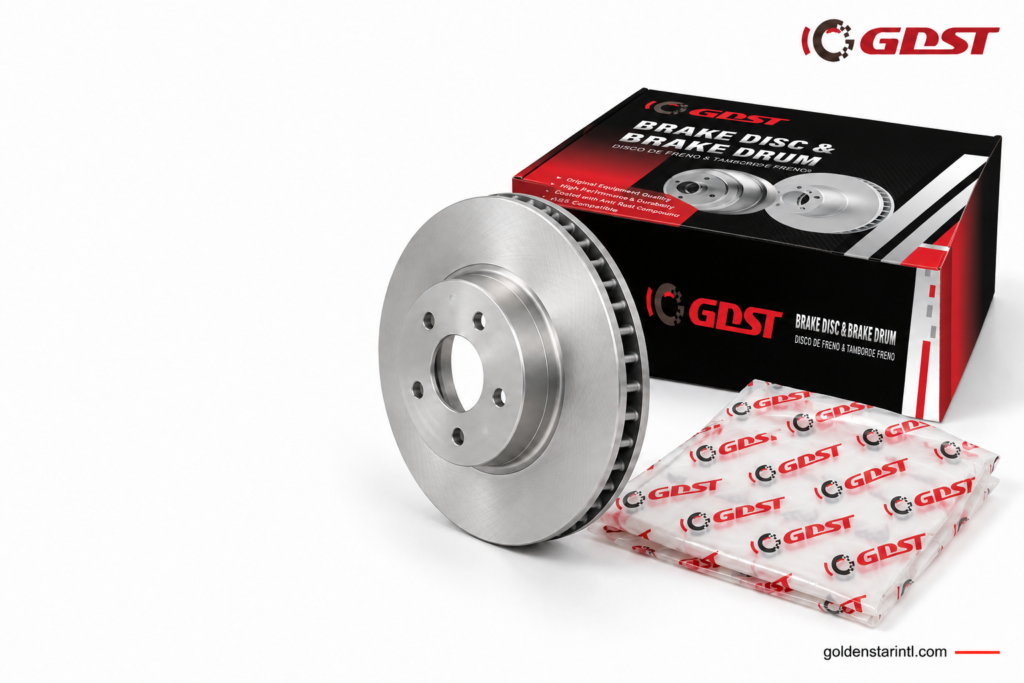
• OEM/ODM Support — Product matching, custom marking, and private-label packaging.
• MOQ: 50 pcs per model — Suitable for multi-reference aftermarket purchasing.
• Lead Time: 50 days — Standard purchasing lead time for confirmed orders.
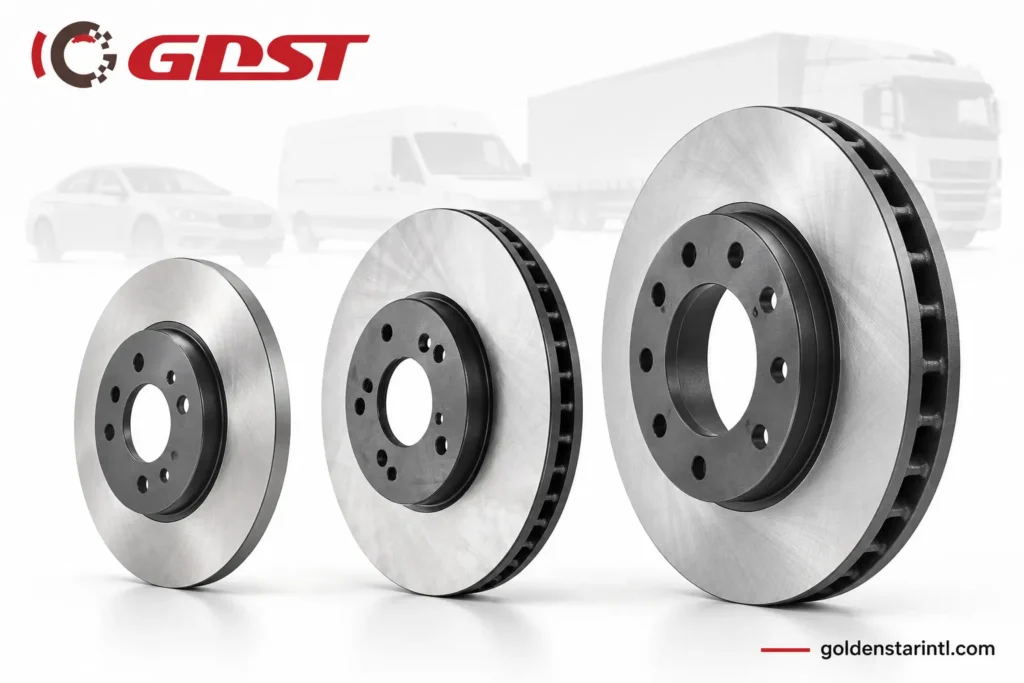
Grey cast iron, also written as gray cast iron, is one of the most commonly used materials for conventional automotive brake discs.
Its combination of useful thermal characteristics, vibration damping capability, castability, machinability, and manufacturing economy makes it suitable for many automotive braking applications.
GDST supplies cast iron brake discs for various passenger and commercial vehicles, including European, Japanese, Korean, and American vehicle applications.
Our available brake disc range includes solid and internally ventilated designs. Selected references may also be available with corrosion-protective coatings or additional machining features.
The appropriate brake disc is determined by the vehicle’s braking system requirements, OEM reference, rotor geometry, and approved material specification.
|
Brake Disc Type |
Structural Features |
Typical Applications |
|
Solid Cast Iron Brake Disc |
Single friction ring without internal ventilation channels |
Selected passenger-car and rear-axle applications |
|
Vented Cast Iron Brake Disc |
Internal cooling passages between two friction surfaces |
Passenger cars, SUVs, and commercial vehicles |
|
Coated Cast Iron Brake Disc |
Specified protective surface treatment |
Automotive aftermarket replacement |
|
Slotted Cast Iron Brake Disc |
Machined grooves on the friction surfaces |
Selected performance-oriented applications |
|
Drilled Cast Iron Brake Disc |
Cross-drilled friction ring where the design permits |
Application-specific replacement programs |
|
Custom Brake Disc Casting |
Customer-defined casting geometry and machining requirements |
Engineering-led OEM/ODM projects, subject to feasibility review |
For standard aftermarket replacement products, our team can assist with OEM reference matching and product specification confirmation.
For custom projects, customers may submit drawings or samples to discuss material, casting, machining, and production requirements.
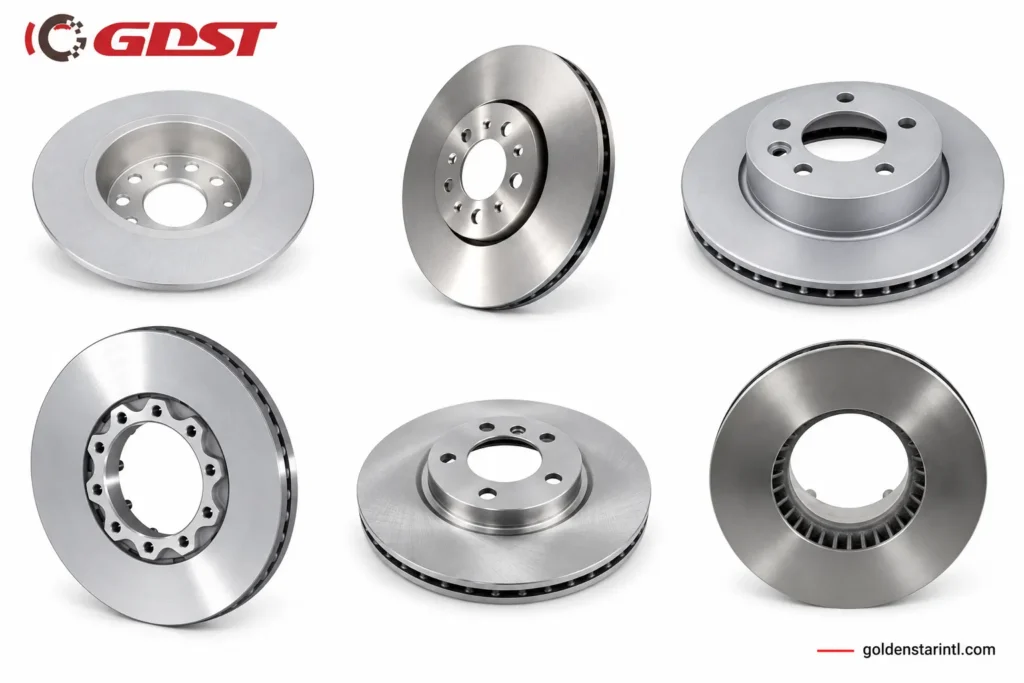
GDST offers more than 2,000 brake disc references for different international vehicle applications.
The following ten references illustrate our product coverage across passenger vehicles, light commercial vehicles, and heavy-duty trucks.
|
OE Reference |
Vehicle Application |
Rotor / Product Type |
Listed Axle Position |
|
5Q061-5601B (5Q0615601B) |
Audi Q2 / SEAT Ateca / Skoda Karoq / VW T-Roc |
Solid |
Rear |
|
55611-52R00 |
Suzuki Baleno / Swift V |
Solid |
Rear |
|
2N0615301A |
Volkswagen Crafter Bus |
Vented |
Front |
|
42510-TV8-E00 |
Honda Civic IX |
Solid |
Rear |
|
81.50803.0048 |
MAN commercial truck applications |
Vented |
Front & Rear |
|
67752279 |
Volvo FL6 |
Vented |
Rear |
|
9754210012 |
Mercedes-Benz Atego |
Vented |
Front |
|
43512-37080 |
Toyota Dyna 300 |
Vented |
Front |
|
F8UZ-1102-CA |
Ford E-350 / E-450 / Super Duty applications |
Vented hub-and-rotor assembly reference |
Front |
|
402069X001 |
Nissan Atleon |
Vented |
Front |
The references are drawn from GDST’s representative product list. They illustrate catalog coverage rather than confirming one identical grey cast iron grade across all ten products. The Ford reference is associated with a hub-and-rotor assembly. Final vehicle compatibility, axle position, assembly configuration, and product specifications must be verified before ordering.
Brake discs differ significantly in their geometry, installation dimensions, and performance requirements.
The following parameters are commonly used for product identification, specification review, and quotation.
|
Technical Parameter |
Available Specification / Requirement |
|
Product Name |
Cast Iron Brake Disc / Grey Cast Iron Brake Rotor |
|
Base Material |
Grey cast iron |
|
Material Grade |
According to approved product specification |
|
Rotor Configuration |
Solid or ventilated |
|
Outside Diameter |
Model-specific |
|
Nominal Disc Thickness |
Model-specific |
|
Minimum Service Thickness |
According to approved design |
|
Overall Height |
Model-specific |
|
Center Bore Diameter |
Model-specific |
|
Bolt-Hole Quantity / PCD |
According to mounting specification |
|
Ventilation Geometry |
Model-specific |
|
Surface Finish |
Machined or specified protective coating |
|
Dimensional Tolerance |
According to approved drawing |
|
OEM Reference |
Available for supported applications |
|
Product Marking |
GDST or approved customer branding |
|
Packaging |
GDST packaging or eligible private-label packaging |
Dimensional specifications and material grades are determined for each brake disc reference. A single universal dimensional tolerance or hardness range should not be assumed for the entire product range.
Need a specific brake rotor model?
Send your OEM part number list or technical requirements to GDST for product matching and quotation.
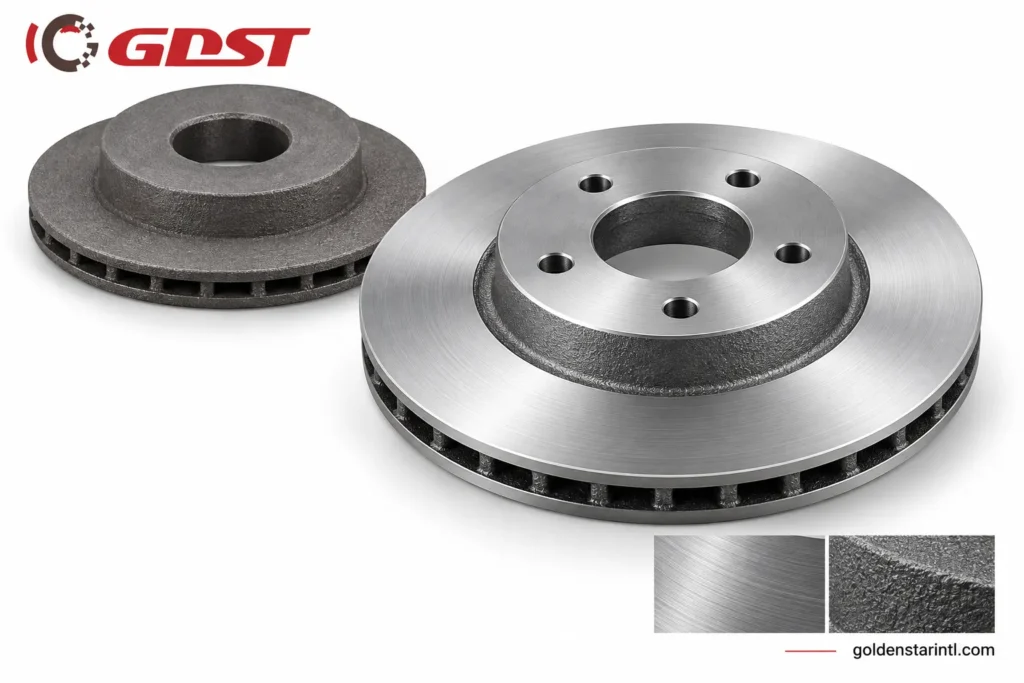
Grey cast iron is widely used for conventional automotive brake discs because its material characteristics provide a practical balance between braking requirements and manufacturing efficiency.
During braking, friction between the brake disc and brake pads converts vehicle kinetic energy into heat.
The rotor must operate under changing thermal and mechanical loads while providing the specified friction surfaces and structural geometry.
Grey cast iron contains graphite flakes distributed within an iron-based matrix. Its chemical composition, graphite structure, matrix microstructure, and processing conditions influence its mechanical and thermal properties.
1. Thermal Properties
Grey cast iron provides useful thermal conductivity and heat-storage characteristics, supporting thermal management within the braking system.
However, the actual temperature distribution and cooling behavior depend on the rotor geometry, ventilation structure, braking conditions, and surrounding airflow.
The material alone does not determine the brake system’s resistance to overheating or brake fade.
2. Vibration Damping Capability
The graphite-containing microstructure contributes to the damping behavior of grey cast iron.
This characteristic is beneficial in applications where friction-induced vibration and noise are important design considerations.
Actual brake noise depends on the complete braking system, including the brake pads, caliper, mounting arrangement, and operating conditions.
3. Wear and Mechanical Properties
Grey cast iron provides a suitable material foundation for many conventional brake rotor applications.
Nevertheless, brake disc wear depends on material composition, hardness, graphite morphology, matrix structure, friction material, contact pressure, and temperature.
Higher carbon content or greater hardness does not automatically guarantee longer service life.
4. Castability and Machinability
Grey cast iron is compatible with established foundry manufacturing processes and can be cast into complex geometries.
This is particularly useful for internally ventilated brake discs, where the casting process must form cooling passages within the rotor.
Subsequent machining establishes the required mounting and friction surface dimensions.
5. Manufacturing Economy
The widespread availability of grey cast iron production processes, combined with its castability and machinability, makes it economically practical for many automotive aftermarket brake disc applications.
However, grey cast iron also has limitations, including susceptibility to corrosion and wear during service.
These advantages and limitations are discussed in the technical literature on automotive grey cast iron brake discs [1].
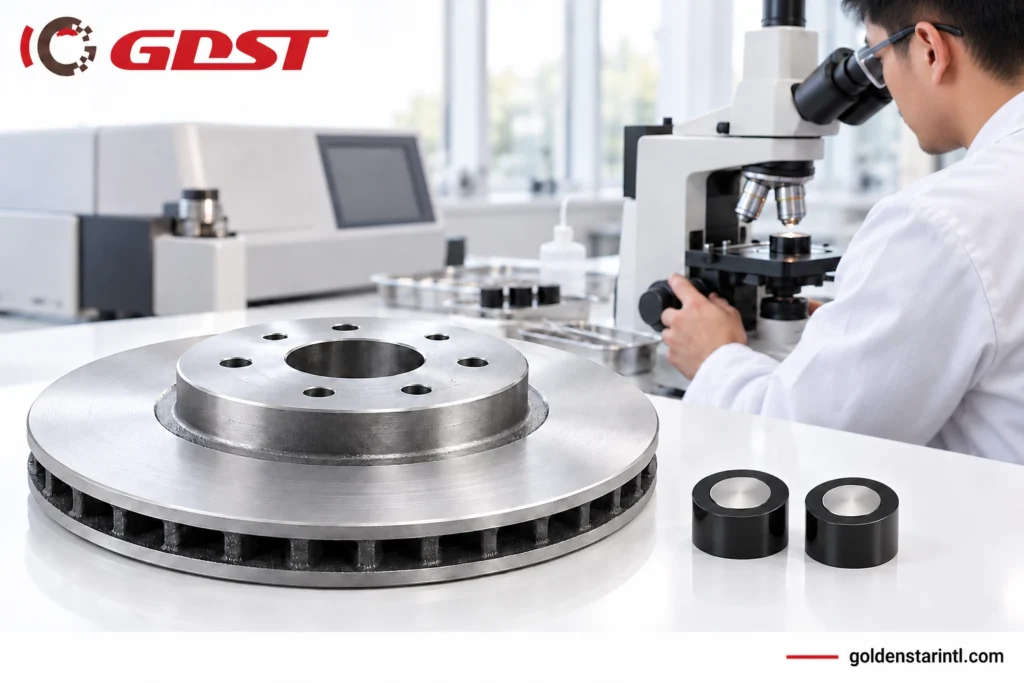
The performance of a cast iron brake disc depends on more than its general material classification.
Chemical composition, graphite morphology, matrix microstructure, and hardness all influence the resulting material characteristics.
In automotive grey cast iron, carbon and silicon are important elements associated with graphite formation and the solidification process.
Manganese, phosphorus, sulfur, and selected alloying elements may also be controlled according to the required material properties.
Material specifications should be defined by the applicable engineering drawing, OEM requirement, or agreed material standard.
GDST has provided a factory laboratory inspection record for a brake disc identified by drawing number YH20242, dated June 11, 2026.
The report contains chemical composition measurements for the inspected grey cast iron component.
|
Chemical Element |
Specified Range / Limit |
Recorded Result |
Reported Status |
|
Carbon (C) |
3.10–3.50% |
3.40% |
Pass |
|
Silicon (Si) |
1.70–2.30% |
1.95% |
Pass |
|
Manganese (Mn) |
0.50–0.90% |
0.70% |
Pass |
|
Phosphorus (P) |
≤0.12% |
0.05% |
Pass |
|
Sulfur (S) |
≤0.12% |
0.07% |
Pass |
|
Chromium (Cr) |
≤0.35% |
0.22% |
Pass |
Source: GDST-supplied Factory Laboratory Inspection Report, Drawing No. YH20242, June 11, 2026.
All six reported chemical composition measurements fall within the corresponding limits stated in the inspection record.
These values represent the inspected component specification. They are not universal composition requirements or guaranteed values for every GDST brake disc reference.
Grey cast iron typically contains graphite in a flake-like structure.
Graphite morphology, particle distribution, and the surrounding metallic matrix influence the resulting material properties.
For brake discs, metallurgical evaluation may include graphite morphology, pearlite content, ferrite content, and other material characteristics specified in the acceptance requirements.
Research comparing different cast irons used for brake disc rotors demonstrates that wear behavior varies with material design and experimental conditions [2].
Additional research using conventional metallographic techniques and Barkhausen noise analysis has investigated relationships between graphite morphology and hardness in flake graphite cast iron brake discs [3].
These findings support the importance of evaluating material structure alongside chemical composition and hardness.
The YH20242 factory report also includes metallurgical inspection items. However, the applicable acceptance criteria and recorded microstructure results should be reviewed in the original report before making detailed quantitative claims.
Grey cast iron may be specified using recognized material standards, including EN 1561 or SAE J431, depending on the engineering requirements.
Examples of industry material designations include EN-GJL-200 and EN-GJL-250.
These are material classification examples, not a statement that all GDST brake discs use these grades.
The hardness value of a tested component cannot independently establish its complete material grade.
For projects requiring a particular material classification, customers should specify the grade and relevant acceptance requirements when requesting a quotation.
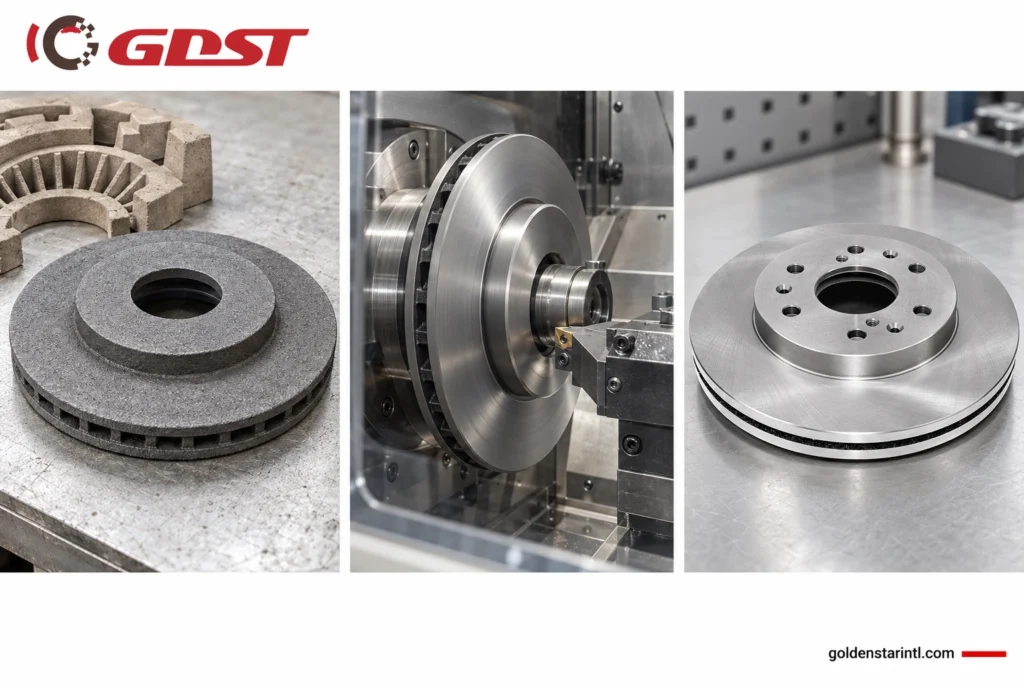
Brake disc casting forms the initial iron component that will subsequently undergo machining and inspection to become a finished brake rotor.
Sand casting is an established manufacturing process for automotive grey cast iron brake discs.
For ventilated designs, the mold and core arrangement must create the intended internal cooling passages, while the subsequent machining process establishes the required rotor geometry.
Research on automotive grey iron castings demonstrates the importance of molten-metal flow, mold design, and solidification behavior in casting process development [4].
GDST works with its brake disc manufacturing and supplier network to coordinate applicable casting, machining, and product inspection requirements.
1. Raw Material Preparation
The manufacturing process begins with selecting and preparing the required metal charge materials.
Raw material selection and composition control are important because chemical composition contributes to the resulting microstructure and properties.
2. Melting and Composition Control
The charge material is melted and prepared for casting.
Chemical analysis may be used to evaluate whether the molten iron meets the agreed composition requirements.
3. Mold and Core Preparation
Casting molds define the preliminary rotor shape.
For ventilated brake discs, suitable core designs form the internal cooling channels according to the required construction.
4. Pouring and Solidification
Molten iron is introduced into the mold and allowed to solidify.
The pouring and cooling conditions influence casting quality, microstructure formation, and the possibility of casting defects.
5. Casting Cleaning and Inspection
Following cooling and mold removal, castings are cleaned and evaluated before machining.
Inspection may include appearance, relevant casting defects, and other requirements specified in the manufacturing process.
6. Precision Machining
Machining operations establish the brake disc’s critical dimensions and surfaces.
These may include:
• Friction surface machining
• Center bore machining
• Mounting face machining
• Bolt-hole machining
• Rotor thickness control
• Overall height and geometry control
Precision machining is essential because the final brake disc must conform to the specified dimensions and mounting arrangement.
7. Dimensional and Quality Inspection
The machined brake discs are inspected according to the relevant drawings and quality requirements.
Depending on the product program, inspections may include material hardness, disc thickness, surface flatness, runout, parallelism, and dynamic balance evaluation.
8. Surface Finishing and Packaging
Finished products are cleaned and prepared for marking, protective finishing where specified, and packaging.
The exact process sequence and equipment depend on the selected manufacturer and brake disc specification.
For custom projects, GDST can review requirements for raw castings, partially machined components, or finished brake rotors. The availability of each delivery format is subject to project feasibility confirmation.
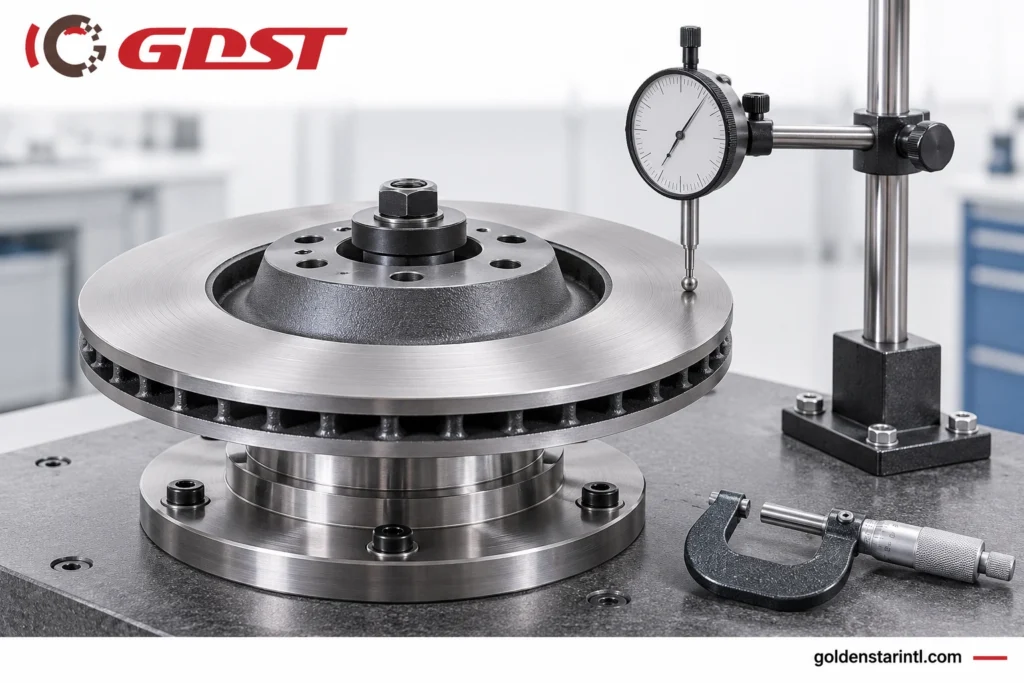
Quality control for cast iron brake discs involves both material verification and dimensional inspection.
Chemical composition and microstructure help characterize the casting material, while machining-related inspections assess the finished component’s geometry.
GDST’s published brake disc supply information identifies hardness testing, runout inspection, and dynamic balance checking among the quality control activities used for applicable brake disc programs.
In addition, GDST has supplied an internal factory laboratory report containing specific inspection results for a grey cast iron brake disc.
|
Inspection Information |
Recorded Details |
|
Component |
Brake Disc |
|
Drawing Number |
YH20242 |
|
Material |
Grey Cast Iron |
|
Inspection Facility |
Factory Laboratory |
|
Inspection Date |
June 11, 2026 |
|
Inspection Coverage |
Chemical composition, metallurgical items, hardness, dimensions, and geometry |
|
Recorded Overall Conclusion |
Pass |
This is a factory laboratory inspection record for the identified drawing. It is not presented as an independent third-party certification or as proof of conformity for the entire GDST brake disc range.
Hardness testing is used to evaluate whether a component meets its specified material acceptance requirements.
For the inspected YH20242 brake disc, the report provides the following result:
|
Inspection Item |
Specified Range |
Recorded Result |
Reported Status |
|
Brinell Hardness |
180–200 HB |
190 HB |
Pass |
The measured hardness falls within the range specified in the factory report.
This result applies to the inspected component. Other brake disc references may have different hardness requirements depending on their material grade, design, and application.
Accurate dimensions and surface geometry are important for brake disc fitment and quality.
For example, disc thickness variation and irregular wear may contribute to brake judder, a form of vibration transmitted through the braking system.
Research on brake judder reduction highlights the relationship between brake disc thickness variation, friction material behavior, and brake system design [5].
The YH20242 factory inspection report records eleven dimensional and geometric inspection items.
|
Inspection Item |
Specified Requirement |
Recorded Result |
Reported Status |
|
Center Bore Diameter |
Nominal 69 mm, +0.04 / +0.11 mm |
+0.10 mm deviation |
Pass |
|
Brake Disc Thickness |
26 ± 0.25 mm |
+0.02 mm deviation |
Pass |
|
Reference Base Thickness |
8.1 ± 0.25 mm |
−0.07 mm deviation |
Pass |
|
Mounting Face Flatness |
≤0.08 mm |
0.02 mm |
Pass |
|
Upper Friction Face Flatness |
≤0.04 mm |
0.02 mm |
Pass |
|
Lower Friction Face Flatness |
≤0.04 mm |
0.02 mm |
Pass |
|
Upper Friction Face Runout |
≤0.10 mm |
0.06 mm |
Pass |
|
Lower Friction Face Runout |
≤0.10 mm |
0.06 mm |
Pass |
|
Upper Face to Mounting Datum Parallelism |
≤0.10 mm |
0.056 mm |
Pass |
|
Lower Face to Mounting Datum Parallelism |
≤0.10 mm |
0.062 mm |
Pass |
|
Parallelism Between Friction Faces |
≤0.10 mm |
0.065 mm |
Pass |
Source: GDST-supplied Factory Laboratory Inspection Report, Drawing No. YH20242, June 11, 2026.
All eleven inspection items were recorded as meeting their respective drawing requirements.
Material Verification
The chemical composition measurements provide information about the inspected casting material and its conformity with the limits in the report.
Hardness Verification
The recorded 190 HB result demonstrates conformity with the specified 180–200 HB hardness range for the inspected component.
Dimensional Conformity
Measurements of bore diameter, rotor thickness, and related features help verify that a part meets its drawing requirements.
Surface Geometry
Runout, flatness, and parallelism inspections help evaluate the machined rotor’s geometry.
Inspection Traceability
A report linked to a specific drawing provides a reference for reviewing the inspection requirements and results of that component.
However, these measurements do not independently establish vehicle-level braking performance, brake noise, stopping distance, high-temperature fatigue life, or long-term production consistency.
For engineering projects or volume purchasing, customers can discuss the availability of supporting inspection documents for the selected reference.
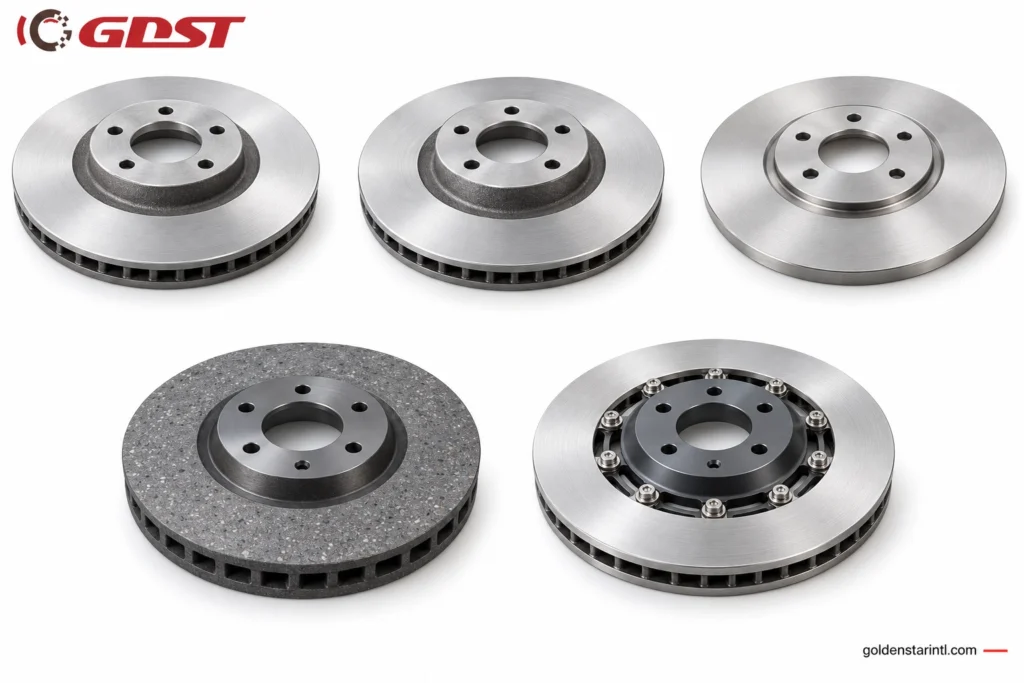
Different brake disc materials and construction methods are selected according to the intended application, operating conditions, manufacturing requirements, and cost.
Conventional grey cast iron offers a practical balance of material characteristics and established manufacturing processes.
Other materials may be considered for specialized applications, including lightweight or high-performance brake system designs.
|
Material / Construction |
Main Characteristics |
Key Considerations |
Typical Applications |
|
Conventional Grey Cast Iron |
Established casting process, useful thermal and damping properties |
Relatively high weight, corrosion, and frictional wear |
Conventional OEM and aftermarket replacement |
|
High-Carbon Grey Cast Iron |
Grey iron with composition and microstructure designed for particular requirements |
Benefits require application-specific validation |
Selected OEM and aftermarket programs |
|
Steel |
Material properties depend on alloy and manufacturing process |
Requires appropriate thermal and friction-system design |
Selected specialist braking systems |
|
Carbon-Ceramic Composite |
Lightweight construction and specialized high-temperature performance |
High manufacturing cost and specific system requirements |
Certain premium and high-performance vehicles |
|
Bi-Material Rotor |
Separate friction ring and mounting structure |
More complex design, joining, and manufacturing |
Selected lightweight applications |
High-carbon grey cast iron is not automatically superior to every conventional grey iron grade.
Wear and thermal performance depend on chemical composition, microstructure, friction material, rotor design, and operating conditions.
Comparative research on brake rotor cast irons shows that material selection should be based on specific performance requirements and validated test results [2].
Grey cast iron brake discs can experience significant thermal loading during braking.
However, elevated-temperature performance depends on material grade, temperature, loading history, and fatigue conditions.
Research on EN-GJL-250 grey cast iron used for automotive brake discs found that low-cycle fatigue life decreased significantly under elevated-temperature testing, particularly at 700°C [6].
Therefore, GDST does not present one universal maximum operating temperature for all cast iron brake disc references.
Not necessarily.
Protective coatings and wear-resistant friction-surface coatings serve different purposes.
Corrosion-protective finishes may be used to reduce surface corrosion in designated areas, while specialized friction-surface coatings require separate tribological evaluation.
Research on laser-cladded grey cast iron brake rotors demonstrates that surface treatment can involve trade-offs between friction behavior, wear, particle emissions, and environmental performance [7].
For GDST brake discs, coating availability and specifications should be confirmed for the selected model.
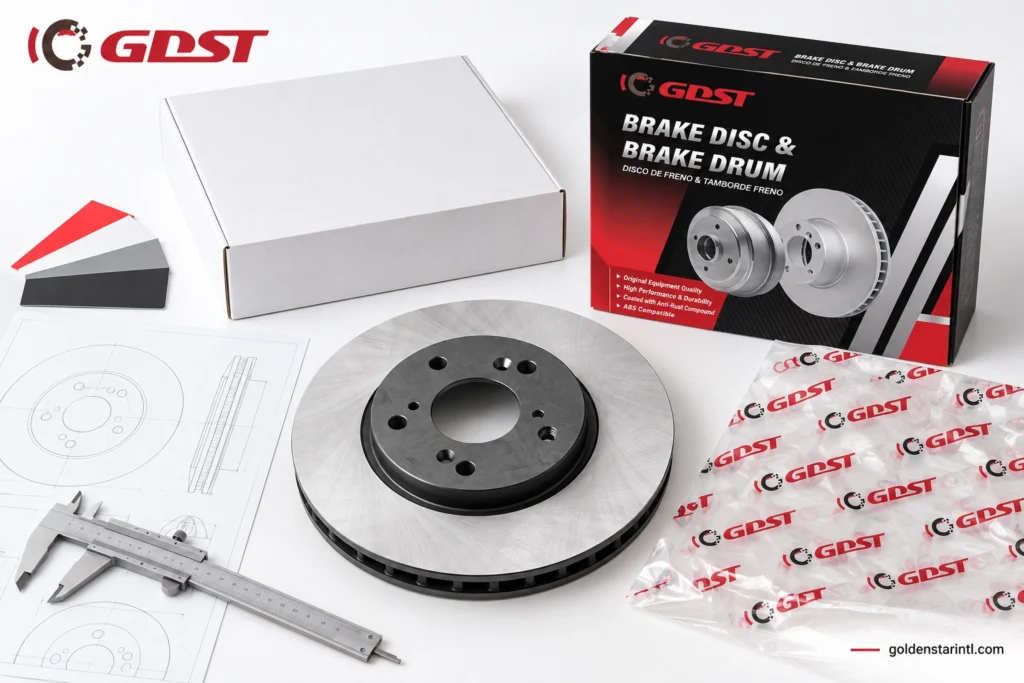
GDST supports aftermarket distributors, automotive parts brands, and importers with OEM/ODM sourcing services.
Customers can submit existing OEM references for standard replacement products or provide engineering requirements for custom projects.
Send us your OEM reference list, vehicle application information, or existing product specifications.
Our team can review the available references and confirm product matching, quotation availability, and relevant specifications.
For custom or engineering-led projects, customers may specify a required grey iron grade or material acceptance standard.
Material availability and production feasibility are reviewed according to the requested application.
Drawings and samples can be reviewed to identify key requirements such as:
• Rotor outside diameter and thickness
• Mounting height and center bore
• Mounting hole geometry
• Solid or ventilated structure
• Surface finish and dimensional tolerances
New designs may require additional tooling, development review, and sample validation.
Eligible brake disc products can be evaluated for customer-specific marking or identification.
Marking requirements should be confirmed before order approval.
GDST supports private-label packaging services for eligible wholesale customers.
Customers may provide approved artwork or discuss packaging design requirements with our team.
Brand authorization, packaging quantities, and production arrangements must be confirmed before customization.
Customers may discuss samples and relevant inspection documents before committing to larger orders.
For newly developed designs, sampling and validation requirements should be agreed during the project review.
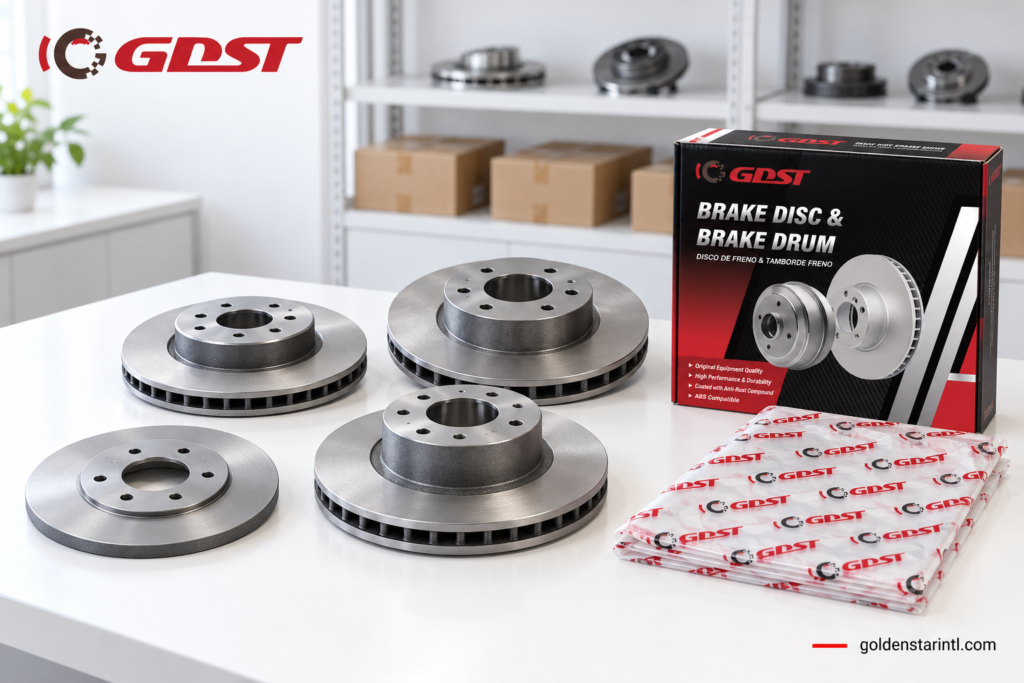
GDST is a China-based automotive parts supplier with manufacturing experience, international sourcing capabilities, and a network of cooperating automotive parts factories.
Our manufacturing background began with brake cylinder production in 1995. Over time, GDST expanded into additional brake components, suspension parts, and other automotive aftermarket categories.
Today, we support international customers through coordinated product sourcing, quality requirements, private-label services, and export operations.
Established Automotive Parts Experience
Our automotive parts background extends over more than two decades, including long-term experience in brake component supply.
2,000+ Brake Disc References
Our brake disc product range covers various international passenger and commercial vehicle applications.
Factory Quality Inspection Evidence
The supplied factory laboratory report demonstrates the type of chemical, hardness, and dimensional inspection information available for a specific brake disc drawing.
Passenger Car and Commercial Vehicle Coverage
Our representative product range includes solid and ventilated brake disc references for passenger cars, light commercial vehicles, and trucks.
OEM/ODM Purchasing Support
We support product matching, private-label packaging, customer marking, and engineering-related inquiries.
Coordinated Manufacturing Network
GDST works with cooperating automotive parts factories to support product selection, manufacturing requirements, and order fulfillment.
International Trade Experience
We work with automotive parts importers, wholesalers, and distributors across overseas markets.
For buyers sourcing grey cast iron brake discs from China, our aim is to combine broad product availability with clear specifications, practical order quantities, and responsive purchasing support.
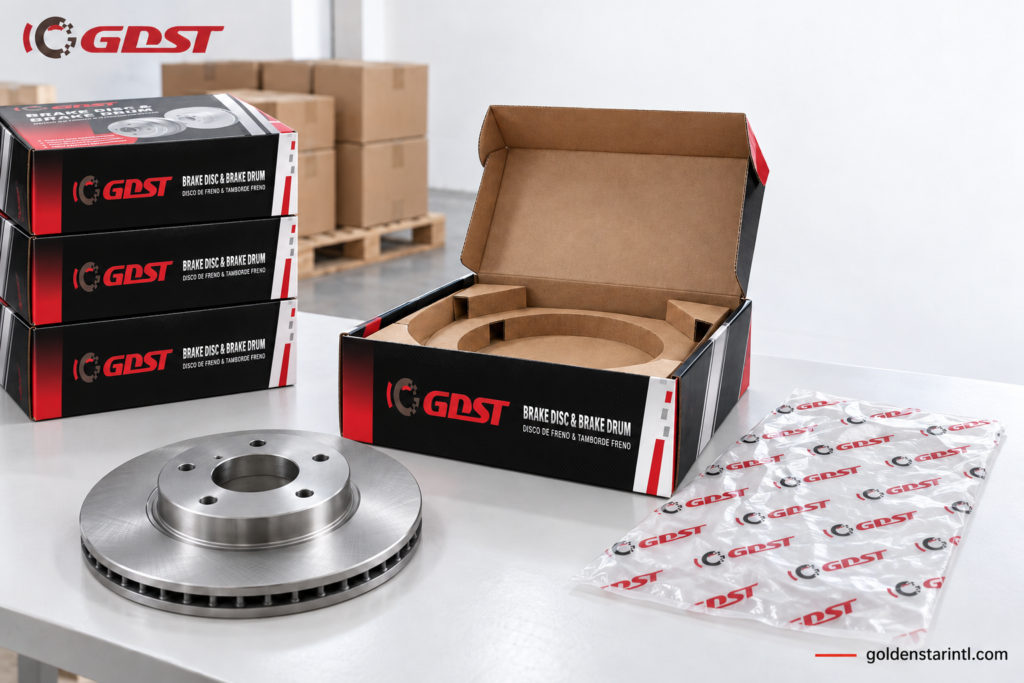
GDST offers wholesale supply programs for cast iron brake discs and related aftermarket products.
Our current purchasing terms are:
|
Purchasing Item |
GDST Terms |
|
Minimum Order Quantity |
50 pcs per model |
|
Lead Time |
50 days |
|
Product Range |
2,000+ brake disc references |
|
OEM Reference Matching |
Supported |
|
Custom Branding |
Available for eligible orders |
|
Private-Label Packaging |
Supported, subject to approval |
|
Custom Casting / Machining |
Subject to project feasibility review |
|
Technical Documentation |
Availability confirmed by product and project |
Step 1 — Submit Your Inquiry
Provide your OEM references, estimated quantities, vehicle applications, and purchasing requirements.
Step 2 — Confirm Product Specifications
GDST reviews the available brake disc references and relevant technical information.
Step 3 — Receive a Quotation
We prepare an offer based on the selected products, order quantities, destination, and additional requirements.
Step 4 — Confirm Samples or Technical Requirements
Where required, buyers can discuss samples, drawings, inspection documentation, and packaging details.
Step 5 — Order Confirmation
After the specifications and commercial terms are agreed, the order proceeds according to the confirmed arrangement.
Step 6 — Production and Delivery
The standard lead time is 50 days. Any special development, tooling, or nonstandard order requirements are reviewed separately.
1. What is a cast iron brake disc?
A cast iron brake disc is a rotating automotive braking component manufactured from cast iron and machined to the required dimensions. The brake pads contact the disc’s friction surfaces to generate braking torque and slow the vehicle.
2. What is the difference between gray cast iron and grey cast iron?
There is no material difference. “Gray” is the American English spelling, while “grey” is commonly used in British English. Both terms refer to the same material family.
3. What grade of grey cast iron is used for automotive brake discs?
Different brake disc applications may require different material specifications. Standards such as EN 1561 and SAE J431 provide recognized approaches to specifying grey cast iron properties. The applicable grade must be confirmed for the selected component.
4. Does GDST use the same chemical composition for every brake disc?
Not necessarily. Material requirements may vary by product and application. The chemical composition values shown on this page are from a specific factory inspection report for drawing YH20242 and do not apply automatically to all GDST references.
5. Is high-carbon grey cast iron better than conventional grey cast iron?
Not in every situation. Performance depends on material composition, microstructure, friction material, braking conditions, and rotor geometry. Material suitability should be evaluated against the actual engineering requirements.
6. What is the difference between a brake disc casting and a finished brake disc?
A brake disc casting is the component produced by the foundry before the final machining and finishing operations. A finished brake disc has undergone the processes required to meet its specified dimensions and product requirements.
7. Can GDST supply custom brake disc castings?
GDST can review custom brake disc casting and machining inquiries through its manufacturing and supplier network. Availability depends on the product design, tooling requirements, material specification, order quantity, and project feasibility.
8. What is the difference between solid and ventilated cast iron brake discs?
A solid brake disc has a single friction ring without internal ventilation passages. A ventilated brake disc incorporates internal channels between its friction surfaces. The required structure depends on the original brake system design.
9. What hardness was recorded in GDST’s factory inspection report?
The YH20242 factory inspection report recorded 190 HB against a specified hardness range of 180–200 HB. This result applies to the inspected component, not automatically to every GDST brake disc.
10. What runout result was recorded in the factory inspection report?
The report recorded friction-face runout measurements of 0.06 mm for both measured faces, against a specified maximum of 0.10 mm for the inspected drawing.
11. Does GDST provide brake disc inspection documentation?
Customers can discuss the availability of relevant inspection records and supporting technical information. Documentation availability depends on the product reference, supplier, and agreed inspection requirements.
12. Can GDST supply heavy-duty truck brake discs?
GDST’s representative brake disc list includes references associated with MAN, Volvo, Mercedes-Benz, Toyota Dyna, Ford commercial vehicles, and Nissan Atleon. Final product matching and availability must be confirmed according to the vehicle configuration.
13. Can cast iron brake discs have corrosion-protective coatings?
Yes. Certain brake rotor products use protective coatings on designated surfaces. Coating type, application area, and technical requirements depend on the selected product specification.
14. What is GDST’s MOQ for cast iron brake discs?
GDST’s minimum order quantity is 50 pieces per model.
15. What is the lead time for brake disc orders?
GDST’s standard lead time is 50 days. Custom development or special orders may require separate confirmation.
16. Can I order brake discs with my own brand and packaging?
Yes. GDST offers private-label and customization services for eligible orders. Packaging requirements, artwork approval, brand authorization, and commercial conditions are confirmed before production.
17. What information should I provide for a brake disc quotation?
Please provide your OEM references, vehicle applications, order quantities, destination, and any required material, technical, or packaging specifications. Drawings and samples can also support custom project evaluation.
Are you sourcing grey cast iron brake discs, automotive brake rotors, or custom brake disc casting solutions from China?
GDST supports automotive parts importers, distributors, and private-label brands with product matching, bulk supply, and technical specification review.
With more than 2,000 brake disc references, an MOQ of 50 pieces per model, and a standard lead time of 50 days, we can help you evaluate your next aftermarket brake disc purchasing project.
For an accurate quotation, please provide the following information:
|
Required Information |
Details to Provide |
|
OEM Reference |
OE part number or purchasing list |
|
Vehicle Application |
Make, model, and applicable vehicle details |
|
Brake Disc Type |
Solid, ventilated, or other specified design |
|
Material Requirement |
Grey cast iron grade, if specified |
|
Technical Drawing |
Drawing or product sample information, if available |
|
Order Quantity |
Required pieces per model |
|
Packaging |
GDST packaging or approved private label |
|
Destination |
Destination country or port |
|
Contact Details |
Company name, email, and WhatsApp |
Send your inquiry list to GDST to discuss available references, pricing, specifications, and order arrangements.
GDST Auto Parts — Automotive Brake Parts Manufacturing & Global Supply
Explore More GDST Brake Disc Products
Learn More About GDST Auto Parts
The following publications provide scientific background for the material, casting, wear, quality control, and thermal performance discussions on this page. They are independent research sources and should not be interpreted as laboratory certifications of GDST products.
[1] Aranke, O., Algenaid, W., Awe, S., & Joshi, S. (2019).
Coatings for Automotive Gray Cast Iron Brake Discs: A Review.
Coatings, 9(9), 552.
https://doi.org/10.3390/coatings9090552
[2] Cueva, G., Sinatora, A., Guesser, W. L., & Tschiptschin, A. P. (2003).
Wear resistance of cast irons used in brake disc rotors.
Wear, 255(7–12), 1256–1260.
https://doi.org/10.1016/S0043-1648(03)00146-7
[3] Makowska, K., & Kowalewski, Z. L. (2024).
Analysis of the Microstructure and Hardness of Flake Graphite Cast Iron Using the Barkhausen Noise Method and Conventional Techniques.
Journal of Nondestructive Evaluation, 43, Article 54.
https://doi.org/10.1007/s10921-024-01065-w
[4] Kermanpur, A., Mahmoudi, Sh., & Hajipour, A. (2008).
Numerical simulation of metal flow and solidification in the multi-cavity casting moulds of automotive components.
Journal of Materials Processing Technology, 206(1–3), 62–68.
https://doi.org/10.1016/j.jmatprotec.2007.12.004
[5] Doi, K., et al. (2000).
Brake judder reduction technology—brake design technique including friction material formulation.
JSAE Review, 21(4), 497–502.
https://doi.org/10.1016/S0389-4304(00)00072-2
[6] Pevec, M., Oder, G., Potrč, I., & Šraml, M. (2014).
Elevated temperature low cycle fatigue of grey cast iron used for automotive brake discs.
Engineering Failure Analysis, 42, 221–230.
https://doi.org/10.1016/j.engfailanal.2014.03.021
[7] Olofsson, U., Lyu, Y., Åström, A. H., et al. (2021).
Laser Cladding Treatment for Refurbishing Disc Brake Rotors: Environmental and Tribological Analysis.
Tribology Letters, 69, Article 57.