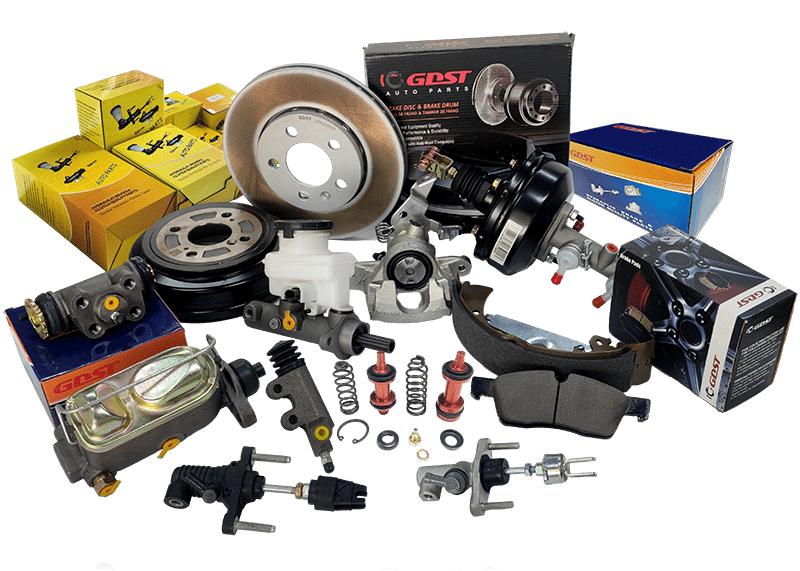
How do you evaluate a brake caliper supplier when the real risk isn't the unit price—it's what happens after the caliper reaches your customer?
Every week, we field inquiries from importers and distributors who are frustrated with their current supplier. The calipers arrived on time. The price was competitive. Then the returns started. Brake drag. Piston seizure. Fitment mismatches that mechanics discovered mid-job. These aren't unusual stories in the brake aftermarket. They are patterns we see repeatedly because the buyer's evaluation process focused on the wrong criteria.
A brake caliper supplier should be evaluated on total cost of ownership and risk exposure—not unit price.1 The best supplier combines certified quality systems (IATF 16949), verified OE coverage with application-specific validation, production capacity that supports consistent batch quality, and transparent defect escalation processes. Price is the entry point; everything else determines whether your inventory investment generates profit or liability.
This guide walks through the evaluation framework we use with our own B2B customers—the same framework we wish every buyer applied before placing their first sample order. We have seen where the gaps hide. Here is how to find them before they become your problem.
Why does unit price fail as a supplier selection criterion?
Because the cheapest caliper often becomes the most expensive one after accounting for warranty returns, replacement freight, lost customer trust, and liability exposure in a safety-critical braking system2.
Most buyers begin with price comparison. That is rational. But price captures only the transaction cost—not the ownership cost. A caliper that costs $45 landed may look better than one at $58, until you factor in an 8% return rate versus a 1.5% return rate, the freight cost of air-shipping replacements, and the reputational damage when a distributor's customer discovers a seized piston.
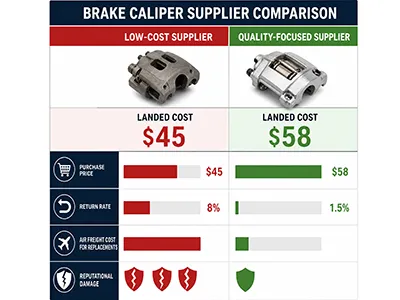
We have worked with multiple customers who transitioned from lower-priced suppliers after experiencing these hidden costs. One distributor in Europe switched after a single container generated 12% return claims within six months—mostly for piston corrosion and bracket misalignment. The replacement freight alone consumed the price advantage from the first order. More importantly, their downstream customers lost confidence in the brand. That loss is hard to quantify on a P&L, but it shows up in reorder rates.
What total cost of ownership includes for brake calipers
| Cost Factor | Low-cost supplier risk | Quality supplier impact |
|---|---|---|
| Unit price | Low initial outlay | Higher upfront cost |
| Warranty return rate | Often 5–15% in our observation | Typically under 2% |
| Replacement freight | Air freight at $8–15/kg | Minimal, infrequent |
| Customer retention | Drops with each quality incident | Stable or growing |
| Liability exposure | Higher due to inconsistent QC | Managed through traceability |
| Inspection overhead | Buyer must double-check batches | Supplier's QC is reliable |
The math changes when you add these factors. A $45 caliper with a 10% return rate plus air freight replacements costs more than a $58 caliper with a 1.5% return rate and surface-shipped replacements. This is not theoretical—it is what our customers' purchasing data shows after switching.
Does IATF 16949 certification guarantee product quality?
No. IATF 16949 certifies that a manufacturer has a mature quality management system and process discipline. It does not guarantee that every production batch is defect-free, that specific product lines are validated, or that the supplier has solved all application-specific fitment risks.3
IATF 16949 is the automotive industry's quality management standard.4 It requires documented procedures for design control, production process control, traceability, corrective action, and continuous improvement.5 A certified supplier has passed a third-party audit verifying that these systems exist and function.
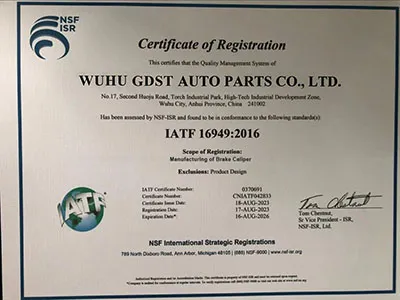
But here is what the certificate does not tell you:
What to verify beyond the certificate
A buyer told us last year that their IATF-certified supplier shipped a batch of calipers with inconsistent piston bore finishing. The certificates were current. The quality system was documented. But the production line had a tooling wear issue that escaped the inspection station for three shifts before detection. The certificate didn't catch it. Traceability records did—once we showed the buyer what to look for.
Ask for these specific documents from any supplier, certified or not:
- Line inspection records for the product line you are sourcing—not generic samples, but the actual inspection data from recent production runs
- Dimensional inspection reports for critical features: bore diameter, bracket mounting surface flatness, bleeder thread form, guide pin fit tolerance
- Leak test protocols and pass/fail records for the specific caliper models you need
- Traceability documentation showing how raw material lots map to finished products—can they trace a returned caliper back to its casting batch and machining shift?
- Corrective action reports for any quality incidents in the past 12 months
IATF 16949 means the supplier has a system for managing quality. It does not mean the system always works for your specific product. Verification is still your responsibility, and the best suppliers welcome it.
How many OE references should a brake caliper supplier have?
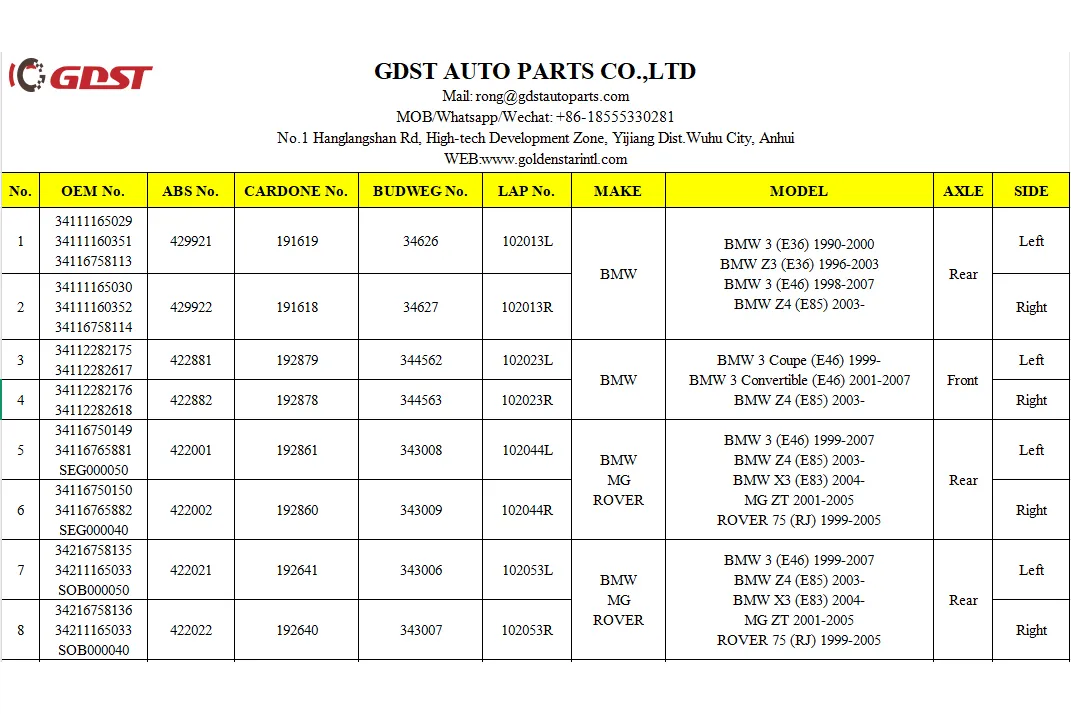
OE reference count indicates catalog breadth, not fitment accuracy or application validation. What matters more is whether the supplier can help you confirm that a given OE number actually matches your target vehicle's brake system configuration.
We maintain over 5,000 OE references for calipers covering American, European, Japanese, and Korean vehicles. That catalog is useful—it tells a buyer whether the supplier likely covers the applications they need. But we have also learned the hard way that an OE number is just the starting point.
Why OE cross-referencing is not enough
Consider a common scenario: A buyer sources a caliper for a 2015–2018 Toyota Camry. The OE number cross-references correctly. But the Camry uses different brake configurations depending on trim level, optional packages, and production month.6 Some have single-piston floating calipers with a specific bracket offset. Others use different piston diameters. The caliper that fits one configuration may not fit another, even though the OE number matches the model range.
We have handled customer returns where the caliper was technically the correct OE reference, but the bracket design did not clear the vehicle's wheel spoke profile, or the bleeder screw was positioned such that a mechanic could not bleed the system without removing the caliper. These are not manufacturing defects—they are application mismatches that occur when supplier and buyer do not validate fitment beyond the catalog.
Instead of asking "how many OE numbers do you cover," ask these questions:
- Do you validate fitment beyond cross-referencing? What testing or vehicle-specific checks do you perform?
- Can you confirm piston count, bracket design, bleeder position, and guide pin type for the specific application I am sourcing?
- What is your process when a buyer reports a fitment mismatch? Do you investigate the root cause and update your catalog?
The supplier's willingness to engage on these questions matters more than the number of OE references in their database.
Can I trust sample quality to predict production batch quality?
No. A perfect sample can be produced from a carefully selected batch that does not represent the supplier's normal production consistency.7 Sample quality is necessary but not sufficient—the real evaluation requires examining the supplier's production process, quality control systems, and capacity utilization.
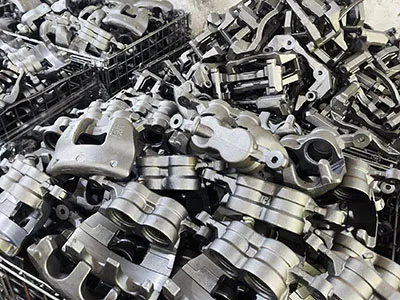
This is one of the most common mistakes we see B2B buyers make. A sample arrives. It looks excellent. Machining is clean, finish is consistent, the caliper bleeds smoothly and the piston retracts properly. The buyer places a container order. The production batch shows different results: casting surface porosity that was absent from the sample, inconsistent thread cleaning, or piston bore roughness on a percentage of units.
What to evaluate beyond the sample
We have participated in dozens of customer onboarding processes where the transition from sample to bulk order revealed what the sample alone could not. Here is what we learned matters:
Production capacity utilization. A supplier running at 95% capacity may rush orders through, skip inspection steps, or let unqualified operators handle critical machining.8 Ask about current capacity utilization, production lead time, and how they handle rush orders without compromising QC.
Process consistency across shifts. Quality variations between day and night shifts are common in manufacturing.9 Ask whether inspection protocols are identical across all shifts, and whether automated inspection equipment (if used) is calibrated identically. Some of the fitment issues we have traced back to our own production were shift-related—a night operator used a different torque setting for bleeder screws.
Raw material sourcing continuity. Casting quality is a major variable in brake caliper reliability. Does the supplier use the same foundry for all production, or do they switch sources based on price? Changing raw material suppliers introduces variability that may not show in a sample but will appear across a full container.10
Defect escalation response. This is the most revealing test. Send the supplier a sample with a legitimate but minor quality observation. How do they respond? Do they acknowledge it, investigate, and offer corrective action? Or do they deflect, make excuses, or ignore the concern? The response pattern to a small issue predicts how they will handle a real problem—and in brake calipers, real problems eventually happen.
One of our long-term customers initially sourced from three suppliers concurrently. They told us that our response to a minor thread issue on a sample—we traced it to a tap wear condition, replaced the tap, and sent updated inspection records—was why they consolidated their volume with us. The other suppliers had lower prices but slower, less transparent responses to problems.
Frequently Asked Questions
What is the minimum order quantity for private-label brake calipers?
MOQ varies by supplier and product line. For caliper models that share components across multiple applications, MOQ may be as low as 50–100 units per SKU. For unique applications requiring new bracket tooling or casting molds, MOQ typically starts at 500–1,000 units. GDST offers flexible MOQ arrangements depending on the customer's volume commitment and product mix strategy.
How long does it take to develop a new brake caliper reference?
Development timelines depend on whether the caliper uses existing components or requires new castings and tooling. For references that share platform components, development takes 30–60 days from OE sample receipt to first production batch. New casting development requires 90–120 days for mold creation, sample approval, and production validation.
Can a buyer combine OE and private label on the same product?
Yes. Many of our customers maintain dual inventory: OE-branded calipers for standard distribution and private-label calipers for their own brand packaging. The underlying product uses the same manufacturing specifications, quality control, and performance testing. The only difference is the packaging, laser marking, and documentation.
What is the typical defect return rate for quality brake calipers?
In our experience, well-controlled brake caliper production should yield defect return rates below 2%. Industry benchmarks for automotive aftermarket calipers typically range from 1–3% for established manufacturers with IATF-certified systems.11 Rates above 3% indicate process control issues that require investigation before scaling orders.
Does the supplier test every caliper before shipping?
This varies by manufacturer. GDST conducts 100% leak testing, piston retraction testing, and visual inspection on every finished caliper. Dimensional inspection is performed on a statistical sampling basis per production batch unless the customer specifies 100% dimensional inspection as a contract requirement.
Conclusion
Selecting a brake caliper supplier is not a price-minimization exercise. It is a risk-management decision that affects your inventory investment, your brand reputation, and your customers' safety. The evaluation framework that works is the one that looks beyond the sample, past the certificate, and underneath the catalog count—into the production process, the quality systems, the defect response patterns, and the supplier's willingness to partner on application validation rather than just ship boxes.
We have seen buyers succeed by asking harder questions earlier, and we have seen them absorb losses by relying on price alone. The difference is not the caliper on the pallet. It is the evaluation that happened before the purchase order was signed.
If you are evaluating brake caliper suppliers for your import, wholesale, or distribution business, contact GDST to discuss your product requirements and quality specifications. We can provide the documentation, samples, and production data you need to make an informed supplier decision.
"8 Ways to Improve Your Supplier Selection Process", https://www.nist.gov/blogs/manufacturing-innovation-blog/8-ways-improve-your-supplier-selection-process. Procurement research treats total cost of ownership as a broader measure than purchase price, incorporating costs associated with quality, delivery, service, and supplier performance over the purchasing relationship. Evidence role: general_support; source type: paper. Supports: Research on total-cost supplier selection supports including quality failures, logistics, warranty, and other post-purchase costs in addition to acquisition price.. Scope note: This evidence supports the evaluation framework generally rather than quantifying the total cost of brake calipers specifically. ↩
"Functional Safety Assessment of a Generic, Conventional, ...", https://www.nhtsa.gov/sites/nhtsa.gov/files/documents/13497a_812574_hydraulicbrakingsystem.pdf. Vehicle safety regulations impose specific braking-performance and failure-warning requirements, reflecting the braking system's safety-critical role in maintaining vehicle control and stopping capability. Evidence role: expert_consensus; source type: government. Supports: Vehicle safety authorities regulate braking performance because adequate braking is essential to safe vehicle operation.. Scope note: Regulatory treatment establishes the safety importance of braking systems but does not determine liability in any particular commercial dispute. ↩
"ISO 9001 explained", https://www.iso.org/home/insights-news/resources/iso-9001-explained.html. Management-system certification provides evidence that specified organizational processes have been assessed; it is not product certification and does not establish that every unit or batch is free from defects. Evidence role: general_support; source type: institution. Supports: Accreditation and standards bodies distinguish certification of an organization's management system from certification or approval of individual products.. Scope note: Certification can reduce process risk when effectively implemented, but the source does not measure the defect rate of any particular certified supplier. ↩
"IATF 16949", https://en.wikipedia.org/wiki/IATF_16949. The International Automotive Task Force defines IATF 16949 as an automotive quality-management-system standard applicable to organizations manufacturing automotive production and relevant service parts. Evidence role: definition; source type: institution. Supports: Official IATF materials describe IATF 16949 as requirements for an automotive-sector quality management system.. ↩
"Internal Audit Checklist Form", https://www.nist.gov/document/isoiec17025cklist-2009-compatibleword2003-2doc. IATF 16949 extends ISO 9001 for automotive manufacturing and includes requirements addressing production controls, identification and traceability, corrective action, and continual improvement. Evidence role: definition; source type: institution. Supports: Authoritative descriptions of IATF 16949 identify process control, identification and traceability, nonconformity management, corrective action, and continual improvement among its quality-system requirements.. Scope note: The precise applicability of individual clauses depends on an organization's activities, customer-specific requirements, and any permitted exclusions. ↩
"Brake Calipers", https://autoparts.toyota.com/products/category/maintenance-brakes-brake-calipers. Toyota application data list brake components against vehicle-specific attributes such as model configuration and production period, showing that model year alone may be insufficient for exact parts identification. Evidence role: case_reference; source type: institution. Supports: Toyota application records or official parts listings distinguish brake-component references by vehicle specification, option, or production date within the stated Camry model years.. Scope note: The available distinctions may vary by market and VIN; the source must be checked to confirm the article's specific claims about piston diameter and bracket design. ↩
"6. Process or Product Monitoring and Control", https://www.itl.nist.gov/div898/handbook/toolaids/pff/pmc.pdf. Statistical quality-control guidance emphasizes that a sample supports inference about a production lot only when its selection and size adequately represent the population from which it was drawn. Evidence role: mechanism; source type: government. Supports: Statistical sampling guidance establishes that conclusions about a production population depend on representative selection and adequate sample size.. Scope note: This principle shows why one selected unit is weak evidence of batch consistency, but it does not prove that a particular supplier intentionally selected an unusually good sample. ↩
"Environmental regulations, capacity utilization, and high-quality ... - PMC", https://pmc.ncbi.nlm.nih.gov/articles/PMC8486764/. Manufacturing studies associate operation near full capacity with congestion, longer queues, and reduced flexibility, conditions that can place additional pressure on production and quality-control processes. Evidence role: mechanism; source type: paper. Supports: Operations research can support an association between high utilization, congestion, reduced schedule flexibility, and quality or delivery pressure.. Scope note: Such evidence would support the general risk mechanism, not a universal 95% cutoff or the assertion that suppliers necessarily skip inspections or use unqualified operators. ↩
"Association between night-shift work, sleep quality and health ... - PMC", https://pmc.ncbi.nlm.nih.gov/articles/PMC7477971/. Research on shift work links night schedules and circadian disruption with fatigue and reduced alertness, factors associated with increased error risk in safety-sensitive and industrial tasks. Evidence role: mechanism; source type: research. Supports: Shift-work research documents differences in fatigue, alertness, supervision, and error risk that can affect operational performance during night work.. Scope note: This evidence provides a plausible general mechanism but does not establish that brake-caliper quality routinely differs by shift at a specific factory. ↩
"Managing Risks Due to Ingredient Variability in Food Production", https://nvlpubs.nist.gov/nistpubs/jres/121/jres.121.002.pdf. Casting quality is sensitive to material composition and foundry process conditions, so a change in material source or production route can introduce variation requiring renewed qualification and process control. Evidence role: mechanism; source type: paper. Supports: Materials and manufacturing research shows that changes in feedstock composition, foundry practice, or process conditions can alter casting properties and defect distributions.. Scope note: The evidence supports the possibility of added variability, not the certainty that a supplier change will produce defects detectable in every container-sized order. ↩
"Used-car lemon law: fact sheet | New York Attorney General", https://ag.ny.gov/resources/individuals/car-auto/used-car-lemon-law-fact-sheet. Published warranty or field-return data report the proportion of aftermarket brake calipers returned for verified defects within a defined population and observation period. Evidence role: statistic; source type: research. Supports: Independent field-return or warranty data would need to show the observed return-rate distribution for aftermarket brake calipers and define the manufacturer population and measurement period.. Scope note: A 1–3% benchmark should not be generalized unless the source uses comparable definitions, distinguishes verified defects from installation or application errors, and specifically covers established IATF-certified manufacturers. ↩