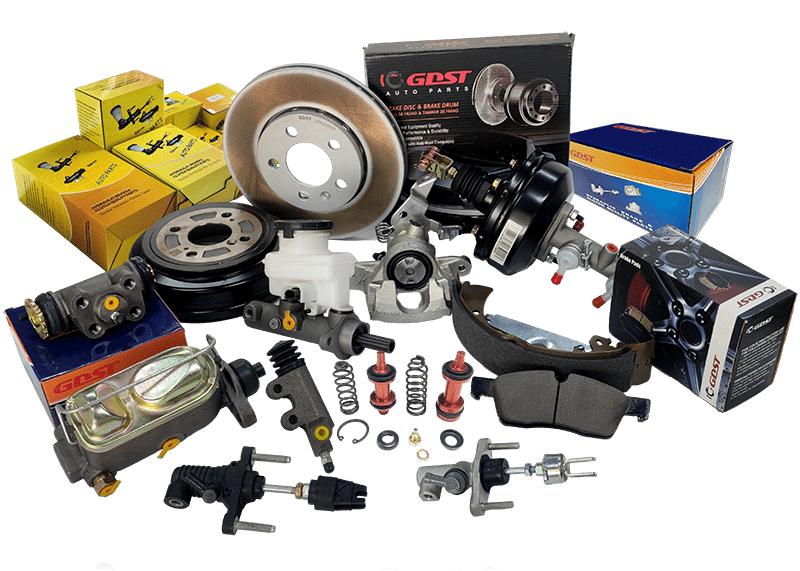
A sliding brake caliper is often judged by its single piston, simple appearance, or lower price. That quick judgment can lead buyers toward the wrong specifications and unnecessary warranty risk. Based on my manufacturing experience, the better approach is to examine how the sliding mechanism works, where the caliper will be used, and how its critical components are produced.
A sliding brake caliper is a disc brake component that uses one or more pistons on one side of the rotor and a caliper body that moves along guide pins. Hydraulic pressure pushes the inner pad against the rotor, while the caliper slides inward and pulls the outer pad into contact, creating balanced clamping force.1
The operating principle is straightforward, but the quality judgment is not. I have seen buyers compare calipers by piston count and unit price while overlooking guide pin tolerances, protective boots, casting condition, and corrosion resistance. Those less visible details often have a much greater effect on service life.
How Does a Sliding Brake Caliper Work?
A sliding brake caliper must move freely every time the driver applies and releases the brake pedal. If the sliding mechanism cannot move as designed, the caliper may apply uneven pressure, drag after braking, or wear one pad faster than the other. Understanding this movement makes the design much easier to evaluate.
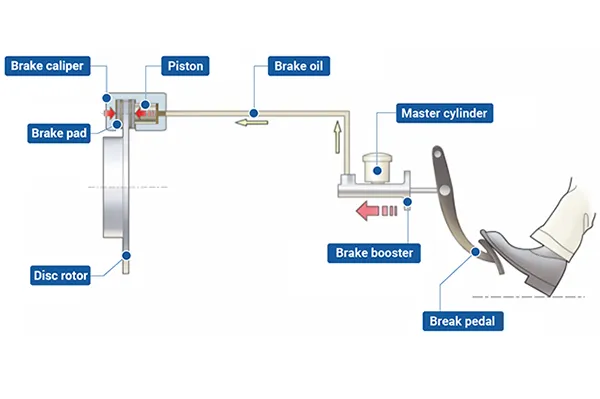
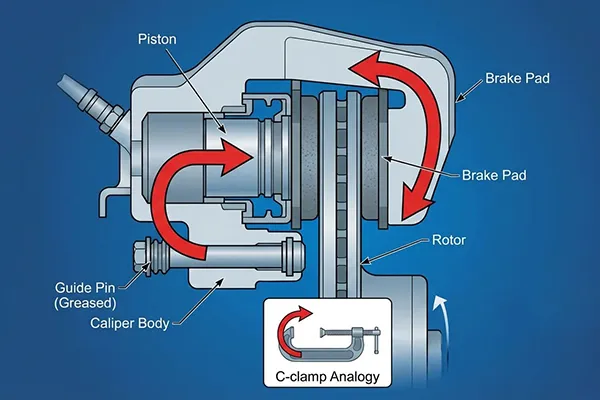
A sliding caliper uses hydraulic pressure to move its piston against the inner brake pad. The resulting reaction force moves the caliper body across lubricated guide pins, bringing the outer pad against the rotor. Both pads then clamp the rotating disc, converting vehicle motion into heat through friction.
The piston starts the clamping action
When the driver presses the brake pedal, the master cylinder sends pressurized brake fluid into the caliper. That pressure acts on the piston area and moves the piston outward. The piston then pushes the inner brake pad against the rotor.
The piston seal has two important jobs. It prevents fluid leakage, and its elastic deformation helps the piston retract slightly when pressure falls.2 That small retraction helps restore running clearance between the pad and rotor.
The caliper body creates the opposite force
The caliper housing is not rigidly fixed in one lateral position. Instead, it is supported by a bracket and allowed to move along guide pins. When the inner pad contacts the rotor, the reaction force pulls the housing toward the vehicle centerline. The housing then presses the outer pad against the opposite rotor face.
In simplified terms, the sequence is:
- The driver presses the brake pedal.
- Hydraulic pressure enters the caliper bore.
- The piston pushes the inner pad.
- The caliper housing moves on its guide pins.
- The housing pulls the outer pad into contact.
- Both pads clamp the rotor.
- Pressure falls, and the system releases.
This movement is why the terms sliding caliper and floating caliper are often used interchangeably in the aftermarket.3 Some technical catalogs make finer distinctions, but both terms commonly describe a caliper that moves laterally to apply the outer pad.
Why can one piston provide effective braking?
Piston count does not tell me the complete braking story. Hydraulic force depends on fluid pressure and effective piston area, while actual vehicle stopping performance also depends on the rotor, brake pad friction, tire grip, brake balance, and control systems.4
A single large piston can provide substantial clamping force. Because the housing reacts through the sliding mechanism, the design applies force to both sides of the rotor. More pistons can help distribute pressure or support a different package, but their presence alone does not prove that a caliper is stronger, safer, or better suited to a particular vehicle.5
I treat piston count as a design characteristic, not as a quality grade.
Is a Sliding Brake Caliper Reliable?
Some aftermarket buyers associate a lower part count with lower quality. I understand why that assumption appears reasonable, especially when marketing materials emphasize multi-piston designs. However, simplicity can be an engineering advantage when the component matches the vehicle’s braking load, packaging limits, cost target, and expected duty cycle.
A properly designed and manufactured sliding brake caliper is reliable for its intended application. Its single-sided piston arrangement can reduce weight, manufacturing complexity, and packaging requirements without sacrificing required braking performance.6 Reliability depends more on material quality, machining accuracy, sealing, corrosion protection, and guide pin movement than on piston count.
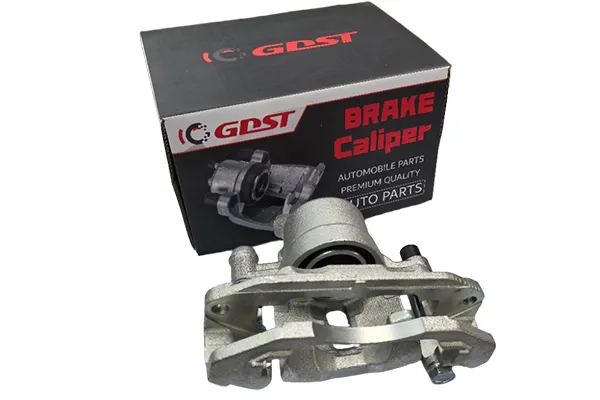
Design intent is not the same as cheapness
I have manufactured and inspected thousands of sliding calipers during more than 20 years in brake caliper production. In that work, I have seen how an apparently simple design still requires controlled casting, accurate machining, compatible rubber parts, correct lubrication, and consistent assembly.
Automotive manufacturers use sliding designs across a broad range of economy, mid-range, and premium passenger vehicles. They also appear in light commercial applications when their specifications match the axle load and braking requirements. That original-equipment coverage matters because it shows that the architecture is not limited to the lowest-priced vehicles.
The design provides several practical benefits:
- Lower unsprung mass: A compact caliper can help reduce component weight around the wheel.
- Efficient packaging: The design can fit within limited wheel and suspension space.
- Fewer hydraulic components: Fewer pistons and seals can reduce complexity.
- Cost-effective production: The architecture can meet required performance without unnecessary parts.
- Straightforward service: Many repair markets already understand the design and stock compatible components.
These benefits do not mean that every sliding caliper is well made. They mean that buyers should not reject the architecture merely because it has one piston or a lower quotation.
Application determines suitability
I always bring the discussion back to the original application. A caliper should be selected according to its OE reference, bracket geometry, piston diameter, rotor dimensions, hose connection, mounting points, pad profile, and parking brake configuration where applicable.
Duty cycle also matters. A passenger car used for normal commuting does not create the same operating conditions as a heavily loaded commercial vehicle, repeated mountain descent, or sustained track use.7 A buyer who ignores that difference may select the wrong product even if the product itself has good manufacturing quality.
I therefore separate two questions:
- Is the caliper architecture suitable for the vehicle’s intended load case?
- Has the supplier manufactured that architecture correctly?
A sliding brake caliper can be the right answer to the first question and still fail the second if its guide system, seals, coating, or machining are poor.
Which Sliding Brake Caliper Quality Indicators Matter Most?
A polished housing can make a strong first impression, but appearance does not reveal guide pin clearance, boot performance, bore finish, or internal cleanliness. I have found that many costly sourcing mistakes begin when buyers inspect visible surfaces but fail to request evidence for the working interfaces.
The most important sliding brake caliper quality indicators include guide pin accuracy, boot and seal material, corrosion protection, casting integrity, bore machining, bracket geometry, lubrication, and performance testing. Buyers should verify these features against the intended application instead of relying on piston count, paint color, sample weight, or price alone.
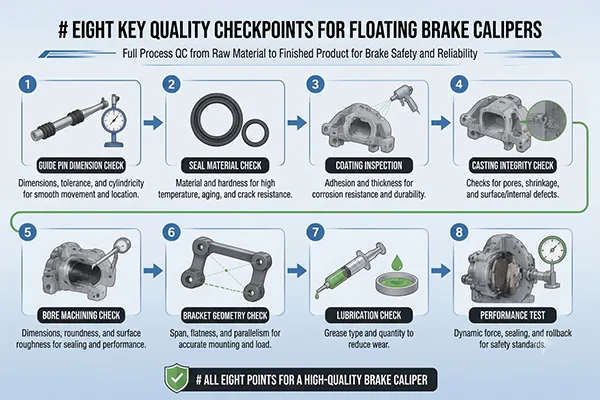
1. Guide pins and guide bores
The guide system allows the housing to move while maintaining alignment. A guide pin must have suitable dimensions, straightness, surface condition, and corrosion protection. Its mating bore and bushing must also provide controlled movement.
If the fit is too tight, contamination, lubricant deterioration, or corrosion can cause sticking. If the fit is too loose, the assembly may produce noise, uneven movement, or unstable pad contact.8 I therefore look beyond whether a pin “slides” in a hand-held sample. I want to know whether the dimensions and surface treatment remain consistent across production batches.
Buyers can ask suppliers about:
- Guide pin dimensional inspection
- Pin surface treatment or plating
- Guide bore tolerance control
- Pin and bushing material
- Specified lubricant
- Lubricant compatibility with rubber components
- Assembly cleanliness
- Movement inspection after assembly
2. Dust boots and piston seals
The guide pin boot protects the sliding interface from water, salt, dust, and road debris. A torn, poorly seated, or unsuitable boot can allow contamination to reach the pin. Once corrosion begins, the caliper may stop moving freely.9
The piston boot and hydraulic seal have different functions, but both require correct material and geometry. I do not recommend judging rubber parts only by softness or appearance. Buyers should ask whether the material is suitable for brake system temperatures, brake fluid exposure where applicable, environmental conditions, and the supplier’s specified lubricant.
A small boot can determine whether the mechanism remains protected through multiple seasons. That fact is easy to miss when procurement teams focus on larger or more visible components.
3. Casting quality and machining accuracy
The caliper body and bracket must have adequate structural integrity. Manufacturers should control casting defects such as excessive porosity, inclusions, cracks, and incomplete filling.10 They must also machine critical surfaces accurately.
Important machined features can include:
- Piston bore diameter and surface finish
- Seal groove geometry
- Mounting hole position
- Guide bore alignment
- Hose and bleed screw threads
- Bracket mounting faces
- Pad abutment areas
Our 20,000㎡ production facility uses CNC equipment because repeatable geometry is essential for stable assembly. However, equipment alone does not guarantee quality. I also expect controlled inspection, calibrated measuring systems, process records, and corrective action when results move outside specifications.
4. Corrosion protection
A sliding brake caliper operates close to water, road salt, dirt, and repeated temperature changes.11 Corrosion protection should therefore cover more than the visible housing.
I pay particular attention to the following areas:
| Area | Why it matters | What a buyer should verify |
|---|---|---|
| Guide pins | Corrosion can restrict sliding movement | Coating, plating, surface condition, and protection |
| Caliper housing | Corrosion affects appearance and long-term condition | Pretreatment and coating process |
| Bracket and pad seats | Rust can interfere with pad movement | Surface treatment and dimensional allowance |
| Bleed screw and threads | Corrosion can complicate service | Material, plating, thread protection |
| Hardware | Clips can lose fit or corrode | Material and corrosion-resistant finish |
A good-looking coating can still hide weak pretreatment or poor protection inside the sliding interface. I therefore prefer process evidence over color alone.
How Should Buyers Compare Sliding Brake Caliper Quotes?
Two quotations may appear to cover the same OE number while representing different assumptions about materials, included hardware, testing, and packaging. A buyer who compares only the final unit price may unknowingly remove the controls that protect margins later through fewer claims, returns, and catalog disputes.
Buyers should compare sliding brake caliper quotes by confirming application data, critical materials, machining controls, corrosion treatment, guide system specifications, included accessories, testing, traceability, warranty terms, and production capacity. The comparison should use a common specification sheet so that every supplier is pricing the same technical and commercial scope.
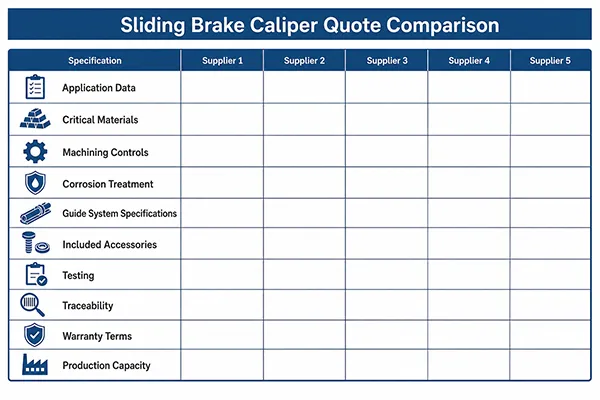
Start with application accuracy
Before comparing quality, I confirm that every supplier is quoting the same part. OE cross-reference errors can involve subtle differences that are not obvious in a general product photograph.
A buyer should verify:
- OE reference and interchange numbers
- Vehicle make, model, year, and engine where relevant
- Front or rear axle position
- Left, right, or interchangeable fitment
- Piston diameter
- Mounting hole spacing
- Bracket inclusion
- Pad profile
- Rotor diameter and thickness compatibility
- Bleeder and hose connection position
- Parking brake or electronic parking brake features
- Included hardware
One incorrect connection angle or bracket dimension can make an entire batch unusable even if the casting and coating are excellent.
Compare evidence, not adjectives
Terms such as “premium,” “heavy duty,” and “high quality” are difficult to compare. I prefer measurable specifications and documented controls.
| Comparison point | Weak quotation detail | Better quotation detail |
|---|---|---|
| Guide pins | “Standard pins” | Material, finish, dimensions, and inspection method |
| Rubber parts | “High-quality rubber” | Material specification and compatibility requirements |
| Casting | “Good casting” | Casting control and defect inspection process |
| Machining | “CNC machined” | Critical dimensions, inspection plan, and equipment control |
| Corrosion protection | “Painted” | Pretreatment, coating process, and verification method |
| Testing | “100% tested” | Named tests, acceptance criteria, and record availability |
| Traceability | “Batch controlled” | Lot code, production records, and component traceability |
| Packaging | “Neutral box” | Protection method, labeling, barcode, and carton specification |
I also ask whether the sample is representative of normal mass production. A specially prepared sample tells me less than a unit taken from a standard production batch.
Consider total sourcing cost
The lowest factory price does not always create the lowest total cost. Importers and distributors also carry costs related to:
- Warranty handling
- Freight for replacements
- Customer service time
- Inventory quarantine
- Catalog corrections
- Brand reputation
- Lost workshop or retail accounts
- Emergency replenishment
I once discussed a sourcing problem with a distributor after guide pins began sticking during the first severe winter season. The basic fitment was correct, but the pin protection and boot details had not received enough attention during quotation comparison. The direct loss was not limited to replacement units. The distributor also had to investigate inventory and explain the issue to a key customer.
I do not use that case to claim that sliding designs fail frequently. I use it to show how one overlooked specification can affect an entire inventory line.
How Can a Sliding Brake Caliper Reduce Warranty Risk?
Warranty risk rarely comes from one headline specification. It usually develops through a chain of smaller issues, such as loose OE matching, inconsistent machining, unsuitable boots, insufficient lubrication, damaged packaging, or incomplete batch records. I reduce that risk by building checks around the caliper’s real working interfaces.
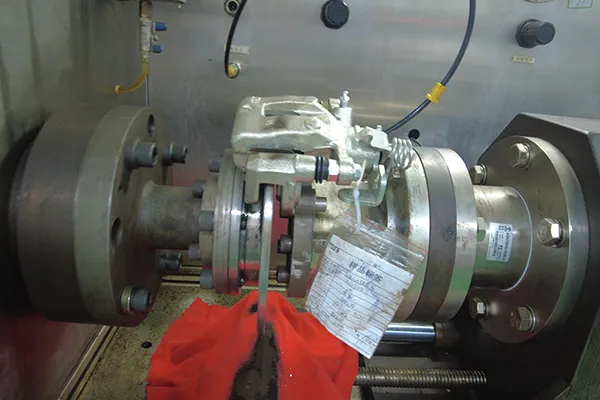
A sliding brake caliper can reduce warranty risk when buyers establish an approved specification, validate fitment, review production controls, inspect critical dimensions, verify functional testing, and monitor early field feedback. Consistent batch traceability also helps suppliers identify the production scope quickly if a problem occurs.
Create a critical-to-quality checklist
I recommend converting the application and manufacturing requirements into a checklist that both the buyer and supplier approve. The checklist should separate critical characteristics from cosmetic preferences.
A practical checklist can cover:
- Fitment controls: Mounting dimensions, bracket geometry, connections, and side identification.
- Hydraulic controls: Piston bore, seal groove, piston condition, leakage control, and bleed function.
- Sliding controls: Guide pin dimensions, movement, lubricant, boots, and assembly condition.
- Material controls: Casting, piston, pins, seals, boots, and hardware.
- Surface controls: Coating, plated parts, masked areas, threads, and corrosion protection.
- Functional controls: Sliding action, leakage or pressure testing, and parking brake operation when fitted.
- Packing controls: Port protection, boot protection, accessories, labels, and carton strength.
- Traceability controls: Production date, lot code, inspection record, and operator or line reference where used.
Use certification correctly
GDST operates under an IATF 16949:2016-certified quality management system. I view that certification as a framework for process control, traceability, corrective action, and continual improvement. I do not view a certificate as proof that every individual part is automatically suitable.
Buyers should still examine the control plan for the product family, the supplier’s response to nonconformities, and the records available for important processes. A useful audit follows the physical product from incoming material through casting, machining, cleaning, coating, assembly, testing, labeling, and packing.
Monitor early orders carefully
I recommend closer inspection during the first production orders rather than waiting for a large field history. Buyers can use:
- Pre-shipment sampling
- Dimensional reports
- Functional inspection records
- Packaging checks
- Small initial order quantities for new references
- Claim coding by failure symptom
- Photos and installation details for returned units
Return information must also distinguish product issues from installation issues. For example, uneven pad wear can involve a restricted guide system, but it can also involve pad fit, bracket corrosion, hose restriction, or installation practices. Good technical communication helps both sides reach the correct conclusion without making unsupported assumptions.
When Is a Sliding Brake Caliper the Correct Choice?
A buyer may understand the design and still need to decide whether a specific reference belongs in the catalog. I do not make that choice from piston count or market positioning. I start with verified application data and the braking system configuration specified for the vehicle.
A sliding brake caliper is the correct choice when it matches the vehicle’s OE braking architecture, dimensions, hydraulic requirements, mounting arrangement, and intended duty cycle. Importers should follow validated fitment information rather than replacing the original design based on the assumption that more pistons automatically provide a better aftermarket solution.
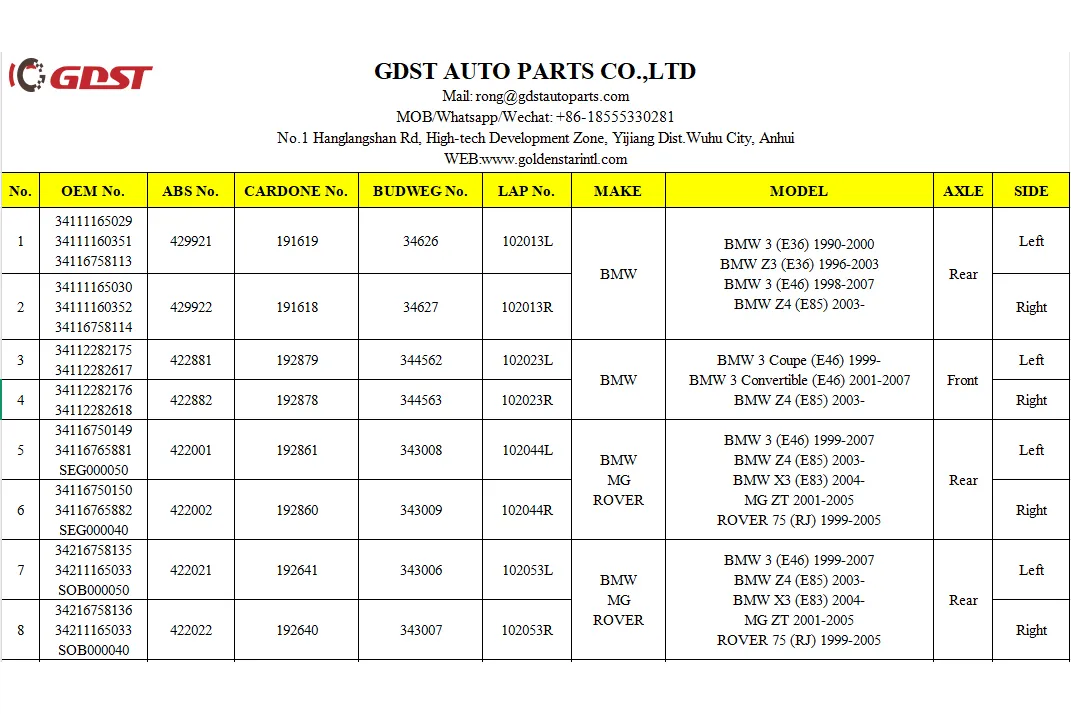
Let OE fitment guide catalog decisions
The aftermarket should preserve the function and fit of the original system unless a properly engineered conversion has been developed. If a passenger vehicle was designed around a sliding caliper, a correct replacement should reproduce the relevant geometry and operating characteristics.
I would not position a random multi-piston part as an “upgrade” merely because it looks more substantial. Such a change can affect hydraulic balance, wheel clearance, pad contact, hose routing, mounting, and service compatibility.
For normal replacement catalogs, buyers should prioritize:
- Accurate OE cross-referencing
- Regional vehicle coverage
- Correct axle and side identification
- Complete application notes
- Consistent product photography
- Clear hardware inclusion
- Stable availability
- Claim and update procedures
Wide coverage requires disciplined data
A broad catalog creates commercial value only when its application data is dependable. GDST works with more than 5,000 OE references across American, European, Japanese, and Korean vehicles. In my experience, expanding coverage responsibly requires continuous attention to supersessions, regional differences, bracket variants, and electronic parking brake configurations.
A sourcing team should not add references only because a supplier can provide a low minimum order quantity. The team should also consider vehicle population, sales history, regional demand, stock turnover, and the cost of maintaining accurate catalog information.
The right product decision combines three forms of fit:
- Technical fit: The part matches the braking system.
- Commercial fit: Demand justifies inventory.
- Supplier fit: The manufacturer can maintain consistent quality and supply.
That framework is more useful than classifying calipers as cheap or premium based on visual complexity.
Frequently Asked Questions
Is a sliding brake caliper the same as a floating caliper?
The terms are often used interchangeably because both describe a caliper body that moves laterally on pins or guides. Some technical references distinguish between specific mounting arrangements, but aftermarket catalogs commonly use “sliding” and “floating” for the same general single-sided piston architecture.
Does a single-piston caliper provide enough braking force?
Yes, when the caliper is correctly designed for its application. Braking force depends on hydraulic pressure, piston area, rotor dimensions, pad characteristics, and the complete vehicle braking system. A single piston is not automatically weaker or less reliable than a design with several pistons.
What causes sliding caliper guide pins to seize?
Guide pins may seize because of corrosion, damaged boots, contamination, unsuitable lubricant, poor surface protection, incorrect clearances, or lack of service. I recommend evaluating the pin, bore, boot, lubricant, and assembly process as one system rather than treating the pin as an isolated component.
What should I request from a sliding caliper supplier?
I suggest requesting OE application data, critical dimensions, material specifications, guide pin and boot details, corrosion protection information, testing scope, traceability procedures, packaging specifications, warranty terms, and production capacity. Buyers should also confirm whether quoted samples represent standard mass production.
Does IATF 16949 certification guarantee caliper quality?
No certification can replace product verification. IATF 16949 provides a strong quality management framework for process control, traceability, risk management, and corrective action. Buyers should still review product specifications, inspection records, test methods, production consistency, and the supplier’s handling of nonconforming parts.12
Conclusion
A sliding brake caliper is a deliberate engineering solution, not an inferior version of a fixed design. Its reliability depends on correct application, guide pin integrity, boot and seal quality, casting condition, machining accuracy, corrosion protection, and controlled assembly. Piston count and unit price cannot replace those criteria.
When you compare suppliers, I recommend using one technical checklist and requesting measurable evidence for each critical feature. If you need help reviewing sliding caliper specifications, OE coverage, or private-label requirements, contact GDST Auto Parts to discuss a sourcing plan built around fitment accuracy and long-term warranty control.
"BRAKE CALIPER GUIDE PINS", https://beta.centralseminary.edu/uploaded-files/sk9XuQ/5FE099/brake_caliper__guide-pins.pdf. Automotive brake-system references describe a floating or sliding caliper as using piston force on the inboard pad and lateral housing movement to apply the outboard pad against the opposite rotor face. Evidence role: mechanism; source type: education. Supports: An automotive engineering or instructional source should confirm that hydraulic pressure applies the inboard pad and reaction force moves the sliding caliper to apply the outboard pad.. ↩
"Additive Manufactured Formula SAE Brake Caliper", https://ideaexchange.uakron.edu/cgi/viewcontent.cgi?article=2738&context=honors_research_projects. Studies of disc-brake caliper seals identify hydraulic sealing and elastic seal recovery as mechanisms that contribute to limited piston rollback after pressure release. Evidence role: mechanism; source type: paper. Supports: A technical study should document fluid sealing and elastic seal deformation as contributors to piston rollback and running-clearance recovery.. Scope note: Actual rollback and running clearance also depend on seal geometry, groove design, pressure history, rotor motion, and component condition. ↩
"Figure 4 - from DESIGN AND ANALYSIS OF MODULAR CALIPER", https://www.academia.edu/figures/2918714/figure-1-floating-caliper-design-right-pushing-the-left-pad. General automotive references frequently group sliding and floating calipers as movable caliper designs in which pistons act from one side and the housing shifts laterally to apply the opposing pad. Evidence role: definition; source type: encyclopedia. Supports: A reference source should show that both terms are used for laterally movable caliper designs with pistons located on one side of the disc.. Scope note: Specialist texts may distinguish the terms according to the precise mounting or guide arrangement. ↩
"Additive Manufactured Formula SAE Brake Caliper", https://ideaexchange.uakron.edu/cgi/viewcontent.cgi?article=2738&context=honors_research_projects. Brake-engineering treatments derive piston force from hydraulic pressure acting over effective piston area and analyze vehicle deceleration as the result of the complete brake, tire, road, and control-system interaction. Evidence role: mechanism; source type: education. Supports: Engineering material should establish the pressure-times-area relationship and explain that deceleration is constrained by rotor torque, friction materials, brake distribution, tires, and control systems.. Scope note: The relationship does not by itself establish the performance of a particular caliper or vehicle. ↩
"Design and analysis of modular caliper assembly. - SOAR", https://soar.wichita.edu/bitstreams/d11f560c-d3e4-4f2d-8000-f6a5dd8d80de/download. Engineering analyses evaluate calipers through effective hydraulic area, structural stiffness, pad-pressure distribution, thermal behavior, and system compatibility rather than treating piston count as an independent quality or safety rating. Evidence role: general_support; source type: paper. Supports: A brake-design source should show that total effective piston area, structural stiffness, pressure distribution, rotor geometry, and system matching are more informative than piston count by itself.. Scope note: Additional pistons can provide design advantages in particular applications, so this evidence does not imply that piston count is irrelevant. ↩
"irjet- monoblock brake caliper design and analysis", https://www.academia.edu/44332742/IRJET_MONOBLOCK_BRAKE_CALIPER_DESIGN_AND_ANALYSIS. Automotive engineering references identify compact packaging, fewer hydraulic components, and potentially lower mass and manufacturing complexity as advantages of floating-caliper layouts when designed to meet the vehicle's braking requirements. Evidence role: general_support; source type: education. Supports: An engineering reference should identify lower component count, compact packaging, and lower potential mass as recognized advantages of floating or sliding calipers.. Scope note: These are architecture-level tendencies, not proof that every sliding caliper is lighter or performs adequately in every application. ↩
"irt No. FHWA-RD-79-116", https://rosap.ntl.bts.gov/view/dot/30251/dot_30251_DS1.pdf. Vehicle-safety research shows that heavier loading and repeated or prolonged braking, particularly on descents, increase brake energy absorption and temperature and can raise the risk of performance degradation. Evidence role: mechanism; source type: government. Supports: Government safety research or technical literature should document the higher thermal load associated with vehicle mass, prolonged descents, and repeated braking.. Scope note: The magnitude of the effect depends on vehicle mass, speed, grade, brake sizing, cooling, and driver or control-system behavior. ↩
"(PDF) Design and Analysis of a Brake Caliper", https://www.academia.edu/130258071/Design_and_Analysis_of_a_Brake_Caliper. Research on floating-caliper guidance systems indicates that restricted slider motion can disrupt force equalization and pad release, while excessive clearance can permit vibration or impact that contributes to noise and unstable contact. Evidence role: mechanism; source type: paper. Supports: Research should connect guide friction or restricted movement with uneven force and wear, and excessive clearance with vibration, impact, or noise potential.. Scope note: Specific acceptable clearances are design-dependent, and brake noise or uneven wear can have several causes unrelated to guide pins. ↩
"Brake Caliper Guide Pins", https://training.jacksonms.gov/book-search/aiwlo5/8OK154/brake-caliper_guide-pins.pdf. Brake service and failure-analysis literature identifies damaged guide boots as a pathway for moisture and debris ingress, which can degrade lubrication, promote pin corrosion, and restrict floating-caliper movement. Evidence role: mechanism; source type: research. Supports: A failure-analysis or maintenance source should establish that damaged slider boots allow moisture and contaminants to enter, promoting corrosion and impaired guide movement.. Scope note: Boot damage increases risk but does not establish that corrosion or seizure will occur in every case. ↩
"DIE CASTING DEFECTS CAUSES AND SOLUTIONS DIE CASTING ...", https://beta.centralseminary.edu/virtual-library/vMyvFj/4FE085/die__casting_defects__causes_and-solutions.pdf. Materials-engineering references classify porosity, nonmetallic inclusions, cracking, and incomplete mold filling among casting defects that can reduce effective section, create stress concentrations, or impair structural integrity. Evidence role: definition; source type: education. Supports: A materials or manufacturing source should define these as recognized casting defects and explain their potential effect on structural integrity.. Scope note: Whether a particular indication is unacceptable depends on its size, location, material, loading, and the applicable drawing or inspection standard. ↩
"USE OF MAGNESIUM CHLORIDE DURING SNOW STORMS", https://www.cga.ct.gov/2014/rpt/2014-R-0001.htm. Transportation and corrosion studies document that wheel-end components are exposed to moisture, road debris, chloride-based deicing salts, and repeated heating and cooling, all of which can accelerate corrosion or coating degradation. Evidence role: general_support; source type: government. Supports: Transportation or corrosion research should document underbody brake-component exposure to water and chloride deicers and the resulting corrosion risk.. Scope note: Exposure severity varies substantially with climate, road treatment, vehicle use, maintenance, and component shielding. ↩
"IATF 16949", https://en.wikipedia.org/wiki/IATF_16949. Official standards guidance characterizes IATF 16949 as an automotive quality-management-system standard focused on process effectiveness, risk-based controls, defect prevention, and continual improvement; management-system certification is not product certification. Evidence role: expert_consensus; source type: institution. Supports: Official IATF or ISO guidance should establish that IATF 16949 concerns an organization's automotive quality management system rather than certifying each manufactured product.. Scope note: Certification can provide relevant evidence of organizational controls, but product conformity still requires specification review, inspection, testing, and production evidence. ↩