Fixed brake caliper design often gets treated like an automatic upgrade, but that idea causes expensive mistakes. Buyers see the “premium” label, assume better performance, and overlook fitment, cost, and manufacturing risk. I want to clear that up by explaining how a fixed brake caliper works and when it truly makes sense.
A fixed brake caliper works by using pistons on both sides of the brake rotor1 to clamp the pads evenly without a sliding mechanism2. This design can improve pedal response, pad pressure balance, and heat control3, but it also requires tighter manufacturing precision4, more careful vehicle matching, and higher cost than a floating caliper.
If you source brake parts for the aftermarket, the real question is not whether fixed calipers look better on paper. The real question is whether they fit your market, your customer base, and your warranty expectations. That is where the details start to matter.
What Is a Fixed Brake Caliper?
A lot of buyers hear the term but do not always connect it to the structural tradeoff behind it. That gap creates confusion, especially when fixed and floating calipers get compared as if one simply outranks the other. I think that mindset leads to poor product planning.
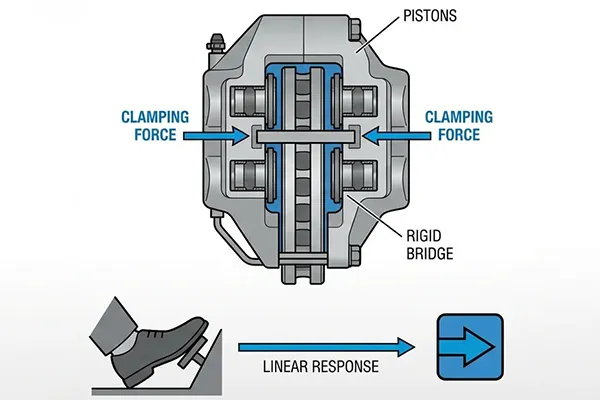
A fixed brake caliper is a brake caliper body that stays rigidly mounted in place while pistons on both sides of the rotor push the brake pads inward. Unlike a floating caliper, it does not slide on guide pins to apply braking force to the opposite pad.
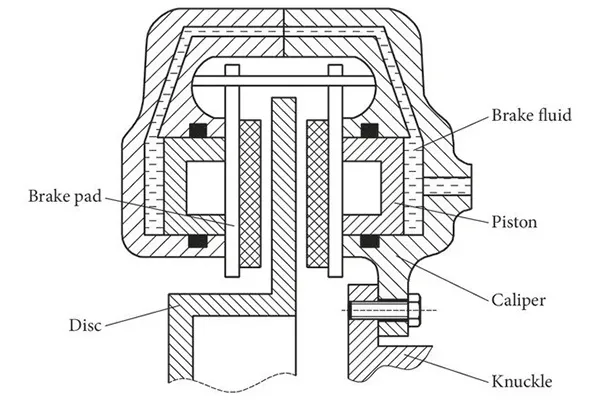
From my production-side perspective, a fixed brake caliper is best understood as a specific architecture, not a luxury badge. The body mounts solidly to the knuckle or bracket. Hydraulic pressure enters the caliper and activates pistons positioned on both sides of the brake disc. Those pistons move inward at the same time and clamp the rotor directly.
Why the structure matters
The absence of a sliding frame changes several things:
- Clamping force becomes more symmetrical5
- Pedal response can feel more immediate
- Heat can distribute more evenly6
- Manufacturing tolerance becomes more critical
In a floating design, one side of the caliper pushes first, and the caliper slides to pull the outer pad into contact. In a fixed design, both sides act directly. That sounds simple, but in practice it raises the precision requirement for every key feature.
From our production line experience, the most common defect risks in fixed calipers are not visible from the outside. They usually come from:
- Piston bore alignment deviation
- Seal groove tolerance errors
- Dust boot seating inconsistency
- Bridge stiffness or machining variation
- Surface finish issues inside the bore
A floating caliper can sometimes tolerate minor misalignment because the guide pin system absorbs some variation. A fixed caliper has far less forgiveness. If the bores do not align correctly, piston movement can become uneven. If the seal groove geometry is off, seal rollback changes and long-term leakage risk rises.
Fixed vs floating at a glance
| Feature | Fixed Caliper | Floating Caliper |
|---|---|---|
| Piston location | Both sides of rotor | Usually one side |
| Sliding mechanism | No | Yes |
| Pedal feel | Often more consistent | Usually adequate for normal use |
| Heat management | Often better in repeated braking | Good for many standard applications |
| Manufacturing tolerance demand | High | Moderate |
| Cost | Higher | Lower |
| Maintenance complexity | Higher | Lower |
| Typical applications | Performance, heavy-duty, repeated braking | Mainstream passenger vehicles |
I have seen buyers assume that “fixed” automatically means better sell-through. In reality, the success of a fixed caliper program depends on whether your market actually needs its benefits and can support its cost. That is why understanding the structure comes first.
How Does a Fixed Brake Caliper Work?
Many people know that a caliper squeezes the rotor, but they do not know what changes when the caliper is fixed rather than floating. That missing step matters because it affects braking feel, temperature behavior, wear patterns, and service demands.
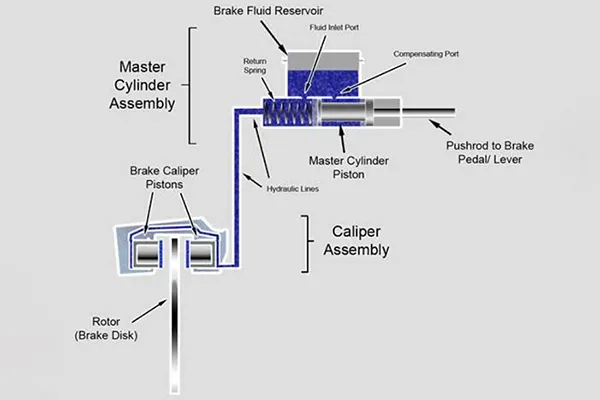
A fixed brake caliper works by converting hydraulic brake pressure into equal clamping action from pistons mounted on both sides of the rotor. When the driver presses the brake pedal, fluid pressure moves the pistons outward, forcing both pads against the disc to create friction and slow the car.
The operating sequence is straightforward, but the execution is where quality separates reliable products from risky ones.
Step-by-step working principle
- The driver presses the brake pedal
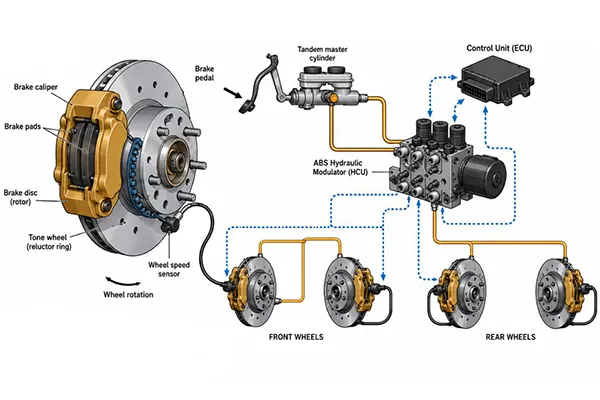
- The master cylinder generates hydraulic pressure
- Brake fluid travels through the brake line into the caliper
- Pressure acts on the pistons inside the fixed caliper body
- Pistons on both sides move toward the rotor
- Inner and outer brake pads clamp the disc
- Friction converts motion into heat
- The vehicle slows down
- When pressure is released, seal elasticity helps retract the pistons slightly
That final step is often overlooked. A fixed caliper does not usually use springs to pull the pistons back significantly. Instead, the square-cut seal deforms under pressure and then elastically returns when pressure drops7. That tiny rollback creates running clearance between pad and rotor.
Why precision matters in how it works
From our manufacturing experience, this is where many buyers underestimate risk. A fixed design only works well when the internal geometry is correct. I have seen cases where a caliper looked perfect externally but later developed uneven pad wear or slow piston return because of minor bore or groove issues.
Critical precision points
- Piston bore roundness
- Bore center alignment across both sides
- Seal groove width and depth
- Surface roughness in fluid-contact areas
- Dust boot retention profile
- Bridge and mounting face accuracy
If those dimensions drift, the result can include:
- Pad drag
- Uneven wear
- Inconsistent pedal feel
- Premature seal wear
- Leakage in service
- Warranty returns that are hard to diagnose
Why some drivers feel better modulation
A fixed brake caliper often gives more stable pedal modulation, especially during repeated or high-temperature braking. The more rigid body and direct two-sided actuation reduce some compliance in the system. That can help the driver control braking force more precisely.
Still, I would not present that as universal superiority. On an ordinary passenger car used for daily commuting, the average driver may not notice enough difference to justify the higher part cost. In B2B terms, that means demand depends heavily on vehicle segment and customer expectation.
Why Does a Fixed Brake Caliper Perform Differently?
Buyers often hear broad claims like “better braking,” but that phrase is too vague to be useful. You need to know which part of braking improves, under what conditions, and whether those gains matter in the target market.
A fixed brake caliper performs differently because its rigid body and opposed-piston layout can deliver more even pad pressure, better heat behavior, and more consistent response under repeated braking. Those gains are most noticeable in high-load or high-temperature conditions, not always in normal daily driving.
I think the most honest way to explain this is to separate real advantages from marketing language.
Where fixed calipers usually help
1. More consistent pad pressure distribution
Because pistons act from both sides, pressure can be distributed more evenly across the pad surface. That can improve wear balance and contact stability.
2. Better heat management in repeated braking
Fixed calipers are often used in applications where heat fade resistance8 matters. Repeated braking creates rotor and pad temperature buildup. A well-designed fixed caliper can manage this environment more consistently.
3. More stable pedal feel
The rigid body and direct clamping action can reduce flex compared with some floating systems. This can create a firmer and more predictable brake response.
4. Better high-temperature modulation
In performance or heavy-load use, the driver may feel more control when braking near the system’s thermal limits.
What “better braking” should actually mean
Instead of saying “better braking,” I prefer to use specific outcomes such as:
- More consistent braking after repeated stops
- More even pad wear across the axle
- Improved pedal response at elevated temperature
- Reduced performance variation under heavy duty cycles
These are meaningful because they describe operating conditions.
Where the benefit may not justify the cost
For standard passenger vehicles on normal roads, a floating caliper often delivers fully acceptable stopping performance at lower cost and easier serviceability. That matters for distributors and category managers.
Here is a practical comparison:
| Use Case | Fixed Caliper Advantage | Commercial Sense |
|---|---|---|
| Sports cars | High | Strong |
| Track-oriented vehicles | Very high | Strong |
| Heavy repeated downhill braking | High | Strong |
| Standard city commuter cars | Moderate to low | Often limited |
| Cost-sensitive aftermarket segments | Low | Often weak |
| Fleet vehicles with simple service needs | Mixed | Case by case |
I have observed that buyers often overlook the difference between engineering value and market value. A fixed caliper may be technically impressive, but if the customer base does not demand it, the category can become slow-moving inventory with higher support costs.
What Are the Manufacturing and Quality Risks of a Fixed Brake Caliper?
This is the section many sourcing teams skip, and I think that is a mistake. A fixed caliper’s performance depends heavily on manufacturing precision, so supplier capability matters even more than the product concept itself.
The main manufacturing risks of a fixed brake caliper include piston bore misalignment, seal groove machining errors, body distortion, and poor tolerance control. These defects can cause uneven braking, leakage, pad drag, or early warranty failure, even when the caliper looks fine during basic visual inspection.
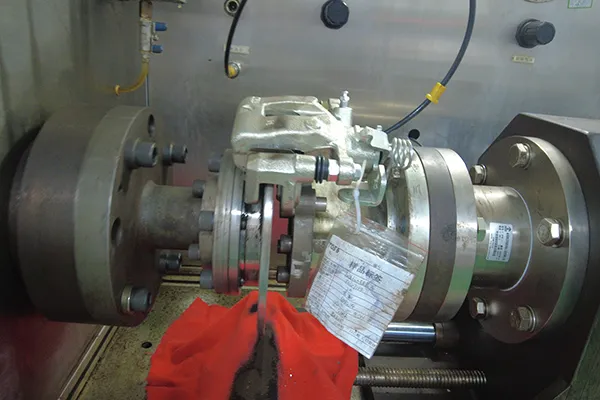
From our production line experience, the hidden risk in a fixed brake caliper is that every bore, groove, and contact feature has to work together precisely. There is no sliding mechanism to mask errors.
Key manufacturing challenge areas
Piston bore alignment
Opposed pistons must move smoothly and symmetrically. If bore centers shift beyond tolerance, the pistons can apply uneven force or create extra friction.
Seal groove machining
Seal groove geometry is critical. If the groove is too shallow, too deep, too wide, or rough, the seal cannot behave correctly under pressure. That affects rollback, leakage, and durability.
Hot pressing and housing stability
In one-piece or multi-part housings, hot-pressing precision and stress control affect final dimensional stability. If the housing distorts slightly after processing, bore relationships can change.
Dust boot fitment
A dust boot is not a cosmetic part. It protects the piston and bore area from contamination. If the retention profile is weak or inconsistent, water and debris enter, and long-term corrosion risk rises.
What buyers should verify with a supplier
I recommend that buyers ask very direct process questions:
- How is bore concentricity controlled?
- What are the critical tolerances for seal groove width and depth?
- Is 100% leak testing9 performed?
- How is piston movement consistency checked?
- What inspection method is used for mounting face and bridge accuracy?
- Does the supplier validate dust boot retention and sealing?
- What process controls support IATF 1694910 compliance?
Practical supplier evaluation checklist
| Control Point | Why It Matters | Buyer Question |
|---|---|---|
| Bore machining accuracy | Affects piston motion | How do you verify bore alignment? |
| Seal groove tolerance | Affects sealing and rollback | What is your groove inspection frequency? |
| Pressure testing | Detects leakage | Is every caliper leak tested? |
| Surface finishing | Affects seal and piston wear | What Ra target do you control? |
| Material consistency | Affects strength and durability | How do you trace casting batches? |
| Assembly validation | Affects field reliability | Do you test piston return behavior? |
I have learned that warranty risk often starts in areas that buyers cannot see during a sample review. A sample may look excellent on the outside. However, if internal machining discipline is weak, field failures may appear months later. That is why fixed calipers reward serious supplier auditing more than visual product comparison.
When Should Buyers Choose a Fixed Brake Caliper?
The biggest commercial mistake is treating fixed calipers as universal upgrades. That mindset creates fitment issues, pricing pressure, and unnecessary complexity in markets that do not need them.
Buyers should choose a fixed brake caliper when their market serves vehicles or users that face repeated high-heat braking, value pedal consistency, and can support higher product and installation costs. For standard passenger car segments, floating calipers often remain the more practical choice.
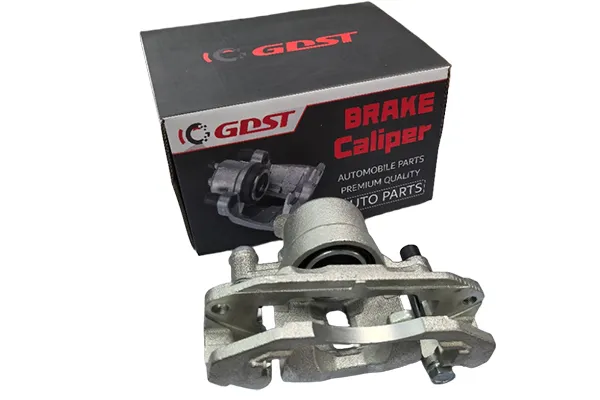
I always come back to application first. The correct question is not “which is better?” The correct question is “which design fits the use case, service environment, and customer expectation?”
Good-fit applications for fixed calipers
- Performance-oriented passenger vehicles
- Sports cars
- Track day or motorsport-adjacent builds
- Heavy vehicles with repeated braking cycles
- Premium aftermarket segments where appearance and feel matter
- Markets where end users accept higher service cost
Cases where floating calipers may be the smarter choice
- Standard commuter vehicles
- Cost-sensitive wholesale channels
- Markets with limited technician familiarity
- Fleets that prioritize easy maintenance
- Segments where wheel fitment is highly variable
- Programs where low return rate matters more than premium positioning
Fitment is not automatic
A fixed brake caliper is not a drop-in universal replacement. Buyers who ignore this usually face returns and installer complaints.
Important fitment factors
- Mounting bracket compatibility
- Wheel clearance
- Rotor size and thickness match
- Brake line routing
- Master cylinder fluid volume compatibility
- Pad shape and hardware compatibility
If master cylinder volume does not match the caliper piston area, pedal travel and feel can change significantly.11 If wheel clearance is insufficient, the assembly simply will not fit. If brake line routing is awkward, installers may face leakage or hose stress issues.
A simple decision framework
- Define vehicle segment
- Check real demand for performance braking
- Review local installation capability
- Evaluate wheel and bracket fitment risk
- Estimate warranty and return exposure
- Compare margin against support cost
I have seen fixed caliper programs succeed very well in the right niche. I have also seen them create headaches when buyers stocked them mainly because the category looked premium. In the aftermarket, premium appearance alone does not protect margin. Fitment accuracy and application logic do.
Frequently Asked Questions
Is a fixed brake caliper better than a floating caliper?
Not always. A fixed brake caliper can offer better heat control, pad pressure balance, and pedal consistency, but it also costs more and needs tighter manufacturing precision. For many standard passenger vehicles, a floating caliper remains the more practical and economical solution.
Does a fixed brake caliper improve stopping distance?
Not automatically. Stopping distance depends on tire grip, vehicle weight, rotor size, pad friction, and brake balance. A fixed brake caliper usually improves consistency and modulation under repeated braking rather than guaranteeing dramatically shorter stops in all conditions.
Why is a fixed brake caliper more expensive?
A fixed brake caliper costs more because it uses a more complex structure, more pistons, tighter machining tolerances, and stricter assembly control. Bore alignment, seal groove accuracy, and housing rigidity all raise manufacturing difficulty and inspection requirements.
Can I replace a floating caliper with a fixed brake caliper?
Not as a simple swap in most cases. A fixed brake caliper may require different brackets, wheel clearance, brake line routing, rotor matching, and master cylinder compatibility. Buyers should never assume universal fitment without detailed technical verification.
What is the biggest quality risk in fixed caliper sourcing?
From our production experience, the biggest hidden risks are piston bore alignment and seal groove machining errors. These defects may not show during a visual check, but they can lead to leakage, uneven braking, pad drag, or early field failure.
Conclusion
A fixed brake caliper works by using pistons on both sides of the rotor to create direct, even clamping force without a sliding mechanism. That design can deliver stronger heat management, more consistent response, and better modulation in demanding conditions. Still, it is not a universal upgrade. It requires tighter manufacturing precision, careful fitment validation, and a market that truly values its benefits. If you are evaluating fixed calipers for your aftermarket lineup, contact GDST Auto Parts to discuss OE coverage, private label options, and practical sourcing support for your target market.
"Disc brake", https://en.wikipedia.org/wiki/Disc_brake. Reference works on disc brakes describe fixed calipers as rigidly mounted housings, typically with opposed pistons acting on both sides of the disc, in contrast to sliding or floating calipers that move laterally to apply the outer pad. Evidence role: definition; source type: encyclopedia. Supports: That fixed brake calipers are mounted rigidly and commonly use pistons on both sides of the rotor rather than a sliding frame.. ↩
"Disc brake", https://en.wikipedia.org/wiki/Disc_brake. Automotive engineering teaching materials define floating calipers as laterally movable units, often guided by pins or slides, that transmit force to the outer pad through caliper motion, whereas fixed calipers remain stationary relative to the mounting bracket. Evidence role: definition; source type: education. Supports: That floating calipers use guide pins or a sliding arrangement to bring the outer pad into contact, whereas fixed calipers do not rely on that movement.. ↩
"Cal Poly BSAE Brake Caliper", https://digitalcommons.calpoly.edu/cgi/viewcontent.cgi?filename=1&article=1899&context=mesp&type=additional. Engineering studies of disc brake assemblies report that caliper stiffness and load distribution influence pedal feel, pad contact pressure, and thermal loading; these findings provide mechanism-level support for the claim that fixed opposed-piston designs can improve response and pressure balance, although the magnitude depends on the full brake system design. Evidence role: mechanism; source type: paper. Supports: That caliper rigidity and opposed-piston force application can contribute to more uniform pad loading and more consistent response and thermal behavior under demanding braking.. Scope note: Support is contextual because vehicle-level outcomes vary with rotor size, pad material, hydraulic system design, and operating conditions. ↩
"Cal Poly BSAE Brake Caliper", https://digitalcommons.calpoly.edu/cgi/viewcontent.cgi?filename=1&article=1899&context=mesp&type=additional. Technical literature on brake caliper design and manufacturing identifies bore position, seal-groove geometry, and housing stiffness as critical dimensions affecting piston motion and sealing performance, supporting the statement that fixed opposed-piston calipers demand close process control. Evidence role: general_support; source type: research. Supports: That opposed-piston brake calipers are sensitive to geometric tolerances such as bore alignment, groove geometry, and structural stiffness.. Scope note: Direct side-by-side tolerance thresholds for fixed and floating calipers may not always be reported in a single source. ↩
"Types of Brake Calipers: Fixed vs. Floating Explained", https://www.matfoundrygroup.com/products/types-of-brake-calipers-fixed-vs-floating-explained. Analytical and finite-element studies of disc brakes show that piston arrangement and caliper stiffness affect contact pressure distribution across the pad, supporting the proposition that opposed-piston fixed calipers can achieve more symmetric clamping than sliding single-piston designs. Evidence role: mechanism; source type: paper. Supports: That opposed-piston fixed calipers can produce more symmetric or uniform pad loading than single-sided sliding arrangements.. Scope note: The degree of symmetry depends on piston sizing, pad geometry, and structural compliance, so the support is design-dependent rather than universal. ↩
"thermal analysis of disk brake in order to study the ...", https://mavmatrix.uta.edu/cgi/viewcontent.cgi?article=1774&context=mechaerospace_theses. Brake thermal analysis literature indicates that caliper geometry, contact pressure distribution, and repeated braking conditions affect heat generation and temperature fields in pads and discs, which is consistent with the claim that fixed caliper layouts may support more even thermal behavior. Evidence role: mechanism; source type: paper. Supports: That caliper architecture and pad loading patterns influence thermal distribution during braking.. Scope note: This is contextual support because thermal outcomes also depend strongly on rotor ventilation, pad compound, speed, and duty cycle. ↩
"Numerical simulation and experimental research on ... - PMC", https://pmc.ncbi.nlm.nih.gov/articles/PMC9633771/. Studies of hydraulic disc brake seals describe piston retraction after brake release as arising primarily from elastic deformation and recovery of the square-section seal, which creates the small running clearance between pad and disc. Evidence role: mechanism; source type: paper. Supports: That piston rollback in disc brakes is commonly produced by elastic deformation and recovery of the square-section seal.. ↩
"Brake fade", https://en.wikipedia.org/wiki/Brake_fade. Automotive engineering references on performance braking commonly place fixed opposed-piston calipers in applications that prioritize repeated-stop thermal stability and resistance to brake fade, reflecting their established use in severe-duty and performance contexts. Evidence role: historical_context; source type: education. Supports: That fixed calipers are commonly associated with high-performance or severe-duty braking contexts where thermal consistency and fade resistance are priorities.. Scope note: This supports typical application context rather than proving that every fixed caliper automatically resists fade better than every floating design. ↩
"49 CFR Part 570 -- Vehicle in Use Inspection Standards", https://www.ecfr.gov/current/title-49/subtitle-B/chapter-V/part-570. Automotive quality and safety references treat hydraulic leakage as a critical brake-system failure mode and describe pressure or leak testing as an established control method for verifying component integrity in production and validation. Evidence role: expert_consensus; source type: institution. Supports: That leak integrity is a critical quality attribute for hydraulic brake components and is commonly addressed through validation or production testing.. Scope note: A source may support the importance of leak testing without mandating universal 100 percent end-of-line testing for every manufacturer. ↩
"IATF 16949", https://en.wikipedia.org/wiki/IATF_16949. The IATF 16949 standard defines requirements for automotive quality management systems with emphasis on process control, defect prevention, and continuous improvement across the automotive supply chain, making it relevant context for evaluating brake component manufacturing controls. Evidence role: definition; source type: institution. Supports: That IATF 16949 is an automotive quality management standard intended to govern process consistency, defect prevention, and supply-chain quality in automotive production.. Scope note: Certification alone does not prove the quality of any specific caliper program or supplier output. ↩
"What size master cylinder bore do I need? - Help Center", https://help.summitracing.com/knowledgebase/article/SR-05507/en-us. Brake system engineering materials explain that master-cylinder bore and stroke determine fluid displacement, while caliper piston area determines the fluid volume needed for pad application; together these parameters influence pedal travel and feel. Evidence role: mechanism; source type: education. Supports: That hydraulic ratio between master cylinder displacement and caliper piston area influences brake line pressure, fluid displacement, pedal travel, and pedal feel.. ↩