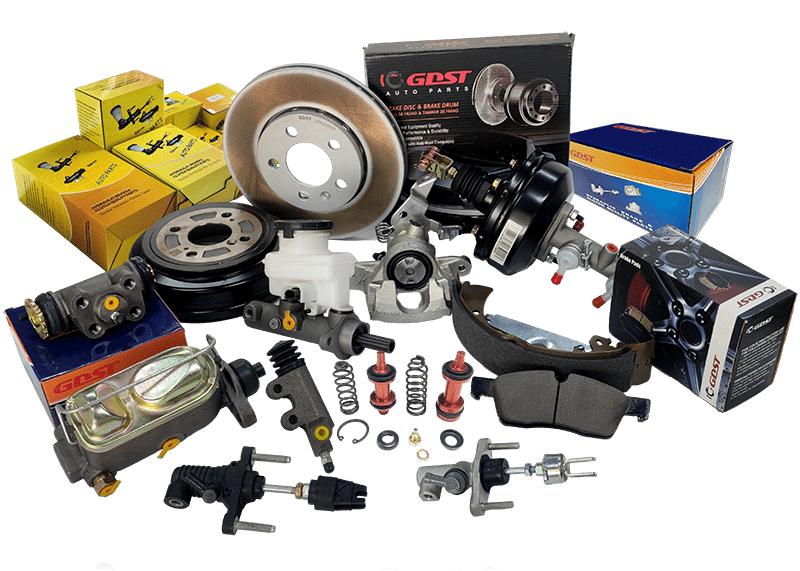
When I answer the question “do you have to change brake discs when changing pads?”, I start with the condition of the discs—not with a universal rule. Replacing serviceable discs can increase costs unnecessarily, while reusing worn or damaged discs can create safety, performance, complaint, and warranty risks. A measured inspection provides the better answer.1
You do not automatically have to change brake discs when changing brake pads. The existing discs may be reused if they remain above the vehicle’s specified minimum thickness2, have acceptable runout, show an even wear pattern, and have no cracks, serious scoring, heat damage, or other defects. You should replace them when inspection shows they are outside the vehicle or manufacturer’s requirements.
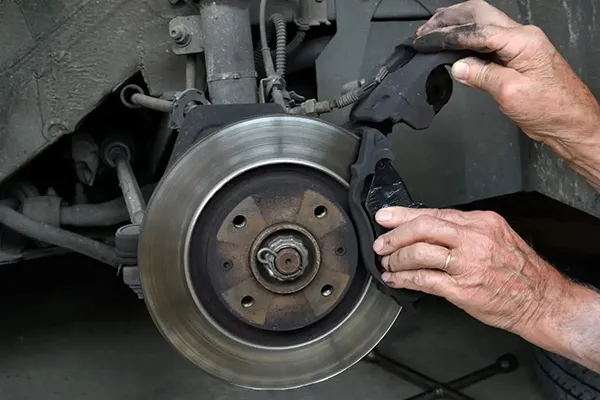
In my experience with brake disc manufacturing information, technical documentation, and aftermarket customer questions, the safest approach is condition-based rather than age-based. I encourage buyers and vehicle owners to request inspection findings, measurements, and the relevant technical limits before approving either pads-only service or a complete disc-and-pad replacement.
Why do people think they must change brake discs with pads?
Many drivers hear that brake discs and brake pads should always be replaced as a complete set. That advice can sound reassuring because both parts work together, but it can also lead to unnecessary spending when no inspection supports disc replacement. The opposite mistake can be more serious when an old disc has hidden wear.
The idea that you must change brake discs whenever you change pads comes from a practical service concern: new pads need a suitable friction surface. However, the disc and pad do not need to have the same age. A disc can remain serviceable through more than one pad replacement if it still meets the applicable requirements.3
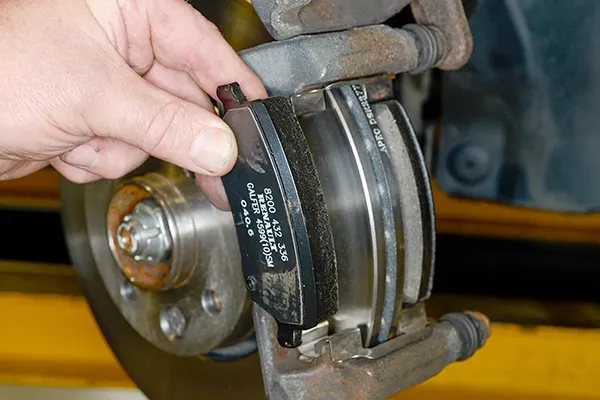
What is the correct principle?
The correct principle is to inspect the brake disc and compare its measured condition with vehicle-specific specifications. The key checks usually include:
- Disc thickness compared with the specified minimum value.
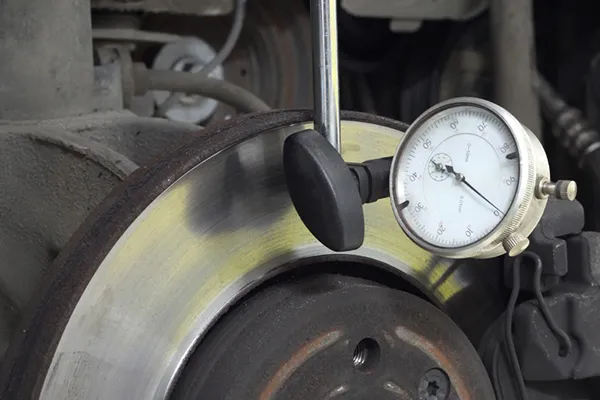
- Lateral runout and possible distortion.
- Surface condition and wear pattern.
- Cracks, deep grooves, corrosion, or impact damage.
- Heat spots, blue discoloration, or other signs of thermal stress.
- Compatibility with the replacement brake pads.
- Correct fitment, mounting, and bedding-in requirements.
The disc’s age alone does not prove that replacement is necessary. A recently installed disc may still require replacement if it has been damaged or incorrectly fitted. An older disc may remain usable if it has sufficient material, acceptable geometry, and a suitable friction surface.
Why is a universal rule unreliable?
Brake systems vary significantly between vehicle models, axles, operating conditions, and component designs.4 A disc used on a small passenger car may not have the same thickness, cooling design, wear allowance, or inspection limit as a disc used on an SUV or commercial vehicle.
For this reason, I do not recommend applying one universal minimum thickness or replacement interval to every vehicle. The applicable limit should come from an authoritative source such as:
- The vehicle manufacturer’s repair information.
- The original equipment or replacement disc markings.
- A reputable brake component manufacturer’s technical documentation.
- A qualified repair professional using the correct vehicle data.
Why should buyers be cautious about both extremes?
I see two common concerns in brake service discussions:
- Fear of over-servicing: The owner worries that a repairer is recommending discs simply to increase the invoice.
- Fear of under-servicing: The owner worries that reusing the disc will reduce braking performance or create a future problem.
Both concerns are reasonable. A defensible recommendation should explain what was found. If a repairer recommends disc replacement, I would ask whether the disc is below its specified thickness, has excessive runout, has an uneven surface, or shows heat or structural damage. If a repairer recommends reusing the disc, I would ask whether the disc was measured and confirmed compatible with the new pads.
In our product and customer communications, I find that clear evidence is more useful than a simple “always replace” or “never replace” statement. A disc-and-pad decision should be based on condition, specification, and application.
When should you change brake discs with new pads?
You should change brake discs with new pads when the discs are below the applicable minimum thickness, have excessive runout, display serious surface damage, or show evidence of cracking or heat-related deterioration. You should also consider replacement when the disc cannot provide a suitable, compatible friction surface for the new pads.
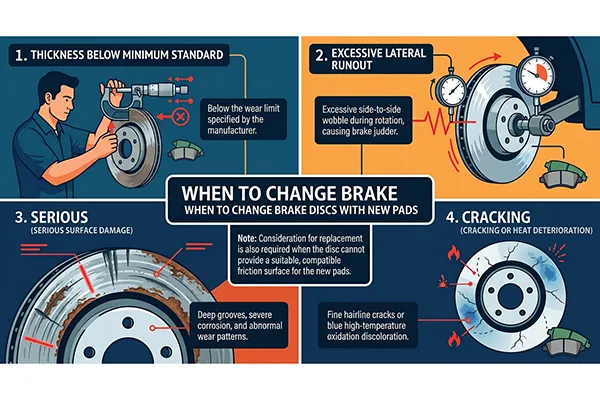
A disc does not need to look completely new to be serviceable. At the same time, a disc that still rotates or appears acceptable through a wheel opening is not automatically safe to reuse. The recommendation should rely on inspection and measurement.
1. The disc is below its minimum thickness
Every disc has an applicable minimum thickness. This value is not interchangeable between vehicles or disc designs. The limit may be shown on the disc, listed in technical documentation, or provided through vehicle-specific service information.
Disc thickness matters because the disc must retain enough material for braking loads and heat management. Continued wear reduces the remaining material available to absorb and dissipate heat.5 A disc that has reached or fallen below its specified limit should not be treated as serviceable merely because the braking system still feels normal.
I recommend asking for three pieces of information:
- The measured thickness.
- The specified minimum thickness.
- The measurement method and location, if relevant.
The vehicle-specific specification should always control the decision. I would not use a generic thickness number from another vehicle or an online discussion as a substitute.
2. The disc has excessive runout or distortion
Runout describes unwanted variation as the disc rotates. Excessive runout can contribute to pedal pulsation, uneven pad contact, noise, and irregular wear.6 The source may involve the disc, hub, mounting surface, wheel installation, or another related issue, so a qualified professional should evaluate the complete system.
A disc that has excessive runout may not be corrected simply by installing new pads. The new pads may begin wearing against an uneven rotating surface. If the underlying cause is not identified, the vehicle may develop repeated complaints after the service.
I treat runout as a measurement issue rather than something that should be judged only by driving feel. Some drivers notice pulsation, while others may not. The absence of a noticeable symptom does not prove that the disc meets the applicable limit.
3. The surface has deep grooves or an uneven wear pattern
Light surface marks can occur during normal use. However, deep grooves, heavy lips, patchy contact, or pronounced uneven wear may prevent the new pads from bedding correctly.
A new pad needs adequate contact with the disc’s working surface. If only part of the pad contacts the disc, the braking system may require more time to establish a consistent contact area. Uneven contact can also create noise, vibration, or accelerated wear.
The repairer should determine whether the surface condition can be corrected using an approved procedure or whether disc replacement is more appropriate. I would not assume that machining or resurfacing is suitable for every disc. The remaining thickness, disc design, local rules, and manufacturer instructions all matter.
4. The disc shows cracks, severe heat damage, or structural concerns
Cracks are a clear reason to stop treating the disc as a routine reuse candidate.7 Severe heat damage, substantial blue or purple discoloration, heat checking, or other signs of thermal stress also require professional assessment.8
Visual signs alone do not provide a complete diagnosis, but they can identify a reason for closer inspection. The disc may have experienced severe braking loads, a sticking caliper, improper pad contact, overloading, or another system issue. Replacing the disc without addressing the cause may allow the problem to return.
5. The disc and new pads are not properly compatible
Brake pad and disc compatibility includes more than physical dimensions.9 The parts should be intended for the same application and operating requirements. Important considerations can include:
| Evaluation area | Why it matters |
|---|---|
| Vehicle and axle application | The component must fit the correct vehicle position |
| Disc dimensions | Diameter, thickness, height, and center bore affect fitment |
| Friction surface | The surface must support proper pad contact |
| Pad material | The pad compound should be suitable for the disc and application |
| Thermal requirements | Heavy vehicles or demanding use may require different specifications |
| Certification or market requirements | Buyers should verify applicable documents and approvals |
| Bedding-in instructions | Correct installation helps establish consistent contact |
In aftermarket procurement, I see fitment accuracy as a basic quality requirement. A disc may appear similar to another part but still be incorrect for the application. Vehicle owners should use the correct catalog number and have the installer verify the part before installation.
Can you reuse brake discs when changing pads?
You can reuse brake discs when changing pads if a qualified inspection confirms that the discs remain within the applicable limits and have no significant damage. The disc should have suitable thickness, acceptable runout, an appropriate surface, correct fitment, and compatibility with the replacement pads.
Reusing a disc is not automatically unsafe, and replacing a disc is not automatically unnecessary. The answer depends on measurable condition and the quality of the installation. I encourage vehicle owners to separate evidence-based reuse from casual reuse based only on appearance.
What should an inspection include?
The factors typically checked include the following:
Disc thickness
The inspector should measure the working area and compare the result with the correct minimum thickness. The measurement should account for the disc’s design and any wear lip that could distort a casual reading.
Lateral runout
The inspector should check whether the disc rotates within the permitted runout range. The applicable limit must come from the relevant vehicle or component information.
Surface condition
The inspector should look for:
- Deep scoring.
- Uneven pad contact.
- Heavy corrosion on the friction surface.
- Cracks or heat checking.
- Severe hot spots.
- Excessive wear lips.
- Contamination from grease, oil, or other materials.
Mounting and fitment
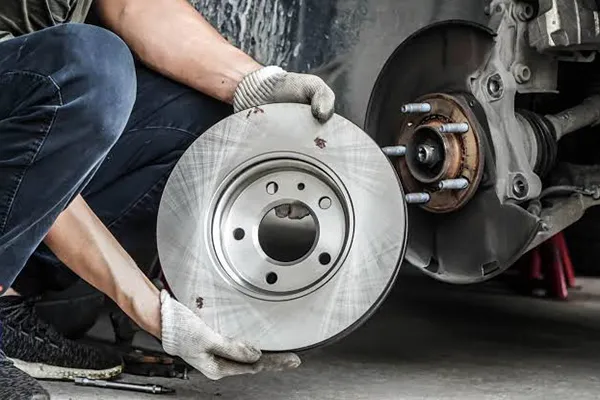
The hub and disc mounting faces should be clean and correctly assembled.10 Dirt, corrosion, incorrect wheel installation, or mounting problems can affect disc behavior. A serviceable disc may perform poorly if the installation is incorrect.
Pad compatibility
The replacement pads should be correct for the vehicle and axle. The pads should also be installed according to the supplier’s instructions, including any required clips, shims, or hardware.
Does a good-looking disc prove that reuse is safe?
No. A visual check is useful, but it is not enough for every decision. A disc can look reasonably smooth while being below its minimum thickness or outside the permitted runout limit. Conversely, a disc can show light cosmetic corrosion after storage or limited use without automatically requiring replacement.
Driving feel also has limits. A driver may not feel early-stage uneven wear, and a quiet brake system is not proof that every specification is satisfied. I therefore prefer a documented inspection rather than a conclusion based on appearance, noise, or the current pedal feel alone.
What does proper bedding-in involve?
New pads may need a bedding-in process so that their friction material forms a consistent contact layer on the disc.11 The exact process depends on the vehicle, pad supplier, and application. I do not recommend using one generic driving procedure for every vehicle.
The installer should follow the relevant instructions and avoid treating the first few braking events as a final performance test. During bedding-in, the driver should use reasonable caution and follow the instructions provided by the vehicle or component manufacturer.
A serviceable reused disc may work well with new pads when the mating surfaces are suitable and the installation is correct. However, the outcome also depends on caliper operation, hardware condition, wheel-end assembly, and the absence of contamination or mechanical faults.
What questions should vehicle owners ask?
I suggest asking direct questions without assuming that the recommendation is either honest or excessive. Useful questions include:
- What is the measured disc thickness?
- What is the specified minimum thickness for this vehicle or component?
- Was runout measured?
- What surface or structural condition led to the recommendation?
- Is the disc compatible with the proposed pads?
- Are replacement discs required by a manufacturer instruction, or are they being recommended because of measured wear?
- What documentation supports the specification?
These questions help turn a vague sales recommendation into an understandable technical decision. They also help a repair professional explain why pads-only service is appropriate when the discs remain serviceable.
How can you evaluate a recommendation to change brake discs?
You can evaluate a recommendation to change brake discs by requesting the inspection findings and comparing them with authoritative vehicle or component data. I would look for a clear connection between the measured condition and the proposed repair, rather than relying on the disc’s age, appearance, or a universal replacement rule.
This approach protects both sides. Vehicle owners can reduce the risk of unnecessary cost, while repairers can show that a replacement recommendation is based on safety and technical requirements rather than guesswork.
What evidence makes a recommendation defensible?
A strong recommendation usually identifies:
- The specific axle or wheel position.
- The measured disc thickness.
- The applicable minimum thickness.
- Any runout or distortion result.
- The visible damage or wear pattern.
- The reason the existing disc is incompatible or unsuitable.
- The replacement part number and application.
- Any applicable installation or bedding instructions.
The repairer may not provide every detail on a standard invoice, but the owner can reasonably ask for an explanation. The answer should be specific enough to show why the disc needs replacement.
How should aftermarket buyers assess brake disc suppliers?
The same reasoning applies when I evaluate brake disc supply for aftermarket brands, importers, wholesalers, and distributors. A supplier should offer more than a low unit price. Buyers should evaluate whether the manufacturer can produce consistent, correctly fitting parts at the required volume.
I would review the following areas:
| Supplier evaluation area | Questions for buyers |
|---|---|
| Product development | Are designs based on accurate OE references and technical data? |
| Fitment coverage | Does the catalog cover the required vehicle applications? |
| Manufacturing process | Are casting, machining, coating, balancing, and inspection controlled? |
| Quality testing | Are thickness, hardness, runout, balance, coating, and appearance checked? |
| Final inspection | Does the supplier verify every finished batch or product as specified? |
| Documentation | Can the supplier provide current quality and certification documents? |
| Capacity | Can the factory support forecast demand and stable delivery? |
| Customization | Are private label, packaging, and OEM/ODM services available? |
| Technical communication | Can the supplier respond clearly to fitment questions? |
At GDST Auto Parts, I work from the perspective of a manufacturer that has handled brake disc quality information, product documentation, and customer questions since 2002. Our stated capabilities include a 100,000-square-meter factory, more than 500 employees, 50 production lines, monthly capacity of 400,000 brake discs, and more than 5,000 applications. Buyers should still verify current capacity, product data, and certification documents during procurement.
What quality information should buyers verify?
A buyer should verify the quality system and product documents rather than relying on a general claim of “high quality.” GDST identifies IATF16949 and ISO9001 quality management certifications and selected ECE-R90 product certification for applicable European-market products. Buyers should confirm the certificate scope, validity, issuing organization, and whether the specific products are covered.
Relevant manufacturing and testing information may include:
- Raw material inspection.
- Dimensional verification.
- Hardness testing.
- Runout testing.
- Balance testing.
- Salt spray testing for applicable coated products.
- Coating adhesion testing.
- High-temperature performance testing.
- Appearance and packaging inspection.
- Quantity and labeling confirmation.
- Final inspection before shipment.
These checks do not replace vehicle-specific professional evaluation. They help buyers assess whether a supplier has a repeatable quality process and enough documentation to support their own product and warranty responsibilities.
How can buyers reduce future complaints?
Buyers can reduce complaints by confirming the application before placing an order and by controlling the information supplied to their customers. A complete product program should include:
- Accurate application and interchange data.
- Clear installation guidance.
- Correct packaging and labeling.
- Batch traceability where available.
- Defined inspection and warranty procedures.
- Technical support for fitment questions.
- Clear instructions for bedding-in and handling.
- A process for investigating noise, vibration, and premature wear complaints.
In my experience, many complaints begin with an incorrect application, poor installation, contaminated friction surfaces, or a mismatch between customer expectations and product use. Supplier selection cannot eliminate every field variable, but a well-controlled manufacturer can give buyers stronger documentation and more consistent products.
Frequently Asked Questions
Do I have to change brake discs every time I change brake pads?
No. You do not have to change brake discs every time you install new pads. A qualified inspection should confirm that the discs meet the applicable thickness and runout limits, have no serious damage, and provide a suitable surface for the new pads.
How do I know whether my brake discs need replacement?
You should ask for measured thickness, the applicable minimum thickness, runout results, and details about surface or structural damage. Deep grooves, cracks, severe heat damage, excessive wear, or distortion can support replacement, but the exact decision should follow vehicle-specific technical information.
Can new brake pads damage old brake discs?
New pads do not automatically damage old discs. Problems are more likely when the disc is already unserviceable, the surfaces are incompatible, the parts are incorrectly fitted, or the bedding-in process is not followed. A professional should evaluate the complete brake assembly when concerns arise.
Is a brake disc replacement recommendation always necessary?
A replacement recommendation is not automatically necessary simply because the pads are being changed. However, it may be justified when measurements or inspection show that the disc is outside the applicable requirements. You should request the findings and compare them with authoritative technical data.
Should brake discs and pads be bought from the same manufacturer?
They do not always need to come from the same manufacturer, but the parts must be correctly specified and compatible for the vehicle and axle. Buyers should verify fitment, technical requirements, certification documents where applicable, and installation guidance before selecting aftermarket components.
Conclusion
You do not automatically have to change brake discs when changing pads. I recommend a condition-based decision that considers disc thickness, runout, wear pattern, surface condition, damage, fitment, and compatibility with the replacement pads. Vehicle owners should request measurements and compare them with the correct manufacturer or vehicle specifications instead of relying on appearance or a universal rule. For aftermarket buyers, GDST Auto Parts provides brake disc manufacturing, OE-based development, testing, private label, and OEM/ODM support. Contact GDST to discuss your applications, quality documentation, packaging, and long-term supply requirements.
"19VAC30-70-80. Service brakes. - Virginia Law", https://law.lis.virginia.gov/admincode/title19/agency30/chapter70/section80/. Professional brake-service procedures treat measured thickness, runout, and physical condition as relevant evidence when evaluating a disc for continued use or replacement. Evidence role: expert_consensus; source type: research. Supports: The source should document the use of measured thickness, runout, and surface-condition checks in professional brake inspection procedures.. Scope note: Procedures differ by vehicle and jurisdiction, so general inspection guidance does not replace the applicable manufacturer specification. ↩
"19VAC30-70-80. Service brakes. - Virginia Law", https://law.lis.virginia.gov/admincode/title19/agency30/chapter70/section80/. Government vehicle-inspection guidance supports assessing a brake disc against its specified minimum thickness before determining whether continued service is permissible. Evidence role: general_support; source type: government. Supports: The source should establish that brake-disc serviceability is assessed against a specified minimum thickness and that measurements should be compared with the applicable vehicle or component limit.. Scope note: Inspection guidance may identify minimum-thickness requirements without providing the specification for every vehicle or disc design. ↩
"19VAC30-70-80. Service brakes. - Virginia Law", https://law.lis.virginia.gov/admincode/title19/agency30/chapter70/section80/. Automotive service guidance generally treats rotor replacement as condition-dependent, permitting reuse when the rotor remains within specified dimensional and physical limits. Evidence role: general_support; source type: education. Supports: The source should explain that rotor replacement is determined by inspection criteria rather than automatically required whenever pads are replaced.. Scope note: The conclusion is contextual and must be confirmed against the specific vehicle manufacturer’s instructions and local inspection rules. ↩
"(PDF) Car Brake System Analytical Analysis", https://www.academia.edu/77734574/Car_Brake_System_Analytical_Analysis. Institutional braking standards and engineering references define requirements according to vehicle and application characteristics rather than a single specification applicable to all brake systems. Evidence role: general_support; source type: institution. Supports: The source should show that braking-system requirements and component specifications are defined according to vehicle category, axle, mass, performance, and operating conditions.. Scope note: Such standards establish design or performance requirements and may not directly prescribe replacement decisions for a particular used disc. ↩
"thermal analysis of disk brake in order to study the ...", https://mavmatrix.uta.edu/cgi/viewcontent.cgi?article=1774&context=mechaerospace_theses. Brake-system research indicates that rotor geometry and remaining material affect thermal capacity and temperature response under braking loads. Evidence role: mechanism; source type: paper. Supports: The source should describe how disc geometry and remaining mass influence heat storage, temperature rise, and thermal performance during braking.. Scope note: Thermal behavior also depends on ventilation, vehicle mass, speed, braking duty, airflow, and pad characteristics; thickness alone does not predict performance in every use case. ↩
"Sacrificial Shield for the Wheel Hub Bearing Flange to ...", https://saemobilus.sae.org/articles/sacrificial-shield-wheel-hub-bearing-flange-maintain-low-brake-rotor-lateral-runout-2008-01-2548. Engineering analyses associate excessive rotor runout or related thickness variation with cyclic brake-force variation, pedal pulsation, vibration, and uneven contact. Evidence role: mechanism; source type: paper. Supports: The source should explain how lateral runout or thickness variation produces cyclic brake-force variation, vibration, or uneven friction-material contact.. Scope note: The reported symptoms can also arise from hub, caliper, wheel-installation, or other brake-system faults, so runout alone does not establish the cause in an individual vehicle. ↩
"19VAC30-70-80. Service brakes. - Virginia Law", https://law.lis.virginia.gov/admincode/title19/agency30/chapter70/section80/. Vehicle-inspection and brake-service guidance treat cracking of a brake disc as a serious defect that is inconsistent with routine continued service. Evidence role: expert_consensus; source type: government. Supports: The source should identify cracks in a brake disc as a defect requiring rejection, replacement, or further qualified assessment.. Scope note: The applicable rejection criteria may distinguish between permissible surface heat checks and structurally significant cracks. ↩
"19VAC30-70-80. Service brakes. - Virginia Law", https://law.lis.virginia.gov/admincode/title19/agency30/chapter70/section80/. Brake-material studies associate pronounced rotor discoloration and heat checking with elevated thermal exposure and localized thermal stress, supporting further inspection. Evidence role: mechanism; source type: research. Supports: The source should explain the relationship between excessive brake temperatures, rotor discoloration, heat checks, and changes in material or friction behavior.. Scope note: Color alone is not a definitive failure criterion; interpretation depends on the disc material, operating history, severity, and other inspection findings. ↩
"Tribological characteristics of composite brake pads under ...", https://pmc.ncbi.nlm.nih.gov/articles/PMC12800048/. Brake-component standards and engineering references treat compatibility as an application-specific combination of fit, friction behavior, thermal performance, and compliance requirements rather than dimensional interchangeability alone. Evidence role: definition; source type: institution. Supports: The source should define or demonstrate compatibility factors such as vehicle application, dimensions, friction characteristics, thermal performance, and required approvals.. Scope note: The source may describe qualification or testing requirements without determining whether a particular aftermarket pad and disc pair is suitable. ↩
"Rotor Runout: Cause and Correction", https://www.brakeandfrontend.com/rotor-runout-cause-and-correction/. Brake-installation studies and technical procedures identify the hub-to-rotor mounting interface as a potential source of alignment error and measured runout when surfaces are contaminated or improperly assembled. Evidence role: mechanism; source type: paper. Supports: The source should show that debris, corrosion, or incorrect seating at the hub-disc interface can introduce runout or affect rotor alignment.. Scope note: The interface is only one possible cause of runout or vibration, and the source may not establish a universal cleanliness threshold. ↩
"Tribological Behavior of Friction Materials of a Disk-Brake Pad ...", https://pmc.ncbi.nlm.nih.gov/articles/PMC9323244/. Brake-friction research describes bedding as a process during which pad material develops more uniform contact and transfer characteristics on the rotor surface. Evidence role: mechanism; source type: paper. Supports: The source should explain the formation of the pad-disc transfer layer and the relationship between bedding procedures, contact uniformity, and friction behavior.. Scope note: The appropriate bedding procedure varies by vehicle, pad formulation, rotor condition, and manufacturer instructions; the research does not justify one universal driving routine. ↩