Brake disc noise troubleshooting often begins with a vague complaint such as “the brakes squeal” or “the rotor clicks.” That lack of detail can lead after-sales teams to replace parts without finding the real cause. I use a risk-based screening process to identify urgent cases, collect useful evidence, and narrow down the possible variables.
Brake disc noise troubleshooting should start with safety risk, not a one-sound-one-part diagnosis. I recommend urgent professional inspection when noise accompanies reduced braking force, severe grinding, vibration, warning lights, a burning smell, or suspected metal-to-metal contact. For lower-risk cases, operating conditions, installation history, wear patterns, and component compatibility provide the next clues.
From my experience handling manufacturing quality control and customer feedback, I have learned that noise rarely provides enough evidence by itself. I help importers, brands, and wholesalers structure their first-level investigation before they classify a complaint, authorize replacement, or return parts for analysis.
Which Brake Disc Noise Symptoms Require Urgent Inspection?
A distributor may receive a noise complaint without knowing whether the vehicle is safe to operate. That uncertainty becomes dangerous when serious symptoms are treated as a normal bedding-in issue. I recommend that after-sales teams separate high-risk cases from routine information collection before discussing possible causes.
I treat severe grinding, changed braking performance, strong vibration, warning lights, burning odors, smoke, overheating, fluid leakage, or suspected metal-to-metal contact as high-risk signs.1 I advise the customer to stop remote experimentation and arrange inspection by a qualified brake professional. Sound alone cannot confirm that continued vehicle operation is safe.
I Start With a Safety Triage
I use a simple triage process because an after-sales team should not diagnose a safety-critical brake system from a short audio clip. A recording may capture the sound, but it does not show hydraulic condition, remaining pad thickness, caliper operation, fastener security, or actual braking performance.2
| Reported condition | Initial risk level | Recommended first response |
|---|---|---|
| Minor squeal with normal braking and no other symptoms | Information needed | Record operating conditions and arrange inspection if persistent |
| Brief noise after rain or overnight parking | Information needed | Check whether the noise disappears after limited normal use |
| Clicking after recent installation | Potentially significant | Check fitment, hardware, fasteners, and installation promptly |
| Continuous grinding | High | Stop remote diagnosis and request professional inspection |
| Reduced braking force or longer stopping response | High | Avoid continued use and arrange qualified inspection |
| Strong pedal or steering vibration | High | Request immediate inspection of the complete brake and wheel assembly |
| Burning smell, smoke, or unusual heat | High | Stop operation safely and seek professional assistance |
| Brake or stability-system warning light | High | Follow the vehicle manufacturer’s warning guidance and obtain inspection |
This table supports initial screening only. I do not use it as a final diagnosis. Vehicle design, brake layout, driving conditions, and previous repairs can change the risk picture.
I Avoid Advising “Drive It and See”
A short-lived sound caused by light surface oxidation may disappear3, but an after-sales team cannot safely assume that every new or intermittent noise is harmless. If a customer reports performance changes or severe mechanical symptoms, continued driving can increase damage and risk.
I recommend that B2B teams create an escalation rule in their warranty procedure:
- Ask about braking performance before discussing sound.
- Ask about warning lights, heat, smell, smoke, and vibration.
- Identify whether the sound is continuous or occasional.
- Ask whether the vehicle was recently repaired or involved in an impact.
- Escalate high-risk reports to a qualified workshop or vehicle professional.
This sequence helps the seller respond responsibly. It also prevents commercial pressure to approve or reject a claim before anyone has examined the vehicle.
How Should I Interpret Squeal, Grind, and Click Sounds?
Sound labels can mislead an after-sales team because two customers may describe the same noise differently. I therefore ask when, where, and under what load the sound occurs. A cold-start squeal under light braking provides different evidence from grinding during every wheel rotation or clicking while braking and turning.
I interpret squeal, grind, and click as starting points rather than diagnoses. I compare the sound with temperature, speed, pedal pressure, steering input, installation timing, and recurrence. These conditions help me decide which areas require inspection, but they do not prove that the brake disc, pad, caliper, or hardware has failed.
What Can Squeal Suggest?
Brake squeal often involves vibration within the friction system.4 The pad, disc surface, caliper, shims, clips, and mounting points can all influence that vibration.5 Moisture, dust, contamination, temperature, pad compound, glazing, and bedding condition may also affect when it becomes audible.
I ask the following questions:
- Does the squeal occur when the brakes are cold, hot, or both?
- Does it happen under light pedal pressure or hard braking?
- Does it occur at low speed, high speed, or just before stopping?
- Did it begin immediately after new discs or pads were fitted?
- Does the sound disappear after several controlled brake applications?
- Were the shims, clips, and other fitting hardware inspected or replaced?
- Are the pad and disc specifications suitable for the application?
A squeal does not automatically demonstrate poor rotor material or machining. Disc surface condition and dimensional consistency matter, but the friction pairing and installation system matter too.
What Can Grinding Suggest?
I treat grinding more cautiously because it can be associated with severe pad wear, metal-to-metal contact, trapped debris, damaged friction surfaces, incorrect assembly, or contact between rotating and stationary parts.6 Corrosion after long storage can also create a rough sound, although the severity and persistence require evaluation.
I ask whether the grinding:
- Occurs only during braking or during all wheel rotation
- Is continuous, rhythmic, or intermittent
- Appeared suddenly or became worse over time
- Is accompanied by scoring, heat, vibration, or reduced braking
- Comes from one wheel position or cannot be localized
- Began after a component was installed or disturbed
Visible deep scoring or suspected metal contact requires professional inspection. I do not recommend approving a claim solely because a photo shows circumferential marks. An inspector still needs to check pad condition, foreign material, caliper movement, and remaining component dimensions.
What Can Clicking Suggest?
Clicking may relate to movement, clearance, hardware, fitment, or another part near the wheel assembly. It can occur during initial brake application, release, direction changes, turning, or repeated wheel rotation. Each pattern points the inspection in a different direction without confirming one cause.
For example, I would distinguish between:
- One click when changing from forward to reverse
- Repeated clicking that follows wheel speed
- Clicking only while the brake pedal is pressed
- Clicking while turning
- Clicking that began immediately after installation
- Clicking combined with looseness, vibration, or steering changes
Recent installation makes a prompt hardware and fitment inspection especially important. The workshop should verify the correct parts, fastener condition, assembly position, and nearby component clearance according to the applicable service information.
When Can the Brake Disc Contribute to Noise?
Some complaints are attributed to the brake disc before the full assembly is checked. That assumption can create unnecessary replacements and repeated repairs. From a manufacturing perspective, I know that disc geometry and surface quality can affect the friction system, but I treat the disc as one diagnostic variable among several.
A brake disc may contribute to noise when runout, thickness variation, machining consistency, surface condition, coating residue, material consistency, balance, or fitment is outside the required specification. However, I also check hub cleanliness, pad compatibility, caliper operation, hardware, contamination, and installation accuracy before classifying the disc as the primary cause.
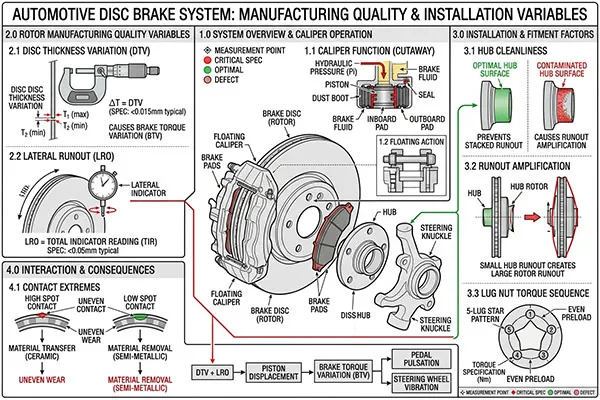
Disc Variables Worth Evaluating
I recommend that technical and after-sales teams review measurable evidence instead of relying only on appearance. Useful disc-related checks include:
- Part-number and application accuracy: The dimensions and design should correspond to the intended vehicle application.
- Lateral runout: Excessive installed runout can affect contact consistency and may contribute to vibration or uneven wear.7
- Thickness consistency: The inspector should measure the disc at multiple positions using an appropriate calibrated tool.
- Surface finish: The braking faces should have a controlled, consistent finish suitable for the pad interface.
- Casting and material consistency: Material properties can influence wear, thermal behavior, and friction interaction.8
- Ventilation and geometry: The vane arrangement, overall thickness, offset, center hole, and mounting dimensions should match the specification.
- Coating condition: Coated non-friction areas should provide intended corrosion protection, while any friction-face treatment should behave as designed.
- Shipping damage or corrosion: Poor storage, impact, or water exposure may alter the component before installation.
A supplier should define these characteristics through controlled drawings, specifications, inspection plans, and traceable production records. Buyers should verify quality-system certificates and product approvals as documents rather than treating a certificate logo as proof that every individual complaint has one specific cause.
The Installed Assembly Matters
A disc can meet its dimensional specification before shipment and still operate poorly if the mounting surface introduces error. Rust scale, dirt, burrs, or damage between the hub and disc can affect installed alignment.9 Uneven wheel-fastener tightening may also influence the assembly.10
I often ask for both component measurements and installation information because the two sets of evidence answer different questions:
| Evidence | What it helps evaluate |
|---|---|
| Disc runout measured off the vehicle | Basic component geometry |
| Installed runout measurement | Disc, hub, mounting surface, and installation interaction |
| Thickness readings at several points | Wear pattern and thickness consistency |
| Hub-face photographs | Corrosion, debris, burrs, or surface preparation |
| Pad-face photographs | Glazing, uneven contact, contamination, or foreign material |
| Torque procedure record | Whether installation followed the applicable specification |
| Part numbers and vehicle details | Fitment and catalog accuracy |
I recommend calibrated measurement and qualified professional evaluation. An unverified handheld video cannot replace these checks.
Is Noise From New Brake Discs Automatically a Product Defect?
Noise soon after installation often creates pressure for an immediate warranty replacement. However, replacing the disc without checking the surrounding system can leave the actual cause unchanged. I have seen feedback cases where the first report contained only “new rotors make noise,” with no mileage, pad information, photographs, or installation record.
I do not classify new brake disc noise as an automatic defect. Early noise can involve bedding-in, pad condition, friction-material compatibility, hub preparation, installation accuracy, fitting hardware, corrosion protection, or contamination. I collect evidence first and recommend prompt inspection whenever the noise is severe, persistent, or accompanied by performance changes.
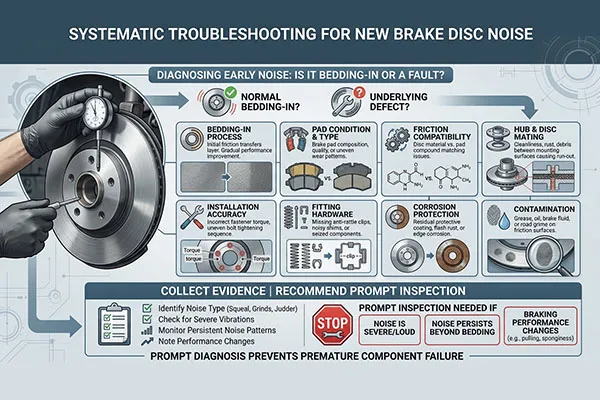
Bedding-In Is a Process, Not a Universal Excuse
New pads and discs need an appropriate contact relationship.11 However, I avoid using “bedding-in” as a blanket explanation for every complaint. The correct procedure can vary by pad type, disc design, vehicle, and component supplier. The installer should follow the applicable manufacturer’s instructions.
During an early complaint, I ask:
- Were new pads installed with the new discs?
- Were old pads reused, and what was their wear condition?
- Were the pad surfaces contaminated or glazed?
- Was the hub face cleaned and inspected?
- Were caliper slides, pistons, clips, and shims checked?
- Were the correct tightening sequence and torque specifications followed?
- How many kilometers or miles had the vehicle traveled when the noise began?
- Did the driver perform repeated hard stops immediately after installation?
- Did the vehicle remain parked in wet conditions?
- Does the noise improve, worsen, or remain unchanged?
These questions help distinguish an initial friction-interface issue from a persistent mechanical problem. They also reveal whether the evidence is adequate for a warranty decision.
Early Replacement Can Create Repeat Claims
If an after-sales team replaces the disc while leaving a sticking caliper, worn hardware, contaminated pad, dirty hub, or incorrect part selection unchanged, the replacement may develop the same symptoms. The business then absorbs a second claim without learning from the first one.
I recommend a controlled claim process:
- Confirm the vehicle and application data.
- Record the installation date and mileage.
- Identify every part replaced during the original repair.
- Document the noise conditions.
- Obtain clear photographs and measurements.
- Request a professional inspection report for serious or unresolved cases.
- Preserve returned parts and their position labels for supplier analysis.
This approach does not delay legitimate claims. It helps the buyer and manufacturer identify whether the complaint concerns the disc, another component, the installation process, or several interacting factors.
How Can B2B Teams Collect Better Brake Noise Evidence?
Vague information is one of the biggest obstacles in brake disc noise troubleshooting. A short message such as “the customer says it grinds” does not support root-cause analysis. I help downstream teams convert that message into a structured case file that can be reviewed by the distributor, installer, and manufacturer.
A useful brake noise report should document vehicle identity, wheel position, sound conditions, installation history, mileage, related symptoms, replacement parts, and inspection findings. I also request clear images of both disc faces, pads, hub surfaces, hardware, scoring, rust, wear marks, and suspected foreign material before making a product-quality classification.
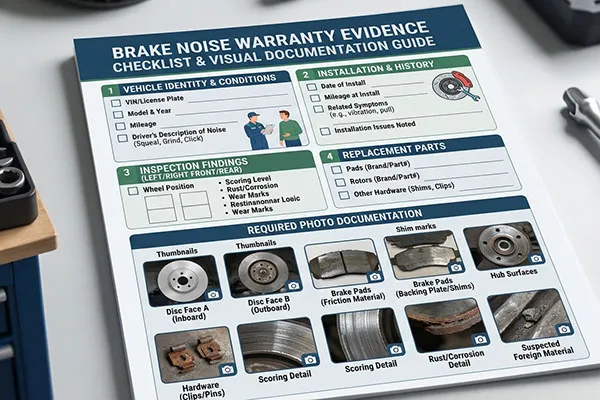
I Use a Standard Intake Form
A standard form improves consistency between sales, warranty, technical, and supplier teams. It also reduces repeated emails that ask one question at a time.
I suggest collecting the following fields:
Vehicle and product details
- Vehicle make, model, year, engine, and relevant market specification
- Vehicle identification information where appropriate
- Disc and pad part numbers
- Batch, production, or traceability codes
- Axle and wheel position
- Purchase and installation dates
Operating conditions
- Cold or hot braking
- Low, medium, or high speed
- Light, moderate, or hard pedal application
- Straight-line braking or braking while turning
- Dry, wet, dusty, or corrosive environment
- One-time, intermittent, or continuous noise
- Noise during braking, release, reversing, or normal rotation
Installation and service history
- Mileage before and after installation
- Whether discs, pads, and hardware were replaced together
- Hub-cleaning and runout-check information
- Caliper inspection findings
- Fastener tightening method
- Bedding procedure used
- Previous brake or suspension repairs
Visual and measured evidence
- Full-view photos of both sides of each disc
- Close-ups of scoring, discoloration, rust, or contact marks
- Pad friction-surface photos
- Hub and mounting-surface photos
- Runout and thickness readings
- Short video or audio recorded under controlled, safe conditions
- Workshop inspection notes
I Preserve Traceability
Returned parts should be labeled by vehicle, axle, and wheel position. The team should avoid mixing pads or discs from different sides. Cleaning or refinishing the components before supplier review may remove useful evidence.
I also recommend recording who took each measurement, which tool was used, and whether the tool was calibrated.12 These details matter when two parties obtain different results.
I treat a warranty claim as an evidence chain. Each photograph, measurement, and installation record should help explain what happened from production through installation and vehicle use.
Manufacturers can then compare the returned component with drawings, batch records, dimensional inspection results, material controls, and retained production information. That comparison is more useful than debating whether a phone recording “sounds like a bad rotor.”
Frequently Asked Questions
Can a brake disc cause squealing?
Yes, a brake disc can contribute through its surface condition, geometry, material consistency, or compatibility with the pad. However, I also consider pad compound, glazing, contamination, caliper condition, shims, clips, hub preparation, and operating temperature. Squeal alone does not prove that the disc is defective.
Why do new brake discs sometimes make noise?
New brake discs may make noise because of bedding conditions, reused or incompatible pads, contamination, hub corrosion, inaccurate installation, or worn hardware. Some initial sounds may be temporary, but I recommend inspection when noise persists or occurs with grinding, vibration, reduced braking, warning lights, or overheating.
Does a grinding sound always mean worn brake pads?
No. Severely worn pads are one possibility, but grinding may also involve debris, damaged surfaces, corrosion, incorrect assembly, or contact between components. I treat persistent grinding as a high-risk symptom and recommend professional inspection rather than assigning the cause remotely.
What photos should an importer request for a brake noise claim?
I request full images of both disc faces, close-ups of wear marks or scoring, pad surfaces, hub mounting faces, caliper and hardware areas, product labels, and traceability codes. Photos should show the wheel position and should be supported by installation details, mileage, measurements, and inspection notes.
Should a distributor replace a noisy disc immediately?
Not automatically. Immediate replacement may be appropriate after professional inspection confirms damage or an unsafe condition. In lower-risk cases, I first verify fitment, installation, pads, hardware, caliper operation, contamination, runout, and wear evidence. This process reduces unnecessary replacements and repeat claims.
Conclusion
Effective brake disc noise troubleshooting begins with safety triage and continues with structured evidence collection. I never assume that squeal, grinding, or clicking identifies one failed part. I review the operating conditions, fitment, pads, calipers, hardware, installation, disc measurements, and surface evidence together. GDST helps aftermarket brands, importers, wholesalers, and distributors evaluate brake disc specifications, quality-control records, private-label requirements, and returned-part evidence. Contact our team to discuss your brake disc sourcing or after-sales evaluation process.
"Part 573 Safety Recall Report 23V-129", https://static.nhtsa.gov/odi/rcl/2023/RCLRPT-23V129-4496.PDF. Government vehicle-safety guidance identifies grinding, reduced braking effectiveness, abnormal vibration, warning lamps, fluid loss, smoke, and overheating odors as possible signs of significant brake-system faults. Evidence role: expert_consensus; source type: government. Supports: Official road-safety or inspection guidance should identify these symptoms as indicators of brake-system defects requiring timely assessment.. Scope note: Such guidance establishes the seriousness of the symptoms but cannot determine the fault or operating safety of a particular vehicle without inspection. ↩
".05 Brakes. | Library of Maryland Regulations", https://regs.maryland.gov/us/md/exec/comar/11.14.09.05. Formal vehicle-inspection procedures assess brake linings, hydraulic integrity, mechanical security, component operation, and braking performance through physical or functional checks rather than acoustic evidence alone. Evidence role: general_support; source type: government. Supports: Brake inspection protocols require visual, dimensional, mechanical, hydraulic, and performance checks that cannot be completed from sound alone.. Scope note: Inspection requirements demonstrate the limits of an audio recording indirectly; they do not evaluate any specific remote-diagnosis method. ↩
"(PDF) Effects of humidity and corrosion on the tribological ...", https://www.academia.edu/100375928/Effects_of_humidity_and_corrosion_on_the_tribological_behaviour_of_the_brake_disc_materials. Studies of cast-iron brake discs show that atmospheric moisture can produce a superficial oxide layer and that subsequent pad contact can alter or remove that layer during braking. Evidence role: mechanism; source type: paper. Supports: Research should document rapid surface oxidation of cast-iron brake discs and the removal or alteration of a light corrosion layer through frictional contact.. Scope note: This mechanism can explain some brief post-parking noise, but it does not establish that an unidentified noise is harmless or oxidation-related. ↩
"Modelling and analysis for friction induced steering brake squeal ...", https://ui.adsabs.harvard.edu/abs/2025MSSP..23612971M/abstract. Engineering reviews characterize disc-brake squeal as a friction-induced vibration phenomenon arising from dynamic instability in the coupled pad, disc, and caliper system. Evidence role: mechanism; source type: paper. Supports: Peer-reviewed reviews should characterize brake squeal as noise generated by friction-induced vibration or instability in the coupled brake assembly.. ↩
"(PDF) Brake squeal: a literature review", https://www.academia.edu/21821720/Brake_squeal_a_literature_review. Experimental and numerical studies of brake squeal show that system stability depends on the coupled dynamic behavior of the rotor, pads, caliper, attachment hardware, shims, and supporting structure. Evidence role: mechanism; source type: paper. Supports: Experimental or modeling research should show that the dynamic properties and interfaces of several brake components affect squeal generation.. Scope note: The relative contribution of each component varies by brake design, operating condition, and vibration mode. ↩
"Checks on brake discs and brake pads, carried out visually ...", https://education.mn.gov/mdeprod/groups/educ/documents/hiddencontent/mdaw/mdu5/~edisp/059294.pdf. Automotive brake-inspection literature associates grinding with conditions that include exhausted friction material, metal-to-metal contact, foreign debris, damaged friction surfaces, assembly faults, and interference between moving and stationary components. Evidence role: general_support; source type: education. Supports: A technical automotive source should describe grinding as a symptom with several possible wear, contamination, damage, or interference causes.. Scope note: Grinding is not acoustically unique to any one condition, so the sound alone cannot identify which mechanism is present. ↩
"(PDF) Disc Brake Run-Out Detection System", https://www.academia.edu/93928989/Disc_Brake_Run_Out_Detection_System. Brake-judder research reports that excessive disc lateral runout can alter periodic pad contact and contribute over time to nonuniform wear or disc-thickness variation, which may generate braking vibration. Evidence role: mechanism; source type: paper. Supports: Research should explain how installed lateral runout changes disc-pad contact and can promote thickness variation, uneven wear, or judder.. Scope note: Runout is one possible contributor; vibration can also originate from thermal distortion, suspension or wheel faults, friction variation, and other assembly conditions. ↩
"Effect of cast-iron disc thickness on the reliability of tribological ...", https://pmc.ncbi.nlm.nih.gov/articles/PMC10864902/. Brake-disc materials research links composition and microstructure to thermal conductivity, heat capacity, resistance to thermal cracking, wear behavior, and frictional interaction with the pad material. Evidence role: mechanism; source type: paper. Supports: Materials research should connect disc composition and microstructure with thermal conductivity, heat capacity, wear resistance, and friction behavior.. Scope note: Material properties affect system behavior but do not, by themselves, establish the cause of noise in an individual assembly. ↩
"Service Bulletin WARRANTY ADMINISTRATION", https://static.nhtsa.gov/odi/tsbs/2013/SB-10068954-5448.pdf. Brake mounting analyses show that corrosion, debris, burrs, or surface damage at the hub-disc interface can prevent flush seating and introduce installed lateral runout. Evidence role: mechanism; source type: research. Supports: Technical research or documented service analysis should show that irregularities at the mounting interface can produce installed lateral runout or misalignment.. Scope note: The magnitude of the resulting error depends on the interface geometry, clamping force, contaminant thickness, and vehicle design. ↩
"Tire Replacement", https://static.nhtsa.gov/odi/tsbs/2023/MC-10234093-0001.pdf. Studies of wheel-end clamping indicate that nonuniform or excessive fastener preload can alter hub and disc deformation and may affect installed runout or braking-force variation. Evidence role: mechanism; source type: paper. Supports: Experimental or finite-element research should evaluate how nonuniform wheel-fastener preload affects hub and brake-disc deformation.. Scope note: The size and practical significance of the effect vary with rotor geometry, hub stiffness, tightening sequence, and preload error. ↩
"Tribological Behavior of Friction Materials of a Disk-Brake Pad ...", https://pmc.ncbi.nlm.nih.gov/articles/PMC9323244/. Brake tribology research describes bedding or running-in as a period in which surface conformity, real contact area, and friction-layer development evolve at the pad-disc interface before more stable friction behavior is reached. Evidence role: mechanism; source type: paper. Supports: Tribology studies should describe running-in, changes in real contact area, and formation of friction or transfer layers at a new pad-disc interface.. Scope note: Bedding behavior and the appropriate procedure depend on the friction material, disc surface, brake design, and operating cycle; it cannot explain every early noise complaint. ↩
"Metrological Traceability: Frequently Asked Questions and ...", https://www.nist.gov/metrology/metrological-traceability. International metrology guidance defines measurement traceability through a documented calibration chain and treats instrument identity, calibration status, method, and measurement conditions as relevant to evaluating a reported result. Evidence role: definition; source type: institution. Supports: International metrology guidance should establish that interpretable measurement results depend on documented instruments, calibration links, procedures, and relevant measurement conditions.. Scope note: Traceability supports confidence and comparability but does not guarantee that a measurement was performed correctly or that the measured part caused the reported noise. ↩