Brake disc vs. brake rotor terminology often creates unnecessary confusion during aftermarket sourcing. Buyers may assume that the two names describe different products, which can lead to inconsistent inquiries, misleading price comparisons, and even incorrect orders. In most cases, clear product data—not the chosen term—solves the problem.
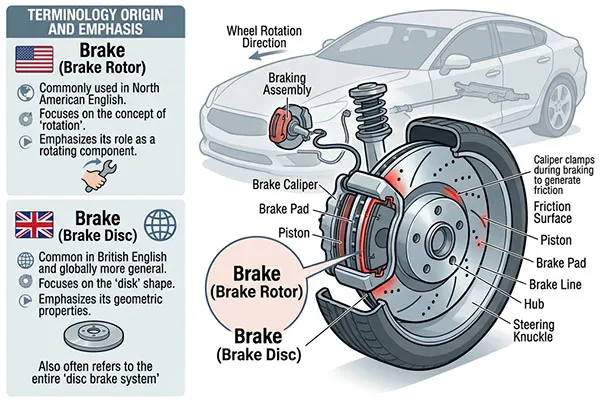
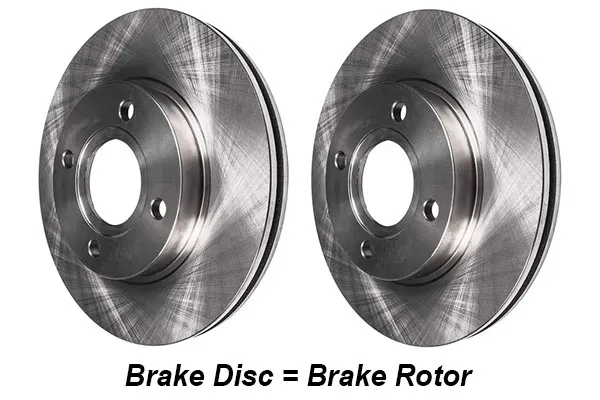
In most automotive aftermarket and purchasing contexts, a brake disc and a brake rotor are the same type of rotating braking component. “Brake rotor” is more common in the United States, while “brake disc” is widely used in Europe and international trade.1 Buyers should confirm fitment and specifications rather than rely on the product name alone.
From our manufacturer-side experience, customers regularly use both terms for the same part. However, the terminology question is only the starting point. Importers, wholesalers, and private-label brands still need to verify OE references, dimensions, construction, surface treatment, certification requirements, and packaging details before confirming an order.
Does Brake Disc vs. Brake Rotor Mean Two Different Parts?
Buyers sometimes separate requests for brake discs and brake rotors because their suppliers, customers, or catalogs use different wording. That approach can create duplicate product records and sourcing confusion. A clear definition helps purchasing teams focus on the technical details that actually identify the required component.
In standard passenger car, SUV, and commercial vehicle aftermarket usage, brake disc and brake rotor usually describe the same part2. The component rotates with the wheel hub and works with the brake pads and caliper.3 The wording normally reflects regional preference, catalog convention, or customer vocabulary rather than a functional difference.
Regional terminology explains most of the difference
We commonly receive inquiries that use “rotor,” “disc,” or both terms in the same purchasing document. Customers in the United States and Canada often prefer brake rotor. Customers in Europe, the Middle East, Africa, and many international trading markets often use brake disc.
The following table shows the usual market preference:
| Market or context | Common term | Other accepted term |
|---|---|---|
| United States | Brake rotor | Brake disc |
| Canada | Brake rotor | Brake disc |
| United Kingdom and Europe | Brake disc | Brake rotor |
| International B2B trade | Brake disc | Brake rotor |
| Technical catalogs | Either term | The catalog standard determines usage |
| Private-label packaging | The target market determines usage | Either term can be correct |
These patterns are useful, but they are not absolute rules. A European customer may request rotors, and an American catalog may include the phrase “disc brake rotor.” The terminology can also change between sales, engineering, and warehouse departments inside the same company.
Context still matters
We do not recommend assuming that every use of “disc” or “rotor” is automatically identical in every technical document. The word “rotor” can describe a rotating component more broadly in mechanical systems.4 The phrase “brake disc” is more specific when it appears without additional context.
However, when an automotive aftermarket buyer requests a front or rear brake rotor for a defined vehicle application, the buyer is normally requesting the same product that another market calls a brake disc.
We treat the name as a communication preference. We treat the OE reference, drawing, application, dimensions, and product specification as the actual product identity.
A buyer should therefore ask a supplier to clarify any ambiguous quotation. This step is especially important when the order includes separate hubs, two-piece designs, drum-in-hat configurations, or assembled components. A drawing or OE cross-reference can prevent a simple naming issue from becoming a costly shipment error.
What Should Buyers Verify Beyond Brake Disc vs. Brake Rotor Terminology?
A familiar product name can create false confidence. Two components may both be described as front brake rotors while having different diameters, heights, thicknesses, bolt patterns, or center-hole dimensions.5 Buyers who confirm orders by description alone can face fitment complaints, inventory problems, and expensive returns.
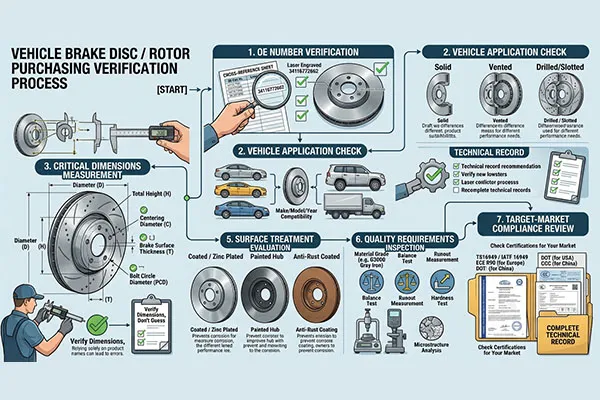
Buyers should verify the OE number, vehicle application, critical dimensions, construction type, surface treatment, quality requirements, and target-market compliance documents. I recommend treating the product name as a search term rather than final order confirmation. A complete technical record provides much stronger purchasing control.
Start with OE and vehicle application data
We usually begin product confirmation with one or more OE numbers. An OE reference gives both parties a stronger starting point than a general description. However, buyers should not use an OE number in isolation because superseded numbers, regional vehicle variants, and catalog cross-reference errors can still occur.6
A complete application record should include:
- The vehicle manufacturer and model should match the intended application.
- The production year range should reflect the actual market version.
- The engine or trim level should be included when brake options vary.
- The axle position should identify front or rear installation.
- The braking system or option code should be provided when multiple systems exist.
- The OE number and existing aftermarket references should be cross-checked.
- The destination market should be identified because regional vehicle specifications can differ.
I have seen inquiries where the same model name covered more than one brake size. In those cases, the vehicle name and year did not provide enough information. The buyer needed an OE number, VIN-derived application data, or physical dimensions to separate the variants.
Confirm critical brake disc dimensions
Buyers should compare the supplier’s drawing or data sheet with their approved catalog record. Depending on the design, the critical dimensions can include:
- The outside diameter must match the approved specification.
- The nominal thickness must match the intended caliper and pad configuration.
- The minimum thickness marking must meet the product requirement.
- The overall height must position the friction ring correctly.
- The center-hole diameter must fit the hub arrangement.
- The pitch circle diameter and bolt-hole quantity must match the application.
- The hub or hat profile must follow the required geometry.
- The drum-in-hat diameter must be checked when a parking brake surface is included.
A small dimensional mismatch can make an otherwise well-manufactured part unsuitable. For this reason, I consider dimensional confirmation more important than whether the quotation says “disc” or “rotor.”
Define the required product configuration
The buyer should also state whether the order requires a solid, ventilated, drilled, slotted, coated, or two-piece design. The requested finish should identify whether the component needs an oil-protected surface, painted hat, partial coating, or full-surface protective coating.
The purchasing team should request certification or test documentation when the target market or customer specification requires it. Buyers should verify the document’s issuer, scope, validity, applicable part numbers, and market relevance. They should also obtain qualified professional evaluation for safety-critical or application-specific decisions.
Does Brake Disc vs. Brake Rotor Terminology Indicate Quality?
Some price comparisons unintentionally treat “disc” and “rotor” as different quality categories. A buyer may assume that a rotor is a premium product or that a disc is a basic product. That assumption can distort supplier evaluations because the name does not reveal how the part was cast, machined, balanced, coated, or inspected.
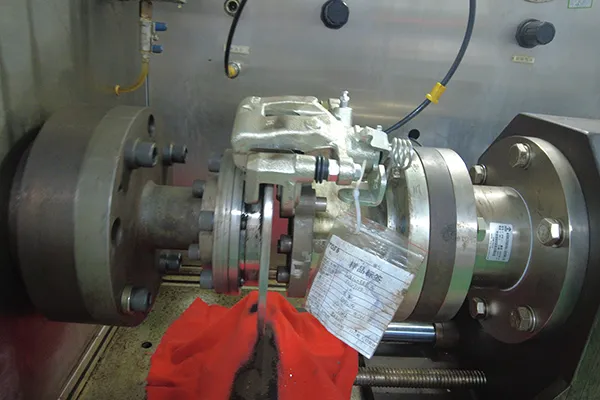
The terms brake disc and brake rotor do not determine material grade, braking performance, durability, price level, or manufacturing quality.7 Product quality depends on the approved design, raw material controls, casting consistency, machining accuracy, run-out control, balance, surface treatment, inspection methods, and conformity with applicable specifications.
Manufacturing controls matter more than vocabulary
From our manufacturing perspective, terminology does not change the production route. A part listed as a rotor for one customer may be listed as a disc for another customer while both products follow the same approved drawing and control plan.
A buyer should evaluate several manufacturing and quality-control areas:
| Evaluation area | What buyers should verify | Why it matters |
|---|---|---|
| Material control | The supplier should provide the specified material standard and inspection method. | Material consistency supports thermal and mechanical performance. |
| Casting quality | The supplier should control casting defects, structure, and traceability. | Casting variation can affect consistency and service life. |
| Machining accuracy | The supplier should measure critical dimensions and friction surfaces. | Accurate machining supports fitment and stable operation. |
| Run-out control | The supplier should define measurement methods and acceptance limits. | Excessive lateral variation can cause application problems.8 |
| Thickness variation | The supplier should control friction-ring thickness across the surface. | Consistency supports predictable brake system operation. |
| Balancing | The supplier should define when and how balance is checked. | Proper control reduces unwanted rotational imbalance. |
| Coating | The supplier should test thickness, adhesion, and corrosion resistance where required. | A suitable coating protects non-friction surfaces during storage and use.9 |
| Final inspection | The supplier should document visual, dimensional, labeling, and packaging checks. | Final checks reduce batch and shipment errors. |
Buyers should compare equivalent specifications
A low quotation for a “brake disc” and a higher quotation for a “brake rotor” do not prove a quality difference. The quoted products may have different coatings, packaging, material requirements, inspection levels, order quantities, or commercial terms.
I recommend normalizing quotations before comparing prices. The comparison should use the same:
- OE reference and application;
- product dimensions and unit weight;
- construction and vane design;
- material specification;
- surface finish or coating;
- testing and inspection plan;
- packaging standard;
- labeling and traceability requirements;
- order quantity and delivery terms; and
- required certification scope.
Certifications also require careful review. A supplier may state that its management system follows ISO 9001 or IATF 16949, while a specific product may need separate market-access documentation such as ECE R90 for relevant European aftermarket applications.10 Buyers should verify certificates and product approvals rather than treating a logo or general statement as sufficient evidence.
How Should Private-Label Brands Manage Brake Disc vs. Brake Rotor Naming?
Private-label companies often sell across markets that use different terminology. If sales uses “rotor,” purchasing uses “disc,” and the warehouse uses both, the business can accidentally create duplicate SKUs or mismatched packaging. A naming policy can keep customer-facing language flexible while protecting internal data consistency.
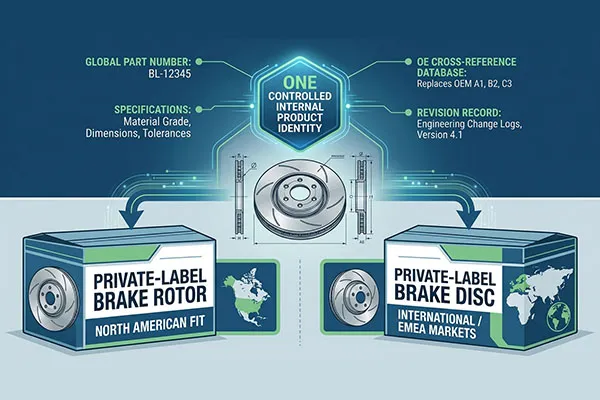
Private-label brands should choose customer-facing terminology for the target market while maintaining one controlled internal product identity. A U.S.-focused package can say “brake rotor,” while a European or international package can say “brake disc.” The underlying item number, OE cross-reference, specifications, and revision record should remain aligned.
Create one internal master record
We recommend that catalog teams assign one master item number to each approved product configuration. The database can store “brake disc,” “brake rotor,” and other accepted phrases as searchable synonyms. This approach prevents the wording from creating separate technical identities.11
A controlled master record should include:
- The internal SKU should uniquely identify the approved product.
- The preferred global description should follow company policy.
- Regional descriptions should support local search behavior.
- The OE and aftermarket cross-references should use controlled data.
- The vehicle application record should include market-specific variants.
- The dimensional drawing should carry a revision number.
- The product design should identify solid, vented, drilled, slotted, or coated features.
- The packaging artwork should link to the correct SKU and revision.
- The required compliance documents should link to the relevant item.
- The supplier code and production specification should remain traceable.
Separate marketing language from technical data
Marketing teams need language that customers recognize. Technical and purchasing teams need stable information that prevents errors. A company can meet both needs by separating the public product name from the controlled technical record.
For example, a brand could use the following structure:
| Data field | U.S. market example | European market example |
|---|---|---|
| Customer-facing name | Front Brake Rotor | Front Brake Disc |
| Internal master SKU | BR-10245 | BR-10245 |
| OE reference | The same approved references apply. | The same approved references apply. |
| Drawing revision | Revision C applies. | Revision C applies. |
| Product specification | The same approved specification applies. | The same approved specification applies. |
| Packaging language | American English is used. | British or local-market wording is used. |
I have found that naming problems often appear during artwork approval rather than initial sourcing. A customer may approve the technical sample but later send packaging that uses a different item number or application description. A final cross-check between the purchase order, drawing, barcode, label, carton, and catalog record can stop that discrepancy before mass production.
Private-label buyers should also agree on who controls product descriptions and revision changes. The brand owner should approve market terminology, while both parties should confirm that the approved words point to the same technical product.
How Can Buyers Compare Brake Disc and Brake Rotor Suppliers Correctly?
Supplier quotations can look comparable even when they include different products or service levels. One supplier may quote an uncoated part in bulk packaging, while another quotes a coated component with branded cartons and expanded inspection. If the buyer compares only product names and unit prices, the buyer may reach the wrong conclusion.
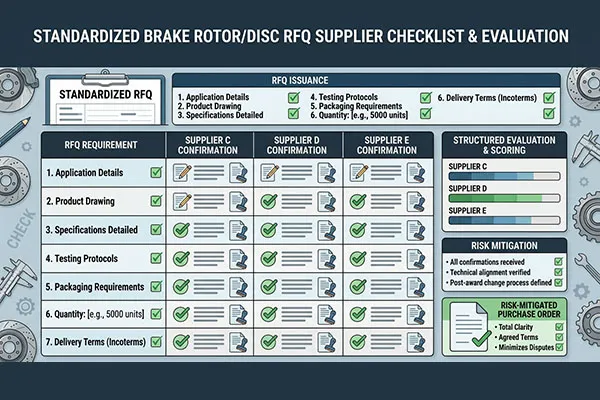
Buyers should issue a standardized request for quotation that defines the application, drawing, specifications, testing, packaging, quantity, and delivery terms. The supplier should confirm every requirement in writing. This process turns a brake disc vs. brake rotor discussion into a structured sourcing evaluation.
Use a standardized RFQ package
A strong request for quotation should contain enough information for each supplier to quote the same scope. I recommend including the following points:
- The RFQ should list the internal item number and preferred description.
- The RFQ should provide OE and aftermarket cross-references.
- The RFQ should include the vehicle application and destination market.
- The RFQ should attach a drawing or approved dimensional data.
- The RFQ should define the material and design requirements.
- The RFQ should state coating and corrosion-resistance expectations.
- The RFQ should identify inspection reports and sample requirements.
- The RFQ should specify packaging, label, barcode, and pallet standards.
- The RFQ should show estimated annual demand and order frequency.
- The RFQ should define trade terms, delivery location, and lead-time expectations.
Evaluate supplier controls, not only supplied samples
A sample can help confirm appearance, dimensions, and packaging. However, one acceptable sample does not automatically demonstrate stable mass-production control.12 Buyers should examine how the supplier manages material intake, tooling, casting, machining, coating, in-process inspection, final inspection, nonconforming products, and batch traceability.
The buyer can ask practical questions such as:
- How does the supplier control drawing revisions?
- How does the supplier verify key dimensions?
- How does the supplier define and measure run-out?
- How does the supplier control coating adhesion and corrosion resistance?
- How does the supplier separate similar-looking applications?
- How does the supplier record batch and inspection data?
- How does the supplier manage packaging artwork changes?
- How does the supplier investigate quality complaints?
We use OE numbers, application data, dimensions, and specifications to clarify customer inquiries because those details create an auditable confirmation process. Buyers can apply the same method to any potential manufacturer.
The buyer should also verify management-system and product-certification documents directly. A qualified engineer, compliance consultant, testing body, or other relevant professional should assess application-specific requirements when the purchasing team does not have the necessary technical authority.
Frequently Asked Questions
Is a brake disc the same as a brake rotor?
Yes. In most automotive aftermarket contexts, a brake disc and a brake rotor refer to the same rotating brake component. The term “rotor” is common in North America, while “disc” is common in Europe and international trade. The buyer should still verify the exact application and specifications.
Is a brake rotor higher quality than a brake disc?
No. The chosen term does not indicate material quality, machining accuracy, braking performance, durability, or price. Buyers should evaluate the specified material, casting controls, dimensions, run-out, balance, coating, inspection records, traceability, and applicable certification documents.
What information should I send when requesting a quotation?
You should provide OE numbers, vehicle make, model, year, axle position, target market, required dimensions, design type, coating, packaging, estimated quantity, and certification requirements. A drawing, sample, or approved catalog reference can help the supplier confirm the correct product.
Which term should a private-label brand use?
A private-label brand should use the term that its target customers recognize. A U.S.-focused brand will usually prefer “brake rotor,” while a European or international brand may prefer “brake disc.” The company should maintain one consistent internal SKU and technical record.
Can two brake discs with similar dimensions fit the same vehicle?
Not necessarily. Two products can appear similar but differ in height, center hole, bolt pattern, friction-ring geometry, drum-in-hat dimensions, or application details. Buyers should confirm fitment through approved OE references, vehicle data, drawings, and qualified technical evaluation.
Conclusion
The brake disc vs. brake rotor question usually has a simple answer: both terms describe the same type of automotive braking component, and regional wording explains most of the difference. However, buyers should never confirm purchases by name alone. OE numbers, vehicle applications, dimensions, construction, coating, inspection criteria, packaging, and verified compliance documents provide the real purchasing controls.
If you need to confirm a brake disc or brake rotor inquiry, contact GDST with your OE references, application list, drawings, samples, or private-label requirements. Our team can review the product data and help you prepare a clear manufacturing quotation.
"Disc brake - Wikipedia", https://en.wikipedia.org/wiki/Disc_brake. Corpus evidence and official regional publications indicate a North American preference for “brake rotor” and a British or European preference for “brake disc”; this establishes a usage pattern rather than an absolute geographic rule. Evidence role: historical_context; source type: research. Supports: Comparative language data or official regional publications should show differing usage of “brake rotor” and “brake disc” in North American and European English.. Scope note: Terminology varies among individual catalogs, organizations, and speakers, so regional usage cannot be treated as universal. ↩
"Disc brake", https://en.wikipedia.org/wiki/Disc_brake. Automotive references commonly identify the brake disc, or rotor, as the rotating member of a disc-brake assembly, supporting the use of the two terms as synonyms in this context. Evidence role: definition; source type: encyclopedia. Supports: An independent automotive reference should define the disc, also called the rotor, as the rotating component of a disc-brake assembly.. ↩
"(PDF) Modification of Disc Brakes Using Rotating Brake Pads", https://www.academia.edu/4815918/Modification_of_Disc_Brakes_Using_Rotating_Brake_Pads. Disc-brake descriptions explain that the rotor turns with the wheel while the caliper forces pads against its friction surfaces, converting vehicle motion into heat through friction. Evidence role: mechanism; source type: education. Supports: An automotive engineering source should explain that the rotor turns with the wheel and that caliper-mounted pads clamp it to create braking friction.. ↩
"Rotor (electric)", https://en.wikipedia.org/wiki/Rotor_(electric). In engineering terminology, a rotor is generally the rotating member of a machine or assembly, so the unqualified word is broader than the automotive phrase “brake rotor.” Evidence role: definition; source type: encyclopedia. Supports: A general engineering reference should define a rotor as the rotating part of a mechanical or electromechanical system.. ↩
"Designing an Automotive Brake Disc - Academia.edu", https://www.academia.edu/51471691/Designing_an_Automotive_Brake_Disc. Replacement-brake standards treat disc diameter, thickness, mounting geometry, and centering dimensions as controlled characteristics, confirming that products with the same general name are not necessarily dimensionally interchangeable. Evidence role: mechanism; source type: institution. Supports: A replacement-brake standard should identify diameter, thickness, offset or height, mounting, and centering dimensions as controlled characteristics of a brake disc.. ↩
"WARRANTY OPERATIONS NEWSLETTER", https://static.nhtsa.gov/odi/tsbs/2021/MC-10218533-9999.pdf. Official vehicle-identification resources distinguish among model year, trim, equipment, and other configuration attributes, while parts records may retain superseded identifiers; together, these facts support cross-checking an OE number against application data, although they do not quantify catalog error rates. Evidence role: general_support; source type: government. Supports: Official vehicle-data guidance should show that model identity alone does not capture all configuration attributes, while part-documentation guidance should establish that identifiers may be replaced or superseded.. Scope note: The support is contextual because official vehicle-data sources generally do not measure the frequency of aftermarket catalog cross-reference errors. ↩
"[PDF] Replacement Discs and Drum - UNECE", https://unece.org/DAM/trans/doc/2009/wp29grrf/ECE-TRANS-WP29-GRRF-65-inf07e.pdf. Technical standards evaluate replacement brake discs through specified dimensions, performance, construction, and conformity criteria rather than through whether the component is labeled a “disc” or a “rotor”; this supports the conclusion that terminology alone is not a quality grade. Evidence role: general_support; source type: institution. Supports: Brake-component standards should show that conformity is evaluated through dimensions, performance tests, material or manufacturing controls, and markings rather than through the use of “disc” or “rotor” in the product name.. Scope note: Standards do not directly test consumer perceptions or pricing practices associated with the two labels. ↩
"Experimental Investigation of Low Speed Disc Brake Judder Vibration", https://www.academia.edu/54078029/Experimental_Investigation_of_Low_Speed_Disc_Brake_Judder_Vibration. Brake-system studies associate excessive disc lateral run-out with periodic pad contact and the development of thickness variation, mechanisms that can contribute to torque fluctuation, pedal pulsation, and brake judder. Evidence role: mechanism; source type: paper. Supports: Brake engineering research should connect lateral run-out with periodic pad contact, uneven disc thickness development, vibration, or judder.. Scope note: Run-out is one of several possible causes of these symptoms, which may also arise from installation, hub, friction-material, or thermal factors. ↩
"Laser-Deposited Multilayer Coatings for Brake Discs - PMC - NIH", https://pmc.ncbi.nlm.nih.gov/articles/PMC12786667/. Experimental studies of coated brake components show that barrier coatings can improve corrosion resistance on protected surfaces, although performance depends on coating chemistry, preparation, thickness, adhesion, and exposure conditions. Evidence role: mechanism; source type: paper. Supports: Experimental research should show that an appropriate coating acts as a barrier against environmental corrosion on coated brake-disc regions.. Scope note: Evidence for a particular coating system does not establish the performance of every painted or coated brake disc. ↩
"ISO 9001 explained", https://www.iso.org/home/insights-news/resources/iso-9001-explained.html. ISO 9001 and IATF 16949 specify requirements for organizational quality-management systems, whereas UNECE Regulation No. 90 provides type-approval requirements for covered replacement braking components; management-system certification therefore does not by itself establish product approval under that regulation. Evidence role: expert_consensus; source type: institution. Supports: Official ISO, IATF, and UNECE materials should distinguish quality-management-system requirements from type approval for replacement brake discs, drums, linings, or related components within the regulation’s scope.. Scope note: The applicability of UNECE Regulation No. 90 depends on the component category, vehicle category, jurisdiction, and current regulatory scope. ↩
"(Almost) all of entity resolution - PMC", https://pmc.ncbi.nlm.nih.gov/articles/PMC11636688/. Research on master-data management and entity resolution shows that canonical identifiers and controlled synonym mappings can reduce duplicate records created by variant names; this supports the proposed database design, although it does not demonstrate outcomes specifically for brake-part catalogs. Evidence role: mechanism; source type: research. Supports: Information-management research should explain how canonical identifiers, controlled vocabularies, and synonym mapping reduce duplicate or fragmented records.. Scope note: The evidence is general to information governance rather than a direct study of automotive aftermarket catalog systems. ↩
"3.4.5. Assessing Process Stability", https://www.itl.nist.gov/div898/handbook/ppc/section4/ppc45.htm. Statistical quality-control guidance distinguishes the conformity of an individual sample from evidence of process stability and capability, which requires repeated production data collected under controlled conditions. Evidence role: expert_consensus; source type: research. Supports: Statistical process-control guidance should establish that process stability and capability require repeated observations over time rather than acceptance of one submitted item.. ↩