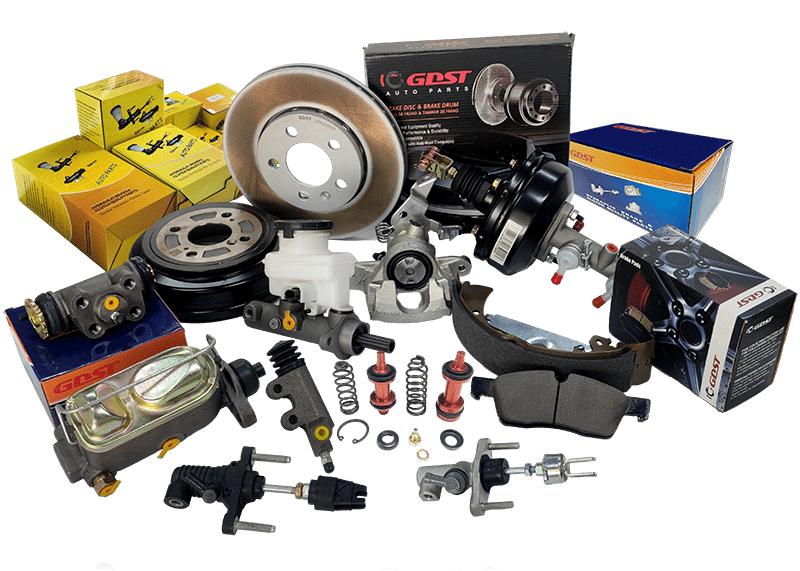
When I discuss OEM vs. aftermarket brake discs with procurement managers, I often hear the same concern: will a lower-priced aftermarket part create quality, warranty, or supply problems? That concern is reasonable because fitment alone cannot prove quality. I recommend comparing measurable controls, certification scope, batch consistency, and total procurement risk.
In OEM vs. aftermarket brake discs procurement, neither category is automatically superior. I compare each specific product by application fitment, OE-based design, material control, dimensional accuracy, hardness, runout, balance, coating performance, certification scope, batch consistency, delivery capability, and after-sales support. A well-controlled aftermarket brake disc can be a practical B2B option1, but buyers must verify the manufacturer’s evidence rather than rely on labels such as “OEM quality.”
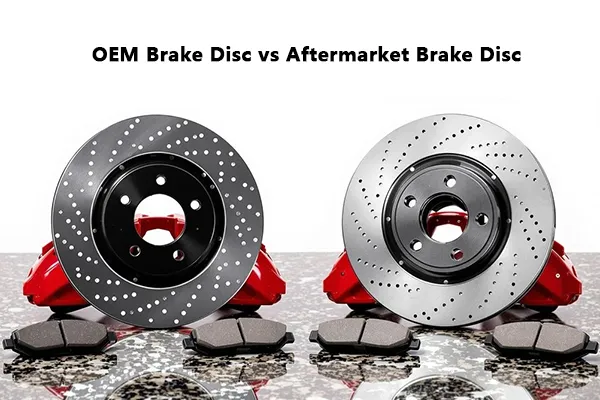
The most useful purchasing decision does not begin with a simple preference for original or replacement parts. I begin by asking what the product must achieve, which market will receive it, and how the supplier controls risk from raw material purchasing through final inspection. The following comparison framework helps me evaluate those questions more consistently.
Is OEM always better than aftermarket brake discs?
The assumption that OEM products are always better can make purchasing easier, but it can also hide important differences between aftermarket suppliers. I have answered many inquiries from buyers who use “OEM” as a quality shortcut. I understand the reason, but I encourage them to examine the evidence behind every product category.
In OEM vs. aftermarket brake discs purchasing, OEM status does not automatically establish that every replacement product is unsuitable2. Aftermarket quality varies by manufacturer, product line, application, production control, and inspection system. I therefore evaluate the actual supplier and part rather than judging the entire aftermarket category.
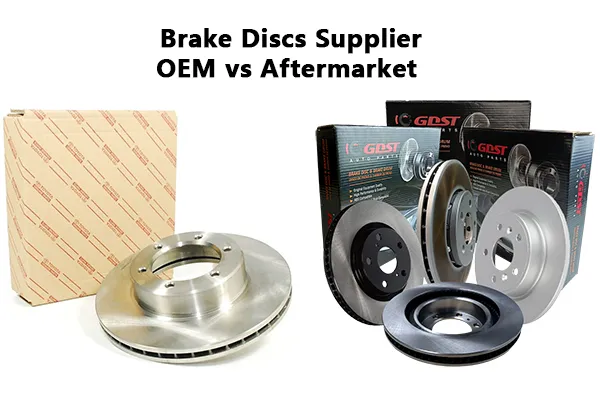
I use “OEM” to describe a particular supply relationship or original vehicle production channel, not as a universal synonym for perfect quality. An original equipment manufacturer may produce parts according to vehicle-maker specifications3, while an aftermarket manufacturer may develop a replacement product using OE dimensions, technical references, material requirements, and application data. These situations are not identical, but the label alone does not answer every procurement question.
What does an aftermarket brake disc need to demonstrate?
I normally ask an aftermarket supplier to provide evidence in several areas:
- Application accuracy: The supplier should identify the relevant vehicle models, years, engine variants, axle positions, and part references.
- OE-based development: The supplier should explain how it establishes dimensions, mounting specifications, friction-surface geometry, and other application requirements.
- Material control: The supplier should control the composition and mechanical properties of the cast iron or other specified material.
- Process consistency: The supplier should use documented manufacturing procedures for casting, machining, balancing, surface treatment, and packing.
- Inspection records: The supplier should maintain records for dimensions, hardness, runout, balance, coating adhesion, appearance, and other relevant checks.
- Traceability: The supplier should connect production information, inspection results, packaging, and shipment records to a defined batch.
- Technical support: The supplier should respond clearly to fitment questions, documentation requests, and nonconformity investigations.
I do not treat “OE replacement,” “OE quality,” or “OEM standard” as independently verified proof. Those terms may describe a design intention, a marketing position, or a supplier’s internal claim. I ask the manufacturer to define the term and provide documents that relate to the quoted product.
Why does product category matter less than supplier control?
A capable aftermarket manufacturer can support a buyer with wide application coverage, private-label packaging, and stable repeat production. However, those advantages only matter when quality controls operate consistently. A small order may look acceptable during a visual inspection while later batches show differences in runout, surface finish, coating, or packaging.
I have seen that procurement discussions become more productive when buyers stop asking, “Is aftermarket as good as OEM?” and start asking, “What controls support this exact part number and batch?” That question moves the discussion from reputation to evidence.
For example, GDST Auto Parts operates with a stated factory area of 100,000 square meters, more than 500 employees, 50 production lines, and a monthly production capacity of 400,000 brake discs. I present these figures as business-context information, not as independent proof that every product is suitable for every vehicle or market. I still recommend that buyers verify the quoted application, production controls, inspection documents, and certification scope before approval.
Can correct dimensions prove aftermarket brake disc quality?
Correct dimensions are necessary, but I do not consider them sufficient evidence of brake disc quality. A disc can appear correct and fit a hub while still showing weaknesses in material consistency, hardness, runout, balance, coating durability, or production repeatability4. I therefore treat dimensional inspection as one part of a wider quality-control program.
An aftermarket brake disc should pass more than a fitment check. I recommend reviewing dimensional results together with material verification, hardness testing, runout control, balance testing, coating inspection, and batch records. This broader evidence helps me determine whether a supplier can produce consistent parts rather than only a visually acceptable sample.
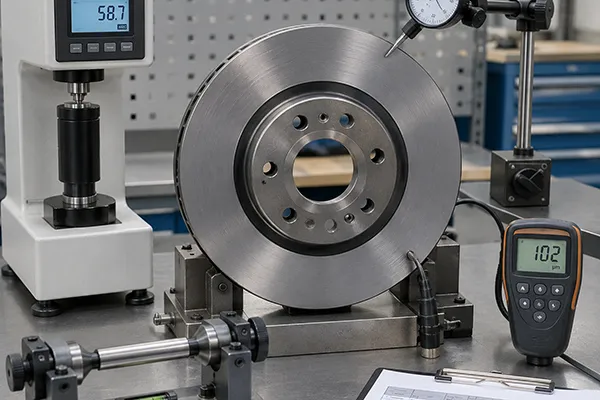
I often find that buyers begin with catalog data because catalog data is easy to compare. Diameter, thickness, height, bolt pattern, center bore, and minimum thickness are important. However, these values do not show how the disc behaves as a manufactured product across repeated batches.
Which quality characteristics should I review?
I use the following checklist during technical and procurement discussions:
| Quality area | What I review | Why it matters to procurement |
|---|---|---|
| Dimensions | Diameter, thickness, height, center bore, bolt pattern, and tolerances | Supports correct application fitment |
| Material | Raw material controls and relevant mechanical properties | Supports strength, durability, and heat resistance |
| Hardness | Test method, location, range, and records | Helps assess material consistency |
| Runout | Measurement method, acceptance range, and batch results | Helps identify potential installation or vibration concerns |
| Balance | Static or dynamic balance method and records | Supports consistent rotating-part control |
| Surface finish | Machining condition and friction-surface consistency | Supports product uniformity |
| Coating | Coating type, adhesion, coverage, and corrosion testing | Supports storage and service-environment protection |
| Traceability | Batch number, inspection record, and production date | Helps investigate nonconformities |
| Final inspection | Appearance, quantity, labeling, and packaging checks | Reduces shipment and identification errors |
I do not interpret one acceptable test result as proof of universal performance. Testing methods, sample quantities, equipment calibration, and acceptance criteria all influence the meaning of a result5. I ask the supplier to explain those details in a way that matches the purchase specification.
Why does batch consistency matter?
A procurement manager usually does not buy only one sample. The buyer may purchase hundreds or thousands of discs over several months. I therefore focus on whether the supplier can repeat the approved specification at commercial volume6.
Batch consistency includes more than the same part number appearing on a carton. It can involve:
- The same raw material requirements.
- The same machining tolerances.
- The same inspection criteria.
- The same packaging and labeling controls.
- The same method for handling nonconforming products.
- The same documentation process for future shipments.
At GDST, our stated quality-control procedures include raw material inspection, dimensional inspection, hardness testing, runout testing, balance testing, salt spray testing, coating adhesion testing, high-temperature performance testing, and 100% final inspection before shipment. I describe these procedures as part of our manufacturing context. I still expect buyers to verify which tests apply to the quoted product, what acceptance criteria we use, and which records we can provide.
What should I request before approving a supplier?
I recommend asking for a controlled sample-approval process:
- Confirm the exact vehicle application and reference numbers.
- Approve a technical drawing or product data sheet.
- Define critical dimensions and tolerances.
- Agree on packaging, labels, and traceability information.
- Review representative inspection records.
- Confirm the production and shipment inspection process.
- Establish how the supplier will manage deviations or complaints.
- Recheck the first production batch against the approved specification.
I also recommend using a qualified engineer or technical evaluator for application-specific decisions. A procurement review can identify supplier risk, but it does not replace professional engineering assessment or vehicle-level validation.
What do certifications prove about OEM vs. aftermarket brake discs?
Certifications can strengthen a supplier evaluation, but I treat them as evidence with a defined scope rather than as blanket guarantees. A certificate may apply to a management system, a particular product, a particular market, or selected applications. I always ask what the document covers and whether it relates to the products under quotation.
Certification can support an aftermarket brake disc purchasing decision when the buyer verifies the issuing body, certificate validity, scope, product references, covered markets, and production controls7. I do not assume that ISO 9001, IATF 16949, or ECE-R90 automatically validates every brake disc, vehicle application, batch, or performance claim.
I regularly receive questions about certification and inspection materials. Those questions are appropriate because a document can look credible while still being irrelevant to the buyer’s actual purchase. A careful review protects the buyer from confusing management-system evidence with product-specific approval.
How should I review a certification?
I use a document-verification checklist:
- Issuer: I identify the organization that issued the document.
- Validity: I check the issue date, expiration date, and current status.
- Scope: I confirm whether the document covers manufacturing, design, testing, or another activity.
- Site: I check whether the named factory matches the site producing the quoted goods.
- Product: I determine whether the document identifies brake discs, specific product families, or only a management system.
- Market: I confirm whether the document relates to Europe, another regulated market, or internal quality management.
- Application: I ask whether the covered approval includes the exact vehicle applications being purchased.
- Traceability: I ask how the supplier links approved products to continuing production batches.
- Surveillance: I check whether ongoing audits or renewals are required.
GDST operates under stated IATF16949 and ISO9001 quality management certifications, and selected products are described as meeting ECE-R90 certification requirements for European aftermarket applications. I recommend that buyers verify the current certificates, certification scope, product coverage, and regulatory requirements directly through appropriate documentation before making a compliance decision.
What is the difference between a management certification and product certification?
A management-system certification evaluates whether an organization operates a defined quality-management system. It can provide useful information about process discipline, documented procedures, and continual improvement. However, it does not necessarily approve every product or guarantee every batch.
A product certification or regulation-based approval may address specific technical requirements for defined products and markets8. Even then, I ask whether the approval covers the exact part number, application, production site, and current manufacturing arrangement.
The following distinction helps me explain the issue:
| Document type | What it may demonstrate | What I still verify |
|---|---|---|
| ISO 9001 | Quality-management system requirements | Product scope and current manufacturing controls |
| IATF 16949 | Automotive quality-management requirements | Site, scope, audit status, and product relevance |
| ECE-R90 documentation | Requirements for covered replacement braking products in applicable markets | Exact product, application, approval status, and market requirement |
| Internal inspection report | Results from defined tests or inspections | Test method, sample size, date, equipment, and acceptance criteria |
| Supplier declaration | Manufacturer’s stated conformity position | Supporting evidence and independent verification where required |
I never advise a buyer to rely on a certificate image alone. I recommend verifying documents with the supplier, certification body, importer, or qualified regulatory professional as appropriate.
Is the lowest brake disc price the lowest procurement cost?
The lowest unit price can look attractive during an initial quotation comparison, but I do not treat it as the lowest procurement cost automatically. A lower-priced product can create additional expenses through complaints, replacements, urgent freight, stock disruption, technical investigation, and lost customer confidence.
The lowest brake disc unit price is not always the lowest total procurement cost9. I compare purchase price with inspection effort, delivery reliability, warranty exposure, replacement logistics, complaint handling, inventory risk, technical support, and the cost of inconsistent batches. A slightly higher quoted price may be commercially stronger when the supplier provides better evidence and more stable support.
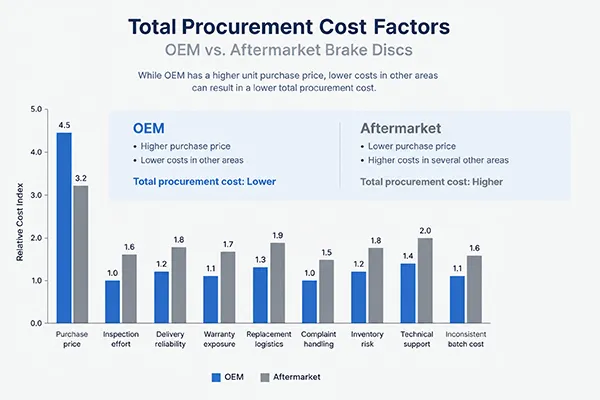
I understand why buyers focus on price. Importers and distributors must protect margins, and a large program can involve significant annual spending. My experience is that price discussions become more useful when I place unit cost beside the operational risks that follow the shipment.
Which costs should I include?
I recommend that procurement teams build a total-cost comparison containing:
- Product price
- Tooling or development charges
- Packaging and labeling costs
- Freight and insurance
- Inspection and laboratory charges
- Customs and import costs
- Inventory carrying cost
- Expected replacement or rework cost
- Complaint investigation time
- Emergency shipment cost
- Cost of stockouts
- Cost of customer returns
- Supplier communication and technical support requirements
I do not assign an expected warranty rate without reliable historical data. I instead recommend that buyers ask suppliers for their documented complaint process, nonconformity response, traceability method, and replacement policy. The buyer can then use internal data and commercial assumptions to calculate exposure.
How does supplier capability affect total risk?
Production capacity matters because a supplier must support both the initial order and future replenishment10. GDST reports 50 production lines, a 100,000-square-meter factory, more than 500 employees, and monthly capacity of 400,000 brake discs. These capabilities may support large-volume aftermarket programs, but I encourage buyers to verify actual available capacity, lead time, production scheduling, and the capacity assigned to the relevant product family.
I also examine whether a supplier can support the buyer’s operating model:
| Procurement requirement | Supplier evidence I request |
|---|---|
| Stable replenishment | Capacity statement, lead-time range, and production schedule |
| Wide catalog expansion | Application list and development process |
| Private label | Packaging samples, artwork process, and labeling controls |
| Consistent quality | Batch inspection records and nonconformity procedures |
| Technical support | Named contact, response process, and fitment documentation |
| Market compliance | Current certificates and product-specific regulatory documents |
| Custom products | Drawing review, sample approval, and change-control process |
A supplier with strong communication can reduce risk before shipment. The supplier can clarify vehicle applications, packaging details, tolerances, and required documents before production begins. That early work can prevent avoidable errors that a low unit price does not compensate for.
Why should I assess after-sales exposure?
Brake components carry a high reputational burden for distributors. I do not make unsupported claims about safety outcomes, but I recognize that inconsistent products can lead to customer dissatisfaction, returns, investigations, and commercial disputes. A buyer should therefore evaluate how the manufacturer handles a suspected issue.
I suggest asking these questions:
- How does the supplier identify affected batches?
- What information does the supplier need to investigate a complaint?
- How quickly can the supplier provide an initial response?
- What inspection records are retained?
- How does the supplier separate product defects from installation or vehicle-system factors?
- What replacement or corrective-action process is available?
- Who pays for agreed replacement goods or additional inspection?
At GDST, our stated process includes 100% final inspection covering appearance, dimensions, quantity, packaging, labeling, and shipment preparation. I present this as a manufacturing-process claim that buyers should confirm during supplier qualification and purchase-contract discussions.
Frequently Asked Questions
Are aftermarket brake discs lower quality than OEM brake discs?
Aftermarket brake discs are not one uniform quality category. Some suppliers may offer poorly controlled products, while others develop parts using OE references and operate documented quality systems. I recommend comparing the exact product, inspection evidence, certification scope, application fitment, and batch controls instead of assuming that the aftermarket label determines quality.
What should I request from an aftermarket brake disc manufacturer?
I recommend requesting application data, technical drawings, material information, inspection procedures, representative test records, quality certificates, packaging details, production capacity, lead times, and complaint-handling procedures. I also ask the supplier to explain which documents apply to the exact part numbers and markets being considered.
Does IATF 16949 prove that every brake disc is compliant?
IATF 16949 certification can indicate that a site operates an automotive quality-management system, but it does not automatically approve every product or application. I advise buyers to verify the certificate’s site and scope, then review product-specific requirements, inspection evidence, and any applicable market regulations.
Does ECE-R90 apply to every aftermarket brake disc?
ECE-R90 requirements do not automatically apply to every product in every market11. The buyer should verify whether the exact brake disc, application, approval, and destination market fall within the applicable requirements. I recommend checking current regulatory documents with the supplier and a qualified compliance professional.
How can I compare two brake disc suppliers fairly?
I use the same request-for-quotation format for both suppliers. I compare exact applications, specifications, test methods, certificate scope, sample approval, minimum order quantity, lead time, capacity, packaging, payment terms, complaint procedures, and total procurement cost. I avoid comparing unit price alone when the evidence and service levels differ.
Conclusion
I view OEM vs. aftermarket brake discs as a supplier-evaluation question rather than a simple quality contest. OEM status can provide useful context, but it does not remove the need to verify fitment, material control, testing, certification scope, batch consistency, delivery capability, and after-sales procedures. A qualified aftermarket manufacturer can be a strong B2B partner when its evidence matches the buyer’s applications and market requirements. I invite importers, distributors, wholesalers, and aftermarket brands to contact GDST Auto Parts for application review, OEM/ODM discussion, private-label support, and documentation verification before placing a production order.
"The U.S. Automotive Industry Supply Chain", https://www.boisestate.edu/cobe/blog/2025/02/the-u-s-automotive-industry-supply-chain-challenges-and-transformations/. Industry and supply-chain research describes aftermarket component sourcing as a viable procurement channel when technical specifications, conformity requirements, supplier controls, and traceability are established. Evidence role: general_support; source type: research. Supports: Neutral market or supply-chain research should support the existence of viable aftermarket procurement channels when product and supplier controls are verified.. Scope note: General aftermarket evidence does not prove that a specific brake-disc supplier or product is suitable. ↩
"The U.S. Automotive Industry Supply Chain - Boise State University", https://www.boisestate.edu/cobe/blog/2025/02/the-u-s-automotive-industry-supply-chain-challenges-and-transformations/. Research on automotive replacement parts indicates that product quality depends on the manufacturer, specification, application, and production controls rather than on the aftermarket classification alone. Evidence role: general_support; source type: research. Supports: A neutral study or review should support the proposition that quality varies among aftermarket products and cannot be inferred solely from the aftermarket category or OEM label.. Scope note: Evidence about automotive replacement parts in general may not directly establish the quality of every brake disc or supplier. ↩
"Automotive industry - Wikipedia", https://en.wikipedia.org/wiki/Automotive_industry. Authoritative automotive terminology references define an original equipment manufacturer as an entity that produces equipment or components used in, or supplied for, an original vehicle-manufacturing system. Evidence role: definition; source type: encyclopedia. Supports: An authoritative reference should define OEM terminology and describe its relationship to original vehicle production or branded equipment supply.. Scope note: The definition does not demonstrate that a particular OEM part meets every quality or performance expectation. ↩
"Brake Pad Inspection Manual", https://education.mn.gov/mdeprod/groups/educ/documents/hiddencontent/mdaw/mdu5/~edisp/059294.pdf. Engineering studies of disc-brake components identify material properties, geometric runout, balance, surface condition, and manufacturing variation as separate parameters that can affect component behavior beyond basic hub fitment. Evidence role: mechanism; source type: paper. Supports: Engineering research should explain why fitment and nominal dimensions do not by themselves characterize brake-disc material properties, rotating balance, runout, surface condition, or durability.. Scope note: The relationship between a measured defect and vehicle-level braking performance depends on the vehicle, installation, operating conditions, and severity of the deviation. ↩
"Uncertainty of Measurement in Quantitative Medical Testing", https://pmc.ncbi.nlm.nih.gov/articles/PMC1934961/. Metrology and laboratory-quality guidance establishes that the credibility and interpretation of measurement results depend on validated methods, suitable sampling, equipment calibration, measurement uncertainty, and defined acceptance criteria. Evidence role: expert_consensus; source type: government. Supports: Metrology guidance should support the dependence of reliable test interpretation on validated methods, calibrated equipment, sampling procedures, uncertainty, and predefined acceptance criteria.. Scope note: Such guidance establishes reliable measurement practice but does not determine the appropriate acceptance limit for a particular brake-disc application. ↩
"Statistical Process Monitoring for Autocorrelated Data - NIST", https://www.nist.gov/programs-projects/statistical-process-monitoring-autocorrelated-data. Manufacturing quality guidance treats process capability, statistical control, change control, and representative production sampling as methods for assessing whether a specification is reproduced consistently at commercial scale. Evidence role: mechanism; source type: institution. Supports: Quality-management and process-control guidance should support evaluating whether an approved specification remains stable during recurring, higher-volume production.. Scope note: Process-control evidence supports production consistency but cannot by itself validate the underlying design or vehicle application. ↩
"Accreditation and Conformity Assessment - EFTA.int", https://www.efta.int/eea-relations-eu/policy-areas/free-movement-goods/accreditation-and-conformity-assessment. Conformity-assessment guidance states that the evidentiary value of a certificate depends on the competence or accreditation of the issuing body and on the certificate’s current validity, defined scope, site, and covered activities or products. Evidence role: expert_consensus; source type: institution. Supports: Accreditation and conformity-assessment guidance should support checking the issuing body, current status, site, scope, and covered products before relying on a certificate.. Scope note: Verification of a certificate does not independently prove that every shipment or batch conforms to the relevant requirements. ↩
"General Use Products: Certification and Testing | CPSC.gov", https://www.cpsc.gov/Business--Manufacturing/Testing-Certification/General-Use-Products-Certification-and-Testing. Regulatory conformity-assessment frameworks provide approvals against specified technical requirements for defined products and applications, with validity determined by the relevant jurisdiction and approval scheme. Evidence role: definition; source type: government. Supports: Regulatory and conformity-assessment sources should support the proposition that product approvals are tied to defined technical requirements, products, applications, and markets.. Scope note: A general description of approval systems does not establish that a particular certificate covers the quoted brake disc or destination market. ↩
"Implementing the OECD Recommendation on Public ...", https://www.oecd.org/en/publications/implementing-the-oecd-recommendation-on-public-procurement-in-oecd-and-partner-countries_02a46a58-en/full-report/implementation-of-the-oecd-recommendation-in-member-and-partner-countries_2305bb1b.html. Total-cost-of-ownership research shows that procurement evaluation can include acquisition, quality, logistics, inventory, failure, warranty, and disruption costs in addition to the supplier’s unit price. Evidence role: mechanism; source type: paper. Supports: Procurement research should support including quality failures, inspection, logistics, inventory, warranty, and disruption costs alongside the quoted purchase price.. Scope note: The relative size of these costs is organization- and product-specific and cannot be inferred without buyer data. ↩
"Supply chain resilience: A review from the inventory ... - PMC", https://pmc.ncbi.nlm.nih.gov/articles/PMC11997565/. Supply-chain research identifies production capacity, capacity allocation, lead-time variability, and replenishment planning as factors that influence a supplier’s ability to fulfill recurring demand. Evidence role: mechanism; source type: research. Supports: Supply-chain research should support the relationship between available production capacity, lead times, replenishment reliability, and supply continuity.. Scope note: A reported capacity figure does not prove that capacity is available for the buyer’s product family, order schedule, or quality requirements. ↩
"ECE Regulation 90", https://en.wikipedia.org/wiki/ECE_Regulation_90. UNECE regulatory materials define Regulation No. 90 within a specified approval framework for covered replacement braking components and do not establish universal applicability to every brake disc or every market. Evidence role: definition; source type: government. Supports: Current UNECE and national regulatory sources should identify the regulated replacement braking components, approval conditions, and jurisdictions in which the requirements apply.. Scope note: National implementation and market-specific rules may differ; the exact product and destination must be checked against current law. ↩