Quick Answer
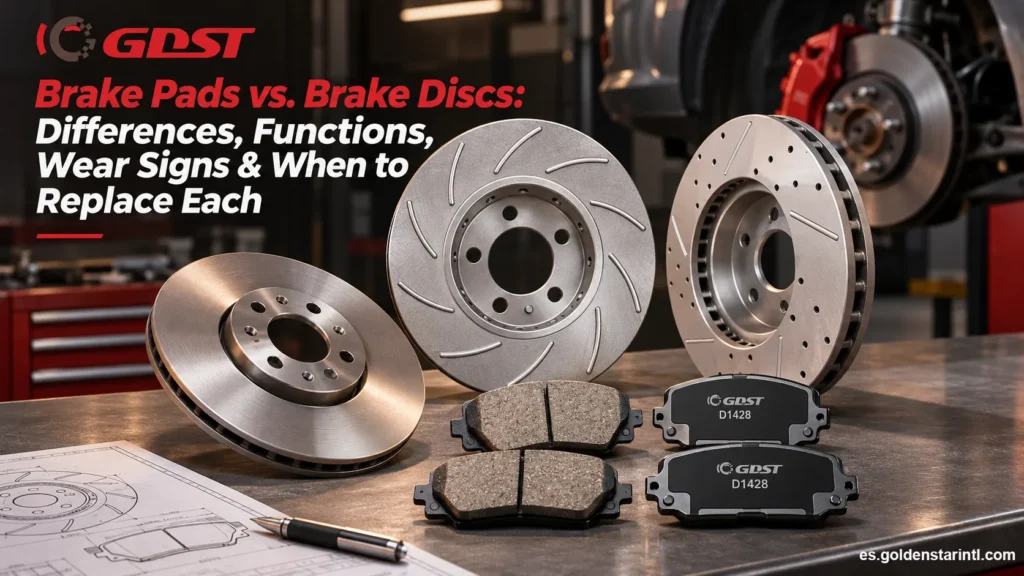
Brake pads and brake discs are two essential components of a vehicle’s disc braking system. Brake pads are friction materials installed inside the brake caliper, while brake discs, also called brake rotors, are rotating metal components connected to the wheel hubs. When the brakes are applied, the pads clamp against the discs to create friction and slow the vehicle. Brake pads generally wear faster, but both components require regular inspection. They do not always need simultaneous replacement. The decision depends on pad thickness, disc condition, and manufacturer specifications.
Brake pads and brake discs work together to slow down and stop a vehicle. Although they perform different functions, both are essential for reliable braking performance and driving safety.
Many drivers know that brake pads require regular replacement but are less familiar with brake disc wear, damage, and replacement requirements. Understanding their differences helps vehicle owners make better maintenance decisions and avoid unnecessary replacement costs.
For automotive parts distributors, wholesalers, and importers, understanding brake pad and brake disc specifications is equally important when selecting replacement components and confirming vehicle compatibility.
Explore GDST Brake Products:
What Are Brake Pads?
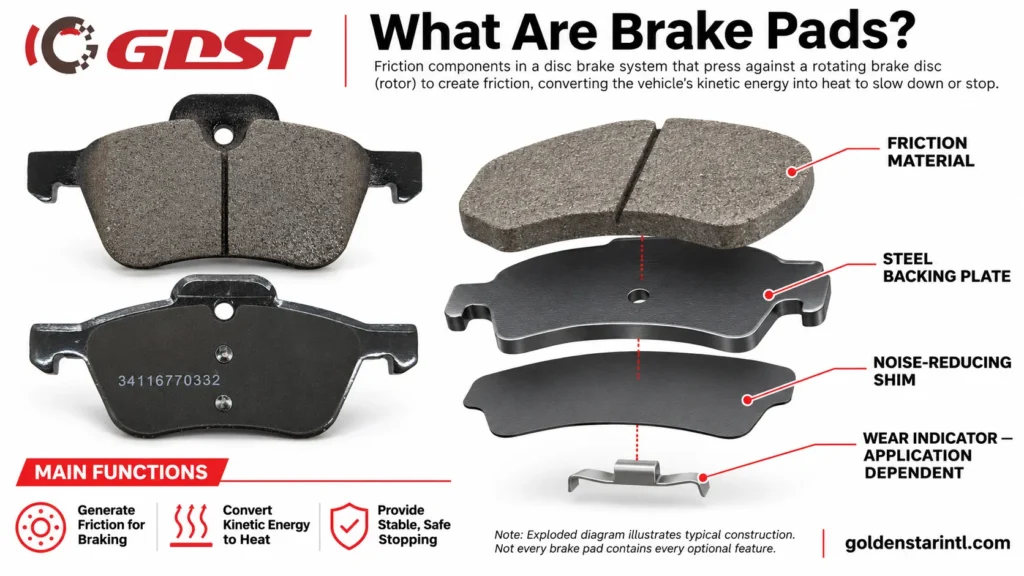
Brake pads are friction components installed inside a disc brake caliper. Their main function is to press against the rotating brake disc and generate friction to slow or stop the vehicle.
A typical brake pad consists of three main elements:
- Friction Material: The working surface that contacts the brake disc. Its formulation may include fibers, metallic materials, resins, lubricants, and friction modifiers.
- Backing Plate: Usually made of steel, it supports the friction material and provides structural strength.
- Shims and Wear Indicators: Shims help reduce noise and vibration, while mechanical or electronic wear indicators alert drivers when the pads approach their service limit.
Brake pads are designed to wear gradually during normal braking. Their lifespan depends on friction material, vehicle weight, driving habits, road conditions, and brake system condition.
What Are Brake Discs?
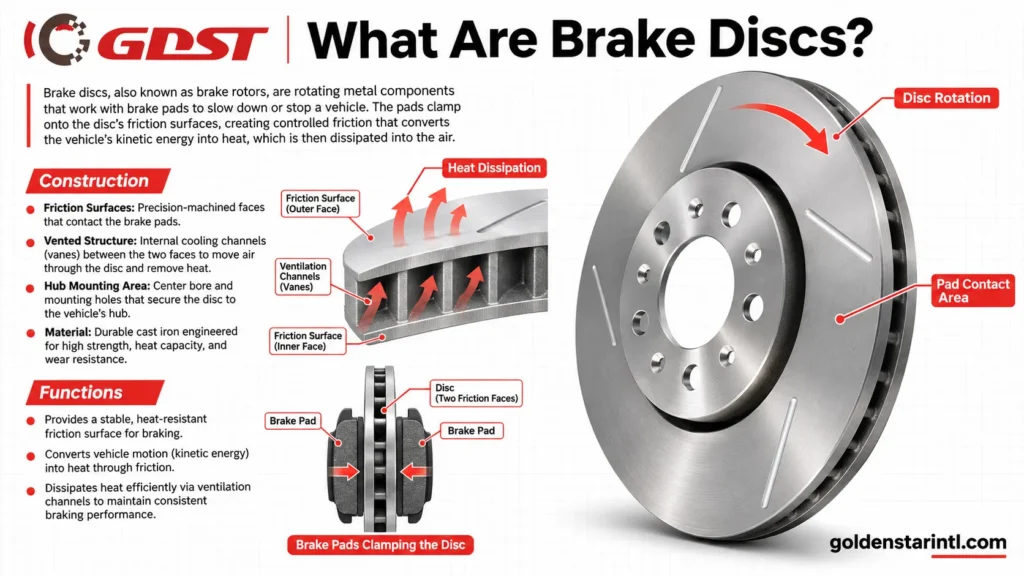
Brake discs, also known as brake rotors, are circular components connected to the wheel hubs. They rotate with the wheels and provide the friction surfaces that the brake pads clamp against.
Most conventional passenger vehicles use cast-iron brake discs because of their durability, heat management, and cost-effectiveness. Some high-performance vehicles use carbon-ceramic composites for specialized braking requirements.
Brake discs perform several important functions:
- Provide stable friction surfaces for brake pads.
- Convert vehicle kinetic energy into heat through friction.
- Dissipate braking heat.
- Maintain consistent braking performance under normal operating conditions.
Brake discs generally wear more slowly than brake pads, but they can develop scoring, cracks, corrosion, heat damage, and excessive thickness variation. They must be replaced when their condition falls outside the vehicle manufacturer’s specifications.
How Do Brake Pads and Brake Discs Work Together?
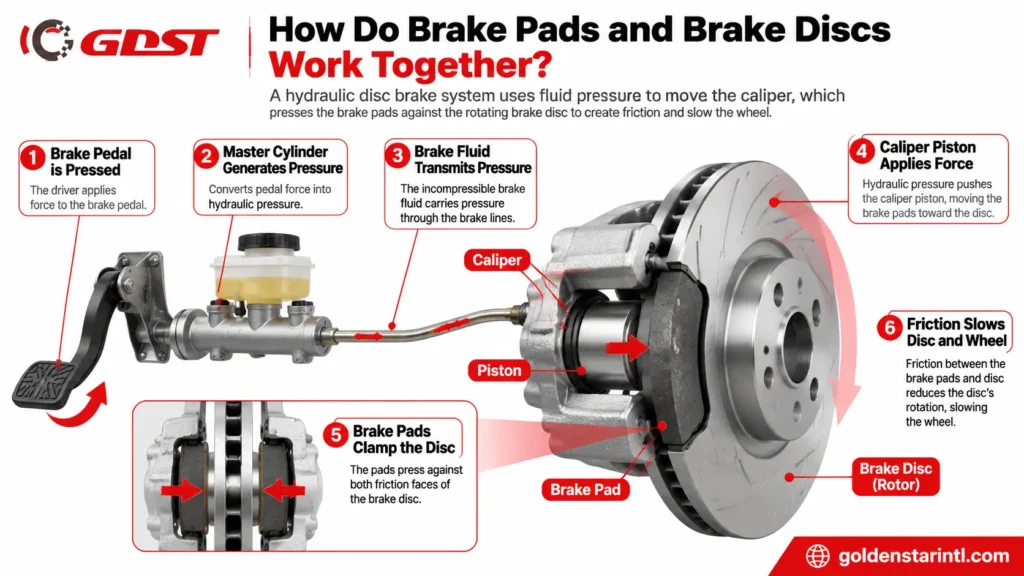
Brake pads and brake discs work as part of a hydraulic braking system.
When the driver presses the brake pedal, the master cylinder generates hydraulic pressure and transfers it through the brake fluid and brake lines. This pressure activates the caliper pistons, pushing the brake pads against both sides of the rotating brake disc.
The resulting friction slows the disc and wheel rotation, converting the vehicle’s kinetic energy primarily into heat.
The braking process follows these steps:
- The driver presses the brake pedal.
- The master cylinder generates hydraulic pressure.
- Brake fluid transfers pressure through the brake lines.
- Caliper pistons push the brake pads toward the disc.
- The pads clamp against the rotating brake disc.
- Friction reduces wheel speed and slows the vehicle.
Modern vehicles also use ABS and electronic brake-force distribution to help maintain braking stability.
Brake pads and brake discs therefore depend on other components, including calipers, pistons, brake fluid, wheel hubs, and electronic controls, to operate correctly.
Brake Pads vs. Brake Discs: Key Differences
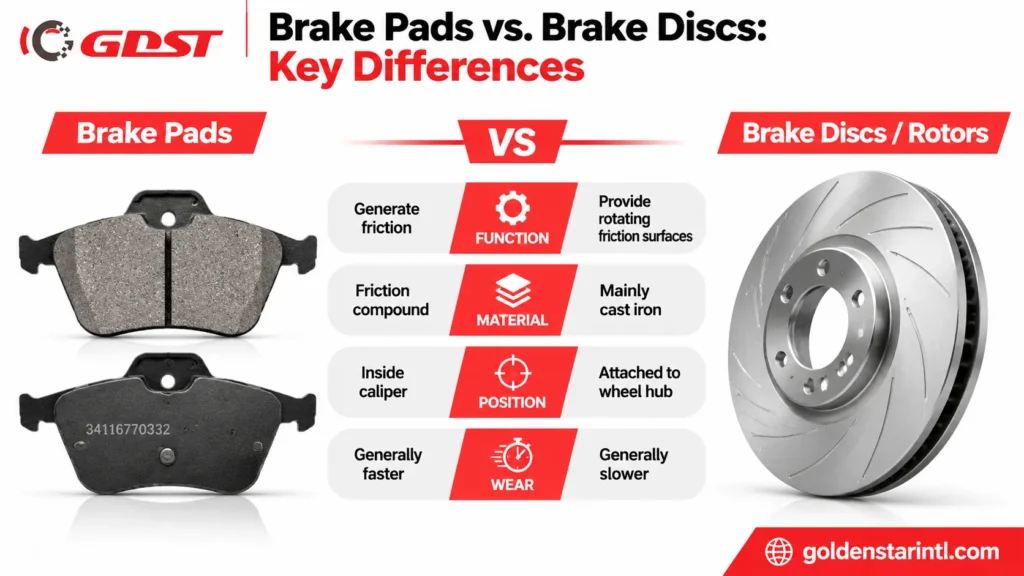
Brake pads and brake discs perform different but complementary functions. Their materials, construction, wear characteristics, and replacement requirements are also different.
| Comparison | Brake Pads | Brake Discs |
| Alternative name | Brake friction pads | Brake rotors |
| Installation location | Inside the brake caliper | Connected to the wheel hub |
| Main function | Generate friction | Provide friction surfaces and dissipate heat |
| Main materials | Ceramic, organic, low-metallic, semi-metallic | Mainly cast iron; some use carbon-ceramic composites |
| Construction | Friction material bonded to a backing plate | Solid or ventilated rotating disc |
| Wear characteristics | Generally wear faster | Generally wear more slowly |
| Common problems | Thin friction material, glazing, cracking, uneven wear | Scoring, cracks, heat damage, excessive thickness variation |
| Replacement criteria | Friction thickness and material condition | Minimum thickness and overall disc condition |
The main difference is simple: brake pads generate friction, while brake discs provide the rotating surface against which the pads work. Both must match the vehicle’s braking system.
Types of Brake Pads and Their Materials
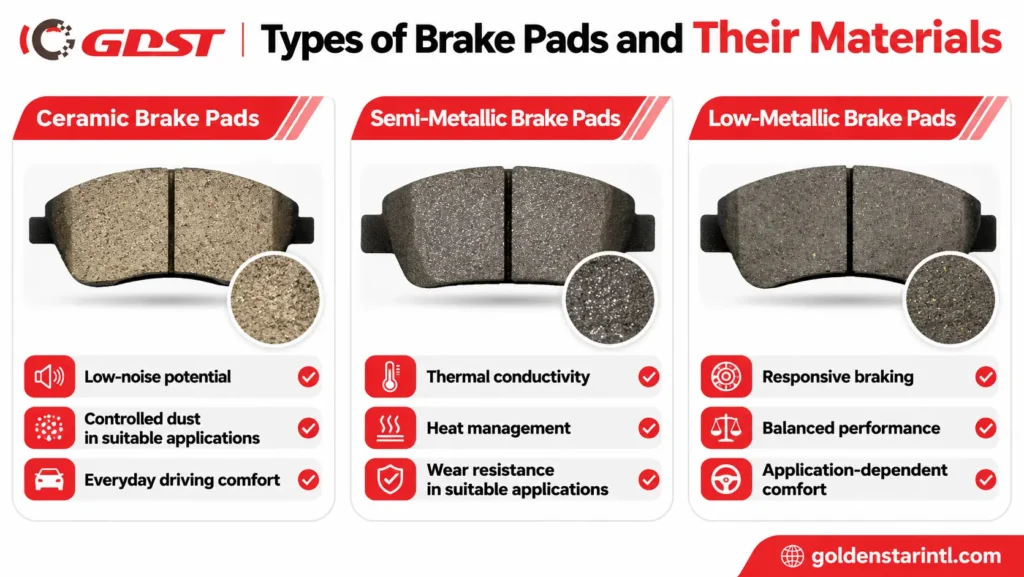
Brake pad performance depends on its friction material formulation. Different materials balance braking performance, noise, dust, heat resistance, and wear characteristics.
Ceramic Brake Pads
Ceramic brake pads use ceramic-based fibers and other friction ingredients. They are commonly selected for passenger vehicles where low noise, controlled brake dust, and comfortable everyday braking are important.
Typical characteristics include:
- Relatively low brake dust in suitable applications.
- Quiet braking performance.
- Smooth braking response.
- Good everyday driving comfort.
However, ceramic brake pads are not automatically suitable for every vehicle. Their performance depends on the formulation and OE application requirements.
Semi-Metallic Brake Pads
Semi-metallic brake pads contain metallic fibers or particles combined with other friction materials. They are commonly used where heat management, wear resistance, and reliable braking performance are important.
Typical characteristics include:
- Good thermal conductivity.
- Strong braking performance in suitable applications.
- Good wear resistance.
- Potentially higher noise and brake dust.
Low-Metallic Brake Pads
Low-metallic brake pads contain a relatively limited proportion of metallic ingredients mixed with organic friction materials and other additives.
Depending on the formulation, they can provide:
- Responsive braking performance.
- Good heat transfer characteristics.
- A balance between braking efficiency and driving comfort.
- Suitability for various passenger vehicle applications.
The correct brake pad material should always be selected according to OE specifications and vehicle requirements rather than material name alone.
Common Types of Brake Discs
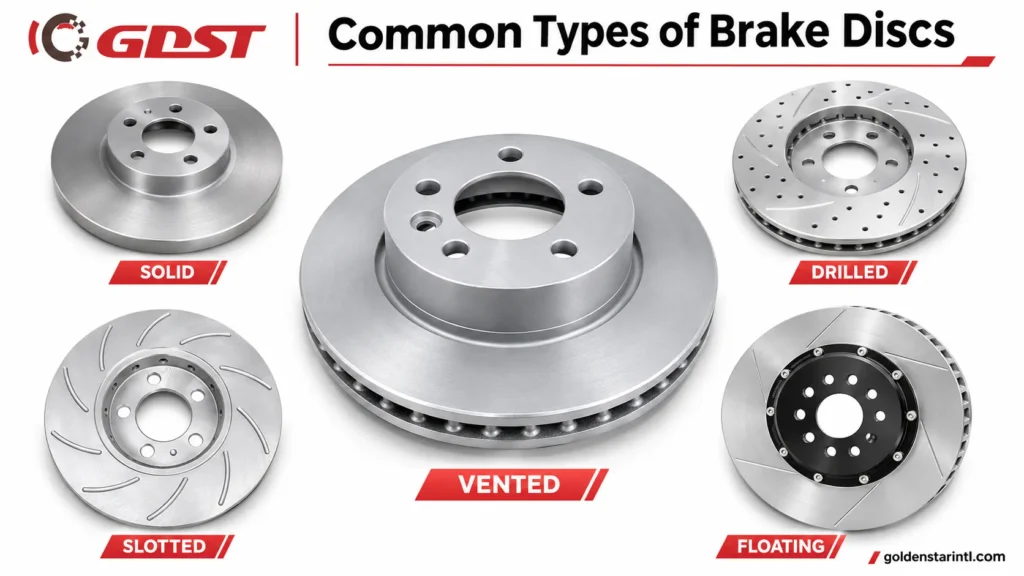
Brake discs are available in different designs to meet vehicle-specific braking and thermal requirements.
Solid Brake Discs
Solid brake discs have a single solid construction without internal ventilation channels. They are commonly used in applications with lower thermal loads, including some rear braking systems.
Vented Brake Discs
Vented brake discs contain internal passages between two friction surfaces. These channels help move air through the disc and improve heat dissipation. They are commonly used in front braking systems.
Drilled Brake Discs
Drilled brake discs have holes through their friction surfaces. These holes can help manage water and debris under certain operating conditions. However, drilling does not automatically improve braking performance in every application.
Slotted Brake Discs
Slotted brake discs feature grooves machined into their friction surfaces. These slots help manage surface deposits and debris and are used in selected performance and demanding driving applications.
Floating Brake Discs
Floating brake discs generally use a two-piece design with a separate friction ring and center carrier. Their construction allows controlled movement or thermal expansion according to the specific design.
The right brake disc type depends on the original vehicle configuration, braking requirements, and approved replacement specifications.
What Are the Signs of Worn Brake Pads?
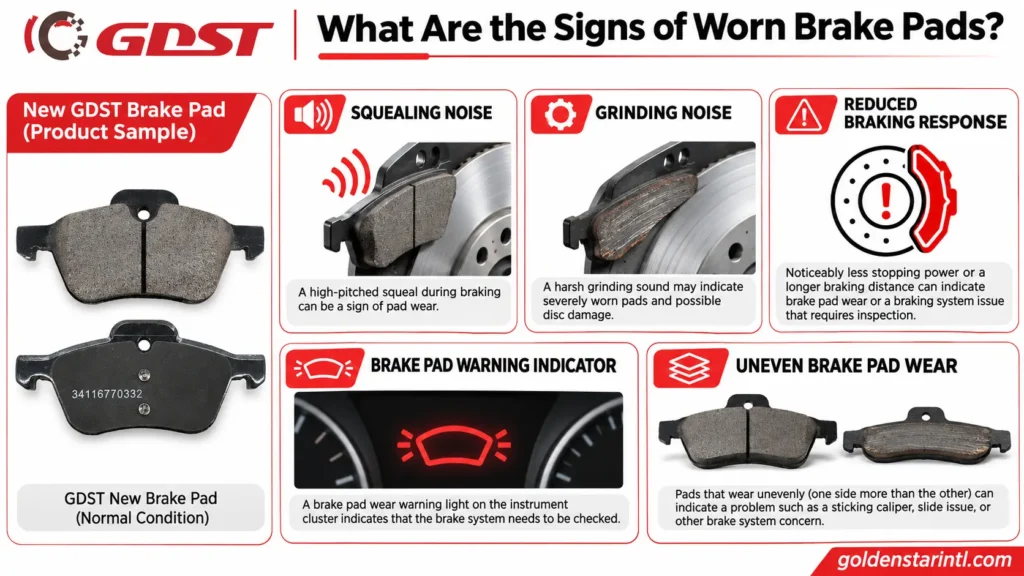
Brake pads gradually lose friction material during normal operation. Recognizing common wear signs helps prevent further damage to the braking system.
Squealing or Screeching Noises
Some brake pads have mechanical wear indicators that produce a high-pitched sound when the friction material becomes thin. However, squealing can also result from vibration, dust, moisture, glazing, or installation issues.
Grinding Noises
A metallic grinding sound may indicate that the friction material has worn away and the backing plate is contacting the brake disc. This can quickly damage the disc and requires immediate inspection.
Reduced Braking Performance
Worn, damaged, or contaminated brake pads may affect braking response. A change in braking performance should trigger an inspection of the complete braking system.
Brake Pad Warning Indicator
Vehicles with electronic wear sensors may display a dashboard warning when the pads approach their service limit. The warning should be checked according to the vehicle manufacturer’s instructions.
Uneven Brake Pad Wear
Significant differences between inner and outer pad wear may indicate sticking caliper pistons, restricted guide pins, damaged hardware, or incorrect installation. The underlying cause should be corrected before installing new pads.
What Are the Signs of Worn or Damaged Brake Discs?
Brake discs generally last longer than brake pads, but they can develop wear and damage that affects braking performance.
Brake Disc Scoring and Grooves
Deep grooves and severe scoring can reduce effective contact between brake pads and discs. The depth and condition of the damage should be inspected before deciding whether replacement is necessary.
Brake Disc Cracks
Cracks caused by excessive heat or mechanical damage can compromise disc integrity. A cracked brake disc should be replaced according to manufacturer requirements.
Excessive Brake Disc Wear
Brake discs become thinner through normal friction. Each disc has a specified minimum thickness, often marked as MIN TH or listed in manufacturer service information. Discs at or below this limit must be replaced.
Blue or Dark Heat Spots
Localized discoloration may indicate excessive heat or uneven thermal loading. Severe heat damage requires professional inspection.
Brake Judder or Vibration
Brake pedal pulsation or steering wheel vibration may result from disc thickness variation, lateral runout, uneven friction material deposits, or other mechanical problems. Proper inspection is necessary to identify the actual cause.
Why Do Brake Pads and Brake Discs Wear at Different Rates?
Brake pads generally wear faster because their friction material is designed to gradually wear during braking. Brake discs are usually made from more durable materials and have greater usable thickness.
Several factors affect their relative wear rates:
- Friction Material: Different formulations have different wear characteristics.
- Vehicle Weight: Heavier vehicles place greater demands on braking components.
- Driving Habits: Frequent hard braking increases friction and heat.
- Road Conditions: City traffic and steep roads often require more frequent braking.
- Brake System Condition: Sticking calipers and restricted guide pins can cause abnormal wear.
- Thermal Conditions: Repeated high-temperature braking can affect both pads and discs.
A vehicle used mainly in heavy city traffic may experience faster brake wear than one driven primarily on highways. Therefore, replacement intervals should be based on actual inspection rather than mileage alone.
When Should Brake Pads Be Replaced?
Brake pads should be replaced when their remaining friction material reaches the applicable service limit or when damage makes them unsuitable for continued use.
Common replacement conditions include:
- Friction material below the specified minimum thickness.
- Brake wear sensor activation.
- Cracked, damaged, or contaminated friction material.
- Severe glazing or other unacceptable surface conditions.
- Uneven wear caused by problems that require pad replacement.
Technicians should inspect the inner and outer pads on both sides of the same axle. Brake pads should normally be replaced as a complete axle set rather than replacing only one individual pad or one side.
When Should Brake Discs Be Replaced?
Brake discs should be replaced when their measured condition falls outside the vehicle manufacturer’s specifications.
Common replacement conditions include:
- Disc thickness at or below the minimum thickness limit.
- Cracks or severe heat damage.
- Deep scoring or excessive surface damage.
- Excessive disc thickness variation (DTV).
- Lateral runout beyond the permitted limit.
- Other structural or dimensional defects.
Disc thickness should be measured with an appropriate micrometer at multiple positions around the friction surface. Visual inspection alone is not enough to confirm that a disc is serviceable.
In some applications, resurfacing may be permitted if the manufacturer allows it and the finished disc remains above the applicable machining thickness. However, not all brake discs can be resurfaced.
When replacement is necessary, both discs on the same axle should normally be replaced together to maintain balanced braking characteristics.
Should You Replace Brake Pads and Discs at the Same Time?
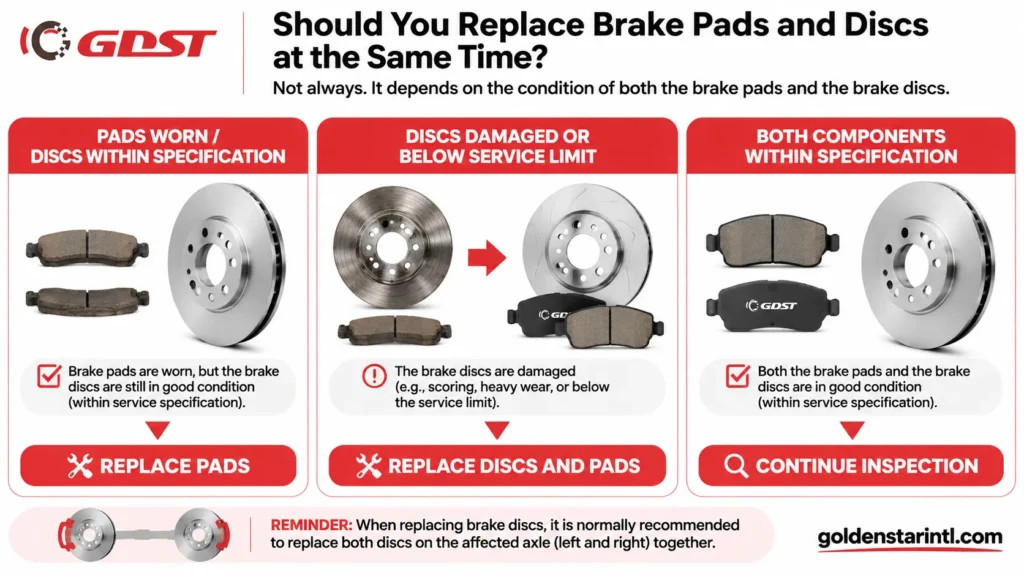
Not necessarily. Whether both components need replacement depends on their individual condition and the vehicle manufacturer’s requirements.
If the existing brake discs remain above minimum thickness, have suitable friction surfaces, and meet all service specifications, replacing only the brake pads may be acceptable.
However, when brake discs need replacement, installing suitable new brake pads at the same time is generally recommended. This helps establish a compatible friction interface and supports proper bedding-in.
| Inspection Result | Brake Pad Recommendation | Brake Disc Recommendation |
| Pads worn, discs in good condition | Replace pads | Retain discs if within specification |
| Pads worn, discs below minimum thickness | Replace pads | Replace discs |
| Pads worn, discs cracked or severely scored | Replace pads | Replace discs |
| Pads in good condition, discs damaged | Replace with suitable new pads | Replace discs |
| Both components within specifications | Continue monitoring | Continue monitoring |
| Uneven pad wear caused by caliper problems | Correct cause and replace pads if necessary | Inspect disc condition |
The key principle is to replace components according to their actual condition, not automatically replace every brake component together.
Should You Replace Front and Rear Brake Pads Together?
Not necessarily. Front and rear brake systems may have different designs, sizes, operating loads, and wear characteristics.
During braking, vehicle weight generally transfers toward the front axle. As a result, front brake pads often experience faster wear. However, this is not universal because vehicle design, electronic parking brakes, and stability control systems can also affect rear brake wear.
If front brake pads have reached their service limit while rear pads remain within specification, replacing the front axle set may be sufficient.
The same principle applies to brake discs: replace both discs on the affected axle when replacement is required. Always follow vehicle-specific service instructions.
How Are Brake Pads and Discs Inspected?
A proper brake inspection should evaluate both friction components and their surrounding hardware.
For brake pads, technicians measure the remaining friction material thickness and compare inner and outer pad wear.
For brake discs, technicians measure thickness at multiple positions and inspect for cracks, scoring, corrosion, and heat damage.
Additional inspection procedures may include:
- Measuring brake disc thickness variation (DTV).
- Checking lateral runout with a dial indicator.
- Inspecting caliper pistons and guide pins.
- Checking pad shims, clips, and retaining hardware.
- Inspecting wheel hub mounting surfaces.
- Checking brake hoses, fluid, and hydraulic components.
These checks help identify whether replacement is necessary and whether an underlying problem is causing abnormal wear.
What Is Brake Disc Thickness Variation and Why Does It Matter?
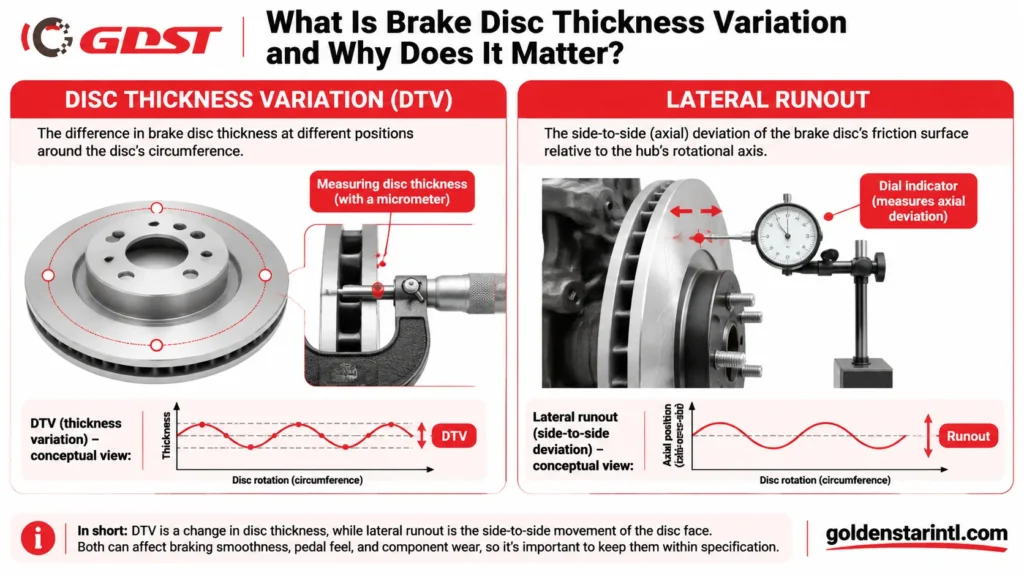
Brake Disc Thickness Variation (DTV) refers to differences in thickness around the disc’s friction surface.
Excessive DTV can cause changing contact pressure between the brake pads and disc, resulting in brake pedal pulsation or vibration.
Another important measurement is lateral runout, which describes the side-to-side deviation of a rotating brake disc.
Excessive lateral runout may contribute to uneven disc wear and eventually create thickness variation. However, DTV and lateral runout are two different measurements.
The common term warped brake rotors does not accurately describe every braking vibration problem. DTV, runout, uneven friction material deposits, and hub mounting issues can all produce similar symptoms.
Proper diagnosis requires suitable measurement tools and manufacturer specifications.
What Factors Affect Brake Pad and Brake Disc Lifespan?
Brake pad and brake disc lifespan varies depending on vehicle design, driving conditions, materials, and maintenance.
- Driving Style: Frequent hard braking and aggressive driving increase friction and wear.
- Road Conditions: Stop-and-go traffic and steep roads generally create more braking demand than highway driving.
- Vehicle Weight: Heavy vehicles, loaded SUVs, and commercial vehicles place greater demands on braking components.
- Brake Pad Material: Different friction formulations have different wear, noise, dust, and thermal characteristics.
- Brake System Condition: Sticking calipers, restricted guide pins, and damaged hardware can cause abnormal wear.
Regular inspection helps identify these problems before they damage other braking components.
How to Choose the Right Brake Pads and Brake Discs
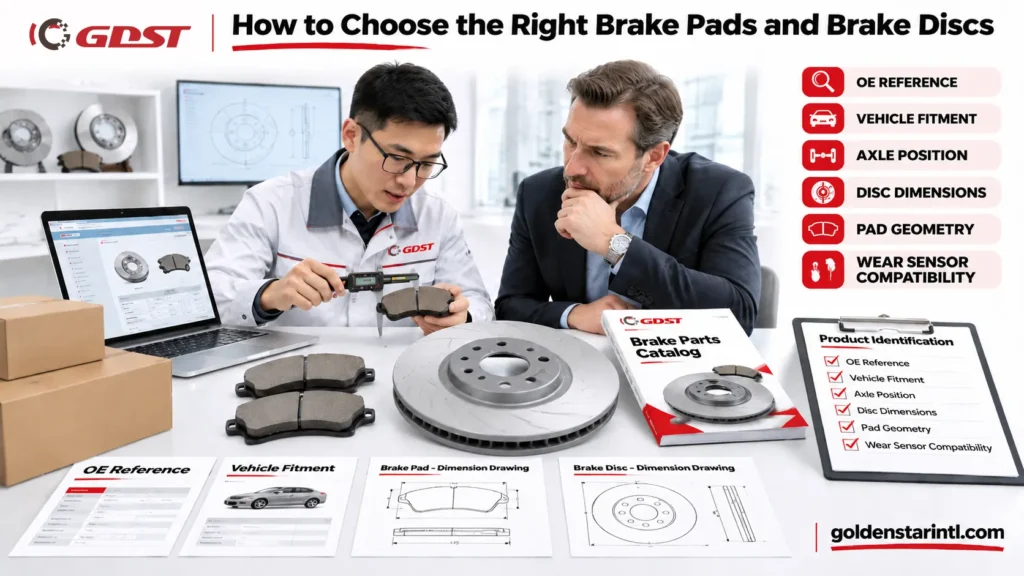
Selecting replacement brake components requires more than checking their appearance. Vehicle application and OE specifications should always be confirmed first.
Important selection factors include:
- Vehicle make, model, year, and engine configuration.
- OE number or cross-reference part number.
- Front or rear axle position.
- Brake pad dimensions and backing plate design.
- Brake disc diameter and thickness.
- Disc height, center bore, and mounting configuration.
- Solid or vented brake disc design.
- Brake pad friction material and intended application.
- Compatibility with wear sensors and brake hardware.
For automotive parts distributors, wholesalers, and importers, accurate product identification is essential when purchasing brake pads and discs in bulk.
A reliable brake parts supplier should provide clear specifications, application references, and consistent quality documentation.
Why Brake Pad and Brake Disc Quality Control Matters
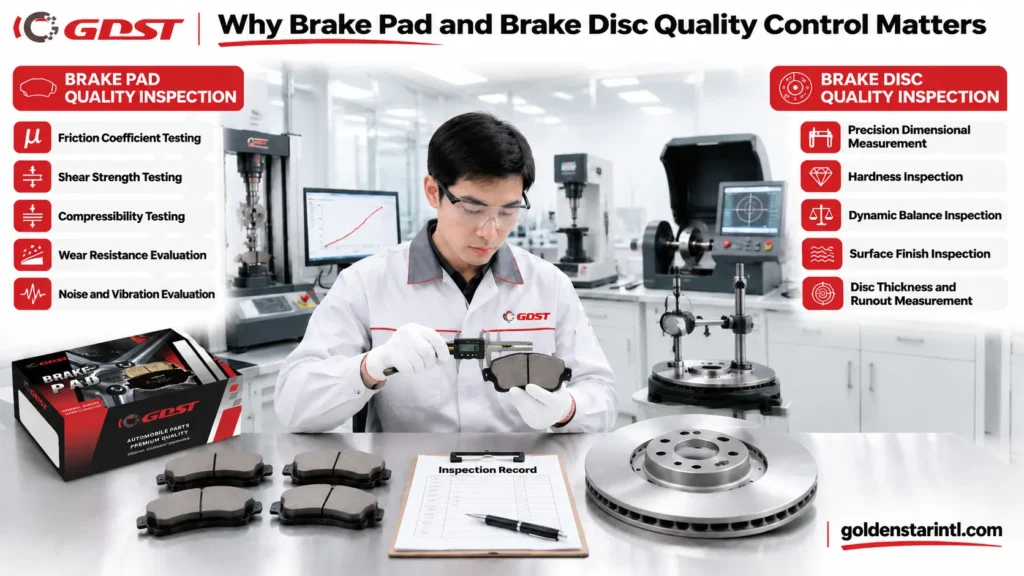
Brake pads and brake discs are safety-related automotive components. Their quality affects braking consistency, durability, noise, vibration, and customer satisfaction.
For brake pads, important quality checks include:
- Friction coefficient consistency.
- Shear strength.
- Wear resistance.
- Noise and vibration performance.
For brake discs, important checks include:
- Dimensional accuracy.
- Dynamic balance.
- Surface finish.
- Thickness consistency.
- Runout inspection.
Effective quality control should cover raw materials, manufacturing processes, finished products, and application verification.
For automotive parts distributors and aftermarket brands, these factors are important when selecting long-term manufacturing partners and maintaining consistent product quality.
Frequently Asked Questions About Brake Pads and Brake Discs
Are brake pads and brake discs the same thing?
No. Brake pads generate friction, while brake discs provide the rotating surfaces against which the pads work.
Are brake discs and brake rotors the same?
Yes. Brake discs and brake rotors refer to the same component in a disc braking system. Brake disc is common in many international markets, while brake rotor is widely used in North America.
Do brake pads wear faster than brake discs?
Generally, yes. Brake pads are designed to wear during braking, while brake discs are usually more durable. Actual wear depends on vehicle design, materials, and driving conditions.
Do I need to replace brake discs every time I replace brake pads?
No. Existing discs can be reused if they meet the manufacturer’s thickness and condition requirements.
Should new brake pads be installed with new brake discs?
Generally, yes. Suitable new pads help establish a compatible friction interface and support proper bedding-in.
How do I know if my brake discs are worn out?
Common signs include deep scoring, cracks, excessive thickness variation, and heat damage. Disc thickness must also be checked against the minimum specification.
Can I replace only one brake disc?
Normally, no. Both brake discs on the same axle should be replaced together to maintain balanced braking characteristics.
Can I replace only the front brake pads?
Yes, if the rear pads remain within their service limits. However, both front pads should normally be replaced together.
What causes brake pedal vibration?
Possible causes include disc thickness variation, lateral runout, uneven friction material deposits, and other mechanical problems. Proper inspection is needed to identify the cause.
How often should brake pads and discs be inspected?
Follow the vehicle manufacturer’s maintenance schedule and inspect the braking system whenever warning signs or abnormal braking behavior appear.
Summary
Brake pads and brake discs perform different but closely connected functions in a vehicle’s disc braking system. Brake pads generate friction, while brake discs provide the rotating friction surfaces and dissipate braking heat.
Although brake pads generally wear faster, both components require regular inspection and condition-based replacement.
New brake pads do not automatically require new brake discs. However, discs that are below minimum thickness, cracked, severely damaged, or outside manufacturer specifications must be replaced. When new discs are installed, suitable new pads should generally be fitted at the same time.
Understanding their differences, materials, functions, and replacement requirements helps vehicle owners maintain reliable braking performance and enables automotive parts distributors to select suitable replacement components.
For professional brake parts sourcing, accurate vehicle fitment, consistent product quality, and reliable manufacturing support are essential when choosing a long-term supplier.