Quick Answer: What Are Brake Discs?
Brake discs are circular metal rotors attached to a vehicle’s wheel hubs. They work with brake calipers and brake pads to slow down or stop the wheels through friction. When the brake pedal is pressed, hydraulic pressure activates the calipers, forcing the pads against the rotating discs. This friction converts kinetic energy into heat, reducing wheel speed. Common brake disc designs include solid, vented, drilled, and slotted rotors, while grey cast iron is widely used for conventional automotive applications.
What Are Brake Discs?
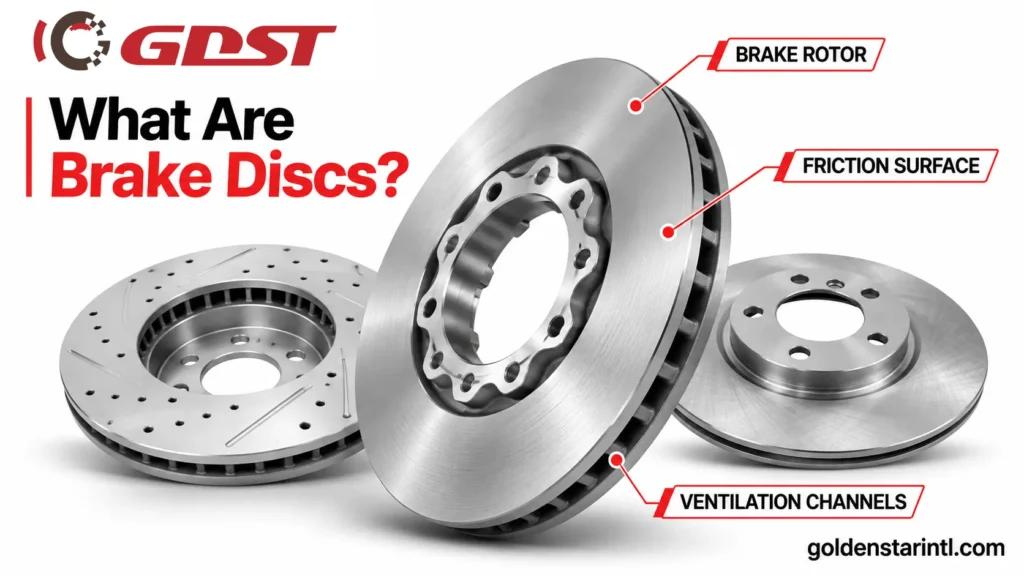
Brake discs, also known as brake rotors, are essential components of a vehicle’s disc braking system. They are circular metal components mounted to the wheel hub and rotate together with the wheels. When the driver applies the brakes, brake pads are pressed against both sides of the rotating disc by the brake caliper, creating friction that slows down or stops the vehicle.
Brake discs play a critical role in converting the vehicle’s kinetic energy into thermal energy through friction. They must provide a stable friction surface, withstand repeated heating and cooling cycles, and maintain sufficient structural strength under demanding driving conditions.
Looking for reliable brake disc solutions for your automotive parts business?
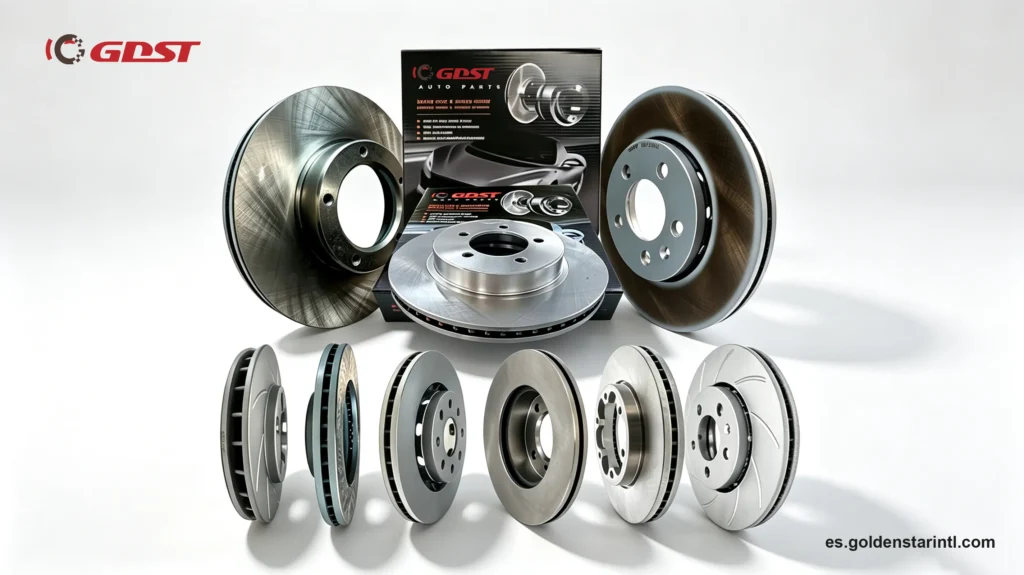
Brake discs are commonly used on passenger cars, SUVs, light commercial vehicles and heavy-duty vehicles. Depending on vehicle design, braking requirements and operating conditions, they may feature solid, vented, drilled, slotted or two-piece constructions.
Although brake discs are often discussed together with brake pads and calipers, each component performs a different function. Understanding their structure, materials, and working principles helps vehicle owners maintain their braking systems and helps automotive parts distributors select suitable replacement products.
What Does a Brake Disc Do?
The primary function of a brake disc is to provide a rotating friction surface against which the brake pads apply pressure. This friction generates braking torque, reducing wheel rotation and helping the vehicle decelerate.
However, brake discs perform several other important functions within the braking system.
- Generate Braking Friction
When the brake pads clamp onto the disc, friction develops between the two surfaces. This friction creates resistance against wheel rotation, allowing the vehicle to slow down or stop.
The effectiveness of this process depends on several factors, including pad friction characteristics, disc surface condition, clamping force, operating temperature and the overall brake system design.
- Dissipate Heat
During braking, a considerable amount of kinetic energy is converted into heat. Brake discs absorb and dissipate much of this heat through their friction surfaces and, where applicable, internal ventilation passages.
Effective heat management helps maintain stable braking performance and reduces the risk of excessive temperature buildup.
- Provide a Stable Friction Surface
Brake discs must maintain consistent contact with the brake pads. Their surface condition, flatness, thickness and dimensional accuracy influence braking smoothness, noise and vibration.
- Support Consistent Braking Performance
A properly designed and manufactured brake disc helps maintain predictable braking behavior under repeated operating conditions. Material properties, structural design and dimensional tolerances all contribute to this performance.
- Withstand Mechanical and Thermal Stress
Brake discs experience repeated mechanical loading and temperature changes. They must resist wear, thermal fatigue, cracking and deformation throughout their intended service life.
What Are the Main Components of a Disc Brake System?
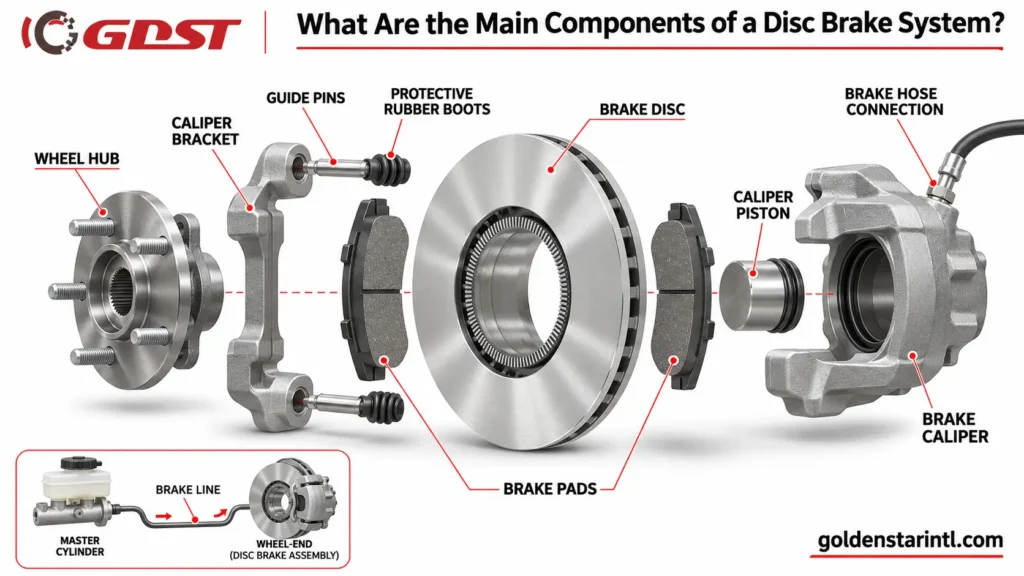
A disc brake system consists of several interconnected mechanical and hydraulic components. Each plays a specific role in transferring the driver’s braking input into friction at the wheels.
Brake Disc (Rotor)
The brake disc is the rotating friction component attached to the wheel hub. Its friction surfaces contact the brake pads during braking.
Depending on the design, it may have a solid or ventilated structure, with different friction ring configurations and mounting arrangements.
Brake Caliper
The brake caliper houses the hydraulic pistons and brake pads. It applies the required clamping force to press the pads against the disc.
There are two common designs: floating calipers and fixed calipers.
Brake Pads
Brake pads contain friction material bonded or otherwise attached to a backing plate. They contact the rotating brake disc and generate the friction required for deceleration.
Caliper Piston
The piston receives hydraulic pressure from the braking system and transfers force to the brake pad. Depending on the caliper design, pistons may be positioned on one or both sides of the disc.
Caliper Bracket
The caliper bracket supports the caliper assembly and maintains its position relative to the brake disc. It also provides mounting points for the caliper and, in many designs, the guide pins.
Guide Pins and Rubber Boots
Floating calipers use guide pins to allow controlled lateral movement. Rubber boots protect the sliding components against moisture, dirt and corrosion.
Brake Master Cylinder
The master cylinder converts mechanical input from the brake pedal and booster system into hydraulic pressure within the brake circuits.
Brake Fluid and Hydraulic Lines
Brake fluid transfers hydraulic pressure from the master cylinder to the wheel brake mechanisms. Hydraulic lines and hoses connect the system components.
Wheel Hub and Dust Shield
The wheel hub supports the rotating assembly and provides the mounting interface for the brake disc. A dust shield helps protect the braking assembly from road debris and contaminants.
How Do Disc Brakes Work?
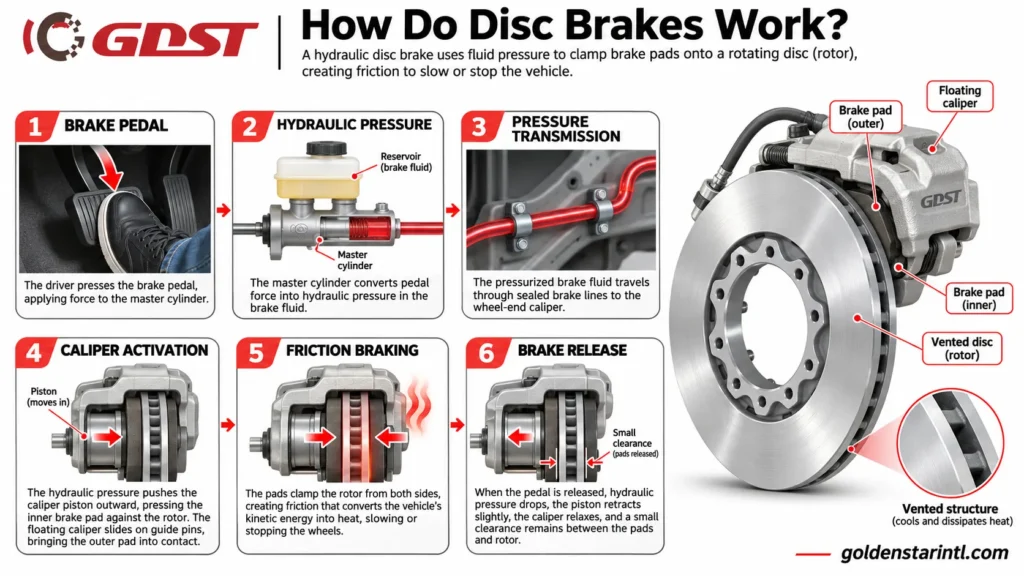
Disc brakes operate through hydraulic pressure and friction. When the driver presses the brake pedal, hydraulic pressure is generated and transmitted to the brake caliper, causing the pads to clamp against the rotating disc.
The braking process can be divided into six main stages.
Step 1: The Driver Presses the Brake Pedal
When the driver applies the brake pedal, mechanical force is transmitted through the pedal mechanism. A brake booster, where fitted, assists the driver by reducing the effort required.
Step 2: The Master Cylinder Generates Hydraulic Pressure
The brake pedal operates the master cylinder, which pressurizes the brake fluid in the hydraulic circuits.
Step 3: Hydraulic Pressure Reaches the Brake Caliper
Pressurized brake fluid travels through the brake lines and hoses to the caliper. The hydraulic pressure acts on the caliper pistons.
Step 4: The Brake Pads Contact the Disc
In a floating caliper system, hydraulic pressure pushes the piston and inner brake pad toward the disc. The caliper body slides along its guide pins, bringing the outer pad into contact with the opposite side.
In a fixed caliper system, pistons positioned on both sides of the disc push the corresponding brake pads inward.
Step 5: Friction Slows the Rotating Disc
The brake pads clamp against the disc, generating friction. This creates braking torque that opposes wheel rotation.
The vehicle’s kinetic energy is converted into thermal energy, causing the disc and pads to heat up.
Step 6: The Brakes Release
When the driver releases the brake pedal, hydraulic pressure decreases. The brake pads stop applying significant clamping force, allowing the disc to rotate freely again.
In conventional disc brake calipers, the elastic deformation of the piston seal helps retract the piston slightly. This allows a small running clearance between the pads and disc.
The following table summarizes the complete braking process.
| Braking Stage | Main Component | Function |
| Driver input | Brake pedal | Initiates braking |
| Pressure generation | Master cylinder | Creates hydraulic pressure |
| Pressure transmission | Brake fluid and lines | Transfers pressure |
| Force application | Caliper and pistons | Pushes the brake pads |
| Friction generation | Brake pads and disc | Creates braking torque |
| Energy conversion | Disc and pads | Converts kinetic energy into heat |
| Brake release | Hydraulic system and piston seals | Reduces clamping force |
How Do Brake Discs Manage Heat?
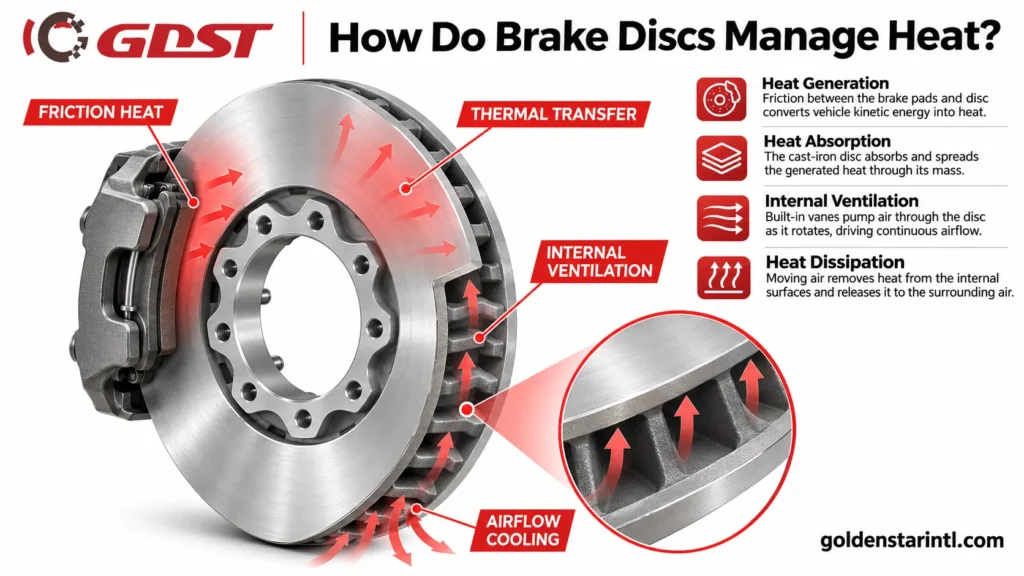
Heat management is one of the most important considerations in brake disc design.
Whenever a vehicle slows down, its kinetic energy must be converted into another form of energy. During conventional friction braking, most of this energy becomes heat at the contact surfaces between the brake pads and discs.
If heat cannot be managed effectively, excessive temperatures may contribute to brake fade, thermal cracking, uneven wear and other braking problems.
Brake discs manage heat through several mechanisms.
Heat Absorption
The brake disc absorbs thermal energy generated during friction. Its material, mass, thickness and thermal properties influence how much heat it can temporarily store.
Heat Dissipation
Heat moves through the disc material and transfers to the surrounding air through convection and radiation. The exposed friction surfaces contribute to this process.
Internal Ventilation
Vented brake discs contain internal passages or vanes between two friction faces. As the disc rotates, these structures help move air through the disc and improve heat dissipation.
Thermal Stability
Brake discs must withstand repeated heating and cooling without developing excessive distortion, cracking or dimensional changes.
Material selection, casting quality, machining accuracy and disc geometry all contribute to thermal performance.
It is important to understand that a larger or more heavily ventilated disc is not automatically better for every vehicle. The correct design depends on vehicle weight, brake system specifications, available wheel clearance and intended operating conditions.
What Materials Are Brake Discs Made From?
Brake disc materials influence thermal performance, wear resistance, mechanical strength, noise characteristics, weight and manufacturing cost.
Different vehicles and applications require different material solutions.
Gray Cast Iron
Gray cast iron is widely used in conventional automotive brake discs because it offers a combination of thermal conductivity, heat capacity, vibration damping, wear resistance, castability and cost-effectiveness.
Its graphite structure contributes to its damping characteristics and helps manage friction-related behavior.
Many passenger cars, SUVs and commercial vehicles use gray cast iron brake discs.
High-Carbon Cast Iron
High-carbon cast iron is used in certain brake disc applications where specific thermal, friction and noise characteristics are desired.
Its performance depends on the complete material composition, manufacturing process and heat treatment rather than carbon content alone.
Carbon-Ceramic Composite
Carbon-ceramic brake discs typically use carbon-fiber-reinforced silicon carbide composite materials.
They are designed for high-performance applications and offer advantages such as reduced weight compared with many conventional cast-iron discs, high-temperature capability and strong resistance to wear under suitable operating conditions.
However, they are significantly more expensive and may have different cold-braking characteristics and replacement requirements.
Steel
Steel brake discs are used in selected applications, including motorcycles and certain specialized vehicles. Their suitability depends on the required mechanical properties, thermal behavior and braking system design.
The following table compares commonly used brake disc materials.
| Material | Main Characteristics | Common Applications | Considerations |
| Gray cast iron | Good thermal capacity, damping and cost-effectiveness | Passenger cars, SUVs and commercial vehicles | Relatively heavy |
| High-carbon cast iron | Specific thermal and friction characteristics | Selected passenger and performance vehicles | Requires controlled material composition |
| Carbon-ceramic composite | High-temperature capability and reduced weight | High-performance and luxury vehicles | High manufacturing and replacement costs |
| Steel | Good strength and application-specific design flexibility | Motorcycles and selected specialized vehicles | Performance depends on grade and design |
For most conventional automotive replacement applications, cast iron remains an important material choice because of its balance of performance, manufacturing practicality and cost.
What Are the Different Types of Brake Discs?
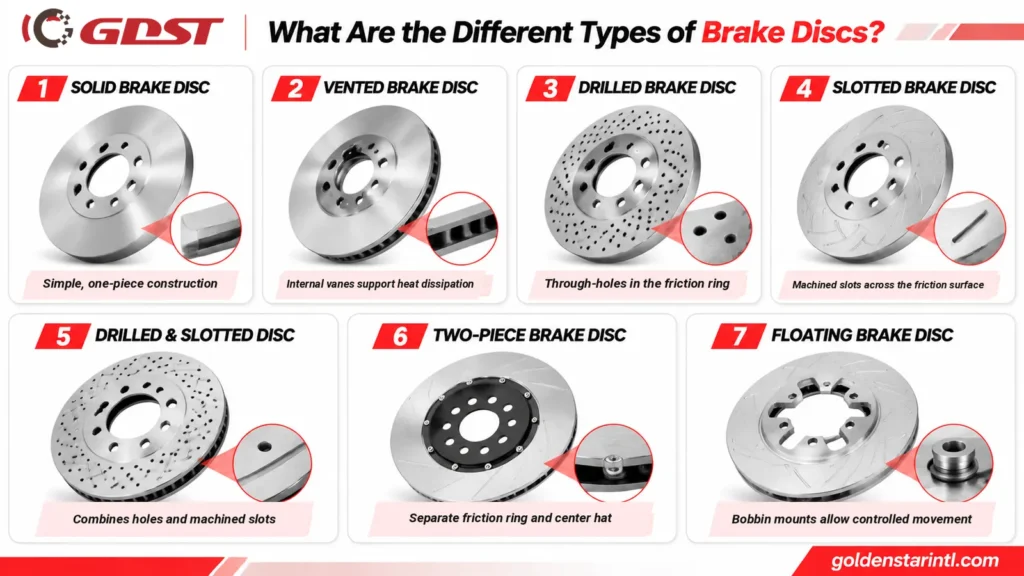
Brake discs are available in several designs. Their differences mainly involve ventilation, friction surface geometry, mounting construction and intended operating conditions.
Solid Brake Discs
Solid brake discs consist of a single solid friction section without internal ventilation passages.
They have a relatively simple structure, lower manufacturing complexity and are commonly used in applications with moderate braking and thermal requirements.
They are frequently found on the rear axles of certain passenger vehicles, although actual configurations depend on vehicle design.
Vented Brake Discs
Vented brake discs consist of two friction faces separated by internal vanes or passages.
As the disc rotates, air flows through these passages to improve heat dissipation.
They are commonly used on front axles and in vehicles with higher thermal braking demands.
Vented designs may use straight, curved or other specially engineered vane configurations.
Drilled Brake Discs
Drilled brake discs feature holes distributed across the friction surface.
Depending on the design, these holes may help reduce mass and provide additional surface features for water and gas management.
However, drilled discs can experience stress concentrations around the holes, potentially increasing the risk of cracking under severe thermal and mechanical loading.
They are not automatically superior to conventional solid or vented discs.
Slotted Brake Discs
Slotted brake discs feature grooves machined into the friction surfaces.
These grooves can help remove surface debris and gases from the pad-disc interface and may support consistent pad contact under certain operating conditions.
However, slotted discs may increase pad wear and generate additional noise depending on the groove design and friction material.
Drilled and Slotted Brake Discs
These discs combine holes and grooves on the friction surfaces.
They are often selected for specific performance-oriented applications where their design characteristics are suitable.
Their suitability should be assessed based on the vehicle’s braking requirements rather than appearance alone.
Two-Piece Brake Discs
Two-piece brake discs typically consist of a friction ring and a separate central hat or mounting section.
The two parts may be connected using specialized hardware.
This construction can reduce unsprung weight and accommodate thermal expansion more effectively, depending on the design.
Floating Brake Discs
Floating brake discs use a mounting arrangement that allows controlled relative movement between the friction ring and the hat.
This helps accommodate thermal expansion and is commonly used in high-performance automotive and motorcycle applications.
The following table compares the main brake disc designs.
| Brake Disc Type | Structural Features | Main Advantages | Typical Applications |
| Solid | Single solid friction section | Simple design and cost-effectiveness | Selected passenger car rear axles |
| Vented | Two friction faces with internal vanes | Improved heat dissipation | Passenger cars, SUVs and demanding applications |
| Drilled | Holes through friction surfaces | Specific surface and weight characteristics | Selected performance applications |
| Slotted | Grooves on friction surfaces | Helps manage pad surface debris | Performance-oriented applications |
| Drilled and slotted | Combined holes and grooves | Combines design characteristics of both | Selected performance applications |
| Two-piece | Separate friction ring and hat | Weight and thermal expansion advantages | Performance vehicles |
| Floating | Controlled movement between friction ring and mounting section | Accommodates thermal expansion | High-performance vehicles and motorcycles |
Disc Brakes vs. Drum Brakes: What Is the Difference?
Disc brakes and drum brakes are two common friction braking technologies used in vehicles.
Both convert kinetic energy into heat through friction, but they use different mechanical structures.
Disc brakes use brake pads that clamp against a rotating disc, while drum brakes use brake shoes that press outward against the inner surface of a rotating drum.
The main differences include structure, heat dissipation, maintenance and application.
| Comparison Factor | Disc Brakes | Drum Brakes |
| Main friction component | Brake disc or rotor | Brake drum |
| Friction element | Brake pads | Brake shoes |
| Force application | Caliper pistons | Wheel cylinder or mechanical linkage |
| Friction contact | Pads clamp against the disc | Shoes press against the drum |
| Heat dissipation | Generally more effective due to exposed surfaces | Generally less effective because of enclosed construction |
| Inspection | Components are relatively accessible | Internal components require drum removal for inspection |
| Maintenance | Pad and disc inspection and replacement | Shoe, drum, spring and wheel cylinder inspection |
| Parking brake integration | Requires a separate or integrated mechanism | Can use the existing shoe and drum arrangement |
| Common applications | Front and rear axles of many modern vehicles | Rear axles of selected passenger vehicles and commercial applications |
Why Do Some Vehicles Still Use Drum Brakes?
Although disc brakes offer advantages in heat dissipation and inspection accessibility, drum brakes remain relevant.
They can provide cost-effective braking solutions and may integrate conveniently with mechanical parking brake systems.
For certain rear axle applications, drum brakes can meet the required braking performance at a competitive manufacturing cost.
Some vehicles therefore use disc brakes at the front and drum brakes at the rear, while others use disc brakes on all four wheels.
Neither system should be considered universally better without considering vehicle design, operating conditions and engineering requirements.
How Do Front and Rear Brake Discs Differ?
Front and rear brake discs perform the same basic function, but their dimensions, design and operating requirements may differ.
During deceleration, vehicle weight generally transfers toward the front axle. This increases the normal load on the front tires and allows them to generate a larger proportion of the total braking force under many braking conditions.
As a result, front brake systems commonly require greater braking capacity and thermal management.
Front Brake Discs
Front discs are often larger or thicker than rear discs, although the exact configuration varies by vehicle.
They may use vented designs to manage the higher thermal loads associated with front axle braking.
Rear Brake Discs
Rear discs generally operate under different braking loads and may have smaller dimensions or different ventilation structures.
Some rear disc assemblies also incorporate parking brake mechanisms.
Depending on the vehicle, parking brake systems may use an integrated drum-in-hat arrangement, a mechanical mechanism inside the caliper or an electronic parking brake actuator.
Why Is Front-to-Rear Brake Balance Important?
The front and rear braking systems must work together to maintain vehicle stability.
Excessive rear braking can increase the risk of rear-wheel lockup, while insufficient rear braking may reduce the system’s overall braking contribution.
Modern vehicles use brake proportioning strategies and electronic systems such as EBD to help distribute braking force appropriately.
For replacement purposes, front and rear brake discs are not interchangeable unless specifically designed for the same application. Their dimensions, mounting arrangements and braking specifications must match the vehicle.
How Do ABS, ESC and Brake-by-Wire Work With Disc Brakes?
Modern braking systems combine mechanical components with electronic controls to improve vehicle stability and braking management.
Although these technologies do not replace the basic friction mechanism of disc brakes, they influence how braking force is applied and controlled.
Anti-lock Braking System (ABS)
ABS monitors wheel speeds using sensors. When the system detects a wheel approaching lockup during braking, the hydraulic control unit adjusts brake pressure to help maintain wheel rotation.
This helps the driver retain steering control during hard braking, particularly on slippery or uneven surfaces.
Electronic Stability Control (ESC)
ESC monitors vehicle movement and steering input to identify potential loss of stability.
When necessary, it can selectively apply braking force to individual wheels and may also reduce engine or motor torque to help stabilize the vehicle.
Electronic Brakeforce Distribution (EBD)
EBD adjusts the distribution of braking force between the front and rear axles based on operating conditions.
It helps optimize brake force according to factors such as vehicle load and dynamic weight transfer.
Brake-by-Wire
Brake-by-wire systems use electronic signals to communicate braking requests and control braking actuators.
Depending on the system architecture, hydraulic pressure may be generated or regulated by electronically controlled components.
Importantly, brake-by-wire does not necessarily eliminate friction-based disc brakes. Many modern systems still use conventional brake discs and pads at the wheels.
What Causes Brake Disc Wear and Damage?
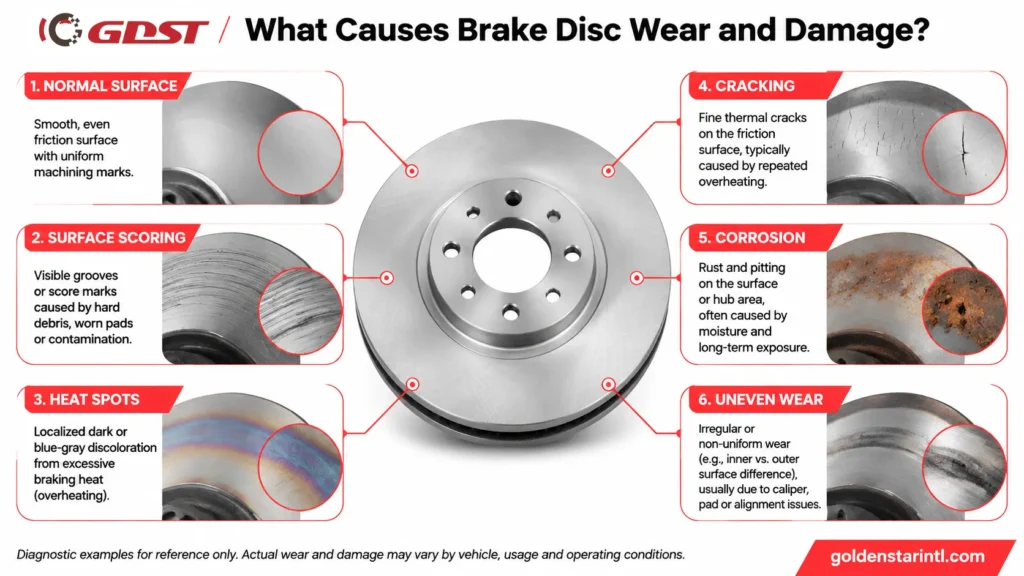
Brake discs gradually wear during normal operation because their friction surfaces repeatedly contact the brake pads.
However, abnormal wear or damage can develop when the braking system operates under excessive heat, contamination, mechanical stress or incorrect installation conditions.
Understanding common symptoms helps identify potential braking problems.
Brake Disc Thickness Wear
As brake pads repeatedly contact the disc, material is gradually removed from the friction surfaces.
When the disc reaches its specified minimum thickness, it must be replaced.
Scoring and Grooves
Deep grooves may develop due to debris trapped between the pads and disc, worn friction material or uneven contact.
Severe scoring can reduce effective contact area and affect braking performance.
Brake Disc Cracking
Thermal and mechanical stress can cause cracks to develop.
Fine surface checking may appear under demanding conditions, but cracks that extend significantly into the friction ring require careful inspection and may indicate that the disc must be replaced.
Blue Spots and Heat Damage
Blue or dark discoloration can indicate localized overheating.
Potential causes include excessive braking temperatures, dragging calipers, incorrect pad-disc compatibility or demanding operating conditions.
Brake Disc Thickness Variation
Thickness variation occurs when different areas of the disc have slightly different thickness measurements.
It can contribute to brake pedal pulsation or steering wheel vibration during braking.
Lateral Runout
Lateral runout refers to the side-to-side deviation of the disc as it rotates.
Excessive runout can contribute to uneven pad contact and, over time, may lead to thickness variation.
Installation errors, hub surface contamination and worn wheel bearings can contribute to excessive runout.
Corrosion
Brake discs exposed to moisture, road salt and environmental contaminants may develop surface corrosion.
Light surface rust can be normal after a vehicle has been parked. However, heavy corrosion or persistent pitting may require professional inspection.
When Should Brake Discs Be Replaced?
Brake discs should be replaced when their condition no longer meets the vehicle manufacturer’s safety and service requirements.
There is no universal replacement mileage because disc wear depends on vehicle weight, driving conditions, braking habits, pad material and environmental exposure.
The following signs indicate that brake discs should be inspected.
- The Disc Has Reached Its Minimum Thickness
Most brake discs have a minimum permissible thickness, often marked as MIN TH or MINIMUM TH.
The measured thickness must remain above this specified limit.
If the disc is below the minimum thickness, replacement is necessary.
- Severe Cracks or Structural Damage Are Present
Cracks, significant heat damage or other structural defects may compromise disc integrity.
Affected discs should be inspected and replaced when required by the manufacturer’s specifications.
- Excessive Runout or Thickness Variation
If measurements exceed the manufacturer’s permitted tolerances, the cause must be identified and corrected.
Depending on the condition and applicable service specifications, machining or replacement may be required.
- Deep Scoring or Severe Corrosion
Deep grooves, substantial pitting and uneven friction surfaces can compromise contact between the pads and disc.
- Persistent Vibration During Braking
Steering wheel vibration, brake pedal pulsation or unusual braking noise may indicate disc-related problems.
However, these symptoms can also result from worn suspension components, wheel bearing problems, tire issues or other braking system faults.
A complete inspection is necessary before replacing components.
Should Brake Discs and Brake Pads Be Replaced Together?
Not necessarily.
Brake pads and discs have different service lives. However, replacing both components together may be appropriate when the discs are worn, damaged or incompatible with the condition of the new pads.
If the existing discs remain within specification and have suitable friction surfaces, they may be reusable with new pads, subject to the vehicle manufacturer’s recommendations.
When replacing brake discs, technicians should also inspect the calipers, guide pins, brake hoses and related hardware.
How to Choose the Correct Brake Discs?
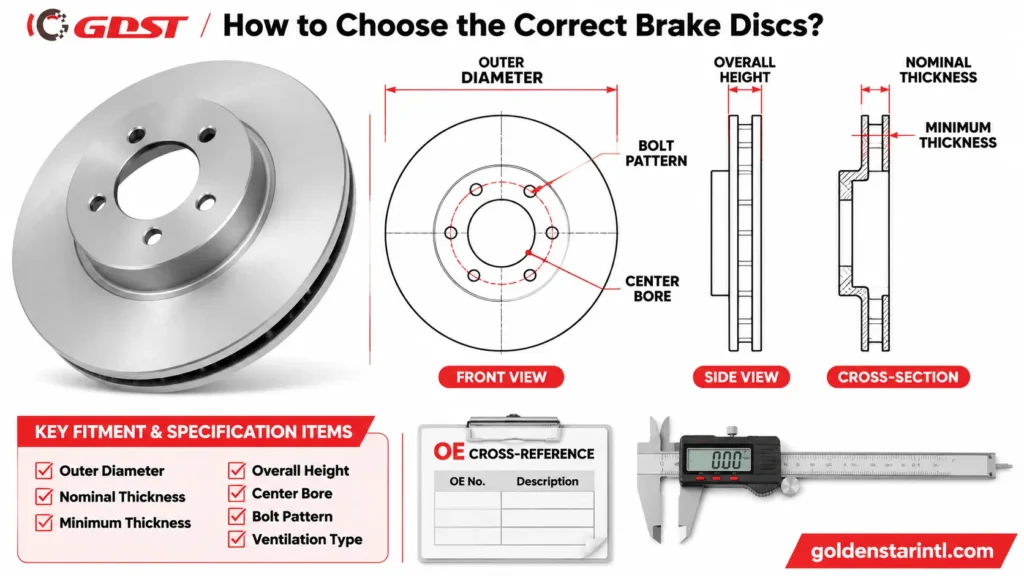
Selecting the correct brake disc requires more than matching its diameter.
Even vehicles with similar model names may use different brake disc configurations depending on engine type, production year, trim level, braking package and axle specification.
The following information should be checked before ordering replacement discs.
OE Number or Reference Number
The original equipment number is one of the most useful references for identifying a compatible replacement brake disc.
Cross-reference information should be verified against reliable vehicle application data.
Brake Disc Diameter
The outer diameter determines the overall size of the friction ring and must match the vehicle’s brake system design.
Nominal and Minimum Thickness
Nominal thickness refers to the specified thickness of a new disc.
Minimum thickness indicates the lowest permissible thickness during service.
Both values should match the relevant OE specification.
Overall Height and Offset
Disc height and offset affect the position of the friction surfaces relative to the caliper.
Incorrect dimensions can cause installation problems or improper pad alignment.
Center Bore and Mounting Configuration
The center bore, bolt pattern and mounting arrangement must match the wheel hub.
Solid or Vented Construction
The selected disc must have the correct structural design for the application.
Directional Ventilation
Some vented brake discs use directional internal vanes.
Where a directional design is specified, the left and right discs must be installed in the correct positions.
Additional Features
Other specifications may include the number of mounting holes, friction ring geometry, protective coating, integrated ABS tone ring or parking brake configuration.
A suitable brake disc selection checklist is shown below.
| Selection Parameter | What to Verify | Why It Matters |
| OE number | Original reference and cross-reference | Confirms vehicle application |
| Disc diameter | Outer diameter in mm | Ensures correct caliper compatibility |
| Nominal thickness | New disc thickness in mm | Matches original brake specifications |
| Minimum thickness | Manufacturer’s service limit | Defines the replacement threshold |
| Overall height | Total disc height and offset | Ensures correct installation position |
| Center bore | Hub mounting diameter | Ensures correct hub fitment |
| Bolt pattern | Number and arrangement of holes | Matches vehicle mounting requirements |
| Disc construction | Solid or vented | Matches original system design |
| Friction surface | Drilled, slotted or plain | Matches application requirements |
| Additional features | Coating, tone ring or parking brake design | Ensures complete application compatibility |
For automotive parts distributors and importers, confirming OE references and maintaining accurate fitment information can help reduce incorrect orders, installation issues and after-sales complaints.
What Should Distributors Check When Selecting a Brake Disc Supplier?
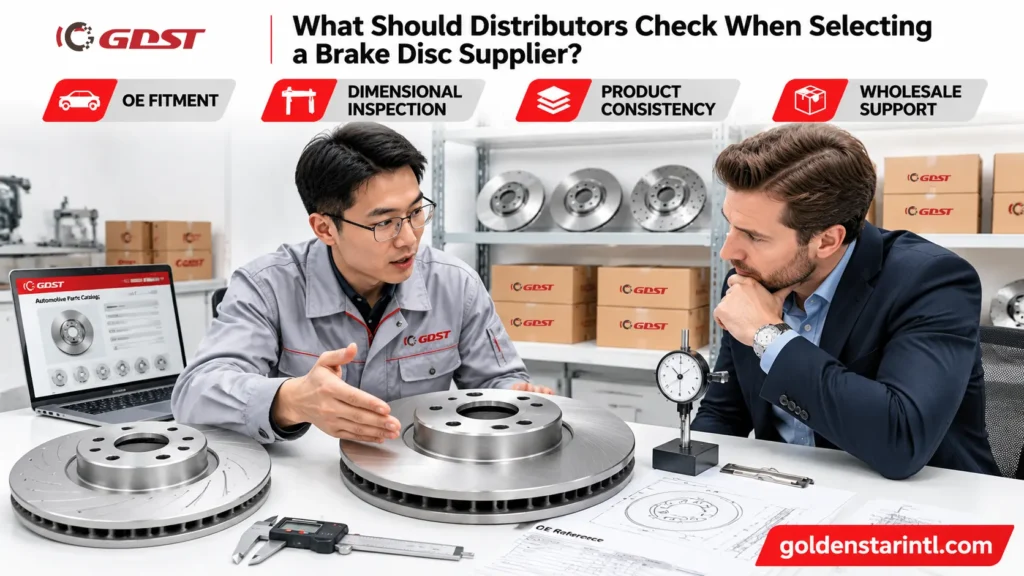
For automotive parts wholesalers, importers and distributors, choosing a brake disc supplier involves more than comparing unit prices.
Product consistency, technical documentation, manufacturing quality, application coverage and supply reliability all influence long-term business performance.
- Product Range and Application Coverage
A supplier should offer suitable brake disc options for the target vehicle market.
Check the availability of different OE references, disc dimensions, axle applications and structural designs.
- Material Specifications
Ask about the materials used in brake disc production, including the relevant casting specifications and material inspection procedures.
Material consistency is important for achieving predictable mechanical and thermal properties.
- Dimensional Accuracy
Brake disc dimensions must meet the required OE specifications.
Important inspection items include outer diameter, thickness, overall height, center bore, mounting hole positions and friction surface geometry.
- Manufacturing and Quality Control
Ask how the supplier controls machining accuracy, surface finish, disc balance, thickness variation and lateral runout.
A professional supplier should be able to explain its quality inspection procedures and provide relevant documentation.
- Testing and Traceability
Check whether the supplier can provide appropriate material reports, dimensional inspection records and other relevant quality documentation.
Testing requirements should be aligned with the product type, application and applicable standards.
- Packaging and Corrosion Protection
Brake discs are metal components that may be exposed to moisture during transportation and storage.
Protective coatings, suitable packaging and effective moisture prevention help preserve product condition before installation.
- OEM, ODM and Private Label Services
For distributors developing their own automotive parts brands, customized packaging, labeling and product development support can be valuable.
Confirm the supplier’s actual customization capabilities, minimum order quantities and sample policies before placing an order.
- Delivery and After-Sales Support
A reliable supplier should provide clear lead times, order communication, product identification and a defined process for handling quality-related claims.
Building a long-term supply relationship requires consistent product quality and dependable communication.
Looking for a brake disc supplier for your distribution business?
Contact the team with your OE references, target vehicle applications and purchasing requirements to discuss suitable product options.
Frequently Asked Questions About Brake Discs
- Are brake discs and brake rotors the same thing?
Yes. Brake discs and brake rotors generally refer to the same component. Brake disc is commonly used in many international markets, while brake rotor is widely used in North America.
- How do brake discs work?
Brake discs work by providing a rotating friction surface. When the brake pedal is pressed, hydraulic pressure activates the caliper pistons, causing the brake pads to clamp against the disc and slow the vehicle.
- What are the main parts of a disc brake system?
The main components include the brake disc, brake caliper, brake pads, caliper pistons, master cylinder, brake fluid and hydraulic lines. Caliper brackets and guide pins are also important in many designs.
- What is the difference between solid and vented brake discs?
Solid discs have a single solid friction section, while vented discs contain internal air passages between two friction faces. Vented designs generally provide better heat dissipation.
- Are drilled or slotted brake discs better?
Not necessarily. Drilled and slotted discs offer specific friction surface characteristics, but their suitability depends on vehicle design, driving conditions and pad compatibility. Drilled discs may also have greater crack sensitivity under severe thermal loading.
- How long do brake discs last?
Brake disc service life varies according to driving habits, vehicle weight, brake pad material and operating conditions. Always inspect disc thickness and condition rather than relying on a universal mileage interval.
- What is the minimum brake disc thickness?
Minimum thickness is the lowest permissible service thickness specified by the vehicle or disc manufacturer. It is commonly marked on the disc as MIN TH or MINIMUM TH.
- Can brake discs be resurfaced instead of replaced?
In some cases, yes. Resurfacing may be possible if the manufacturer permits it and the finished disc remains above the specified minimum thickness while meeting applicable dimensional tolerances. Otherwise, replacement is necessary.
- Should brake discs be replaced in pairs?
Brake discs are generally replaced in axle pairs to help maintain balanced braking performance. The vehicle manufacturer’s service recommendations should always be followed.
- How can I identify the correct brake disc for my vehicle?
Use the vehicle’s OE reference number and verify the disc diameter, thickness, height, center bore, mounting configuration, and other application-specific specifications. Vehicle model and year alone may not be sufficient.
Conclusion
Brake discs are essential components of modern automotive braking systems. Working together with brake pads, calipers, and hydraulic controls, they convert vehicle kinetic energy into heat through friction, allowing vehicles to slow down safely and predictably.
Their performance depends on multiple factors, including material composition, structural design, heat dissipation, dimensional accuracy, and compatibility with the complete braking system.
Understanding the differences between solid, vented, drilled, slotted, and two-piece brake discs helps vehicle owners make informed maintenance decisions and enables automotive parts distributors to select suitable products for their markets.
For automotive parts businesses, choosing the right brake disc supplier also requires careful consideration of product coverage, OE compatibility, manufacturing consistency, quality inspection, and long-term supply capabilities.