f
Quick Answer
The best brake pads for your vehicle are those that match its original specifications, braking system, and driving conditions. Ceramic pads generally offer quieter operation and less visible dust, while semi-metallic pads can suit more demanding applications. Before buying, check vehicle fitment, OE numbers, friction performance, rotor compatibility, and product quality. Always prioritize verified compatibility over price or material type alone.
Choosing the best brake pads for your vehicle requires more than comparing prices or materials. The right choice depends on your vehicle’s original braking system, driving conditions, and performance requirements.
Ceramic, semi-metallic, low-metallic, and organic brake pads offer different characteristics in terms of braking performance, noise, dust, heat resistance, and wear. No single material is ideal for every vehicle.
Whether you are replacing brake pads for a passenger car, SUV, or truck, understanding vehicle compatibility, friction materials, rotor condition, and product quality will help you make the right choice.
1. Start with Your Vehicle’s Original Brake Pad Specifications
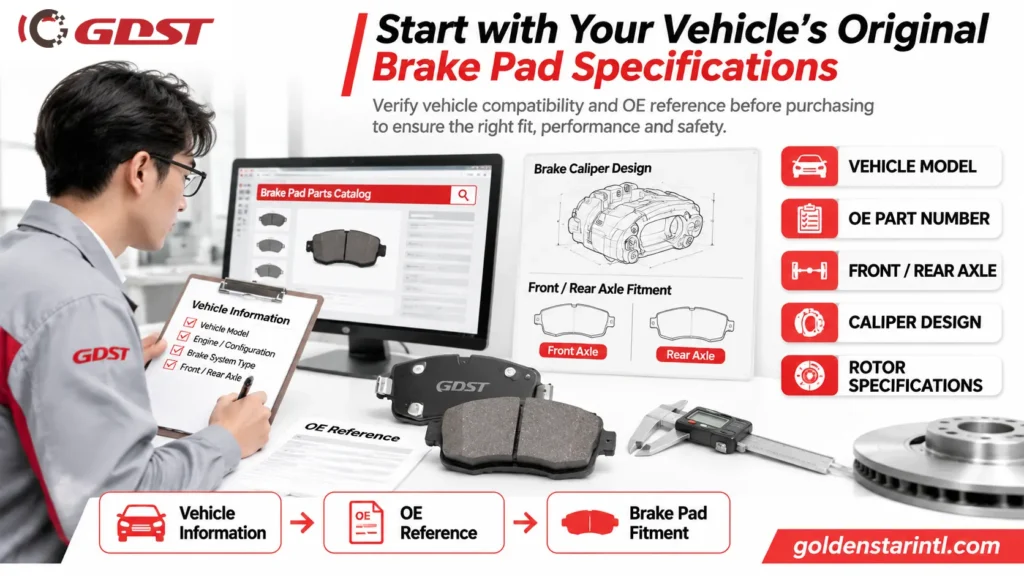
Before comparing brake pad materials or brands, confirm which products are compatible with your vehicle. Even vehicles of the same model and year may have different brake configurations depending on their engine, trim level, production date, or optional brake package.
Using an incorrectly matched brake pad can cause installation problems and affect braking performance.
Check the following information before purchasing:
- Vehicle make, model, and production year.
- Engine size and vehicle configuration.
- Front or rear axle application.
- Original Equipment (OE) part number.
- Vehicle Identification Number (VIN), where required.
- Brake caliper design and brake system specifications.
- Rotor diameter and thickness.
OE part numbers provide a useful starting point for identifying replacement brake pads, but they should always be verified against the vehicle’s actual configuration.
For distributors and automotive parts buyers, checking OE references and fitment information before ordering helps reduce incorrect applications, returns, and inventory problems.
2. Understand the Different Types of Brake Pads
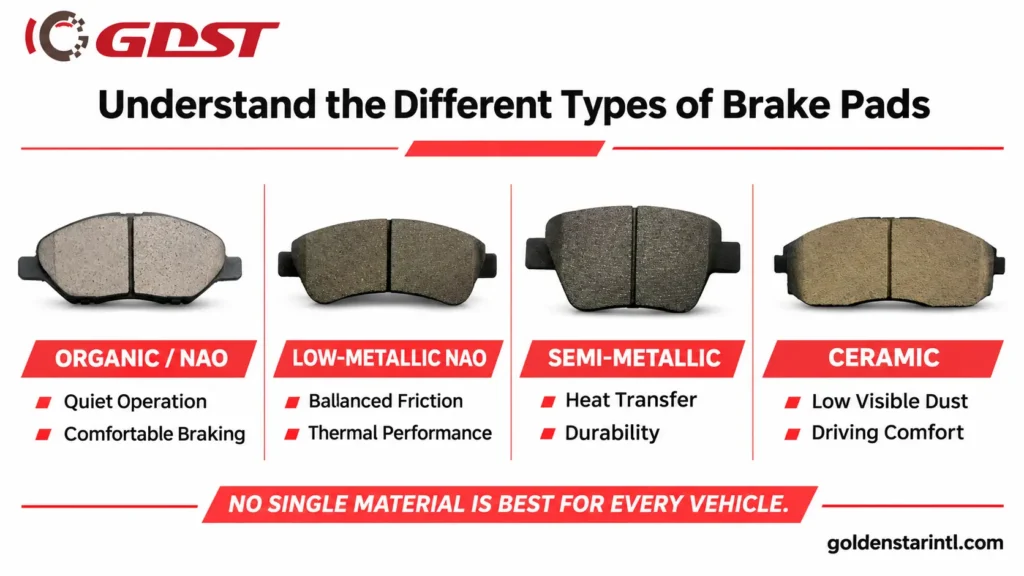
Brake pads use different friction material formulations to achieve specific braking, wear, thermal, and noise characteristics. The four common categories are Organic (NAO), Low-Metallic NAO, Semi-Metallic, and Ceramic.
Their actual performance depends on the complete formulation and manufacturing process, not simply the material category.
Organic or NAO Brake Pads
Organic brake pads use non-asbestos fibers, resins, fillers, and friction modifiers. They generally offer quiet operation and comfortable braking, making them suitable for some light-duty passenger vehicles.
However, their heat resistance, wear resistance, and high-temperature performance vary by formulation.
Low-Metallic NAO Brake Pads
Low-Metallic NAO brake pads combine an organic-based friction material with a relatively small proportion of metallic ingredients.
They can offer a balance of braking response and thermal performance, but some formulations may produce more dust or noise than ceramic alternatives.
Semi-Metallic Brake Pads
Semi-metallic brake pads contain metallic ingredients such as steel fibers and iron, combined with binders, lubricants, and friction modifiers.
They generally provide good heat transfer and durability in suitable applications, making them common in passenger cars, SUVs, and trucks.
However, some formulations may produce more brake dust, noise, and rotor wear.
Ceramic Brake Pads
Ceramic brake pads use ceramic-based ingredients, fibers, fillers, and friction modifiers.
They are commonly chosen for passenger vehicles because they can offer:
- Lower visible brake dust.
- Quiet operation.
- Stable friction within their intended temperature range.
- Comfortable everyday braking.
- Favorable rotor wear characteristics in compatible applications.
However, ceramic pads are not suitable for every vehicle or high-load application. Their performance depends on the formulation and braking system requirements.
Brake Pad Material Comparison
| Material | Main Advantages | Potential Limitations | Common Applications |
| Organic / NAO | Quiet operation, comfortable braking | Formulation-dependent heat and wear limitations | Light-duty passenger vehicles |
| Low-Metallic NAO | Balanced braking and thermal characteristics | May produce more dust or noise | Selected passenger vehicles |
| Semi-Metallic | Good heat transfer and durability | Possible noise, dust, and rotor wear | Passenger cars, SUVs, trucks |
| Ceramic | Lower visible dust, quiet operation, comfort | Not ideal for every heavy-duty application | Many passenger vehicles |
These are general characteristics rather than guaranteed results. Always consider vehicle compatibility, actual product specifications, and intended driving conditions when selecting brake pads.
3. Consider Your Driving Style and Everyday Operating Conditions
The best brake pads for a vehicle used mainly for city commuting may not be the best choice for a vehicle regularly driven on mountain roads or used for towing.
Driving conditions influence friction temperature, braking frequency, thermal loading, wear, and the amount of time available for the braking system to cool.
Before selecting brake pads, consider how the vehicle is normally used.
City Driving and Daily Commuting
Urban driving involves frequent stops, traffic congestion, low-speed braking, and repeated acceleration and deceleration.
For these conditions, many drivers prioritize:
- Smooth and predictable braking response.
- Low noise during everyday operation.
- Reduced visible brake dust.
- Comfortable pedal feel.
- Consistent performance during repeated normal braking.
Suitable ceramic or carefully formulated low-metallic and semi-metallic brake pads may meet these requirements, depending on the vehicle’s original specifications.
Highway Driving
Highway driving usually involves fewer braking events than congested city traffic, but braking from higher speeds can generate substantial heat.
Brake pads should provide stable friction characteristics within the operating temperature range specified for the vehicle.
A suitable replacement should also maintain compatibility with the original brake rotors, calipers, and overall braking system.
Mountain Roads and Steep Descents
Driving on steep roads can increase brake temperature, especially when the driver relies heavily on the service brakes to control vehicle speed.
In these conditions, thermal stability and fade resistance become important considerations.
However, choosing a more aggressive brake pad is not the only solution. Proper gear selection, engine braking where appropriate, vehicle loading, and correct driving techniques also help manage braking temperatures.
Towing and Heavy Loads
Vehicles used for towing trailers or carrying heavy cargo experience greater braking demands.
The increased vehicle mass and load can raise the energy that the braking system must dissipate during deceleration.
For these applications, replacement brake pads should be specifically approved or recommended for the vehicle’s towing and load requirements.
Do not assume that every semi-metallic brake pad is suitable for towing simply because it contains more metal.
4. Choose Brake Pads Based on Your Vehicle Type
Different vehicles have different braking requirements. Vehicle weight, axle loads, braking system design, engine output, tire characteristics, and intended operating conditions all influence brake pad selection.
The following recommendations provide a starting point, not a substitute for vehicle-specific fitment confirmation.
| Vehicle or Application | Important Selection Factors | Suitable Selection Approach |
| Compact passenger cars | Comfort, noise, everyday braking | OE-compatible ceramic or NAO formulations where specified |
| Sedans | Balanced braking, wear, dust and comfort | OE-matched ceramic, low-metallic or semi-metallic options |
| SUVs and crossovers | Vehicle weight, load and thermal demand | Formulations approved for the vehicle’s braking system |
| Pickup trucks | Payload, towing, axle loads | Vehicle-approved standard or heavy-duty applications |
| Performance vehicles | Operating temperature, friction stability, rotor compatibility | Dedicated performance formulations approved for the system |
| Fleet vehicles | Durability, predictable performance, maintenance costs | Application-tested products matched to fleet duty cycles |
| Electric vehicles | Vehicle mass, regenerative braking strategy, corrosion and low-use conditions | EV-compatible products meeting original braking system requirements |
Passenger Cars
Most passenger cars used for daily transportation require a balanced combination of braking response, comfort, noise control, and durability.
OE-compatible ceramic and semi-metallic formulations are common replacement options, but the correct choice depends on the original braking system.
SUVs and Crossovers
SUVs are often heavier than compact passenger cars and may carry more passengers or cargo.
Their brake pads should be selected according to vehicle weight, original brake specifications, and expected operating conditions.
A product designed for a smaller sedan should not be assumed suitable for an SUV merely because the pad dimensions appear similar.
Pickup Trucks and Commercial Vehicles
Pickup trucks and commercial vehicles may operate under higher payloads, towing conditions, and repeated braking demands.
The correct brake pad must meet the manufacturer’s requirements for the specific vehicle and braking system.
For heavy-duty applications, compatibility and documented performance under the intended load conditions are particularly important.
Performance and Sports Cars
Performance vehicles may operate at higher brake temperatures and experience more demanding deceleration cycles.
Dedicated performance brake pads can offer different friction characteristics and thermal capabilities, but they may also produce more noise, dust, or require higher operating temperatures.
Street-oriented performance pads and track-oriented compounds should not be treated as interchangeable.
Electric and Hybrid Vehicles
Electric and hybrid vehicles use regenerative braking to recover energy during deceleration. As a result, their friction brakes may be used differently from those in conventional vehicles.
Some EVs may experience less frequent friction braking, depending on the driving mode and regenerative braking strategy. This can make corrosion, moisture exposure, and the condition of the friction surfaces important maintenance considerations.
EV brake pads must still meet the vehicle manufacturer’s requirements for fitment, friction performance, and mechanical compatibility.
5. Check Brake Pad and Brake Rotor Compatibility
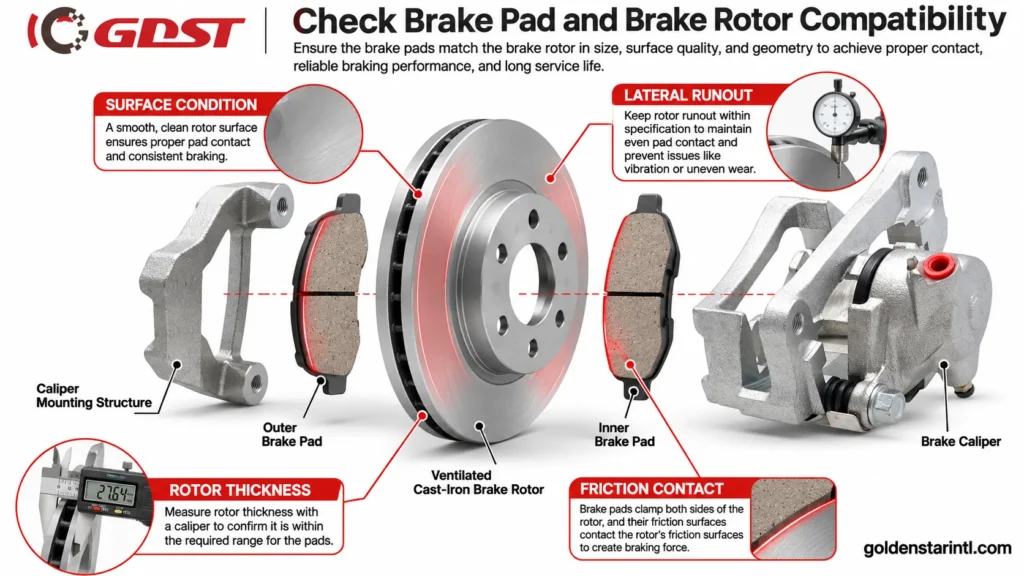
Brake pads and brake rotors work together as a friction pair. Their compatibility is essential for predictable braking performance, acceptable wear, and noise control.
Selecting a new brake pad without checking the existing rotor condition can lead to problems even when the replacement pad itself is correctly specified.
Before installation, inspect the brake rotors for:
- Thickness below the manufacturer’s minimum specification.
- Deep scoring or uneven wear.
- Cracks or other structural damage.
- Heat-related discoloration or damage.
- Excessive lateral runout.
- Surface conditions that may prevent proper pad contact.
If a rotor is below its minimum thickness or has damage that makes it unsuitable for continued service, it should be replaced according to the vehicle manufacturer’s repair requirements.
A rotor that remains within specification may be reusable, depending on its condition and the brake pad manufacturer’s instructions.
Should Brake Pads and Rotors Always Be Replaced Together?
No. Brake pads and rotors do not always need to be replaced at the same time.
If the existing rotors are within the manufacturer’s thickness limits, have an acceptable surface condition, and meet the required runout specifications, they may be suitable for continued use.
However, replacing both components may be necessary when the rotors are excessively worn, damaged, cracked, or otherwise outside service limits.
Always inspect both sides of the braking system and follow the applicable vehicle service procedures.
6. Understand Front and Rear Brake Pad Differences
Front and rear brake pads are not necessarily interchangeable.
They may have different shapes, thicknesses, friction characteristics, backing plate configurations, and OE part numbers.
During deceleration, vehicle weight transfers toward the front axle. The braking system is designed around this dynamic load transfer, so front and rear brake components may have different operating requirements.
Front brake pads often experience greater braking loads in conventional passenger vehicles, but the actual distribution depends on vehicle design, electronic brake-force distribution, regenerative braking, and driving conditions.
When purchasing replacement pads, always verify whether the product is intended for the front or rear axle.
For safe and consistent operation, brake pads should normally be replaced as complete axle sets rather than replacing only one pad or one side of the axle.
7. Evaluate Brake Pad Quality Beyond the Material Name
A brake pad’s material classification alone cannot determine whether it is a high-quality product.
Two ceramic brake pads may have very different friction characteristics, wear rates, noise behavior, and thermal stability because their formulations and manufacturing processes differ.
The same applies to semi-metallic and low-metallic brake pads.
When evaluating brake pad quality, consider the following technical characteristics.
Friction Stability
The friction material should provide predictable braking behavior within its intended operating temperature range.
A suitable formulation should be evaluated for cold performance, operating-temperature behavior, and resistance to excessive friction changes under repeated braking.
Fade Resistance and Recovery
Brake fade occurs when braking effectiveness decreases under demanding thermal conditions.
A well-designed brake pad should maintain appropriate friction characteristics under its intended operating conditions.
The ability to recover after thermal stress is also important.
Wear Resistance
Brake pad wear depends on the friction formulation, rotor material, vehicle mass, driving style, and environmental conditions.
A product that offers lower pad wear does not necessarily guarantee lower overall braking system wear.
Both pad and rotor durability should be considered.
Noise and Vibration Control
Brake noise can result from friction characteristics, pad geometry, backing plate design, caliper condition, rotor condition, installation quality, and vibration within the braking system.
Features such as anti-noise shims, appropriate chamfers, slots, and compatible friction formulations can help control unwanted noise.
However, no product should be described as completely noise-free under every operating condition.
Mechanical Strength and Structural Integrity
The friction material must remain securely bonded to its backing plate during normal braking operation.
Bonding strength, shear resistance, compressibility, and structural consistency are important quality considerations.
A properly manufactured brake pad should also have consistent dimensions and accurate mounting geometry.
8. Look for Brake Pad Testing and Quality Control
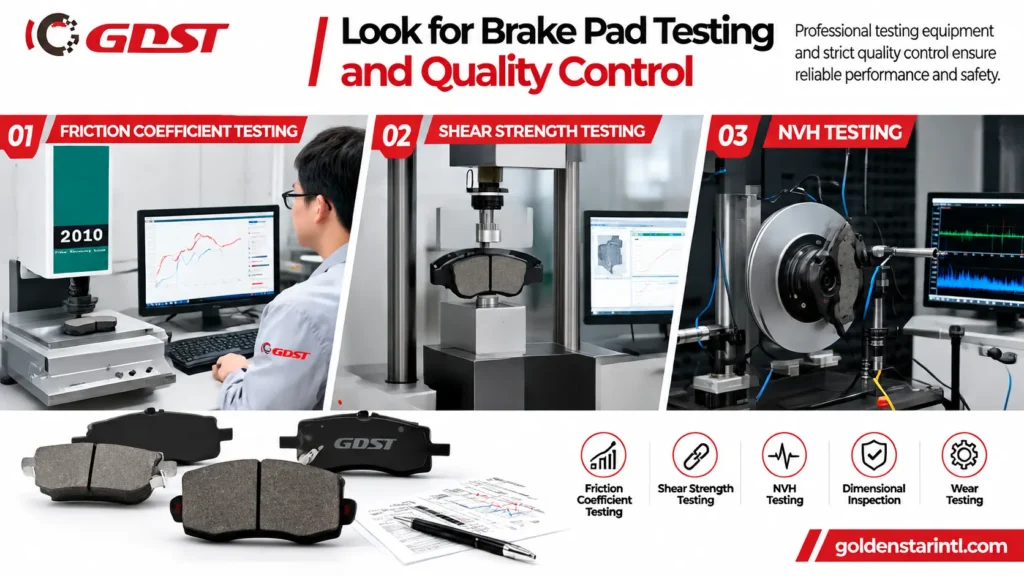
A reliable brake pad manufacturer should be able to explain how its products are evaluated and what quality-control procedures are used.
For manufacturers, importers, wholesalers, and automotive parts distributors, testing information is particularly important because it provides a basis for comparing products beyond their appearance or price.
Professional brake pad testing may involve several procedures to evaluate friction characteristics, mechanical strength, noise behavior, and manufacturing consistency.
Friction Coefficient Testing
Friction coefficient testing evaluates how a brake pad’s friction material behaves under specified test conditions.
The results help manufacturers assess friction characteristics and determine whether a formulation meets its intended performance requirements.
Different friction formulations may behave differently across operating temperatures, so testing should consider the relevant application and test conditions.
Shear Strength Testing
Shear strength testing evaluates the bonding strength between the friction material and the backing plate.
This is an important mechanical quality indicator because the friction material must remain securely attached to its backing plate during normal braking operation.
Consistent bonding strength helps support product structural integrity and manufacturing reliability.
NVH Testing
NVH stands for Noise, Vibration, and Harshness.
Brake NVH testing helps evaluate noise and vibration behavior associated with the friction material and braking system.
It is particularly relevant for passenger vehicles, where drivers expect comfortable and quiet braking operation.
The test results can help identify potential noise and vibration issues and support friction formulation improvements.
Other Important Brake Pad Inspections
| Test or Inspection | What It Evaluates | Why It Matters |
| Friction coefficient testing | Friction characteristics under defined conditions | Helps evaluate braking material behavior |
| Shear strength testing | Bonding strength between friction material and backing plate | Helps assess structural integrity |
| NVH testing | Noise and vibration characteristics | Supports braking comfort and noise control |
| Dynamometer testing | Friction, temperature, wear and other performance parameters | Evaluates performance under controlled test cycles |
| Wear testing | Material loss under defined conditions | Helps assess durability |
| Dimensional inspection | Pad shape, thickness and mounting geometry | Helps verify manufacturing consistency |
Testing equipment and individual test results should be considered together. The availability of a testing machine alone does not prove that every product meets a particular performance level.
A credible manufacturer should be able to explain the applicable test methods, product identification, testing conditions, measured results, and quality-control requirements.
For buyers, requesting product-specific test reports is more useful than relying solely on general statements about factory testing capabilities.
9. Understand SAE Friction Codes, Brake Pad Standards, and Material Formulations
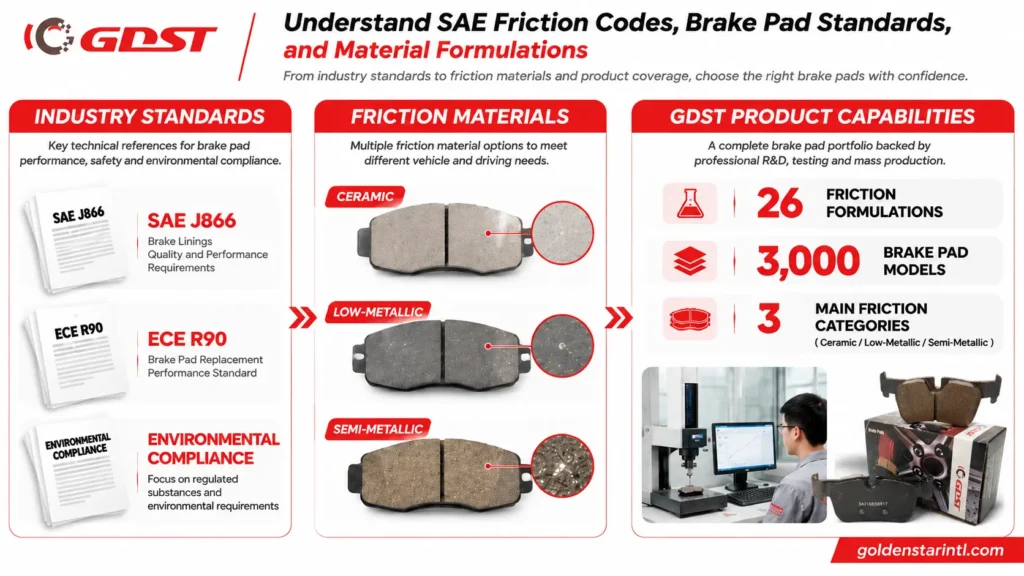
Some brake pads carry friction identification codes that help users understand their friction characteristics.
In North America, SAE J866 provides a standardized identification system for brake lining friction characteristics.
The familiar two-letter code generally describes friction coefficient classifications at normal and elevated test temperatures.
However, SAE J866 is not a universal brake pad quality ranking.
A higher friction code should not automatically be interpreted as a safer or better brake pad. Complete braking performance also depends on the vehicle’s brake system design, operating conditions, rotor compatibility, and other technical factors.
What Is ECE R90?
UN Regulation No. 90 establishes approval requirements for certain replacement brake lining assemblies, drum brake linings, and brake discs and drums within its applicable scope.
For relevant replacement brake lining assemblies, the regulation includes performance requirements intended to establish similarity to the original brake lining assembly and adequate mechanical characteristics.
However, ECE R90 is not a universal certification requirement for every brake pad sold worldwide.
Buyers should check whether the product and vehicle application fall within the regulation’s scope and whether the destination market requires the relevant approval.
Why Friction Formulation Matters
Friction material formulation is one of the most important factors influencing brake pad characteristics.
Even within the same material category, different combinations of fibers, fillers, binders, metallic ingredients, and friction modifiers can produce different results.
For example, two ceramic brake pads may have different friction coefficients, wear characteristics, noise behavior, and temperature responses.
This is why selecting brake pads based only on broad material classifications is not sufficient.
A manufacturer with multiple tested formulations can provide more flexibility when matching products to different vehicle applications and customer requirements.
GDST’s Brake Pad Formulation and Product Coverage
GDST offers 26 different brake pad friction formulations, mainly grouped into three categories:
- Low-Metallic.
- Semi-Metallic.
These formulations provide different friction characteristics and application options for various aftermarket requirements.
GDST’s brake pad product range covers 3,000 models, supporting a broad selection of vehicle applications.
For automotive parts distributors and importers, this range can help simplify product sourcing and expand vehicle coverage through one supplier.
However, the correct formulation and product reference should always be selected according to the vehicle’s original specifications and intended operating conditions.
Environmental Compliance and Copper-Free Brake Pads
Environmental requirements are another factor in brake pad selection.
Some markets, including California and Washington in the United States, have introduced restrictions on copper content in motor vehicle brake friction materials.
Applicable requirements and exemptions vary by market, so importers and distributors should verify the environmental regulations relevant to their destination countries.
A manufacturer should be able to provide appropriate product information and supporting documentation when environmental compliance is required.
10. Consider Brake Dust, Noise, and Driving Comfort
Brake dust and noise are two common concerns among vehicle owners.
However, they should be evaluated as separate characteristics rather than treated as direct indicators of overall product quality.
Brake Dust
Brake dust is generated through the wear of friction materials and the interaction between brake pads and rotors.
Its appearance and quantity depend on the friction formulation, operating temperature, braking frequency, rotor material, and vehicle usage.
Ceramic brake pads are often selected for lower visible dust, but actual results vary between products.
If clean wheels and reduced visible dust are priorities, look for products with documented low-dust performance rather than relying only on material labels.
Brake Noise
Brake squealing and vibration may result from several factors, including friction material characteristics, rotor surface condition, caliper movement, missing or damaged hardware, incorrect installation, and inadequate bedding-in.
Anti-noise shims and appropriate friction formulations can help reduce vibration-related noise.
However, changing the brake pad material alone may not solve a noise problem caused by worn caliper components, damaged rotors, or improper installation.
A proper inspection should identify the actual cause before selecting replacement components.
11. How Long Do Brake Pads Last?
Brake pad service life varies significantly between vehicles and driving conditions.
Some drivers may need replacement relatively early because of frequent urban braking, heavy loads, or aggressive driving. Others may obtain considerably longer service life under lighter operating conditions.
There is no single mileage figure that applies to every brake pad.
Important factors affecting brake pad life include:
- Vehicle weight and axle load.
- Brake pad friction formulation.
- Rotor condition and material.
- City, highway, and mountain driving.
- Driving style and braking frequency.
- Towing and cargo loads.
- Caliper movement and brake system condition.
- Environmental exposure and corrosion.
Instead of relying only on mileage, brake pad condition should be checked through regular inspections.
Common warning signs include:
- A brake wear warning light or electronic notification.
- A mechanical wear indicator producing a squealing sound.
- Grinding noises during braking.
- Reduced braking performance.
- Visible friction material wear.
- Uneven pad wear between wheels or between inner and outer pads.
Grinding, pulling, or unusual pedal behavior should be inspected promptly because these symptoms may indicate problems beyond ordinary pad wear.
Always use the vehicle manufacturer’s minimum thickness specification and applicable service procedures when deciding whether brake pads require replacement.
12. Should You Choose OEM or Aftermarket Brake Pads?
OEM and aftermarket brake pads are both available to vehicle owners, repair shops, and automotive parts distributors.
The important distinction is not simply where the product is sold, but whether it meets the technical requirements of the intended vehicle application.
OEM Brake Pads
OEM brake pads are supplied for original vehicle production or through the vehicle manufacturer’s approved parts channels.
They are generally designed around the vehicle’s original braking system requirements.
Their main advantages include application-specific engineering and established compatibility with the original brake configuration.
However, OEM products may have higher retail prices and may not always be the most economical option for independent repair businesses or aftermarket distributors.
Aftermarket Brake Pads
Aftermarket brake pads are produced for replacement applications outside the original vehicle production supply chain.
A high-quality aftermarket brake pad should provide accurate fitment, appropriate friction characteristics, reliable mechanical construction, and performance suitable for its intended application.
For repair shops and distributors, aftermarket products can provide additional choices in material formulations, product positioning, pricing, and supply arrangements.
The most important purchasing criteria should be product compatibility, technical documentation, applicable approvals, manufacturing consistency, and supplier reliability.
13. Consider the Total Cost of Ownership, Not Just the Purchase Price
The cheapest brake pads are not necessarily the most economical option over time.
When comparing products, consider the complete cost of ownership rather than focusing only on the initial purchase price.
A lower-priced product may offer attractive short-term savings but could result in additional expenses if it has unsuitable friction characteristics, excessive wear, poor noise performance, or inconsistent quality.
A more complete cost comparison should include:
- Initial brake pad purchase price.
- Expected service life under the intended operating conditions.
- Rotor wear and replacement requirements.
- Installation and labor costs.
- Warranty terms and after-sales support.
- Product availability and delivery time.
- Potential costs associated with incorrect fitment or product returns.
For automotive parts distributors, the total cost of ownership also includes inventory turnover, application coverage, warranty claims, and customer satisfaction.
A reliable product with consistent quality and accurate fitment can offer better long-term commercial value than a product selected only because of its lowest unit price.
14. What Should You Check Before Buying Brake Pads?
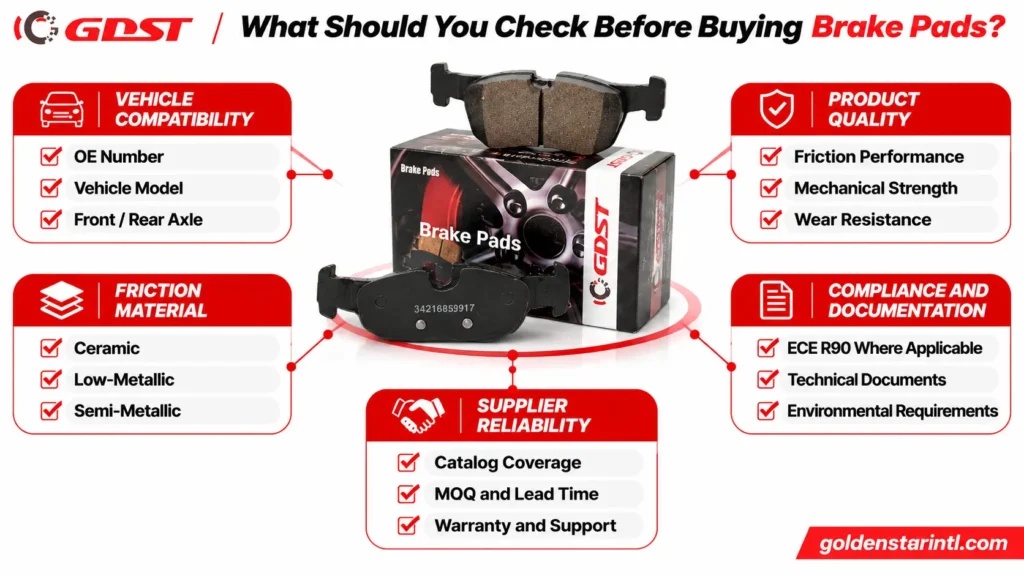
Before purchasing brake pads, use a structured checklist to avoid common selection mistakes.
Vehicle Compatibility
- Confirm the vehicle make, model, year, and configuration.
- Verify the front or rear axle application.
- Check the OE part number or VIN where necessary.
- Confirm caliper and rotor specifications.
Friction Material
- Identify the friction material type.
- Evaluate the intended driving conditions.
- Consider noise, dust, wear, and thermal requirements.
- Avoid selecting products based only on material names.
Product Quality
- Check friction performance documentation.
- Review relevant mechanical strength and wear testing.
- Verify manufacturing consistency and traceability.
- Confirm that product claims are supported by relevant evidence.
Compliance and Documentation
- Check applicable market regulations.
- Verify ECE R90 approval where required.
- Review environmental marking and supporting documents.
- Confirm warranty terms and product identification.
Supplier Reliability
- Check product catalog coverage.
- Request technical specifications and OE cross-references.
- Confirm MOQ, lead time, packaging, and delivery arrangements.
- Evaluate technical support and after-sales service.
15. How to Select a Reliable Brake Pad Manufacturer or Supplier
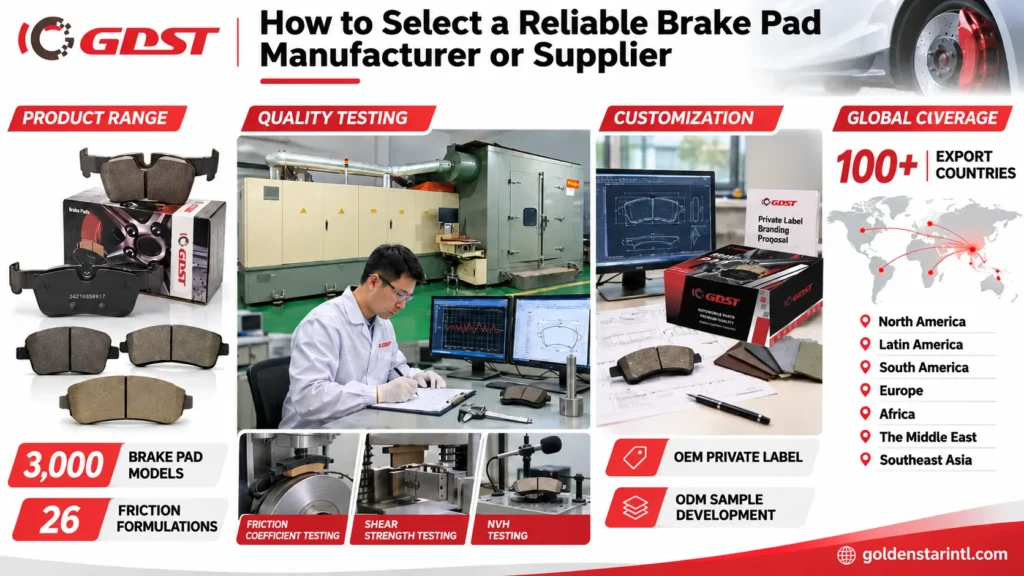
For importers, wholesalers, automotive parts distributors, and repair networks, choosing the right supplier is just as important as choosing the right brake pad.
A reliable manufacturer should offer more than a large product catalog. It should be able to provide accurate application information, stable manufacturing quality, relevant testing capabilities, and consistent supply.
Evaluate Product Range and Application Coverage
A broad product catalog can help distributors serve more vehicle models and reduce the need to source from multiple suppliers.
However, catalog size should be supported by accurate OE cross-references and reliable fitment information.
GDST offers 3,000 brake pad models covering a broad range of aftermarket vehicle applications.
Combined with 26 friction formulations across ceramic, low-metallic, and semi-metallic categories, this product range provides different options for distributors serving diverse vehicle segments and market requirements.
Check Manufacturing and Testing Capabilities
Ask whether the supplier has relevant testing equipment and established quality-control procedures.
For example, GDST’s brake pad testing capabilities include:
- Friction Coefficient Testing Equipment:Used to evaluate friction characteristics under defined test conditions.
- Shear Strength Testing Equipment:Used to assess the bonding strength between friction material and backing plates.
- NVH Testing Equipment:Used to evaluate noise and vibration characteristics associated with brake pad performance.
These testing capabilities support product evaluation and formulation development.
When evaluating a supplier, buyers should also request relevant test reports and confirm that the reported results correspond to the actual products being purchased.
Confirm OEM and ODM Customization Capabilities
Different markets and distributors may require different product specifications, packaging, and branding arrangements.
A capable manufacturer should be able to support different cooperation models, including:
OEM and Private Label Services
Customers can develop their own branded aftermarket brake pad products using customized branding and packaging arrangements.
ODM and Sample-Based Development
For customers with specific product requirements, a manufacturer can support new product development based on customer-provided samples.
This approach can help distributors develop products for particular vehicle applications, market requirements, or business strategies.
Before starting a customization project, confirm product drawings, samples, friction material requirements, technical specifications, testing expectations, and commercial arrangements.
Evaluate Export Experience and Market Coverage
A supplier’s export experience is another important consideration, especially for international distributors and importers.
Different markets may have different vehicle populations, environmental regulations, product documentation requirements, and packaging expectations.
GDST exports automotive brake pad products to more than 100 countries across:
- North America.
- Latin America.
- South America.
- The Middle East.
- Southeast Asia.
This international market coverage reflects experience serving different aftermarket purchasing environments.
However, buyers should still confirm the specific compliance, documentation, and product requirements applicable to their own destination markets.
Check Commercial Terms and Long-Term Support
Before placing an order, confirm the following:
- Minimum order quantity (MOQ).
- Production lead time.
- Packaging and private-label requirements.
- Payment and shipping arrangements.
- Warranty terms.
- Product traceability.
- Technical documentation.
- After-sales communication and support.
A long-term supplier relationship should be based on reliable product quality, accurate fitment, clear communication, and transparent commercial terms.
For importers and distributors, these factors help build a more dependable supply chain and reduce the risks associated with aftermarket brake pad sourcing.
16. How to Bed In New Brake Pads Properly
Bedding-in, also called burnishing, is the process of gradually conditioning new brake pads and their mating rotor surfaces after installation.
It helps establish appropriate contact between the friction material and rotor and can contribute to stable braking behavior.
New brake pads should not automatically be subjected to aggressive braking immediately after installation.
The correct bedding procedure depends on the brake pad formulation, rotor condition, and manufacturer’s recommendations.
General precautions include:
- Follow the specific bedding instructions supplied with the brake pads.
- Avoid unnecessary hard braking during the initial bedding period.
- Allow sufficient cooling between braking applications where required.
- Avoid excessive thermal loading while the friction surfaces are conditioning.
- Check for abnormal noise, vibration, or changes in braking behavior.
Different manufacturers recommend different procedures. Their instructions should not be assumed interchangeable with every other manufacturer’s guidance.
If the vehicle has new pads and rotors, follow the complete installation and bedding instructions provided for that specific combination.
17. Common Mistakes to Avoid When Choosing Brake Pads
Even experienced vehicle owners and parts buyers can make mistakes when selecting replacement brake pads.
The following are some of the most common problems.
Choosing Brake Pads Based Only on Price
A low purchase price does not guarantee good value. Product fitment, friction performance, durability, and quality documentation should also be considered.
Assuming Ceramic Brake Pads Are Always Better
Ceramic formulations can offer attractive comfort and dust characteristics, but they are not automatically suitable for every vehicle or driving condition.
Ignoring OE Specifications
A brake pad that physically resembles the original component may still have an incorrect friction formulation, thickness, or mounting configuration.
Using Performance Pads for Ordinary Driving Without Considering Their Operating Range
Some performance compounds are developed for higher operating temperatures and may not deliver the desired cold performance or comfort during everyday driving.
Replacing Pads Without Inspecting the Rotors
Worn or damaged rotors can affect the performance and service life of new brake pads.
Ignoring Installation and Bedding Procedures
Incorrect installation, unsuitable hardware, or improper bedding can contribute to noise, vibration, uneven wear, and reduced braking effectiveness.
18. Frequently Asked Questions About Choosing Brake Pads
Which Brake Pads Are Best for Most Everyday Cars?
For many passenger cars, a properly matched ceramic or semi-metallic brake pad can provide suitable everyday braking performance.
The best choice depends on the vehicle manufacturer’s original specifications, driving conditions, and the friction characteristics of the specific product.
Are Ceramic Brake Pads Better Than Semi-Metallic Brake Pads?
Neither material is universally better.
Ceramic brake pads are often selected for lower visible dust and comfortable everyday operation. Semi-metallic brake pads may be more suitable for certain applications requiring different thermal and friction characteristics.
The correct choice depends on the complete braking system and intended use.
Do More Expensive Brake Pads Last Longer?
Not necessarily.
Price alone cannot predict brake pad service life. Friction formulation, rotor compatibility, vehicle weight, driving style, and operating conditions all affect wear.
Compare documented product performance and warranty terms rather than assuming a higher price guarantees longer life.
Can I Install Ceramic Brake Pads on Any Car?
No.
Ceramic brake pads must match the vehicle’s braking system specifications and intended operating conditions. Some vehicles require particular friction characteristics or approved replacement materials.
Always verify fitment before purchasing.
Should I Replace All Four Brake Pads at the Same Time?
Not necessarily.
Brake pads are normally replaced in axle sets, meaning both left and right pads on the same axle should be replaced together.
Whether the front and rear axles need replacement at the same time depends on their individual wear conditions and the vehicle manufacturer’s recommendations.
How Do I Know If My Brake Pads Are High Quality?
Look for accurate vehicle fitment, consistent dimensions, appropriate friction characteristics, reliable bonding strength, relevant testing documentation, and compliance with applicable market requirements.
A reputable supplier should be able to explain its product specifications and quality-control procedures.
Are Low-Dust Brake Pads Always Better?
Not necessarily.
Low-dust characteristics may improve wheel cleanliness, but brake pad selection should also consider braking performance, wear, thermal stability, rotor compatibility, and the vehicle’s original specifications.
Do New Brake Pads Need Bedding-In?
In most applications, following an appropriate bedding-in procedure is recommended.
The exact procedure depends on the product and rotor combination. Always follow the manufacturer’s instructions rather than applying a generic procedure to every brake pad.
Can I Use the Same Brake Pads for Different Vehicle Models?
Only when the brake pad manufacturer or vehicle application catalog confirms that the same part is approved for those applications.
Similar appearance or dimensions alone are not sufficient to establish compatibility.
When Should Brake Pads Be Replaced?
Brake pads should be replaced when their friction material reaches the applicable minimum thickness or when inspection identifies damage or other conditions requiring replacement.
Electronic warnings, mechanical wear indicators, unusual noise, and changes in braking behavior should be investigated promptly.
19. Final Thoughts: Choose Brake Pads That Match Your Vehicle and Driving Needs
Choosing the best brake pads is a process of matching the right friction material, product design, and performance characteristics to the vehicle’s original braking system and intended operating conditions.
Start by confirming vehicle compatibility and OE specifications. Then compare ceramic, semi-metallic, low-metallic, and organic formulations based on braking requirements, noise, dust, wear, and thermal performance.
Finally, evaluate product quality, relevant testing documentation, rotor condition, market compliance, and supplier reliability.
For individual vehicle owners, the priority should be safe, predictable braking performance and correct application fitment. For automotive parts distributors and importers, consistent manufacturing quality, accurate OE cross-references, technical support, and dependable supply are equally important.
A reliable brake pad manufacturer should combine broad product coverage, appropriate friction formulations, quality testing capabilities, and flexible OEM and ODM cooperation.
The best brake pads are not necessarily the most expensive or the most aggressively marketed. They are the products engineered and verified for the vehicle, braking system, and operating conditions in which they will be used.