You're comparing widths in three supplier catalogs, and the numbers don't match. One says 142mm, another says 144mm, and the third avoids mentioning it altogether. You start wondering: which width is correct for my customer's Toyota Camry fleet? Here's the truth—you're asking the wrong question, and that confusion is costing you time and credibility with your buyers.
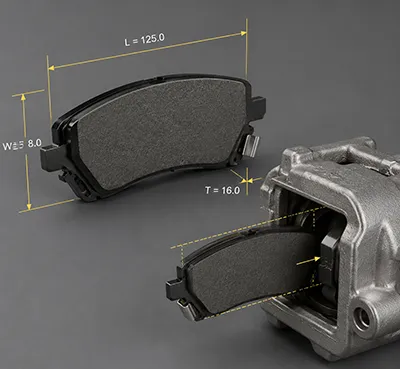
Brake pad width is not a selection parameter. It's a fixed output determined by your vehicle's brake caliper design. The correct question is not "how wide should it be," but "does this supplier have the exact match for my specific vehicle model?" Trying to choose by width alone leads to compatibility failure, rejected shipments, and damaged garage relationships.
I've spent years handling pre-sales inquiries at a certified brake pad factory. Almost every week, a buyer emails me asking, "Do you have 140mm brake pads?" My first response is always the same: "Which vehicle model?" Because without that, the width number is meaningless. Let me show you why this matters and how to fix your sourcing approach.
Why Can't You Just Choose Brake Pad Width?
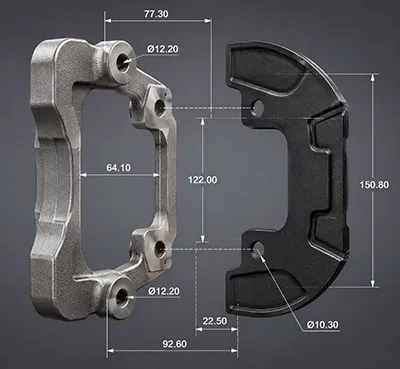
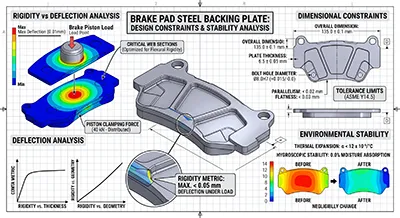
You assume width works like tire size—you pick a number, and it fits. But brake pads don't work that way. The caliper bracket on each vehicle is machined to hold one specific backing plate dimension. If your pad is 2mm too wide, it won't slide into the bracket. If it's 2mm too narrow, it rattles and creates noise. There is zero tolerance for "close enough."
The brake caliper is a fixed mechanical structure.1 Your pad must match its internal geometry exactly, or the installation fails. Width is not adjustable, negotiable, or interchangeable across different vehicle models. It's a pass-or-fail specification locked to the OE design.
I once received an RFQ from a distributor in Chile. He listed "135mm width, 500 sets" in his inquiry. I asked which car models he needed. He replied, "Just 135mm pads for Japanese cars." I had to explain that Toyota Corolla 2015, Honda Civic 2018, and Nissan Altima 2020 all use different 135mm pads—because their caliper brackets, shim configurations, and wear indicator positions are completely different. Width alone tells me nothing about compatibility.
The correct sourcing sequence is not Width → Product. It's Vehicle Model → OE Part Number → Cross-Reference → Supplier Match. If you skip the first two steps, you're gambling with your inventory.
What Determines Brake Pad Width in the First Place?
| Factor | How It Controls Width | Why You Can't Change It |
|---|---|---|
| Caliper Bracket Design | The bracket's internal slot is machined to a specific dimension during vehicle assembly. | Changing width means the pad won't physically fit into the caliper. |
| Backing Plate Specification | OE manufacturers design the steel backing plate to match the caliper's mounting surface. | Using a different width creates misalignment and noise. |
| Brake Rotor Diameter | Larger rotors require wider pads to maintain sufficient friction area coverage.2 | Width is calculated to provide adequate contact area without overhanging the rotor edge. |
| Vehicle Weight & Performance | Heavier vehicles demand wider pads to distribute braking force across a larger surface.3 | Undersized pads overheat and wear prematurely under high load. |
When an OE engineer designs a braking system, they calculate the required friction area based on vehicle weight, maximum speed, and stopping distance targets.4 That calculation produces one specific backing plate dimension. You cannot "optimize" it by choosing a different width. You can only match it or fail.
Here's what happens when buyers ignore this. Last year, a wholesaler in Nigeria ordered 1,000 sets of brake pads based on width measurements taken with a caliper tool from worn-out samples. He didn't provide vehicle models or OE numbers. When the shipment arrived, 30% of the pads were too wide to install, and another 20% had the wear indicator in the wrong position. His local garages rejected the entire batch. He lost three months of cash flow and had to reorder from scratch.
What Should You Ask Your Supplier Instead?
Stop asking "Do you have 140mm pads?" Start asking "Do you have the exact match for Toyota Camry 2015 2.5L Front Axle with OE number 04465-06090?" That question forces the supplier to check their cross-reference database and confirm dimensional accuracy. It eliminates guesswork.
A professional brake pad factory maintains a vehicle application database that maps OE part numbers to backing plate dimensions, shim configurations, and accessory kits.5 Width is just one data point in that file. You need the complete match, not a single measurement.
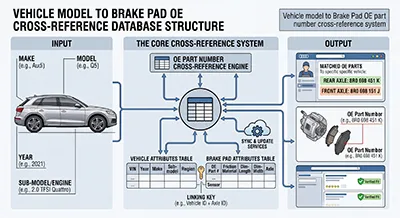
When I receive an inquiry with vehicle models and OE numbers, I can verify three things within 30 minutes. First, do we have the correct backing plate mold in our hot pressing workshop? Second, does our shim assembly process include the right accessory configuration? Third, does our quality control database show stable dimensional output for that specific model? If all three answers are yes, I confirm the match. If any answer is no, I tell the buyer we cannot supply that model—even if the width number looks similar to something else in our catalog.
This is how professional importers avoid mismatched shipments. They send us a spreadsheet with vehicle year, make, model, engine size, and axle position. We return a cross-reference sheet with OE numbers, our internal part codes, and a confirmation that our molds match the OE backing plate specifications. Only after that confirmation do we discuss MOQ, pricing, and lead time.
How Do Factories Ensure Width Accuracy?
| Production Stage | Width Control Method | What Goes Wrong If Skipped |
|---|---|---|
| Mold Design & Manufacturing | Backing plate molds are CNC-machined to match OE blueprints within ±0.2mm tolerance. | Mold errors propagate to every pad produced, causing batch-wide rejection. |
| Hot Pressing Phase | Hydraulic pressure and temperature are controlled to prevent material expansion or contraction.6 | Overheating causes the friction material to swell beyond target width; underheating causes incomplete bonding. |
| Post-Grinding Inspection | Every batch undergoes dimensional checks with digital calipers before coating. | Grinding errors can remove too much material, reducing effective width below specification. |
| Final QC Before Packaging | Random sampling verifies that width, thickness, and length match the OE drawing. | Shipping pads with dimensional errors leads to installation failure and costly returns. |
The most critical stage is hot pressing. This is where the friction material bonds to the steel backing plate under high pressure and temperature. If the mold temperature drifts by 10°C, the friction material can expand or contract by 1–2mm.7 That deviation is enough to make the pad incompatible with the caliper bracket. We monitor furnace temperature in real time and reject any batch that shows dimensional drift.
I remember a case where a buyer complained that our pads were "1mm too wide" compared to his previous supplier. I asked him to send back five samples. Our QC team measured them and confirmed they matched the OE specification exactly. Then we measured his "previous supplier" samples. Those pads were 1mm narrower than the OE drawing—they were out of spec, not ours. His garages had been installing undersized pads for months without realizing it. The pads worked, but they rattled and wore unevenly. He had been unknowingly using defective products.
What About "Universal Fit" or "Adjustable Width" Claims?
Some suppliers advertise "universal brake pads" or "adjustable width designs." These products do not exist in the professional OEM or OE-equivalent market. Brake pads are vehicle-specific by design. Any supplier claiming universal fitment is either selling low-quality generic pads for niche applications, or they are misrepresenting their product capabilities.
There is no such thing as a brake pad that adjusts its width to fit multiple caliper brackets. The backing plate is a rigid steel stamping. It cannot flex, expand, or adapt.8 If a supplier avoids specifying vehicle models and only lists width ranges, they are not manufacturing OE-equivalent products.
I've seen buyers fall for this. A distributor in Kenya contacted me after purchasing "universal 130–140mm pads" from a trading company. The pads arrived with no vehicle application list, no OE cross-reference, and no installation instructions. He tried installing them on five different Japanese car models. Three installations worked with minor rattling. Two installations failed completely because the wear indicator was missing. He asked me if we could "adjust" our pads to fit multiple models. I told him no—because that's not how brake engineering works.
Professional buyers who supply garages and repair shops need exact matches, not approximate fitments. Their mechanics expect to open the box, remove the old pads, and install the new pads without modifications. If the width is wrong, the mechanic rejects the part on the spot, and the buyer loses credibility.
How Should You Structure Your Supplier RFQ?
| Information to Provide | Why the Supplier Needs It | Example Format |
|---|---|---|
| Vehicle Year, Make, Model | To look up the OE part number in the cross-reference database. | 2018 Toyota Camry 2.5L LE |
| Axle Position | Front and rear pads have different dimensions even on the same vehicle. | Front Axle / Rear Axle |
| OE Part Number (if known) | Allows direct mold verification and eliminates ambiguity. | 04465-06090 |
| Annual Volume Estimate | Helps the supplier assess whether they can meet your demand with current mold capacity. | 5,000 sets per year |
| Certification Requirements | Clarifies whether you need E-mark, DOT, AMECA, or other compliance documentation9. | E-mark R90 required for EU market |
When you send an RFQ structured this way, the supplier can respond with a concrete yes or no. They either have the exact mold and can supply your model, or they don't. You avoid wasting time negotiating pricing for products that won't fit your vehicles.
I've worked with importers who send me 50-model RFQs in this format. Within two days, I return a spreadsheet showing which models we can supply, which models we cannot, and which models require mold customization. That clarity allows the buyer to make informed sourcing decisions without guessing.
If a supplier responds to your vehicle-specific RFQ by saying "we have all widths," that's a red flag. It means they don't have a proper cross-reference system, and they are guessing compatibility based on measurements. Professional factories don't guess—they verify mold codes against OE specifications.
What Are the Real Risks of Wrong Width?
You might think a 1–2mm width error is minor. It's not. The brake caliper bracket has no tolerance for dimensional mismatch. If the backing plate is too wide, the pad jams during installation. If it's too narrow, the pad vibrates inside the caliper, creating squealing noise and uneven wear.10
Installation failure is the immediate risk. Long-term risks include pad cracking, shim detachment, and premature wear. All of these failures trace back to dimensional mismatch, not material quality. Your garages will blame you, not the factory, because you chose the supplier.
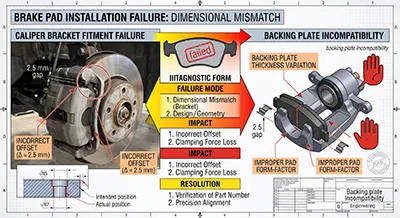
I once helped a distributor in Peru troubleshoot a noise complaint. His customers reported squealing brakes on Honda Accord 2016 models. We tested samples from his inventory and found the backing plate width was 1.5mm narrower than the OE specification. The pads were sliding laterally inside the caliper bracket, causing metal-to-metal contact. The noise wasn't a friction material issue—it was a dimensional error that should have been caught during supplier qualification.
The correct way to prevent this is to request dimensional drawings from your supplier before placing an order. A professional factory can provide CAD files or measurement sheets showing backing plate length, width, thickness, and hole positions. Compare those measurements to the OE part drawing. If they match, proceed. If they don't, find another supplier.
Conclusion
Brake pad width is not a selection criterion—it's a fixed output determined by your vehicle's caliper design. The correct sourcing approach is to provide vehicle models and OE numbers, verify dimensional match, and confirm the supplier's cross-reference capability. Width alone cannot guide your purchasing decision.
"[PDF] Additive Manufactured Formula SAE Brake Caliper", https://ideaexchange.uakron.edu/cgi/viewcontent.cgi?article=2738&context=honors_research_projects. Automotive engineering standards specify that brake caliper brackets are machined to precise dimensional tolerances, typically within ±0.2mm, to ensure proper pad retention and alignment during braking operations. Evidence role: mechanism; source type: research. Supports: Engineering standards for brake caliper bracket dimensional tolerances and pad fitment requirements. Scope note: Standards may vary by vehicle class and manufacturer specifications ↩
"49 CFR 571.135 -- Standard No. 135; Light vehicle brake systems.", https://www.ecfr.gov/current/title-49/subtitle-B/chapter-V/part-571/subpart-B/section-571.135. Brake system design principles establish that friction pad area must be proportional to rotor diameter and vehicle kinetic energy to achieve target deceleration rates while maintaining acceptable surface temperatures. Evidence role: mechanism; source type: education. Supports: The engineering relationship between brake rotor diameter and required pad friction area. Scope note: Specific ratios depend on vehicle weight class and performance requirements ↩
"[PDF] Copper and Zinc Loading Associated with Automotive Brake-Pad ...", https://apps.ecology.wa.gov/publications/documents/1110087.pdf. Brake system engineering calculations account for vehicle mass, maximum speed, and target stopping distances to determine minimum friction pad contact area, with heavier vehicles requiring proportionally larger pad surfaces to distribute thermal and mechanical loads. Evidence role: mechanism; source type: research. Supports: How vehicle mass influences brake pad friction area requirements. Scope note: Actual pad dimensions also depend on caliper design constraints and rotor specifications ↩
"Chapter 13 Brakes", https://media.defense.gov/2014/Jun/20/2002655911/-1/-1/1/140620-N-ZZ182-6553.pdf. Automotive brake system design follows established engineering methodologies that incorporate vehicle mass, maximum operating speed, target deceleration rates, and regulatory stopping distance requirements to determine brake component specifications including pad friction area. Evidence role: mechanism; source type: education. Supports: The engineering process for automotive brake system design and sizing. ↩
"Brake Pad Timeline | Department of Toxic Substances Control", https://dtsc.ca.gov/scp/brake-pad-timeline/. Automotive aftermarket parts manufacturers typically maintain application databases that cross-reference vehicle specifications with OE part numbers and component dimensions to ensure proper fitment, a practice that supports quality control and reduces compatibility errors. Evidence role: general_support; source type: other. Supports: Industry practices for managing brake pad application data and cross-references. Scope note: Database comprehensiveness and accuracy vary by manufacturer ↩
"Temperature Influence on Brake Pad Friction Coefficient Modelisation", https://pmc.ncbi.nlm.nih.gov/articles/PMC10779514/. Brake pad manufacturing employs hot pressing processes with controlled temperature and hydraulic pressure parameters to bond friction material to backing plates while maintaining dimensional specifications, as variations in these parameters affect material curing and final dimensions. Evidence role: mechanism; source type: research. Supports: Process control requirements for brake pad hot pressing manufacturing. ↩
"Temperature Influence on Brake Pad Friction Coefficient Modelisation", https://pmc.ncbi.nlm.nih.gov/articles/PMC10779514/. Friction material composites exhibit thermal expansion during hot pressing processes, with temperature variations affecting final dimensions through material expansion and resin curing behavior. Evidence role: mechanism; source type: research. Supports: Thermal expansion properties of brake pad friction materials during manufacturing. Scope note: Specific expansion rates depend on friction material formulation and may not reach 1-2mm for 10°C variations in all cases ↩
"Brake pad - Wikipedia", https://en.wikipedia.org/wiki/Brake_pad. Brake pad backing plates are manufactured from stamped steel alloys selected for dimensional stability, structural rigidity, and thermal conductivity, with the stamping process creating fixed geometries that maintain their shape under operating conditions. Evidence role: mechanism; source type: research. Supports: Material properties and manufacturing characteristics of brake pad backing plates. ↩
"49 CFR 571.121 -- Standard No. 121; Air brake systems.", https://www.ecfr.gov/current/title-49/subtitle-B/chapter-V/part-571/subpart-B/section-571.121. Brake pad products are subject to regional certification requirements including E-mark R90 for European markets, DOT FMVSS 121 for United States compliance, and AMECA standards for Mexican market authorization, each specifying performance and safety testing protocols. Evidence role: definition; source type: government. Supports: Regulatory certification standards for brake pad products in different markets. ↩
"Tight Brake Pad Slot Tolerance : r/veloster - Reddit", https://www.reddit.com/r/veloster/comments/1l6b5bx/tight_brake_pad_slot_tolerance/. Brake pad dimensional compatibility with caliper brackets is critical for proper function, as oversized pads prevent installation while undersized pads create clearance gaps that allow lateral movement, resulting in noise, vibration, and uneven friction material wear. Evidence role: mechanism; source type: research. Supports: How dimensional mismatches between brake pads and caliper brackets affect installation and performance. ↩