

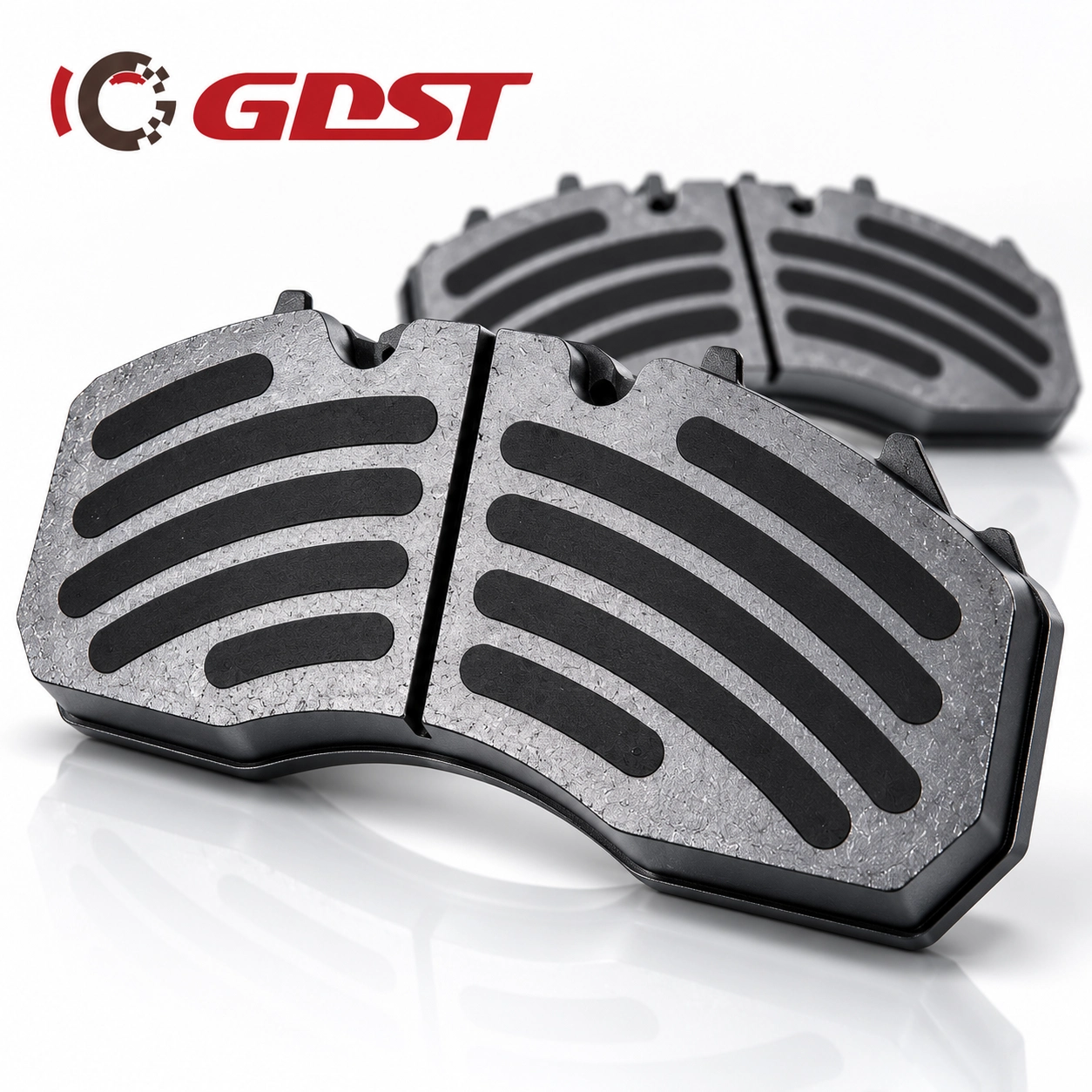
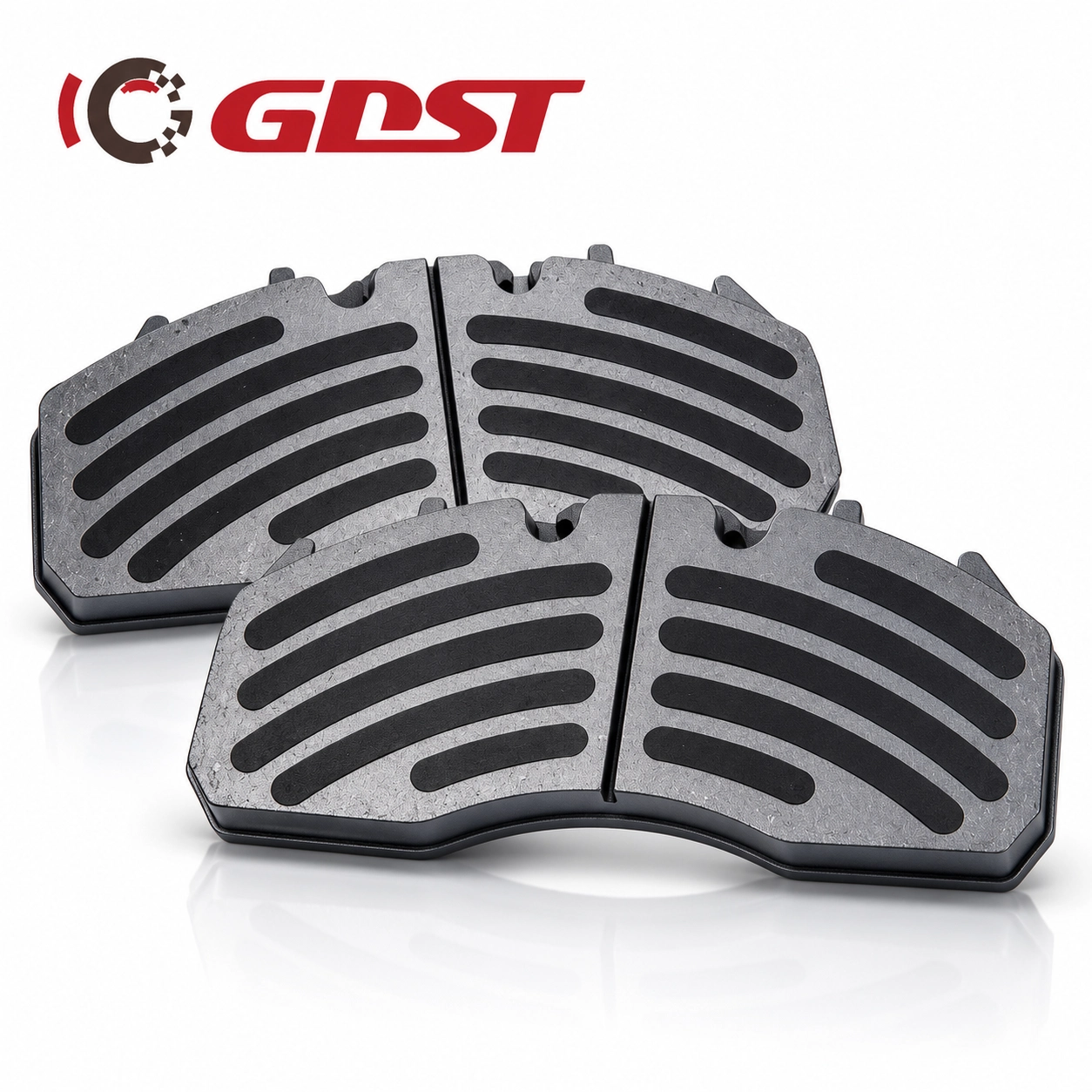
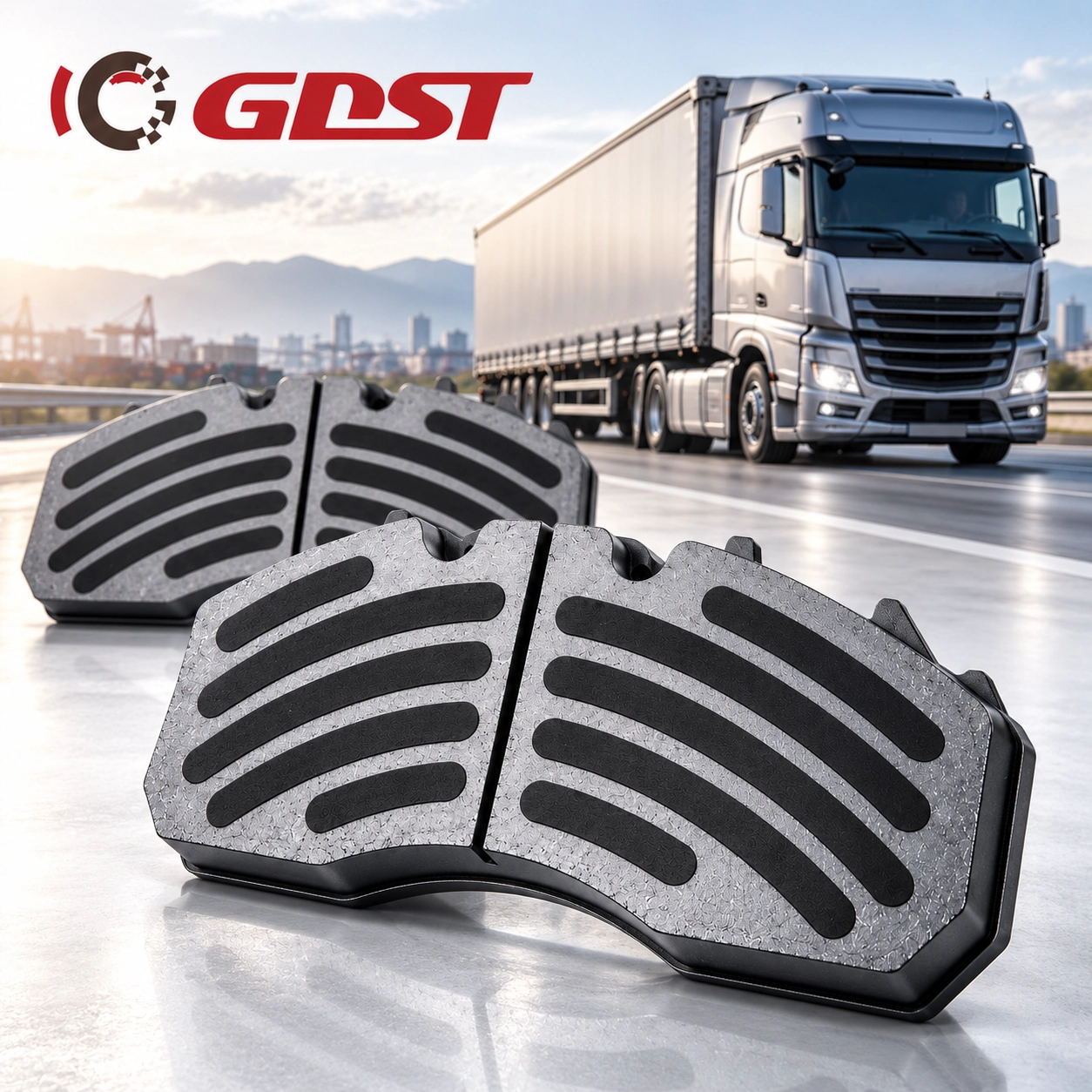
OEM/ODM Truck Brake Pads for Pickup Trucks, Light-Duty Trucks and Commercial Vehicle Applications
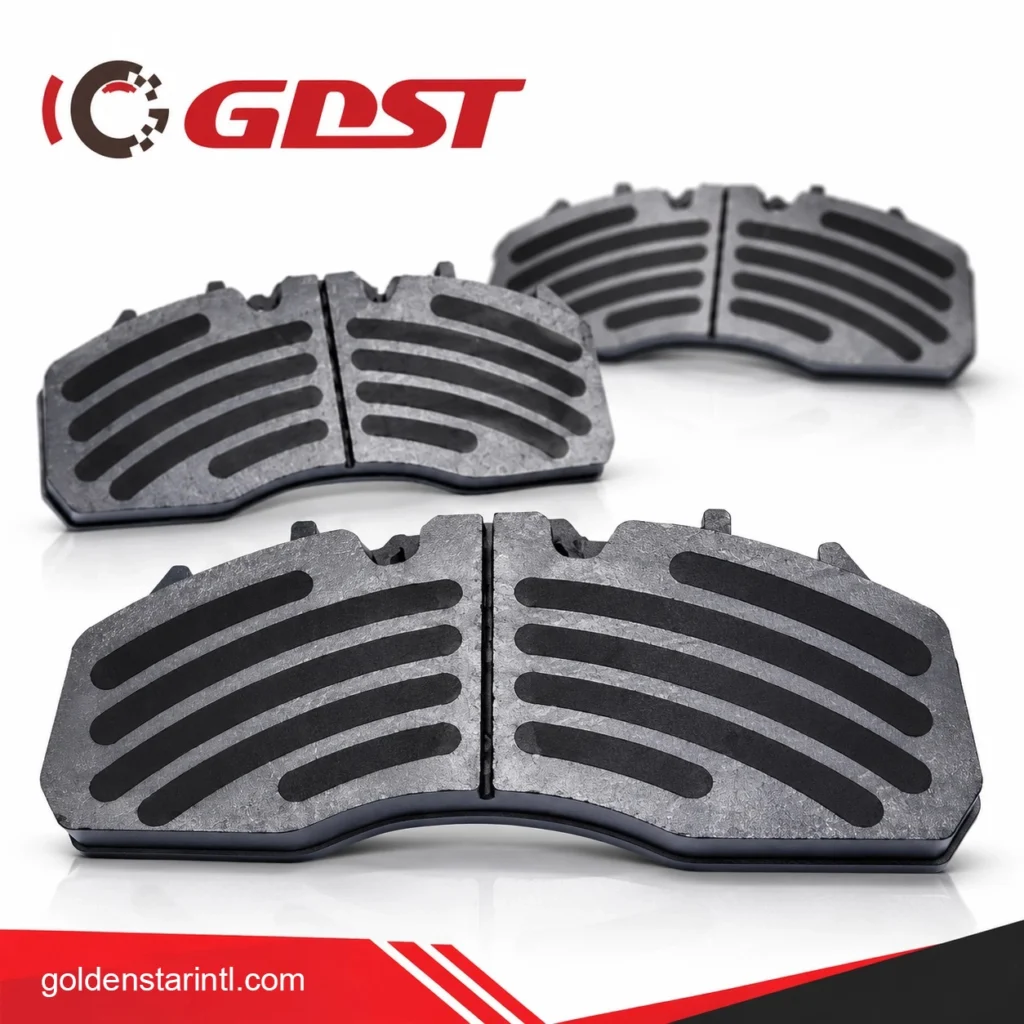
Looking for a reliable truck brake pad manufacturer and wholesale supplier in China? Wuhu GDST Auto Parts Co.,Ltd provides brake pad manufacturing and sourcing solutions for automotive aftermarket importers, distributors, private-label brands and commercial vehicle parts wholesalers.
Our broader brake pad program includes more than 3,000 developed models and 26 friction material formulations across passenger and commercial vehicle applications. Supported by specialized production resources, technical product matching and OEM/ODM services, GDST helps customers identify suitable replacement brake pads for their target markets.
Whether you need truck brake pads for pickup applications, light commercial vehicles or selected heavier commercial vehicle braking systems, we can review your part numbers, technical specifications and purchasing requirements.
We also support customized packaging, approved product development and consolidated purchasing for distributors managing multiple brake pad models.
Product availability, exact vehicle compatibility and applicable testing documentation are confirmed for each specific brake pad model.
|
WVA No. |
Car Model |
|
WVA29137 |
VOLVO |
|
WVA29159 |
SAF, VOLVO |
|
WVA29279 |
MAN |
|
WVA29115 |
Mercedes-Benz, MAN, Volvo, Renault, DAF, Scania, IVECO, BPW, SAF |
|
WVA29125 |
VOLVO, MERITOR |
|
WVA29245 |
Mercedes-Benz |
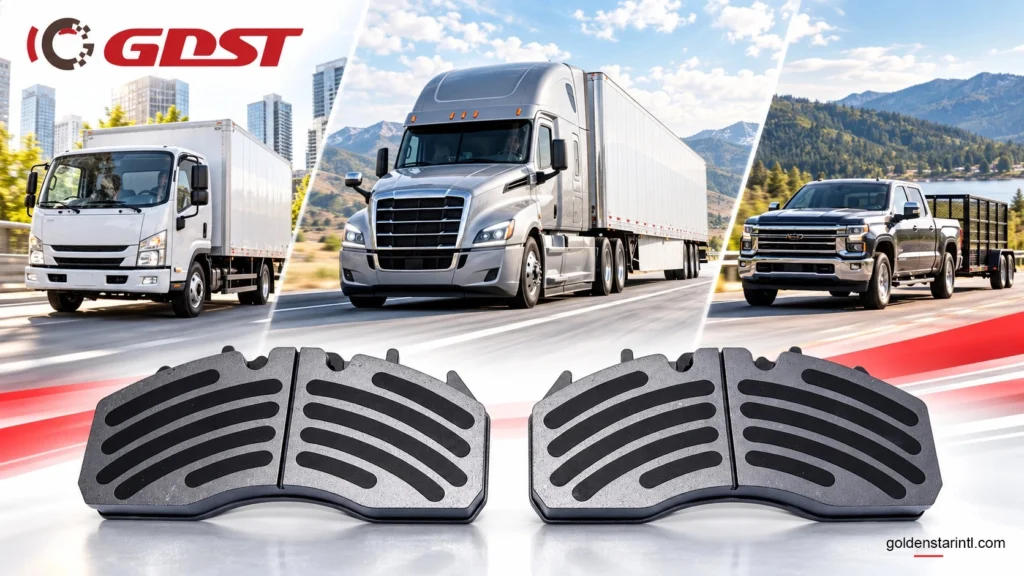
Truck brake pads are friction components used in disc braking systems. When the brakes are applied, the pads interact with the brake disc to generate frictional force, helping slow or stop the vehicle.
However, truck brake pads are not universal components. Pad geometry, friction formulation, backing plate construction and operating requirements can differ significantly between pickup trucks, medium-duty delivery vehicles and heavy commercial trucks.
GDST supports customers sourcing truck brake pads across different aftermarket applications, with product availability determined by the relevant part number and brake system.
Pickup Truck Brake Pads
Pickup trucks commonly use hydraulic disc brake systems, with specific brake pad designs determined by vehicle model, production year, axle position and caliper configuration.
Depending on the application, suitable friction formulations may include semi-metallic, low-metallic or ceramic-based materials.
When selecting pickup truck brake pads, important considerations include:
• Original brake system compatibility
• Normal operating and cargo loads
• Towing and trailer applications
• Friction performance over the intended temperature range
• Noise, vibration and braking comfort
• Brake disc compatibility and wear requirements
Light-Duty Truck Brake Pads
Light-duty trucks are frequently used for urban delivery, utility operations and local transportation.
Their operating conditions may involve repeated braking, changing payloads and frequent start-stop cycles.
Suitable brake pad selection requires confirmation of the original brake system, pad dimensions, friction specifications, and operating requirements.
GDST can review OE references and technical information to identify relevant products within our available range.
Medium- and Heavy-Duty Truck Brake Pads
Medium- and heavy-duty commercial vehicles may use hydraulic disc brakes, air disc brakes or drum brakes, depending on their vehicle and axle configurations.
For commercial trucks equipped with disc brakes, pad compatibility must be confirmed against the installed caliper, brake system and corresponding dimensional requirements.
Customers sourcing heavy-duty truck brake pads should provide existing part numbers, pad drawings or brake system information for verification.
Where the required design is not included in our confirmed product catalog, GDST can review potential development or sourcing options.
Truck Brake Pad Application Overview
|
Vehicle Category |
Common Applications |
Main Selection Considerations |
|
Pickup Trucks |
Daily driving, commercial transport, towing |
Vehicle model, axle, caliper and friction material |
|
Light-Duty Trucks |
Urban delivery, utility fleets |
Pad dimensions, operating load and replacement reference |
|
Medium-Duty Trucks |
Regional delivery, repeated braking |
Brake system, friction stability and temperature requirements |
|
Heavy-Duty Trucks |
Long-distance haulage, commercial transportation |
Disc brake type, caliper, pad geometry and approved friction specifications |
|
Fleet Replacement Programs |
Maintenance across multiple vehicles |
OE cross-references, product identification and consistent specifications |
This table describes application categories for sourcing and product identification. It does not constitute a verified GDST fitment list.
Request GDST Truck Brake Pad Catalog
Send us your target vehicle applications or brake pad part number list. Our team can help review product availability and matching requirements.
Different truck applications place different demands on braking components.
A delivery vehicle operating in stop-and-go traffic may experience frequent braking cycles, while a loaded truck traveling downhill may place substantial thermal demands on its braking system.
Research into brake friction materials demonstrates that operating conditions, including contact pressure and sliding velocity, can influence friction behavior, wear characteristics and particulate emissions.[3]
Consequently, brake pad selection should consider both vehicle compatibility and the intended operating environment.
Urban Delivery and Stop-and-Go Driving
Delivery trucks and utility vehicles often perform frequent braking during daily operations.
Repeated braking can change pad and disc temperatures, while operating loads and driving conditions influence the energy that the braking system must dissipate.
Relevant brake pad characteristics include friction behavior, wear performance, thermal response and compatibility with the vehicle’s braking system.
Highway Transportation and Commercial Fleets
Commercial vehicles used for regional or highway transportation may operate with sustained cargo loads and encounter demanding braking conditions.
Brake pad selection should account for the vehicle’s approved brake system, expected operating conditions and applicable performance requirements.
The appropriate friction material must be evaluated for the specified application rather than selected solely because it is described as heavy-duty.
Pickup Truck Towing Applications
Towing a trailer or carrying additional cargo can increase the braking energy that a vehicle must manage.
For these applications, selecting a suitable brake pad involves more than choosing a material marketed as high-temperature or heavy-duty.
The pad must be compatible with the vehicle’s braking system and validated for the intended operating requirements.
Material changes may also affect cold braking response, noise, pad wear and interaction with the brake disc.
Selecting Brake Pads for Specific Operating Conditions
Truck brake pad performance should be evaluated within defined braking conditions.
Research on automotive friction materials indicates that the interactions between friction compounds, contact surfaces, braking pressure and velocity can produce different friction and wear behaviors.[3][4]
For commercial purchasing projects, GDST recommends confirming the actual vehicle and brake system specifications before choosing a friction material.
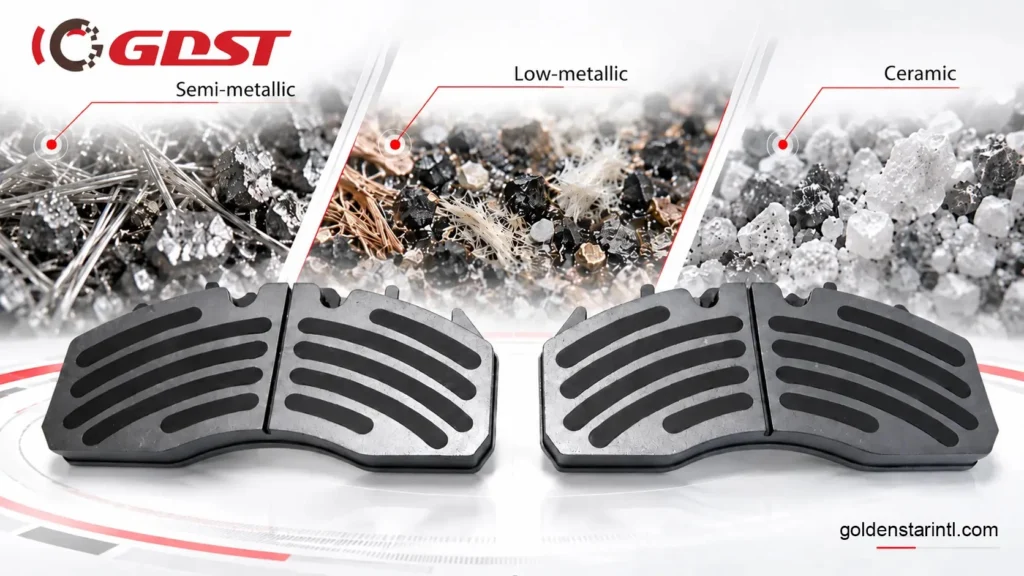
The friction material is a central component of any truck brake pad.
Modern automotive brake friction materials are typically multi-component composites containing combinations of binders, fibers, fillers, abrasives, lubricants and other functional ingredients.
The type, proportion and interaction of these ingredients influence friction performance, wear, noise behavior and other operating characteristics.
Scientific reviews have shown that friction material performance depends on the complete formulation and its operating conditions, rather than a single ingredient or material classification.[1][2]
GDST’s general brake pad portfolio includes 26 friction material formulations, covering semi-metallic, low-metallic and ceramic-based systems.
The formulation available for a particular truck brake pad must be confirmed against its product specification and application requirements.
Semi-Metallic Truck Brake Pads
Semi-metallic brake pads contain metallic constituents combined with other friction materials, binders and functional additives.
Depending on the formulation, metallic constituents can influence thermal conductivity, friction behavior and wear characteristics.
Semi-metallic materials may be considered for applications requiring particular thermal or friction properties.
However, the presence of metallic ingredients does not automatically mean that a brake pad offers superior braking performance or longer service life.
Potential trade-offs include noise behavior, friction stability and wear interactions with the mating brake disc.
Appropriate selection requires application-specific testing and compatibility verification.
Low-Metallic Truck Brake Pads
Low-metallic friction formulations use a controlled proportion of metallic ingredients together with other friction material components.
These formulations can be developed to achieve particular friction, wear and thermal characteristics.
Their actual performance depends on the complete compound, manufacturing process and operating conditions.
Low-metallic brake pads should be selected according to the vehicle’s braking system and validated performance requirements.
Ceramic Brake Pads for Pickup and Light-Duty Trucks
Ceramic-based friction formulations may be suitable for selected pickup truck and light-duty vehicle applications.
Some formulations are developed with attention to noise, dust and braking comfort.
However, ceramic classification alone does not establish suitability for heavy towing, high braking energy or commercial air disc brake systems.
Only formulations evaluated for the intended braking system and operating conditions should be used.
Truck Brake Pad Friction Material Comparison
|
Material Type |
General Characteristics |
Main Selection Considerations |
Application Scope |
|
Semi-Metallic |
Contains metallic constituents within a composite friction material |
Thermal behavior, friction stability, noise and disc wear |
Selected truck and commercial vehicle applications |
|
Low-Metallic |
Uses a controlled amount of metallic ingredients |
Friction behavior, NVH, wear and temperature response |
Selected hydraulic disc brake applications |
|
Ceramic-Based |
Can be formulated with attention to braking comfort, dust and noise |
Load suitability, temperature performance and brake system compatibility |
Selected pickup and light-duty vehicle applications |
|
Application-Specific Formulation |
Developed against defined engineering requirements |
Product validation, development feasibility and target operating conditions |
Approved OEM/ODM or specialized aftermarket projects |
Material Selection Principle
There is no universally superior brake pad friction material for every truck.
The selection should consider vehicle configuration, brake system design, operating conditions, friction characteristics, wear behavior and appropriate test results.[1][2]
Customers with specific friction material requirements can submit their technical specifications for review.
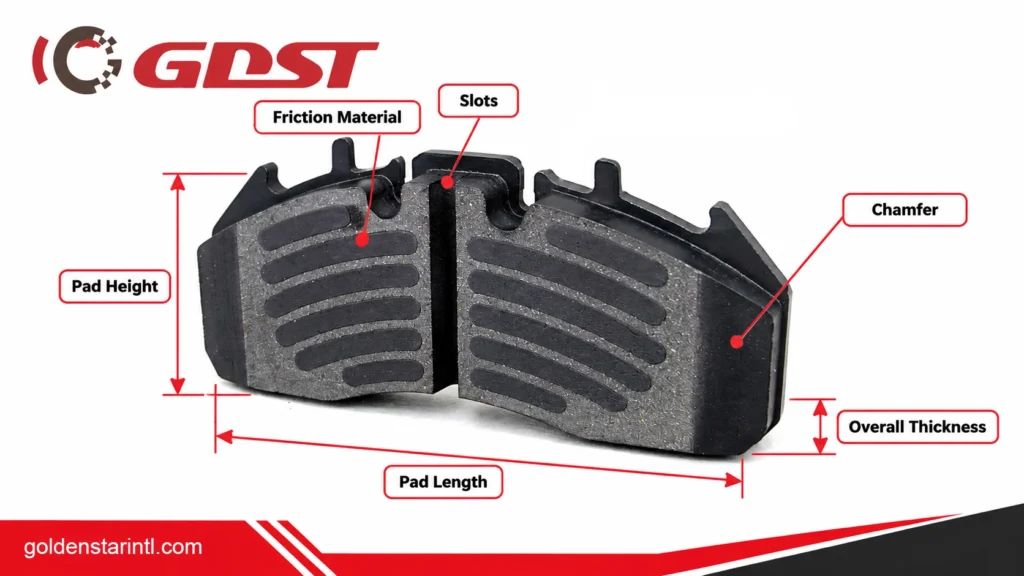
Accurate technical specifications are essential when purchasing truck brake pads for aftermarket distribution or commercial vehicle maintenance.
Two brake pads may appear similar while having different backing plate geometries, thicknesses, mounting features or caliper interfaces.
Incorrect component selection can lead to installation problems and potentially compromise braking system operation.
GDST recommends identifying truck brake pads using verified product references, technical drawings and brake system information.
Truck Brake Pad Technical Specifications
|
Specification |
Description / Available Options |
|
Product Type |
Disc Brake Pad / Brake Pad Set |
|
Application |
Pickup trucks, light-duty trucks and confirmed commercial vehicle applications |
|
Brake System |
Hydraulic disc or air disc, depending on model |
|
Friction Material |
Semi-metallic, low-metallic, ceramic-based or approved application-specific material |
|
Backing Plate |
Steel backing plate; specification varies by design |
|
Pad Length |
Model-specific, mm |
|
Pad Height |
Model-specific, mm |
|
Overall Thickness |
Model-specific, mm |
|
Friction Material Thickness |
Model-specific |
|
Axle Position |
Front, rear or other specified position |
|
Caliper Reference |
Model-specific |
|
OE Cross-Reference |
Available where verified |
|
WVA / FMSI Reference |
Where applicable and confirmed |
|
Wear Indicator |
According to model design |
|
Noise-Reduction Shim |
According to model specification |
|
Slots and Chamfers |
According to applicable design |
|
Supply Unit |
Sets or other agreed packaging units |
|
Custom Packaging |
Subject to project requirements |
|
Testing Information |
Subject to model and documentation availability |
No universal dimensional or friction specification applies to all truck brake pads. Product-specific technical data must be confirmed before ordering.
Information Required for Brake Pad Matching
For accurate sourcing, please provide as much of the following information as possible:
• OE or aftermarket brake pad number
• Truck make, model and production year
• Front or rear axle position
• Brake system or caliper manufacturer
• Existing pad length, height and thickness
• Technical drawings or product photographs
• Required friction material, if specified
• Target market and expected order quantity
Where the supplied reference is insufficient to establish compatibility, additional drawings, measurements or physical samples may be required.
Why Dimensional Compatibility Matters
Brake pad compatibility involves more than friction material dimensions alone.
The backing plate geometry, mounting features, caliper interface and associated components must also correspond to the intended brake system.
Scientific research on brake friction interfaces further demonstrates that the physical contact conditions between friction materials and mating surfaces influence friction and wear behavior.[4]
Accordingly, a cross-reference number should be treated as a product identification aid rather than an unconditional guarantee of interchangeability.
Send Your OE Numbers for Matching
Submit your part number list, drawings or existing brake pad samples for catalog verification and technical review.
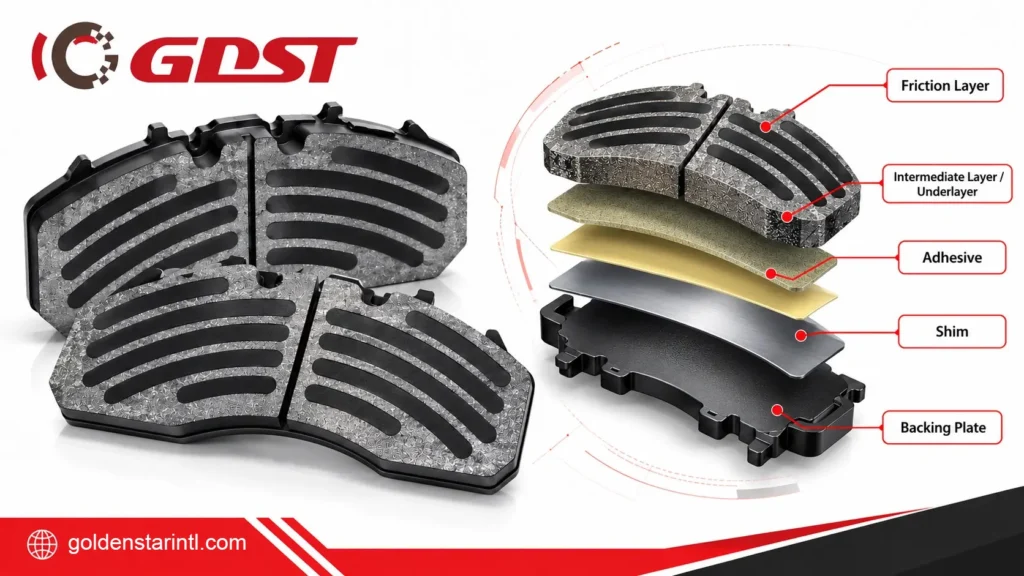
A truck brake pad is an engineered assembly of friction material and supporting components.
Its design must correspond to the specific braking system in which it operates.
Different brake pad models can include additional noise-management, attachment and wear-monitoring features.
Friction Material Layer
The friction layer generates braking friction against the rotating brake disc.
Its properties depend on the friction material composition, manufacturing process and operating conditions.
During braking, the contact interface develops a changing surface structure that can influence friction and wear behavior.
Research on automotive brakes demonstrates that contact surface formation and changes in the real contact conditions play an important role in friction behavior.[4]
Steel Backing Plate
The backing plate provides structural support for the friction material and interfaces with the brake caliper assembly.
Its dimensions, surface preparation and attachment to the friction material are important elements of component design.
The backing plate must match the intended braking system’s dimensional and mechanical requirements.
Bonding Layer and Underlayer
Depending on the design, brake pads may contain bonding layers or intermediate materials between the friction material and steel backing plate.
These layers can be incorporated to achieve specified attachment, mechanical or thermal characteristics.
Their composition and function depend on the approved product construction.
Noise-Reduction Shims
Certain brake pads incorporate noise-reduction shims between the backing plate and associated caliper components.
Brake squeal is a complex vibration phenomenon involving friction forces and the dynamic behavior of multiple brake system components.[5]
Research on multilayer viscoelastic shims demonstrates that these components can influence damping, stiffness and the stability of particular vibration modes.[6]
However, a shim does not guarantee noise elimination under every braking condition.
Shim design and application must be compatible with the intended brake system.
Slots, Chamfers and Wear Indicators
Some brake pads include slots, chamfers or mechanical and electrical wear indicators.
These features vary according to the original design and intended application.
They should not be added, removed or modified without suitable engineering evaluation.
Brake Pad Construction Overview
|
Component |
Primary Function |
Verification Considerations |
|
Friction Layer |
Produces friction during braking |
Formulation and validated operating requirements |
|
Steel Backing Plate |
Supports the friction material |
Geometry, material and caliper compatibility |
|
Bonding / Intermediate Layer |
Provides specified attachment or other structural functions |
Construction and attachment integrity |
|
Noise-Reduction Shim |
Influences vibration transfer in applicable designs |
Material, geometry and installation |
|
Slots / Chamfers |
Application-specific geometric features |
Approved product drawing |
|
Wear Indicator |
Supports wear monitoring where fitted |
Original system compatibility |
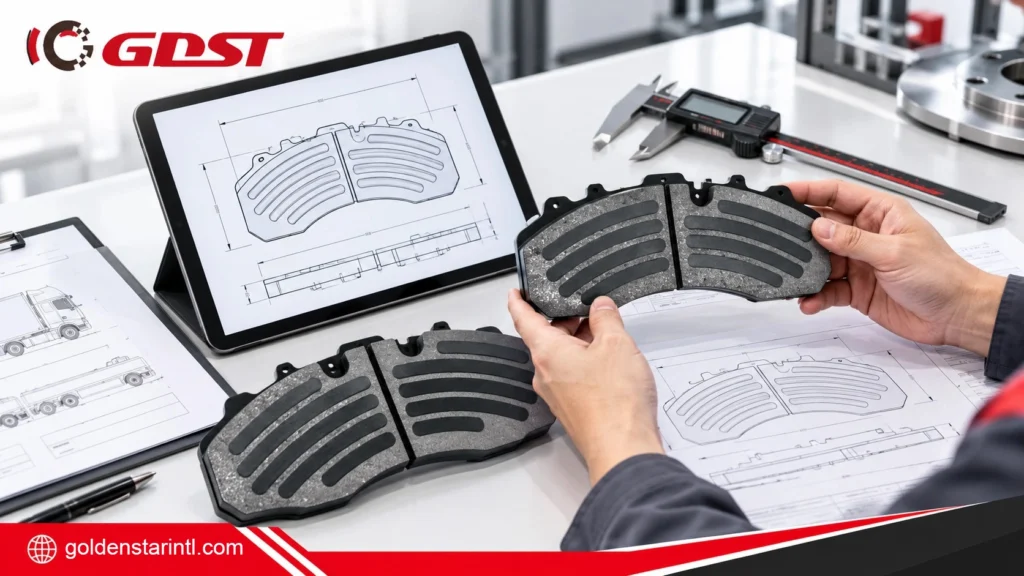
For overseas distributors, accurate part number identification is essential when managing multiple truck brake pad SKUs.
GDST supports product identification through available OE references, aftermarket part numbers, technical drawings and vehicle application information.
Match Truck Brake Pads by OE Number
Customers can submit existing OE or aftermarket reference lists with the required quantities.
Our team can review these references against available product information and identify items requiring additional verification.
Match by Truck Model and Brake System
When a part number is unavailable, customers can provide the vehicle manufacturer, model, year, axle position and installed brake system.
The brake system reference is particularly important because a single vehicle model family may use different calipers or pad designs.
Match by WVA or FMSI Reference
Where applicable, WVA and FMSI references may assist with product identification and comparison.
These identifiers should be checked together with the correct dimensions, brake system information and application details.
A matching reference does not eliminate the need for compatibility verification.
Match by Technical Drawing or Physical Sample
For models not included in the confirmed catalog, GDST can review technical drawings or existing brake pad samples.
Development feasibility depends on the required geometry, friction material, tooling, production requirements and validation scope.
Truck Brake Pad Matching Process
|
Step |
Customer Provides |
GDST Reviews |
| 1. Part Identification |
OE, WVA, FMSI or aftermarket reference |
Available cross-reference information |
| 2. Vehicle Identification |
Make, model, year and axle position |
Application information |
| 3. Brake System Confirmation |
Caliper or brake system reference |
Mechanical compatibility requirements |
| 4. Dimensional Review |
Pad dimensions, drawings or sample |
Geometry and critical interfaces |
| 5. Friction Material Review |
Target application and performance requirements |
Available formulations or development needs |
| 6. Quotation |
Required quantities and packaging |
Product availability and commercial terms |
| 7. Approval |
Sample or inspection requirements |
Agreed confirmation and approval process |
Truck Brake Pad Matching Support
GDST can review your purchasing list and identify the information needed to proceed with product selection or quotation.
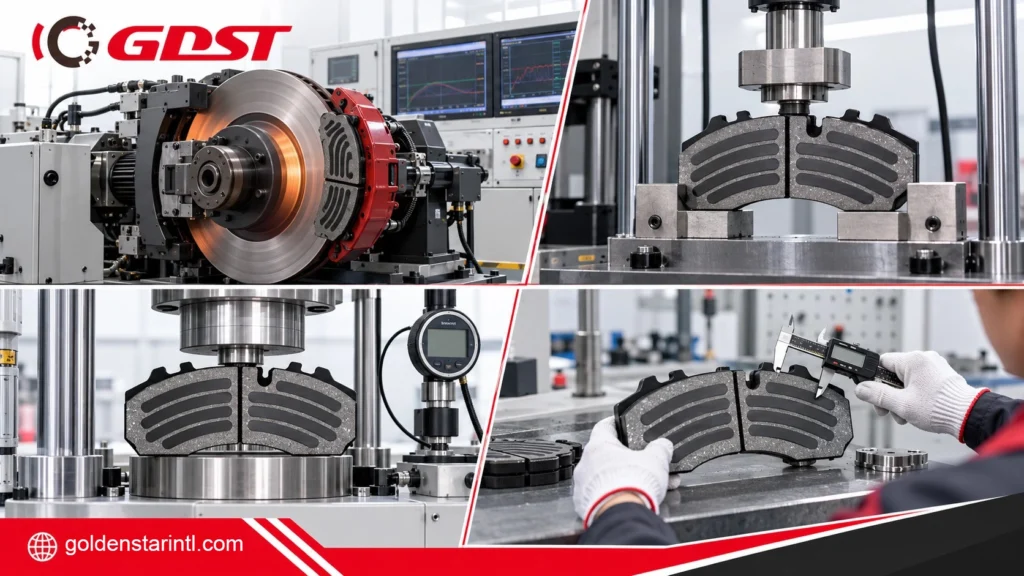
Brake pads are safety-critical automotive components.
Their performance depends on friction material characteristics, structural integrity, manufacturing consistency and compatibility with the braking system.
GDST’s company presentation documents brake friction material testing resources, including dynamometer testing equipment, shear strength testing equipment and instruments for routine physical property inspection.
The presentation includes examples of test reports covering braking effectiveness, fade and recovery, noise-related evaluation and shear strength.
These materials demonstrate the testing resources described in GDST’s brake friction production operations. Product-specific results and test standards must still be verified independently.
Brake Dynamometer Testing: Effectiveness, Fade and Recovery
Brake dynamometer testing evaluates friction material behavior under controlled test conditions.
Depending on the equipment and test program, measurements may include braking response, friction behavior, temperature-related performance and changes during repeated braking events.
GDST’s company presentation shows a passenger-vehicle disc brake dynamometer and a commercial-vehicle test bench identified as the 8000 and F3000 type.
The associated report examples cover disc brake pad testing and commercial-vehicle drum friction material testing, respectively.
Braking Effectiveness
Braking effectiveness testing evaluates the friction system’s response under defined testing conditions.
Results must be interpreted according to the relevant test procedure, applied loads, speeds, temperatures and acceptance criteria.
Brake Fade
Brake fade refers to a reduction in braking effectiveness under demanding operating conditions, commonly associated with elevated temperature and changes in friction behavior.
Research has shown that temperatures at friction interfaces can be spatially non-uniform and that local heat distribution can influence fade and recovery behavior.[7]
This makes controlled thermal testing valuable for friction material evaluation.
Brake Recovery
Recovery testing examines the behavior of the friction system following a fade-related test sequence.
Recovery characteristics should be assessed under the specified procedure rather than inferred from a single friction coefficient measurement.
The commercial-vehicle drum brake report shown in GDST’s company presentation should not be interpreted as a completed heavy-duty air disc brake test report.
Shear Strength Testing for Bonding Integrity
Shear strength testing evaluates the attachment integrity between friction material and its supporting structure under defined loading conditions.
GDST’s company presentation includes a shear strength testing machine and an example test report.
For bonded disc brake pads, shear testing can provide information about the attachment of the friction material to the backing plate.
The applicable test procedure, acceptance criteria and result must be confirmed for each relevant product design.
Hardness, Compressibility and Density Testing
GDST’s company presentation also identifies routine equipment for hardness, compressibility and density evaluation.
These tests help characterize important physical properties of friction materials.
Hardness Testing
Used to assess the hardness of the friction material according to a defined procedure.
Compressibility Testing
Used to evaluate material deformation under specified loading conditions and, where applicable, temperature requirements.
Density Testing
Used to measure the density of the friction material as part of physical property characterization or process monitoring.
Physical properties are useful indicators, but they do not independently establish superior braking performance.
Experimental research has shown that manufacturing conditions influence physical properties, while the relationship between those properties and tribological performance is not necessarily simple or direct.[9]
Noise and Vibration Evaluation
Brake noise can originate from interactions among the friction material, brake disc, caliper and other structural components.
Scientific research identifies disc brake squeal as a complex system-level vibration problem that cannot always be eliminated through friction material changes alone.[5]
GDST’s presentation includes noise-related test report examples.
Actual NVH testing methods, standards and report availability must be confirmed for the specific brake pad model.
Truck Brake Pad Testing Overview
|
Testing Category |
Evaluation Purpose |
Evidence in GDST Company Presentation |
|
Braking Effectiveness |
Friction response under defined conditions |
Disc and drum test report examples |
|
Fade and Recovery |
Friction behavior during and after demanding thermal conditions |
Dynamometer report examples |
|
Noise-Related Evaluation |
Brake noise behavior under specified test conditions |
Testing report examples |
|
Shear Strength |
Friction material attachment integrity |
Testing machine and report example |
|
Hardness |
Friction material physical characteristics |
Routine testing equipment described |
|
Compressibility |
Material deformation under specified conditions |
Routine testing equipment described |
|
Density |
Friction material density |
Routine testing equipment described |
The company presentation shows testing resources and example reports. It does not establish that every truck brake pad model has passed the same test program or obtained a particular certification.
Technical Documentation for OEM and Wholesale Projects
Customers may request a review of available technical documentation when sourcing truck brake pads.
Depending on the product and project requirements, relevant documentation may include:
• Technical drawings and dimensional specifications
• Applicable friction material information
• Product-specific test reports, where available
• Sample inspection and approval information
• Relevant production and inspection documentation
• Applicable certification or regulatory approval information
The availability and relevance of documents must be verified against the specific part number and test scope.
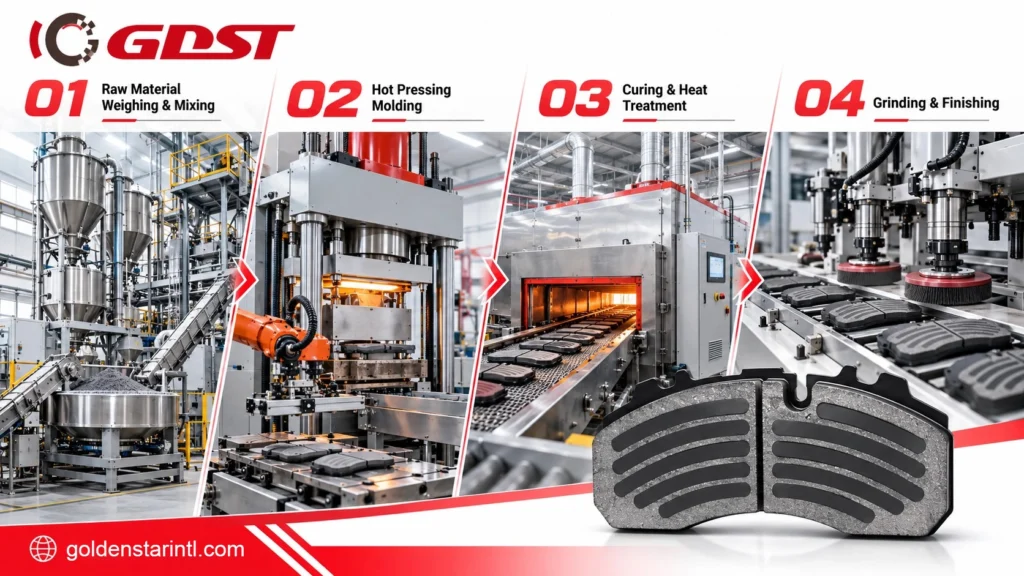
Consistent brake pad manufacturing requires suitable materials, controlled processing conditions and defined inspection procedures.
GDST combines its automotive brake parts manufacturing experience with specialized production resources and established factory partnerships in China.
Our published brake pad factory information describes a production facility covering more than 20,000 square meters with over 100 workers.
GDST’s company presentation further documents automated friction material batching, disc brake pad pressing, controlled heat treatment and automated finishing equipment.
Scientific research indicates that mixing conditions, forming pressure, temperature and heat treatment can influence friction material structure and performance.[8][10]
Automated Friction Material Weighing and Mixing
Brake friction materials contain multiple ingredients that must be prepared according to an approved formulation.
GDST’s company presentation describes an automated weighing and batching system developed for friction material production.
The documented system includes:
• Material bin identification by scanning
• Automatic weighing of ingredients
• Automated material conveying
• Reweighing and feeding operations
• Controlled material mixing
• Automated dispensing
• Computerized process coordination
These functions are designed to reduce manual handling and support consistency in friction material preparation.
Research on brake friction manufacturing has identified mixing sequence and duration among the process variables that may influence material characteristics.[8]
Automated material handling supports process control, but it does not independently establish the friction performance of a finished brake pad.
Automated Commercial Vehicle Disc Brake Pad Pressing
GDST’s company presentation shows an automated pressing line identified for bus and coach disc brake pads.
The documented equipment includes multiple pressing stations with independently controlled hydraulic and electrical systems.
Its described functions include automatic feeding, material weighing, robotic material transfer, backing plate handling, pressing and unloading.
The presentation also identifies production status monitoring and automatic alerts for abnormal operating conditions.
Controlled forming conditions are important because molding pressure, temperature and processing time can influence the physical and tribological characteristics of friction materials.[8][9][10]
However, the applicable pressing process must be selected and verified for each product design.
The bus and coach disc brake pad production line shown in the presentation does not, by itself, establish production coverage for every heavy-duty truck air disc brake pad.
Controlled Heat Treatment and Curing
Heat treatment is an important stage in the manufacture of many resin-bonded brake friction materials.
GDST’s company presentation shows a dedicated friction material curing oven equipped with programmable temperature control.
The described equipment includes:
• PID-based temperature regulation
• Automatic process control
• Computerized temperature monitoring
• Temperature trend recording
• Independent over-temperature alarms
• Automatic heating interruption under specified abnormal conditions
These functions support the monitoring and management of thermal processing conditions.
Research has demonstrated that curing conditions can influence friction characteristics, wear behavior and brake particle emissions in the materials studied.[11]
Therefore, curing temperatures and durations should be defined according to the particular friction material formulation and its production requirements.
The presence of temperature-controlled equipment does not mean that every formulation has been experimentally optimized or independently validated.
Automated Grinding and Finishing
After forming and heat treatment, brake pads may require grinding and other finishing operations to meet their specified dimensions and surface requirements.
GDST’s company presentation documents automated disc brake pad processing equipment.
Depending on the product, the finishing workflow may include:
• Grinding
• Polishing
• Surface coating
• Drying
• Product marking
• Riveting, where applicable
• Packaging
The presentation describes automated material handling and connected processing operations.
Finished product dimensions and characteristics must be checked against approved specifications.
In-Process Inspection and Product Identification
GDST’s company presentation describes inspection during production and identifies marking and packaging operations within its finishing workflow.
In-process inspection helps manufacturers review whether components meet their relevant production requirements.
For international aftermarket distributors, correct part marking and packaging also support SKU identification and shipment verification.
Inspection procedures, sampling plans, acceptance limits and product traceability records should be confirmed for each applicable product or purchasing program.
Truck Brake Pad Manufacturing Process Overview
|
Production Stage |
Documented Capability |
Main Process-Control Consideration |
|
Material Preparation |
Automated weighing and batching system |
Ingredient measurement and handling |
|
Material Mixing |
Automated mixing equipment |
Mixing process and formulation control |
|
Forming and Pressing |
Automated disc brake pad pressing resources |
Pressure, temperature and process settings |
|
Curing |
Programmable friction material curing oven |
Temperature monitoring and thermal processing |
|
Grinding and Finishing |
Automated processing equipment |
Dimensions and finished component requirements |
|
Marking and Packaging |
Product identification and packaging line |
Part identification and approved packaging |
|
Inspection |
In-process inspection described |
Applicable inspection criteria |
Production Support for Truck Brake Pad Projects
For standard replacement products, GDST can check availability within the existing brake pad program.
For newly developed or specialized commercial vehicle brake pads, the required tooling, production route, friction material and testing scope must be confirmed before mass production.
Our technical and commercial teams can review these requirements based on customer drawings, samples and target purchasing quantities.
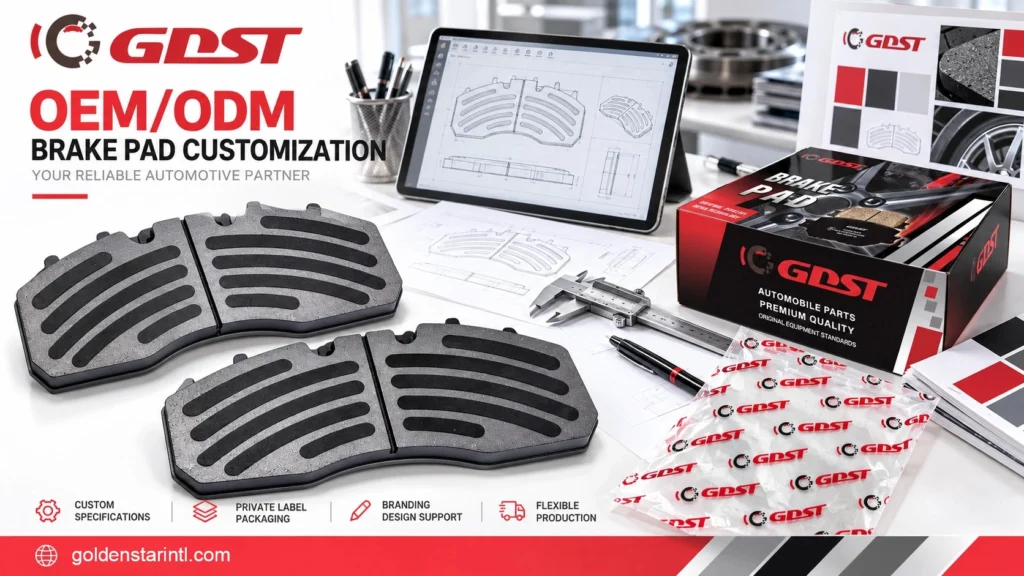
GDST supports OEM/ODM and private-label solutions for automotive aftermarket importers, commercial vehicle parts distributors and wholesale brands.
Our services can help customers organize brake pad purchasing programs under their own product identification and packaging requirements.
Private Label Truck Brake Pad Packaging
Depending on the product and order requirements, customization options may include:
• Customer brand logos
• Product and part number markings
• Customized printed color boxes
• Neutral packaging
• Customer barcode labels
• Approved packaging artwork
• Customized carton configurations
Brand ownership, artwork and labeling requirements should be confirmed before production.
Customized Truck Brake Pad Development
Where an existing product does not meet the required specification, GDST can review potential development based on customer drawings, samples and technical requirements.
Development may involve:
• Dimensional analysis
• Backing plate design review
• Tooling feasibility
• Friction material selection
• Sample production
• Testing and technical evaluation
• Product approval
• Commercial production planning
Any new design or formulation must be evaluated for its intended application before commercial supply.
OEM/ODM Truck Brake Pad Project Workflow
|
Stage |
Main Activity |
|
Requirement Review |
Target market, part numbers, quantities and technical requirements |
|
Product Identification |
Existing catalog matching or development feasibility |
|
Engineering Review |
Drawings, geometry, materials and testing requirements |
|
Branding |
Product marking and packaging approval |
|
Sampling |
Sample preparation and customer evaluation |
|
Production Approval |
Confirmed specifications and agreed acceptance requirements |
|
Manufacturing |
Production under the approved project arrangement |
|
Delivery |
Inspection, packaging and shipment coordination |
Discuss Your OEM/ODM Truck Brake Pad Project
Send GDST your technical drawings, samples, packaging requirements and expected purchasing volume to discuss development and private-label options.
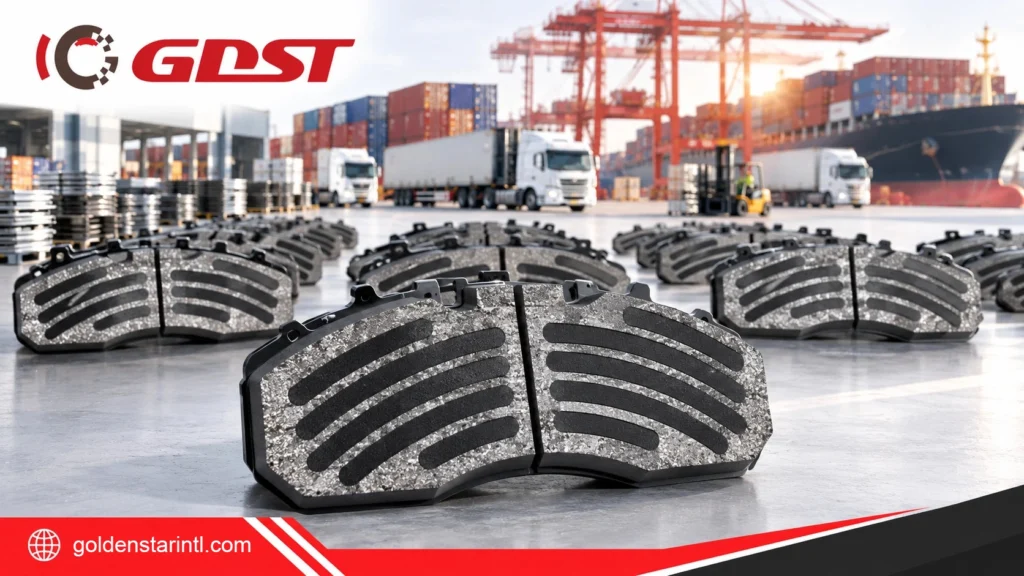
International brake parts distributors require more than individual product availability.
A practical wholesale supply program must also address model coverage, product identification, order quantities, lead times, packaging and technical communication.
GDST supports overseas aftermarket buyers through its brake parts manufacturing resources and factory cooperation network.
Our general brake pad program provides published commercial references for minimum order quantities, production lead times and warranty terms.
Actual terms for truck brake pads must be confirmed for the requested models and purchasing arrangements.
Wholesale Purchasing Information
|
Purchasing Item |
GDST Supply Information |
|
Business Model |
Wholesale, aftermarket distribution and OEM/ODM |
|
Product Coverage |
Confirmed brake pad catalog and application-specific sourcing |
|
MOQ |
General brake pad program reference: 100 sets per model |
|
Production Lead Time |
General brake pad program reference: approximately 45 days |
|
Sample Availability |
Confirmed according to product and project |
|
Friction Materials |
Available formulations according to product specification |
|
Custom Branding |
Approved logos, product identification and packaging |
|
Product Development |
Subject to technical and commercial feasibility |
|
Warranty |
General published reference: 1 year / 30,000 km, subject to applicable written terms |
|
Technical Documentation |
Subject to available product-specific documentation |
|
Export Supply |
International markets according to agreed commercial requirements |
The figures above are general GDST brake pad program references, not unconditional terms for every truck brake pad or heavy-duty commercial vehicle SKU.
Consolidated Purchasing for Multiple Part Numbers
Customers managing large aftermarket catalogs can submit consolidated purchasing lists containing multiple truck brake pad references.
Please include the quantity required for each model and the target market.
This allows our team to review catalog coverage, identify products requiring technical clarification and organize a structured quotation.
Packaging and Export Coordination
Before production, GDST and the customer should agree on:
• Product identification
• Packaging quantities
• Labeling requirements
• Destination market
• Shipping terms
• Required commercial documentation
• Applicable product testing or approval requirements
Any destination-specific certification requirements should be identified during the initial product review.
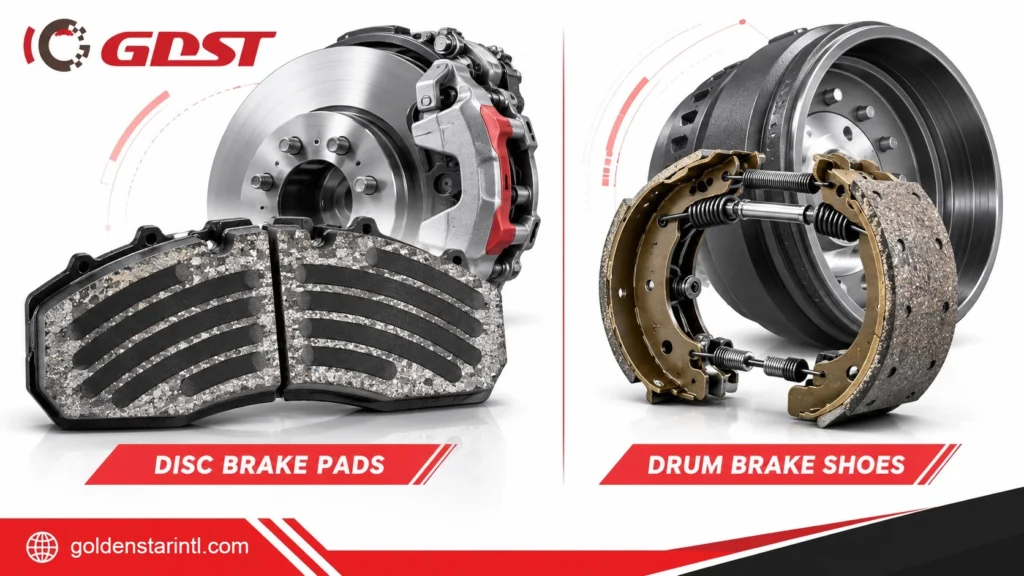
Truck brake pads and truck brake shoes are different friction components used in different types of braking systems.
Correct identification is essential when purchasing commercial vehicle replacement parts.
Truck Brake Pads
Brake pads are used in disc brake systems.
They act against a rotating brake disc or rotor and are designed to fit a specific caliper and brake assembly.
Truck Brake Shoes
Brake shoes are generally used in drum brake systems.
Their friction linings act against the internal surface of a brake drum.
Some commercial vehicles use drum brakes, while others use disc brakes or different braking arrangements across their axles.
Brake pads and brake shoes are not interchangeable.
Brake Pads vs. Brake Shoes Comparison
|
Feature |
Truck Brake Pads |
Truck Brake Shoes |
|
Brake System |
Disc brake |
Drum brake |
|
Friction Contact |
Brake disc / rotor |
Internal drum surface |
|
Primary Supporting Component |
Backing plate |
Brake shoe structure |
|
Product Identification |
Pad geometry, caliper and applicable reference |
Shoe geometry, drum brake assembly and applicable reference |
|
Replacement Compatibility |
Disc brake applications only |
Drum brake applications only |
Customers sourcing drum brake products can also explore GDST Brake Shoe Product Range.
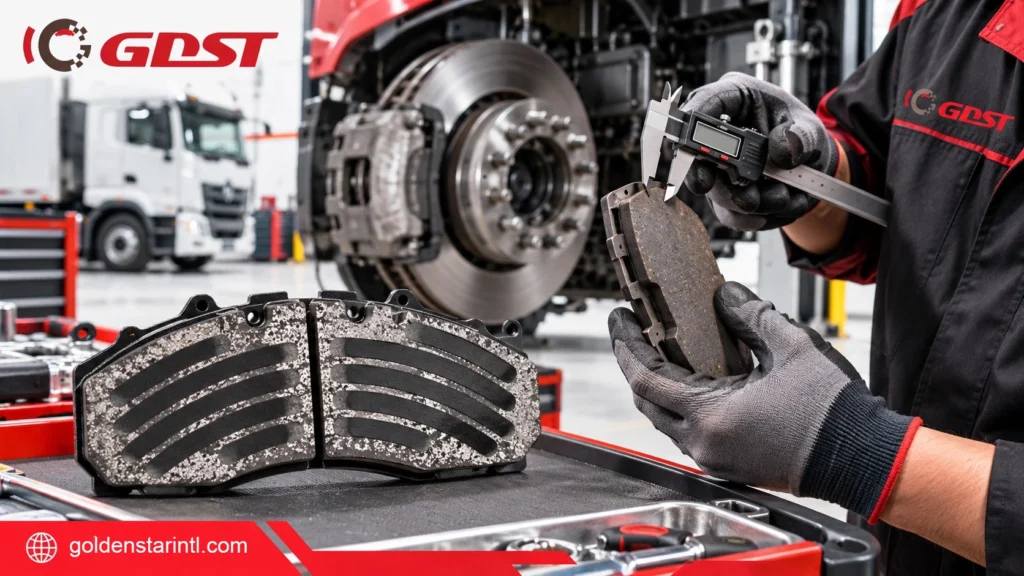
Brake pad wear is influenced by several factors, including friction material characteristics, operating conditions, vehicle loading, brake system design and maintenance.
The friction interface changes during braking as contact surfaces develop and wear.
Research has shown that these surface changes can influence the coefficient of friction and wear behavior.[4]
Therefore, brake pad service life cannot be reliably predicted from friction material classification alone.
Common Signs That Truck Brake Pads Need Inspection
Brake system symptoms requiring professional inspection may include:
• Unusual squealing, scraping or grinding noises
• Reduced braking effectiveness
• Uneven pad wear
• Visible damage to friction components
• Brake warning indicators
• Changes in normal braking behavior
These symptoms may also be associated with calipers, discs, actuators or other brake system components.
A complete diagnosis should identify the underlying cause.
Why Do Truck Brake Pads Wear Unevenly?
Uneven wear can be associated with caliper movement, component condition, installation issues, braking imbalance or operating conditions.
The cause should be investigated before replacement parts are installed.
Simply replacing the friction material without correcting the underlying problem may allow the condition to recur.
When Should Truck Brake Pads Be Replaced?
There is no universal mileage interval suitable for every truck brake pad.
Inspection and replacement should follow the vehicle and brake system manufacturer’s instructions and the applicable safety requirements.
Minimum friction material thickness limits vary according to the braking system, vehicle configuration and relevant regulations.
A regulatory minimum should not automatically be treated as the recommended replacement target.
Professional inspection and correct installation procedures are essential for safe vehicle operation.
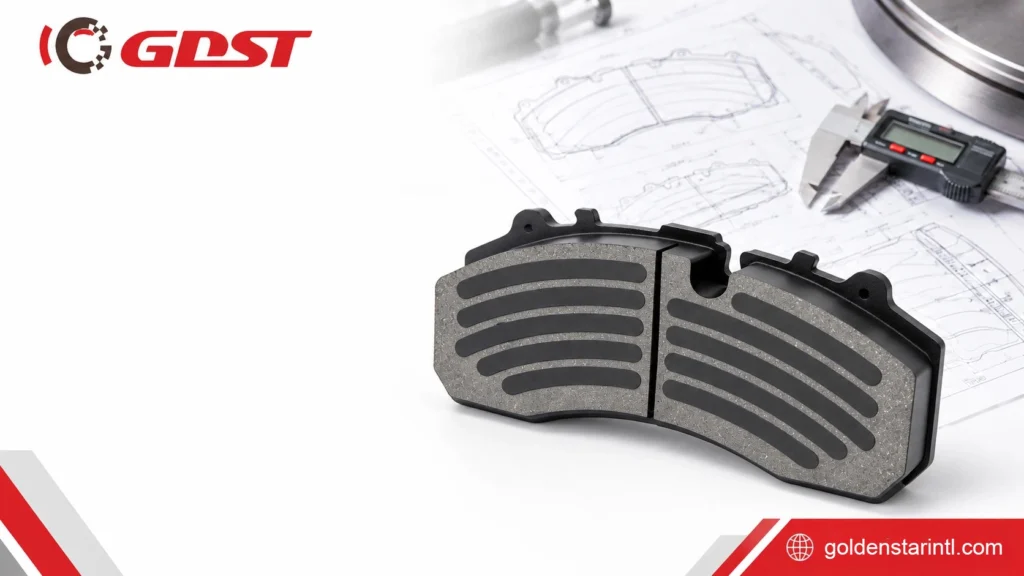
1. What types of truck brake pads does GDST supply?
GDST provides brake pad sourcing and manufacturing support for selected pickup truck, light-duty truck and commercial vehicle applications.
Actual availability depends on the product catalog, vehicle specifications and installed brake system.
Customers can provide part numbers or technical drawings to confirm available models.
2. Can GDST supply heavy-duty truck brake pads?
GDST can review requirements for heavy-duty commercial vehicle disc brake pads.
Please provide the existing pad reference, brake system or caliper model, dimensions and expected quantities.
Our team will check available products or assess potential sourcing and development arrangements.
3. Can you match truck brake pads using OE numbers?
Yes. GDST can review OE and aftermarket reference lists for product identification.
Additional vehicle details, drawings or samples may be required before compatibility can be confirmed.
4. What is the best friction material for truck brake pads?
No single friction material is best for every truck.
The appropriate formulation depends on vehicle design, braking conditions, operating loads, temperature response, friction stability and other requirements.
Published friction material research supports evaluating the complete compound and its intended operating conditions rather than relying solely on a material category.[1][2]
5. Are ceramic brake pads suitable for heavy-duty commercial trucks?
Ceramic-based formulations may be suitable for certain pickup and light-duty vehicle applications.
However, ceramic materials are not automatically suitable for heavy-duty commercial disc brake systems.
The specific product must be compatible with the braking system and validated for its intended requirements.
6. Does GDST use automated brake pad manufacturing equipment?
GDST’s company presentation documents automated friction material weighing and mixing, disc brake pad pressing, controlled curing and automated finishing equipment.
It includes a pressing line identified for bus and coach disc brake pads.
The manufacturing process used for any particular truck brake pad must be confirmed according to its technical specification.
7. What testing equipment is documented by GDST?
GDST’s company presentation shows disc brake and commercial-vehicle drum friction material dynamometer testing resources, a shear strength testing machine and examples of test reports.
It also identifies routine hardness, compressibility and density testing equipment.
The applicability of these resources and available reports to a specific product must be verified.
8. Are all GDST truck brake pads tested on a dynamometer?
The company presentation documents dynamometer testing resources and report examples.
It does not establish that every truck brake pad model has undergone the same test program.
Testing requirements and available documentation should be confirmed for each specific product.
9. Can GDST provide brake pad test reports?
Customers can request a review of available technical test documentation.
The availability of relevant reports depends on the specific product, test conditions and applicable project requirements.
Where new testing is required, the scope and commercial arrangement should be discussed before order approval.
10. Do GDST truck brake pads have E-mark or other certifications?
Certifications and approvals must be verified for each applicable product and market.
Factory testing equipment and general test report examples do not automatically establish ECE R90 or other regulatory approval for every truck brake pad model.
Customers should identify their destination-market requirements during product selection.
11. Can GDST manufacture truck brake pads under my own brand?
Yes. GDST supports private-label projects, including customized packaging and approved product markings.
Customers can submit their branding requirements, part numbers and expected quantities for review.
12. Can you develop truck brake pads from drawings or physical samples?
GDST can review drawings and samples for potential new product development.
Feasibility depends on component geometry, tooling, materials, testing requirements and expected production volume.
13. What is the minimum order quantity for truck brake pads?
GDST’s general brake pad program publishes a reference MOQ of 100 sets per model.
For a specific truck brake pad order, MOQ must be confirmed according to model availability, production requirements and customization needs.
14. What is the production lead time for wholesale orders?
The published general brake pad program references approximately 40–45 days.
Actual lead times depend on the products, quantities, packaging requirements, production scheduling and whether new development is necessary.
15. How long do truck brake pads last?
Brake pad service life depends on the vehicle, brake system, friction material, operating conditions and maintenance.
There is no universal mileage guarantee applicable to all truck brake pads.
Replacement decisions should follow the relevant manufacturer’s inspection guidance and applicable regulations.
16. What information should I provide for a quotation?
Please send your part numbers, quantities, target vehicle applications, destination country and packaging requirements.
Where possible, include brake system details, technical drawings or existing product photographs.
This helps GDST review the requirements more efficiently.
Looking for a truck brake pad supplier for your aftermarket distribution business?
GDST supports international buyers with brake pad sourcing, product matching, manufacturing coordination, private-label services and wholesale purchasing solutions.
Whether you are expanding a pickup truck brake pad catalog, sourcing commercial vehicle replacement parts or planning a customized friction material project, our team can review your requirements and discuss the next steps.
Tell Us What You Need
To help us prepare an accurate quotation, please provide:
• Company name
• Country or destination market
• Email address or WhatsApp contact
• Truck brake pad part numbers
• Truck models or brake system information
• Required quantity per model
• Friction material preference, if specified
• Packaging or private-label requirements
• Technical drawings, samples or product photos, if available
Contact GDST
Email: admin@goldenstarintl.com
WhatsApp: +86 18555330281
Website: https://goldenstarintl.com/contact/
Contact GDST to discuss product matching, sample requirements, technical documentation, customized packaging and wholesale purchasing.
GDST — Automotive Brake Parts Manufacturing and Supply Solutions from China
The following peer-reviewed publications support the general engineering explanations of brake friction materials, tribological behavior, noise, temperature effects and manufacturing processes.
They are not product-specific test reports or independent certifications for GDST brake pads.
[1] Chan, D., & Stachowiak, G. W. (2004). Review of automotive brake friction materials. Proceedings of the Institution of Mechanical Engineers, Part D: Journal of Automobile Engineering, 218(9), 953–966.
https://doi.org/10.1243/0954407041856773
[2] Raghunathan, V., et al. (2024). Advances in brake friction materials: A comprehensive review of ingredients, processing methods, and performance characteristics. Journal of Vinyl and Additive Technology, 30(6), 1396–1431.
https://doi.org/10.1002/vnl.22149
[3] Influence of contact pressure and velocity on the brake behaviour and particulate matter emissions. (2023). Wear, 514–515, 204579.
https://doi.org/10.1016/j.wear.2022.204579
[4] Eriksson, M., Bergman, F., & Jacobson, S. (2002). On the nature of tribological contact in automotive brakes. Wear, 252(1–2), 26–36.
https://doi.org/10.1016/S0043-1648(01)00849-3
[5] Kinkaid, N. M., O’Reilly, O. M., & Papadopoulos, P. (2003). Automotive disc brake squeal. Journal of Sound and Vibration, 267(1), 105–166.
https://doi.org/10.1016/S0022-460X(02)01573-0
[6] Festjens, H., Chevallier, G., Renaud, F., Dion, J.-L., & Lemaire, R. (2012). Effectiveness of multilayer viscoelastic insulators to prevent occurrences of brake squeal: A numerical study. Applied Acoustics, 73(11), 1121–1128.
https://doi.org/10.1016/j.apacoust.2012.03.017
[7] Albers, A., Klotz, T., Fink, C., & Ott, S. (2022). Investigation of the heat distribution in dry friction systems during fade and recovery using fiber-optic sensing and infrared technology. Friction, 10, 422–435.
https://doi.org/10.1007/s40544-021-0506-4
[8] Hentati, N., Makni, F., & Elleuch, R. (2023). Braking performance of friction materials: A review of manufacturing process impact and future trends. Tribology – Materials, Surfaces & Interfaces, 17(2).
https://doi.org/10.1080/17515831.2023.2216092
[9] Kim, S. J., Kim, K. S., & Jang, H. (2003). Optimization of manufacturing parameters for a brake lining using Taguchi method. Journal of Materials Processing Technology, 136(1–3), 202–208.
https://doi.org/10.1016/S0924-0136(03)00159-6
[10] An experimental study on the effects of manufacturing parameters on the tribological properties of brake lining materials. (2010). Wear, 268(11–12), 1524–1532.
https://doi.org/10.1016/j.wear.2010.02.026
[11] Song, W., Park, J., Seo, H., Choi, J., Lee, J. J., Sohn, S. S., & Jang, H. (2023). Reduction of brake emission by optimizing the curing condition for brake pads using an artificial neural network. Wear, 516–517, 204606.