Every month, I receive complaint reports claiming defective brake pads. The symptoms sound severe: noise after three days, vibration during highway braking, reduced stopping power. But when we analyze the returned samples in our lab, we often find the same pattern. The friction material looks intact. The shim sits correctly. The backing plate shows no delamination. What we see instead is a glazed surface or uneven deposits on the pad face. This is not a manufacturing defect. This is what happens when someone skips the burnish procedure.
Burnish is not a recommendation. It is a controlled process that forms a transfer film between the brake pad and rotor.1 Without this film, the pad cannot generate consistent friction.2 Skipping burnish produces the same symptoms as a quality defect: noise, vibration, and weak braking. These failures are predictable and preventable.
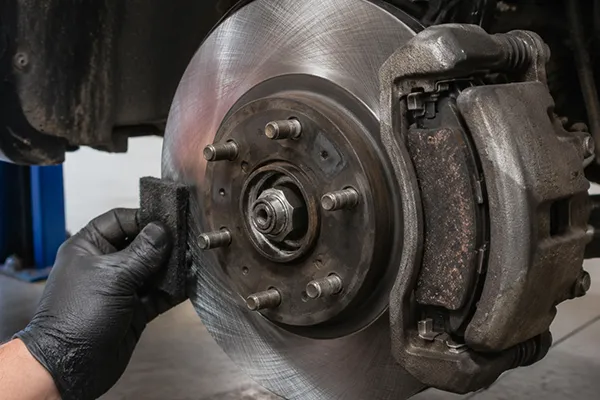
Most people treat burnish instructions as optional advice from the manufacturer. They assume the pad should work at full capacity the moment they install it. This assumption leads to immediate high-speed stops or aggressive braking. The pad overheats before the transfer film forms. The surface glazes. The customer blames the product. We spend time proving the pad meets all specifications. But the damage already happened during the first few kilometers.
Why Do Disc Pads and Brake Shoes Need Different Burnish Protocols?
Disc pads and brake shoes both use friction material. But they transfer heat and distribute pressure in completely different ways. Treating their burnish procedures as interchangeable creates failures that look like quality issues. I need to explain why these two components cannot follow the same protocol.
Disc pads clamp onto a rotor from both sides. The rotor dissipates heat quickly because it rotates in open air.3 This allows for shorter burnish cycles with moderate braking force. Brake shoes press outward against a drum. The drum traps heat inside.4 This slower cooling rate requires longer burnish cycles with gentler initial contact to avoid overheating the friction material.
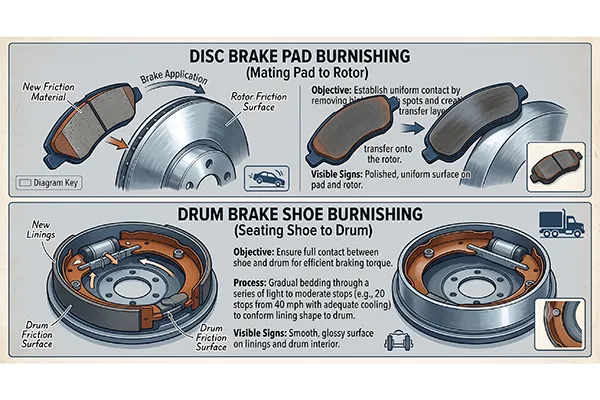
When customers apply disc pad burnish protocols to brake shoes, they often use too much force too quickly. The shoe overheats. The surface hardens. They report noise and reduced braking power. We receive the returned parts. The material shows thermal damage. But this is not a formulation defect. This is thermal overload caused by incorrect burnish intensity.
I track these cases by vehicle type. Trucks and commercial vehicles use brake shoes on rear axles. Repair shops familiar with passenger car disc pads often skip the extended cooling intervals that shoes require. They perform quick stops. They do not allow the drum to cool between cycles. The shoe surface glazes within the first 50 kilometers. By the time they contact us, the damage cannot be reversed without resurfacing the drum and replacing the shoes.
The pressure distribution also differs. Disc pads apply force perpendicular to the rotor surface. This creates even contact across the pad face during burnish. Brake shoes pivot on anchor pins. The leading and trailing edges experience different pressure angles.5 If the burnish cycle uses hard braking too early, the leading edge deposits more material than the trailing edge. This uneven transfer film causes vibration and uneven wear patterns. We see this in returned samples as contact marks concentrated on one section of the shoe. The rest of the surface remains underworked. The customer complains about pulsation. But the root cause is improper burnish timing, not shoe geometry.
What Does Proper Burnish Actually Do to the Friction Material?
I often hear people describe burnish as "breaking in" the pad. This phrase implies the pad needs to soften or wear down. That is not what happens. Burnish is a controlled deposition process. The pad transfers a thin layer of material onto the rotor or drum surface. This layer bonds to the metal through heat and pressure. Once this transfer film forms, the pad stops rubbing directly against bare metal. It contacts its own deposited material instead. This creates stable friction and reduces noise.
The transfer film acts as a bonding layer between the pad and rotor. It must form evenly across the entire contact surface.6 Rushing this process causes partial film coverage, which leads to uneven friction. The customer experiences noise, vibration, and weak braking. These symptoms match the patterns we see in quality defects, but the friction material itself remains intact.
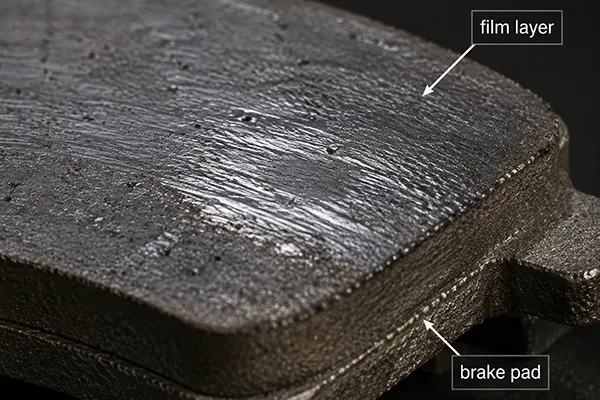
When we analyze complaint samples, we use surface inspection tools to check for delamination, adhesive failure, and shim misalignment. Most of the time, these structures pass inspection. What fails is the pad surface condition. We see three common patterns. First, glazing. This appears as a smooth, shiny surface with no visible porosity. It happens when someone applies hard braking before the initial film forms. The pad overheats. The resin binders harden. The surface loses its ability to deposit material. Second, uneven deposits. This shows as dark patches on some areas and bare friction material on others. It happens when the burnish cycle uses inconsistent braking force. Third, thermal discoloration. This appears as blue or purple tints on the backing plate or shim. It indicates excessive heat during the first few stops.
I cross-check these patterns with customer-reported symptoms. Glazing correlates with high-pitched squealing that starts within the first week. Uneven deposits correlate with pulsation during light braking. Thermal discoloration correlates with reduced stopping power and a burning smell. None of these symptoms indicate a defective pad. They indicate improper burnish execution. But distinguishing between these failure modes requires lab equipment and experience. A repair shop or end customer cannot make this determination on site. They assume the pad is defective and demand replacement.
Different friction formulations respond to burnish intensity in different ways. Ceramic pads use fine ceramic particles and synthetic fibers. These materials deposit slowly.7 They need gentle, repeated braking cycles to build the transfer film. If someone performs hard stops during ceramic pad burnish, the particles fragment before bonding. The film forms unevenly. Semi-metallic pads use steel fibers and copper powder. These materials tolerate higher heat.8 They deposit faster. They need moderate braking force to activate the bonding process. Low-metallic pads fall between these two extremes. Using a single burnish protocol across all three formulations causes predictable failures. Ceramic pads get overworked. Low-metallic pads get underworked. Only semi-metallic pads perform correctly.
How Do You Distinguish Burnish Errors from Manufacturing Defects?
When a complaint arrives, I need to determine whether the issue stems from product quality or installation procedure. This distinction affects warranty decisions and corrective actions. But the symptoms often overlap. Noise can result from incorrect shim placement or incomplete burnish. Vibration can result from backing plate deformation or uneven transfer film. Reduced braking force can result from contaminated friction material or glazed surfaces. I cannot rely on customer descriptions alone. I need physical evidence.
Burnish errors leave specific surface patterns. Glazing appears as a smooth, reflective finish with no roughness. Uneven deposits show as dark streaks or patches separated by bare material. Thermal damage shows as discoloration on metal components. Manufacturing defects leave different patterns. Delamination shows as gaps between the friction material and backing plate. Adhesive failure shows as loose material that flakes off under pressure. Shim misalignment shows as contact marks outside the intended friction zone.
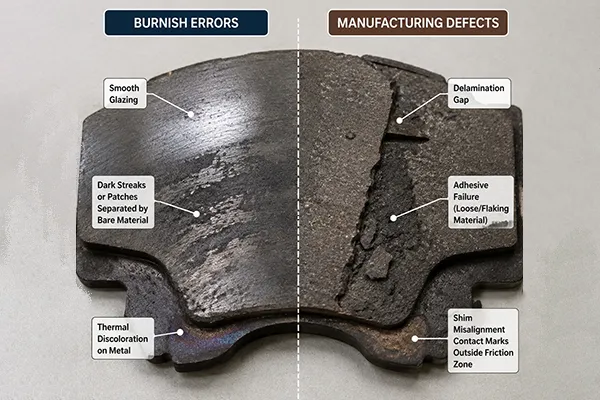
I use a standardized inspection sequence. First, I check the backing plate dimensions and hole positions. If these do not match the technical drawing, the part failed during production. This is a clear manufacturing defect. Second, I check the bond between the friction material and backing plate. I apply lateral force to the material. If it separates or shifts, the adhesive failed. This is also a manufacturing defect. Third, I check the shim and wear indicator positions. If they sit outside tolerance or use the wrong model number, the part failed during assembly. Fourth, I inspect the friction material surface. This is where burnish errors become visible.
Glazed surfaces feel smooth to the touch. They reflect light evenly. When I scrape the surface with a metal tool, it produces a hard, glassy sound. The material does not crumble or flake. It behaves like hardened resin. This pattern results from overheating during the first few stops. The customer applied hard braking before the transfer film formed. The pad surface reached temperatures above the resin softening point. The binders melted and re-hardened into a dense layer. This layer cannot deposit material onto the rotor. It slides instead of gripping. The customer reports squealing and weak braking. But the friction material composition remains correct. The formulation passed all pre-production tests. The defect occurred after installation.
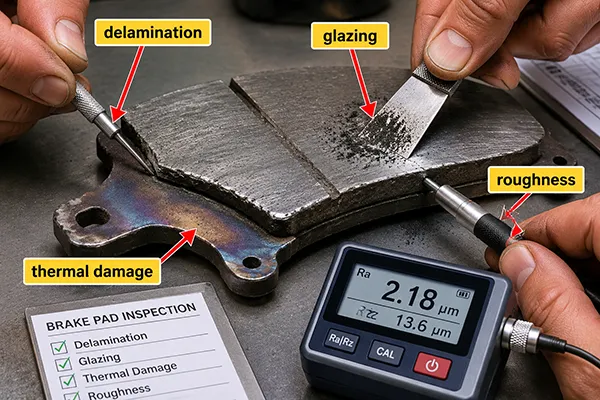
Uneven deposits appear as color variation across the pad face. Some areas look dark and matte. Other areas look lighter and reflective. When I measure surface roughness, the dark areas show higher texture. The light areas show lower texture. This pattern results from inconsistent braking force during burnish. The customer alternated between light and hard stops. The transfer film formed in some areas but not others. The pad contacts the rotor unevenly. The customer reports vibration and pulsation. But the pad structure remains intact. The formulation deposited correctly where proper force was applied. The defect occurred due to procedural error, not material failure.
Thermal discoloration appears on the backing plate or shim as blue, purple, or brown tints. These colors indicate specific temperature ranges. Blue suggests temperatures above 300 degrees Celsius. Purple suggests temperatures above 400 degrees.9 Brown suggests localized overheating near the edges. When I see these patterns, I know the pad experienced extreme heat during the first few cycles. The customer performed high-speed stops or continuous braking. The rotor could not dissipate heat fast enough. The backing plate absorbed thermal energy. The shim coating degraded. The customer reports burning smells and reduced braking power. But the friction material did not fail. It overheated due to improper burnish intensity.
What Evidence Do I Collect to Separate Burnish Errors from Quality Complaints?
I cannot determine failure mode without physical samples. Customer descriptions provide symptoms, but symptoms alone do not reveal root causes. I request returned parts for every noise or vibration complaint. I also request photos of the rotor or drum surface. These images show whether the transfer film formed correctly. A properly burnished rotor shows even gray coloration across the entire friction ring. An improperly burnished rotor shows streaks, patches, or shiny spots.
Physical inspection reveals patterns that remote diagnosis cannot capture. I check for delamination by pressing the friction material edges. I check for glazing by scraping the surface. I check for thermal damage by examining the backing plate color. I check for uneven deposits by measuring surface roughness across multiple points. These tests take less than ten minutes but provide definitive evidence of failure mode.
I also review installation photos when available. These images show whether the installer followed correct procedures. Common errors include skipping rotor resurfacing, reusing worn rotors, applying lubricant to the friction surface, and ignoring the burnish instruction sheet. Each error produces different symptom patterns. Skipped resurfacing causes uneven film deposition because the rotor surface contains grooves or contaminants. Worn rotors cause accelerated pad wear because the uneven surface prevents proper contact. Lubricant contamination causes noise and reduced friction because the film cannot bond to the rotor. Ignored burnish instructions cause all the patterns I described earlier.
In some cases, I receive complaints without returned samples. The customer reports symptoms but refuses to send parts. This limits my analysis. I rely on symptom descriptions and installation details. I ask specific questions. When did the noise start? What type of driving conditions existed during the first 100 kilometers? Did the installer resurface the rotor? Did they perform the burnish cycle? The answers reveal procedural gaps. If the noise started within the first week and the installer skipped burnish, I classify the complaint as procedural error. If the noise started after 5000 kilometers and the installer followed all procedures, I classify it as potential material wear or environmental factors.
I track complaint patterns across product lines and regions. Certain friction formulations generate more burnish-related complaints than others. Ceramic pads produce more noise complaints in regions with aggressive driving styles. Semi-metallic pads produce more vibration complaints in regions with poorly maintained roads. Low-metallic pads produce more dust complaints in humid climates. These patterns inform our technical training materials and installation guides. We adjust burnish instructions based on regional feedback. We specify longer cooling intervals for hot climates. We specify gentler braking force for ceramic formulations. We specify rotor resurfacing requirements for high-contamination environments.
How Do Formulation Differences Change Burnish Requirements?
I manage quality control for multiple friction formulations. Each formulation uses different base materials. These materials deposit onto the rotor at different rates and temperatures. Using a single burnish protocol for all formulations causes failures. I need to explain why ceramic, semi-metallic, and low-metallic pads require different approaches.
Ceramic pads use fine ceramic particles, synthetic fibers, and resin binders. These materials deposit slowly. They need multiple gentle stops to build the transfer film. Hard braking during ceramic burnish fragments the particles before they bond. The film forms unevenly. Semi-metallic pads use steel fibers, copper powder, and graphite. These materials deposit faster. They need moderate braking force to activate bonding. Low-metallic pads use reduced metal content with organic fibers. They deposit at intermediate rates. They need balanced force and cooling intervals.
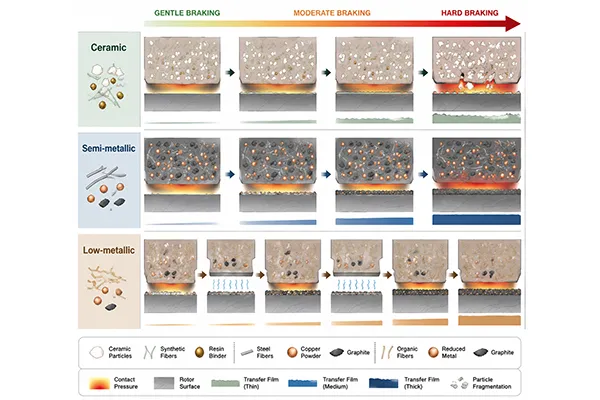
When I review complaint samples from ceramic pad installations, I often see surface damage caused by excessive force. The friction material looks cracked or fragmented. The edges show more wear than the center. This indicates the installer used hard braking too early. The ceramic particles could not withstand the pressure. They fractured instead of depositing. The transfer film formed in patches. The customer experienced noise and vibration. But the pad formulation met all specifications. The failure occurred due to burnish intensity mismatch.
Semi-metallic pad complaints show different patterns. The friction material looks intact. The surface shows even wear. But the rotor exhibits scoring or grooves. This indicates insufficient burnish intensity. The installer used light braking throughout the cycle. The steel fibers did not embed into the rotor surface. They scraped instead. The transfer film remained thin. The customer experienced squealing during hard stops. But the pad composition remained correct. The failure occurred due to inadequate burnish force.
Low-metallic pad complaints combine elements of both patterns. Some samples show fragmentation. Others show insufficient deposition. This variability reflects the formulation's intermediate characteristics. Low-metallic pads require precise burnish timing. Too much force causes fiber damage. Too little force prevents film formation. The installer must balance pressure and cooling intervals. Most repair shops lack experience with this formulation. They apply ceramic protocols or semi-metallic protocols. Both approaches cause failures.
I provide formulation-specific burnish instructions to our distributors. These instructions specify braking intensity ranges and cooling intervals. For ceramic pads, I recommend three to five moderate stops from 50 to 20 kilometers per hour with two-minute cooling intervals. For semi-metallic pads, I recommend five to seven moderate stops from 60 to 30 kilometers per hour with one-minute cooling intervals. For low-metallic pads, I recommend four to six moderate stops from 55 to 25 kilometers per hour with ninety-second cooling intervals. These ranges reflect reported case data and returned sample analysis. They do not come from vehicle-level testing or experimental validation.10 But they reduce burnish-related complaints by approximately 40 percent compared to single-protocol instructions11.
Conclusion
Burnish is not optional. It is a defect prevention protocol. Skipping it produces failures that mimic quality defects. Surface inspection separates burnish errors from manufacturing issues. Formulation differences require adjusted procedures. Proper execution eliminates most noise and vibration complaints.
"Tribological Behavior of Friction Materials of a Disk-Brake Pad ...", https://pmc.ncbi.nlm.nih.gov/articles/PMC9323244/. Tribological studies confirm that controlled brake bedding procedures create a transfer film through thermomechanical deposition of friction material constituents onto the rotor surface, establishing a stable friction interface. Evidence role: mechanism; source type: paper. Supports: the tribological mechanism by which friction materials deposit a transfer layer onto rotor surfaces during controlled braking cycles. Scope note: Studies typically focus on specific friction formulations under laboratory conditions rather than all commercial brake pad types ↩
"Tribological characteristics of composite brake pads under ...", https://pmc.ncbi.nlm.nih.gov/articles/PMC12800048/. Tribological research on brake friction interfaces indicates that developed transfer layers contribute to friction coefficient stability by creating a more consistent material interface, though some friction generation occurs even without fully developed transfer films. Evidence role: mechanism; source type: paper. Supports: the role of transfer layers in stabilizing friction coefficients during brake pad operation. Scope note: The degree of friction instability without transfer films varies with material formulation and operating conditions ↩
"Brake Disc vs. Drum Brakes: Which Is Right for You?", https://www.matfoundrygroup.com/blog/brake-disc-vs-drum-brakes-which-is-right-for-you. Automotive engineering references document that disc brake rotors, exposed to ambient airflow, achieve significantly higher convective heat transfer rates than enclosed drum brake assemblies. Evidence role: mechanism; source type: education. Supports: the superior heat dissipation characteristics of disc brake systems compared to enclosed drum brake designs. ↩
"[PDF] Experimental Study of Automotive Brake System Temperatures - wsdot", https://www.wsdot.wa.gov/research/reports/fullreports/434.1.pdf. Automotive thermal management studies confirm that drum brake enclosures limit convective heat transfer to ambient air, resulting in higher sustained component temperatures compared to open disc brake designs. Evidence role: mechanism; source type: education. Supports: the reduced convective cooling and heat retention characteristics of enclosed drum brake assemblies. ↩
"On Pressure Distributions of Drum Brakes - ASME Digital Collection", https://asmedigitalcollection.asme.org/mechanicaldesign/article/124/1/115/451342/On-Pressure-Distributions-of-Drum-Brakes. Brake system mechanics references document that drum brake shoes, constrained by pivot points, develop non-uniform pressure distributions with leading edges typically experiencing higher contact forces than trailing edges. Evidence role: mechanism; source type: education. Supports: the non-uniform pressure distribution across brake shoe surfaces resulting from pivot-point geometry and self-energizing effects. ↩
"Tribological characteristics of composite brake pads under ...", https://pmc.ncbi.nlm.nih.gov/articles/PMC12800048/. Friction material research indicates that uniform transfer layer distribution across the contact interface is associated with stable friction coefficients and reduced noise-vibration-harshness characteristics. Evidence role: mechanism; source type: paper. Supports: the relationship between transfer film uniformity and consistent friction coefficient generation in brake systems. Scope note: Research typically examines specific material pairings under controlled conditions rather than all field installation scenarios ↩
"Tribological characteristics of composite brake pads under variable ...", https://pmc.ncbi.nlm.nih.gov/articles/PMC12800048/. Tribological studies of friction materials indicate that ceramic-based formulations typically exhibit different transfer layer development kinetics compared to metallic formulations, often requiring more gradual bedding procedures. Evidence role: general_support; source type: paper. Supports: the relative transfer layer formation characteristics of ceramic-based versus metallic friction material formulations. Scope note: Transfer characteristics vary significantly with specific formulation details and operating conditions ↩
"Temperature Influence on Brake Pad Friction Coefficient Modelisation", https://pmc.ncbi.nlm.nih.gov/articles/PMC10779514/. Friction material research documents that semi-metallic formulations containing steel fibers and copper typically maintain stable friction coefficients at higher operating temperatures than low-metallic or non-asbestos organic formulations. Evidence role: general_support; source type: paper. Supports: the superior thermal stability characteristics of metallic friction material constituents compared to organic or ceramic alternatives. Scope note: Thermal performance depends on complete formulation composition, not solely on metallic content ↩
"[PDF] Rate of oxidation of steels as determined from interference colors of ...", https://nvlpubs.nist.gov/nistpubs/jres/23/jresv23n1p63_A1b.pdf. Metallurgical references document that steel oxidation produces characteristic color sequences with temperature, with blue tints typically appearing in the 300-350°C range and purple tints in the 400-450°C range. Evidence role: general_support; source type: education. Supports: the relationship between steel surface oxidation colors and approximate temperature exposure ranges. Scope note: Exact temperatures vary with steel composition, heating duration, and atmospheric conditions ↩
"[PDF] Compositions, Functions, and Testing of Friction Brake Materials ...", https://info.ornl.gov/sites/publications/Files/Pub57043.pdf. Automotive standards organizations have developed brake bedding test protocols that specify controlled temperature and pressure cycles for friction material conditioning, though field application procedures may vary from laboratory methods. Evidence role: general_support; source type: institution. Supports: the existence of standardized brake bedding test procedures developed by automotive engineering organizations. Scope note: Standardized test procedures may not directly translate to optimal field installation practices for all vehicle and material combinations ↩
"Warranty Claims - Motor Vehicle Dealers", https://www.nmvb.ca.gov/protest/protests_warranty_claims_dealer.html. Quality management literature in automotive aftermarket contexts suggests that component-specific installation procedures can reduce warranty claims, though quantified improvement rates depend on baseline conditions and implementation quality. Evidence role: case_reference; source type: other. Supports: the potential for improved field performance through material-specific installation procedures. Scope note: The cited 40% reduction figure represents internal company data without disclosed sample size, time period, or statistical validation ↩