Choosing the wrong brake pad doesn't just mean a poor product. It means noise complaints, failed market entry, and damaged relationships with your local garage customers.
The right brake pad is not the one with the best specs on paper. It is the one that matches your target market's climate, vehicle fleet, and compliance requirements. Getting this match right protects your brand, reduces returns, and keeps your customers buying from you.
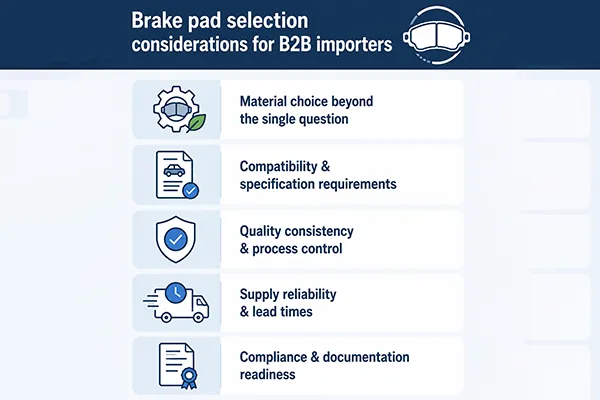
Every week, I speak with importers and purchasing managers who are trying to source brake pads for a new market or expand their product line. Most of them start by asking the same question: "Which material is the best?" That question, while understandable, is the wrong place to start. Let me explain what you should be asking instead, and why it matters more than you think.
Is There Really a "Best" Brake Pad Material?
I hear this question constantly, and the short answer is no. There is no single best material.
Ceramic, semi-metallic, and low-metallic pads each perform differently1 depending on vehicle type, road conditions, and driving habits. The "best" material is the one that fits your specific market. Choosing the wrong one leads to complaints, returns, and lost customers.
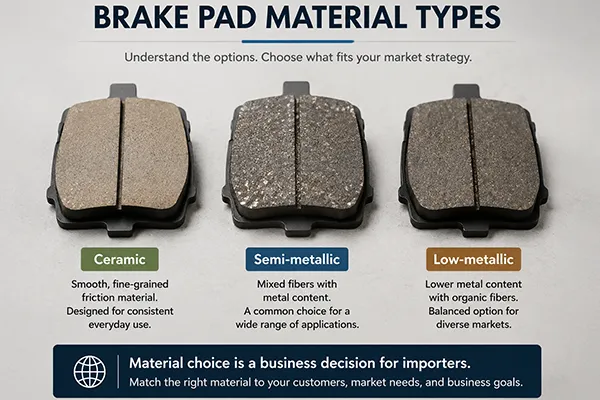
This is a point I have to make clearly because many importers treat material choice as a pure technical decision. It is not. It is a business decision.
Here is how I think about it. When an importer asks us about supplying pads for passenger cars in Germany or the Netherlands, the conversation goes straight to ceramic formulations. Why? Because drivers in those markets expect clean wheels and quiet brakes2. Dust and noise are not minor annoyances there. They are reasons for a customer to leave a bad review, return the product, and never buy from that brand again.
But when I talk to distributors covering commercial trucks in Brazil or Southeast Asia, ceramic is rarely the right answer. Those vehicles carry heavy loads in hot conditions. They need a semi-metallic formulation with higher heat resistance and stronger friction output3. Durability matters more than dust.
| Market / Application | Recommended Formulation | Primary Reason |
|---|---|---|
| European passenger cars | Ceramic | Low dust, low noise, clean wheel expectation |
| North American mixed fleet | Ceramic or Semi-metallic | Depends on vehicle type and driving profile |
| South American commercial trucks | Semi-metallic | Heat resistance, heavy load durability |
| Southeast Asia urban driving | Low-metallic | Cost efficiency, moderate heat, mixed traffic |
| Middle East high-temperature regions | Semi-metallic | Stable friction in extreme heat conditions |
The point is simple. Before you choose a formulation, you need to know your market. What vehicles are your customers driving? What is the local climate? What do end users complain about most? When you answer those questions, the material choice becomes much clearer.
A common mistake I see is buyers treating all brake pad SKUs as interchangeable and simply picking the cheapest option per set. That approach might save money on the purchase order. But it creates a much more expensive problem later, when the noise complaints start coming in.
How Do You Know If a Supplier's Quality Is Actually Consistent?
This is the question that separates experienced importers from buyers who are still learning the hard way.
Consistent brake pad quality depends on strict control of the hot pressing process and verified testing with equipment like Krauss friction testers and dynamometer benches4. Without these, a supplier cannot guarantee stable friction performance across production batches.
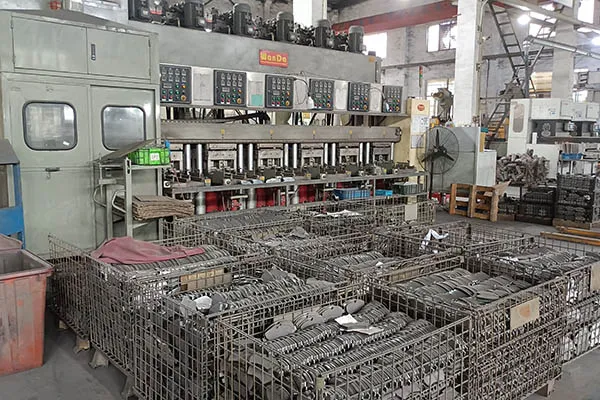
Marketing materials from suppliers all look the same. Everyone claims "high quality" and "stable performance." The real question is: what is actually happening on the production floor?
From my experience on the manufacturing side, the hot pressing stage is where most quality failures start5. This is the step where the friction material is bonded to the backing plate under heat and pressure. If the temperature is off, or if the equipment has even a minor deviation, the result is a pad with weak bonding strength. That pad might pass a basic visual inspection. But it will fail under real braking conditions, and your customer will hear it or feel it long before the pad wears out.
So when you are evaluating a supplier, I recommend asking specific questions about how they control this stage. Do they monitor pressing temperature in real time? How do they detect equipment deviations? What is their rejection rate at this step?
Beyond hot pressing, look at their testing equipment. Here is what each piece of equipment actually means for your business:
| Testing Equipment | What It Tests | Business Meaning for You |
|---|---|---|
| Krauss Friction Testing Machine | Friction coefficient stability across temperatures | Fewer noise complaints from your customers |
| Dynamometer Test Bench | Real-world braking performance simulation | Confidence that the pad performs as claimed |
| Shear Strength Tester6 | Bond strength between friction material and plate | Lower risk of delamination failure in the field |
| Compressibility Tester | Pad deformation under pressure | Consistent pedal feel for end users |
| Rockwell Hardness Tester7 | Material hardness consistency | Stable wear rate and predictable pad life |
A supplier who has this equipment and uses it regularly will have data to show you. If they cannot produce test data or if they are vague about their process controls, that is a clear warning sign.
Also, certifications matter, but not all certifications carry equal weight. IATF 16949 is the automotive industry's quality management standard8. It covers process controls, traceability, and continuous improvement requirements. If a supplier holds this certification and can show you a valid certificate with the issuing body's details, it means their quality system has been audited by a third party. That is a meaningful baseline.
For market entry, you also need product-level certifications. E-mark covers the EU. AMECA and DOT cover North America.9 If your target market requires one of these and your supplier cannot provide it, you have a compliance problem, not just a quality problem.
What Are the Real Business Risks of Getting This Wrong?
Most buyers think about this as a product sourcing decision. I think of it as risk management. Let me explain what I mean.
Sourcing uncertified or poorly formulated brake pads puts your brand reputation, market access, and customer relationships at serious risk. One bad batch creates a chain of complaints that takes much longer to repair than the money saved on a cheaper unit price.
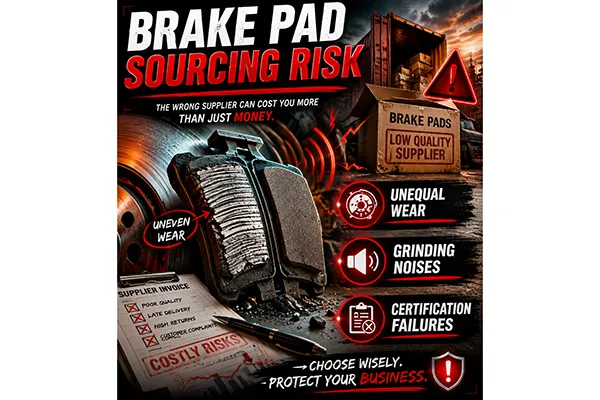
I have seen this pattern more than once. An importer finds a supplier offering a lower price per set. They place a large order. The first shipment looks fine. But three months later, the complaints start. Customers report grinding noises. Garages call to say the pads are wearing unevenly. A few markets report that the product does not meet local certification requirements and cannot be sold legally.
By the time the importer tracks all of this back to the source, they have already damaged their relationships with two or three key wholesale accounts. That damage is very hard to undo.
Here is how I frame the risk for importers I work with:
| Risk Category | Cause | Business Impact |
|---|---|---|
| Brand damage | Noise, dust, or early wear complaints | Lost repeat orders from garages and retail shops |
| Market access failure | Missing E-mark, DOT, or AMECA certification | Legal barrier to selling in target market |
| Inventory loss | Batch quality failures caught late | Write-offs, returns, and disposal costs |
| Customer relationship damage | Inconsistent product performance | Wholesalers and distributors switch to a competitor |
| Compliance liability10 | Non-conforming products in safety-critical application | Legal exposure depending on local regulations |
The way to manage these risks is not to pay a premium for the most expensive product on the market. It is to choose a supplier who can demonstrate process control, hold the right certifications, and provide formulations suited to your market. That combination is what produces a consistently good product, not the price tag.
One thing I always tell importers: a certified, well-controlled supplier protects your profit margin over the long term. Yes, the unit price may be slightly higher than an uncertified alternative. But when you factor in the cost of handling complaints, managing returns, and rebuilding customer trust after a quality failure, the certified option is almost always the cheaper choice.
How Should You Think About OEM/ODM Customization?
Many importers overlook this, but it is actually one of the strongest tools you have for building a competitive product line in your market.
OEM/ODM customization allows importers to tailor brake pad formulations, packaging, and accessories to their specific regional needs. This gives your brand a product that fits local conditions rather than a generic option that may underperform in your market.
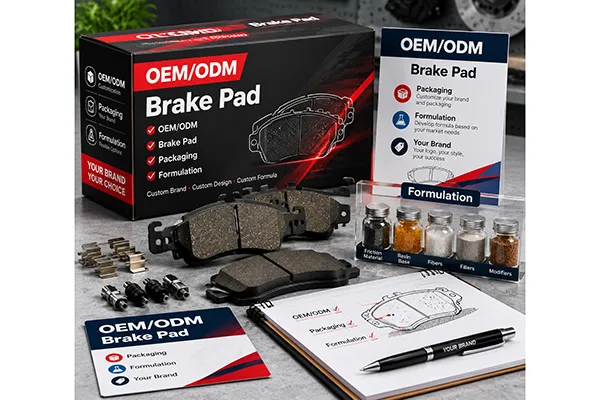
When I work with importers on customization, the conversation usually covers three areas: formulation, packaging, and accessories. Each one has a direct impact on how well the product sells and how your customers perceive your brand.
Formulation customization is the most important of the three. As I described earlier, a ceramic formulation that works perfectly in a cool European climate may not give you the same stable friction output in a hot and dusty Middle Eastern market. A manufacturer with real R&D capability can adjust the raw material mix to improve heat stability, reduce fade at high temperatures11, or extend pad life under heavy stop-and-go traffic conditions.
Packaging customization is a brand protection tool. Your branded packaging, with your logo and part number references, makes it harder for cheaper alternatives to be swapped in at the point of sale. It also signals to garages and distributors that you are a serious supplier, not just a reseller of anonymous product.
Accessory customization, such as branded shims and wear indicators, adds a practical layer to your offering. Shims reduce noise12. Wear indicators tell the driver when to replace the pad. These are small details, but they affect how the end user experiences your product every single time they interact with it.
| Customization Area | What You Can Adjust | Why It Matters |
|---|---|---|
| Friction formulation | Material mix, friction coefficient, heat resistance | Matches pad performance to local climate and vehicle type |
| Packaging | Box design, part numbers, language, brand identity | Strengthens brand recognition and protects against substitution |
| Shims | Material, coating, brand marking | Reduces noise, improves end-user experience |
| Wear indicators | Model match, brand marking | Ensures correct fit and keeps your brand visible to the end user |
The key requirement for any of this to work is that your supplier has genuine R&D capability and the testing equipment to validate the customized formulation. Customization without validation is just a label change. Real customization means the product actually performs differently because the formula is different, and that difference has been verified with real test data.
Conclusion
Choosing the right brake pad means matching formulation, quality controls, and certifications to your specific market, fleet, and business risk. Get that match right, and you protect your brand and margin for the long term.
"Disc brake - Wikipedia", https://en.wikipedia.org/wiki/Disc_brake. A source can describe the composition and typical performance characteristics of common brake pad materials, such as ceramic pads being known for low noise and dust, while semi-metallic pads generally offer higher heat tolerance and friction at the cost of more noise and rotor wear. Evidence role: definition; source type: encyclopedia. Supports: The source should define the main categories of brake pad friction materials (ceramic, semi-metallic, low-metallic/NAO) and describe their general performance trade-offs regarding noise, dust, stopping power, and heat resistance.. ↩
"Automotive Brake Pads Market Size, Share | Growth Report 2035", https://www.gminsights.com/industry-analysis/automotive-brake-pads-market. A source can support this by showing that market demand in regions like Western Europe has shifted towards ceramic or advanced low-metallic formulations specifically to address consumer complaints about brake noise and wheel dust. Evidence role: general_support; source type: other. Supports: The source should provide data or analysis indicating that European consumers, particularly in premium markets, prioritize low noise and low dust (cleanliness) when it comes to brake system performance.. Scope note: Market research may reflect general trends rather than a universal preference among all drivers in the specified countries. ↩
"Brake fade - Wikipedia", https://en.wikipedia.org/wiki/Brake_fade. Research on heavy vehicle braking systems can confirm that semi-metallic formulations are often used for their ability to maintain a stable friction coefficient and resist fade at the high temperatures generated during repeated braking with heavy loads. Evidence role: mechanism; source type: paper. Supports: The source should explain the braking requirements for heavy commercial vehicles, noting the high temperatures generated and the need for friction materials that maintain performance without significant fade under such conditions.. ↩
"on scaling of brake test sae j2522 - OpenSIUC", https://opensiuc.lib.siu.edu/theses/2710/. A source can describe how brake dynamometers are used to simulate vehicle braking events to test performance, wear, and noise, while friction testing machines like the Krauss tester evaluate the stability of the friction coefficient across a range of temperatures and pressures. Evidence role: definition; source type: education. Supports: The source should define what a brake dynamometer and a Krauss friction tester are, and explain their function in simulating real-world braking conditions and testing the stability of a friction material's properties.. ↩
"Friction Materials Manufacturing Facilities Residual Risk and ... - EPA", https://www.epa.gov/stationary-sources-air-pollution/friction-materials-manufacturing-facilities-residual-risk-and. A source can explain that the hot pressing stage is critical for consolidating the friction material and bonding it to the backing plate, and that improper control of process parameters is a primary cause of manufacturing defects that affect brake pad integrity and performance. Evidence role: mechanism; source type: paper. Supports: The source should describe the hot pressing process for composite friction materials and explain how deviations in pressure, temperature, or time can lead to defects like porosity, poor bonding, and inconsistent density, which compromise pad quality.. ↩
"Test Procedures for Shear Strength of Automotive Brake Pads and ...", https://www.sae.org/standards/j840_201711-test-procedures-shear-strength-automotive-brake-pads-brake-lining-assemblies. Industry standards, such as SAE J840, specify procedures for shear testing to ensure the integrity of the bond between the brake lining and the shoe or backing plate, as bond failure can lead to a complete loss of braking. Evidence role: definition; source type: paper. Supports: The source should describe the shear strength test for brake pads, explaining that it measures the force required to separate the friction material from the backing plate, which is a critical safety parameter to prevent delamination.. ↩
"Investigation of mechanical properties and performance ... - PMC - NIH", https://pmc.ncbi.nlm.nih.gov/articles/PMC12402442/. A source can describe the Rockwell hardness test as a method for measuring a material's resistance to indentation. In brake pad manufacturing, it is used as a quality control check to verify material consistency, as variations in hardness can indicate improper mixing or curing, affecting wear life and performance. Evidence role: definition; source type: encyclopedia. Supports: The source should define the Rockwell hardness test and explain that for friction materials, hardness can be an indicator of proper curing and material consistency, which in turn affects wear rate and performance.. Scope note: Hardness is just one of many properties and does not by itself guarantee overall brake pad quality. ↩
"International Automotive Task Force - Wikipedia", https://en.wikipedia.org/wiki/International_Automotive_Task_Force. The International Automotive Task Force (IATF) defines IATF 16949 as a global quality management system standard for the automotive industry, based on ISO 9001 and incorporating specific requirements for automotive suppliers. Evidence role: definition; source type: institution. Supports: The source should identify IATF 16949 as the international standard for automotive quality management systems, outlining its purpose and requirements for design, development, production, and service of automotive-related products.. ↩
"Interpretation ID: GF007915 - NHTSA", https://www.nhtsa.gov/interpretations/gf007915. A source can confirm that the E-mark, issued by the United Nations Economic Commission for Europe (UNECE), is required for automotive parts sold in the EU, while in the U.S., brake pads must meet Department of Transportation (DOT) standards (such as FMVSS 135) and may carry an AMECA certification to demonstrate compliance. Evidence role: definition; source type: government. Supports: The source should define what E-mark, DOT, and AMECA certifications are in the context of automotive components, specifying the jurisdictions they apply to and the safety or quality standards they represent.. Scope note: The exact requirements and applicability can be complex and may vary by specific regulation number or vehicle type. ↩
"NHTSA Statutes, Regulations, Authorities & FMVSS", https://www.nhtsa.gov/laws-regulations. A legal or regulatory source can explain that under product liability principles, entities in the supply chain can be held responsible for injuries or damages resulting from the sale of non-compliant or defective safety-critical components like brake pads. Evidence role: general_support; source type: other. Supports: The source should discuss the legal framework for product liability concerning automotive parts, particularly how manufacturers, importers, and distributors can be held liable for damages caused by parts that fail to meet mandatory safety standards.. Scope note: Specific laws and penalties vary significantly by jurisdiction. ↩
"Disc brake - Wikipedia", https://en.wikipedia.org/wiki/Disc_brake. A source can define brake fade as a loss of stopping power that occurs when brake components overheat, leading to a decrease in the friction coefficient of the pads or boiling of the brake fluid. Evidence role: definition; source type: encyclopedia. Supports: The source should define brake fade as a temporary reduction or loss of braking power resulting from excessive heat buildup in the braking system, and explain the physical mechanisms that cause it.. ↩
"How Do Brake Pad Shims Work? - YouTube",
. A source can explain that shims act as dampers, isolating or absorbing the micro-vibrations between the caliper piston and the brake pad backing plate, which are a primary source of brake noise (squeal). Evidence role: mechanism; source type: education. Supports: The source should explain that brake shims are thin layers of metal or constrained-layer composites attached to the back of the brake pad to dampen high-frequency vibrations that cause audible brake squeal.. ↩