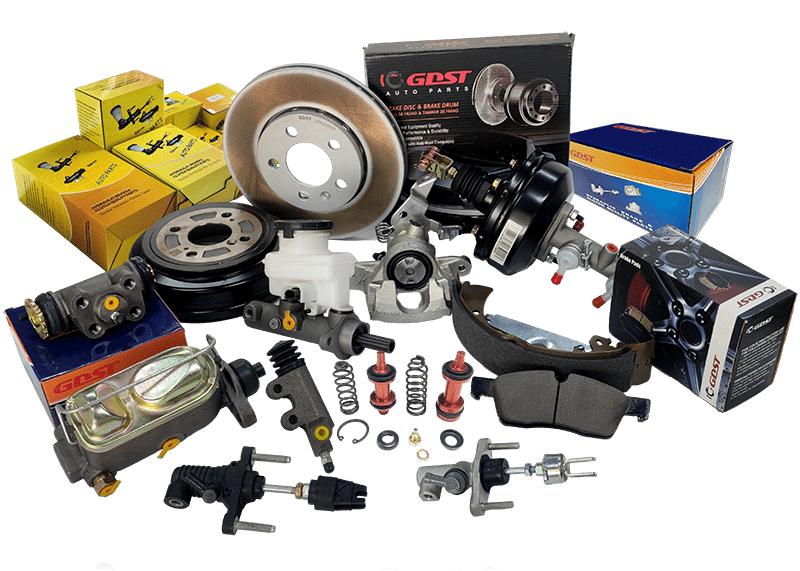
What's a Great Brand for Brake Pads and Rotors?
Pain point: Most buyers waste months chasing brand names, only to end up with quality problems that kill their garage relationships. The real question is different.
The right question isn't "what's the best brand?" It's "which supplier fits my market, my vehicle models, and my business goals?" A great brand for your competitor may be a disaster for you. Your climate, your target vehicles, and your required price point all change the answer completely.
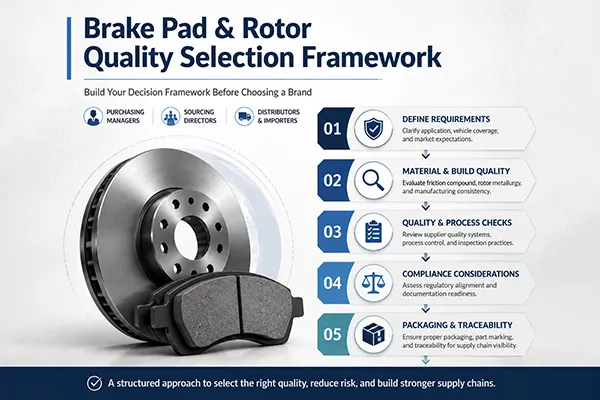
I work at GDST, a brake pad manufacturer in China. Every week, I talk to purchasing managers, sourcing directors, and distributors from South America, Europe, the Middle East, and Southeast Asia. They all open with the same question: "Can you tell me which brand is best?" After years of these conversations, I've learned that this question almost always leads buyers in the wrong direction. The buyers who source well don't chase brand names. They build a decision framework first. In this article, I want to share that framework with you.
Does Your Target Market Actually Define the "Best" Brake Pad?
Most buyers skip this step. They go straight to supplier catalogs and start comparing prices, and then wonder why the pads they ordered don't perform the way they expected.
Your target market defines everything about which brake pad will work. The right friction formulation for a Japanese passenger car in humid Southeast Asia is not the same as one for a European SUV in the dry heat of the Middle East. Vehicle model, local climate, and road conditions all change what "good" means.
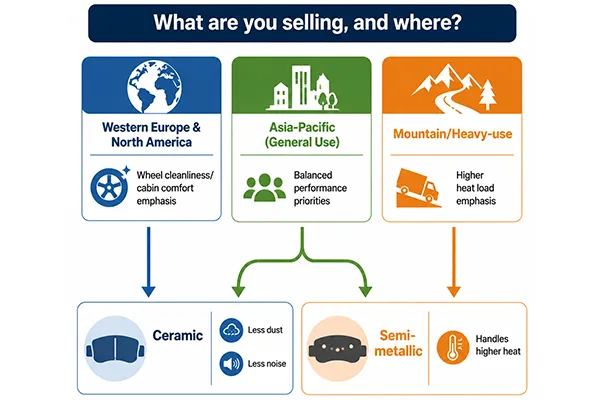
When importers ask us about formulation, the first thing we ask them back is: "What are you selling, and where?" This isn't a sales tactic. It's a necessary step. Ceramic formulations, for example, produce less dust and less noise1. That makes them popular in markets where vehicle owners care a lot about wheel cleanliness and cabin comfort, like Western Europe and North America. Semi-metallic formulations handle higher heat loads better2, which makes them a stronger fit for heavy-use vehicles or markets with aggressive mountain driving.
The friction formulation isn't a spec on a data sheet. It's a business decision. If you sell the wrong formulation into your market, you will get noise complaints, early wear, and returns. Those problems don't just cost you money. They damage your relationships with the repair shops that depend on you.
Here is a simple way to think about the relationship between your market and your product choice:
| Variable | What to Ask | Why It Matters |
|---|---|---|
| Vehicle models | Japanese, Korean, European, American, or mixed? | Backing plate dimensions and friction compound requirements differ significantly3 |
| Climate | Hot and dry, humid, cold, or mixed? | Heat tolerance and corrosion resistance requirements change |
| Road conditions | Highway-heavy, mountain, urban stop-and-go? | Affects wear rate and heat cycling demands |
| End customer priority | Low noise, low dust, long life, or low price? | Determines the correct formulation tier (ceramic, semi-metallic, low-metallic) |
| Price segment | Economy, mid-range, or premium? | Sets the material quality floor and the acceptable cost structure |
Go through this table before you contact any supplier. Your answers will immediately filter out suppliers who can't meet your real needs, and they will give you a much stronger position when you start negotiating.
How Do You See Through Marketing Claims and Identify a Supplier's Real Quality Level?
Every supplier tells you their quality is excellent. Every catalog says "OEM grade" or "premium formulation." After talking to hundreds of buyers who came to us after a bad experience with another supplier, I can tell you that marketing language is the least useful thing you can read during the sourcing process.
A supplier's real quality level shows in their manufacturing process control, not in their brochure. Ask specifically about their hot pressing process, their quality control checkpoints, and the testing equipment they actually operate in-house. Suppliers who can answer these questions in detail are the ones worth talking to.
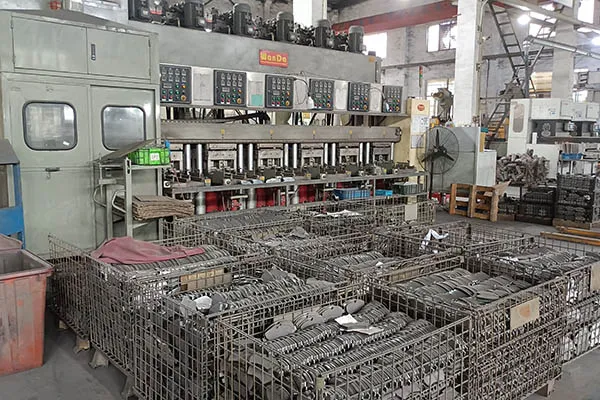
At GDST, when buyers ask us about quality, we don't show them a marketing slide. We walk them through our production sequence: raw material batching, hot pressing, heat treatment, grinding, slotting, chamfering, coating, shims assembly, and packaging. Each step has quality checkpoints. The hot pressing phase is the one we focus on most heavily, because this is where the friction material bonds to the backing plate under high heat and pressure. If the temperature is wrong, or the press equipment has a deviation, you get bonding failures. That leads to delamination in the field, which is a safety failure4.
Buyers rarely think to ask about hot pressing. Most suppliers won't bring it up. But it is the single most critical process in brake pad manufacturing5.
Here are the specific questions I recommend you ask any supplier before placing an order:
| Question to Ask | What a Strong Answer Looks Like |
|---|---|
| What testing equipment do you operate in-house? | They should name specific machines: Krauss friction tester, dynamometer bench, shear strength tester, compressibility tester |
| How do you control the hot pressing phase? | They should describe temperature monitoring, equipment calibration schedules, and rejection criteria |
| What quality checks happen on finished products? | They should describe dimensional checks, shim alignment verification, and wear indicator model matching |
| What standards do your products comply with? | They should cite GB5763-20186 as a minimum, with relevant export certifications layered on top |
| Can you support third-party audits or test reports? | A confident "yes" with a clear process is the only acceptable answer |
If a supplier answers these questions vaguely, or redirects you back to their catalog, that tells you something important. A manufacturer who genuinely controls their process knows exactly how it works and can explain it clearly.
Why Do Certifications Matter More Than a Brand Name?
I've seen buyers get burned by this more than any other issue. They find a supplier with a recognizable name in their local market, they assume that reputation means the quality is certified, and then they try to import the goods only to find that the products can't clear customs or don't meet the legal requirements of their market.
Certifications are not optional extras. They are the legal and commercial foundation of your import business. IATF 169497 confirms that the manufacturer controls their production process systematically. E-mark8 confirms European market compliance. DOT and AMECA9 serve the North American market. Without the right certification, you cannot legally sell the product.
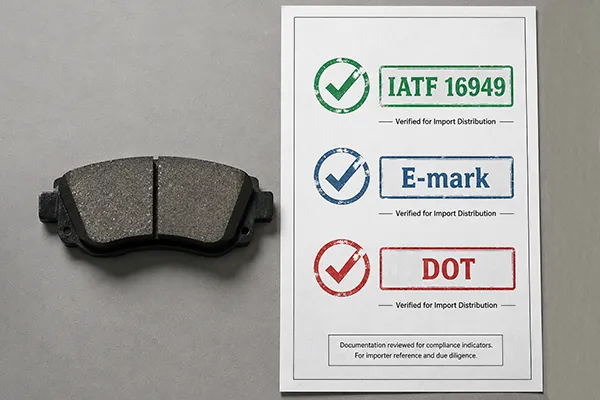
From our experience, the most common sourcing mistake we see is buyers who prioritize price first and certifications second. They find a very low price, they place a large order, and then they discover the supplier's E-mark is either expired, covers only certain SKUs, or was obtained through a third-party certificate holder with no actual oversight over the production line. By then, they have a container of goods they cannot sell legally, or goods that will fail a market spot check.
Here is how to evaluate certifications properly, beyond just asking "do you have it?":
| Certification | What It Covers | What to Verify |
|---|---|---|
| IATF 16949 | Quality management system for automotive manufacturing | Ask for the certificate document with valid dates and the certifying body's name |
| ISO 9001 | General quality management system | Baseline requirement; confirm it's current |
| E-mark (EU) | Product compliance for European market entry | Check which specific product categories are covered; not all SKUs may be included |
| DOT | US market product safety compliance | Necessary for North American distribution |
| AMECA | Aftermarket product recognition for North American market | Valued by US and Canadian distributors specifically |
| 3C | Required for the Chinese domestic market | Relevant if you're evaluating a supplier's domestic vs. export product lines |
Ask for physical copies of these certificates during your vetting process. Check the expiry dates. Check whether the certificate covers the specific product types you are sourcing. A manufacturer who is serious about exports will have this documentation organized and ready to share without hesitation.
What Makes a Supplier a Real Business Partner, Not Just a Parts Vendor?
This is the part that most sourcing guides skip entirely. They focus on the product. But your actual problem as an importer or distributor isn't just finding a good product. It's finding a supply chain partner who won't create business problems for you six months after you start working together.
A good supplier partner protects three things for your business: your reputation with local repair shops through stable quality, your profit margins through direct-factory pricing, and your inventory turnover through reliable lead times and consistent stock availability.
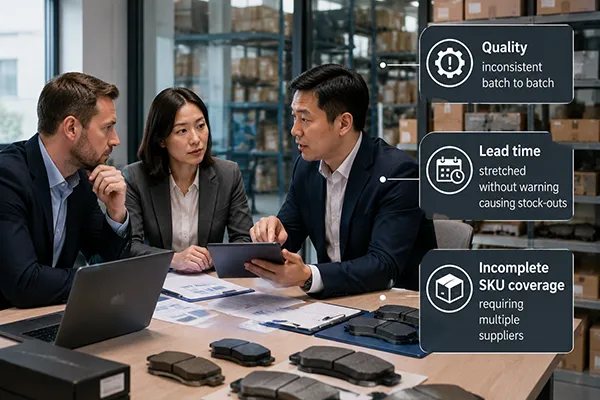
When importers come to us after a bad experience with a previous supplier, the complaint is rarely "the price was wrong." The complaints are almost always one of three things: quality was inconsistent batch to batch10, the lead time stretched without warning and caused stock-outs11, or the SKU coverage was incomplete and they had to manage multiple suppliers for the same product category.
These are business problems, not product problems. And they are exactly the things you need to evaluate before you commit to a supplier, not after.
Here is a checklist I'd recommend for evaluating supplier reliability as a business partner:
| Business Risk Area | Questions to Ask | Red Flags |
|---|---|---|
| Quality consistency | How do you ensure batch-to-batch consistency in friction formulation? | Vague answers, no reference to process documentation |
| Lead time reliability | What is your standard production and delivery cycle? What happens if there is a delay? | No clear timeline, no communication process for delays |
| SKU coverage | Can you cover the full range of models for my target market? Do you maintain cross-reference data? | Only partial coverage, no localized cross-reference support |
| MOQ flexibility | What is your minimum order quantity? Does it apply per SKU or per order? | Rigid minimums that don't fit your stocking strategy |
| OEM/ODM capability | Can you customize packaging, shims branding, or formulation for my market? | No customization capability, or customization only at very high volumes |
| After-sales support | What is your process if we receive defective goods? | No clear warranty or claim process |
At GDST, our MOQ is 100 sets and our standard production and delivery cycle runs 50 to 60 days12. We support brand and packaging customization, and we maintain cross-reference data for Japanese, European, American, Korean, and Chinese vehicle models across our export markets. I'm not mentioning this to pitch you. I'm mentioning it because these are the kinds of concrete, specific answers you should be getting from any supplier you evaluate. If a supplier can't answer these questions with the same level of specificity, that gap in information is itself useful data.
Conclusion
Stop searching for the best brand. Start building the right framework. Define your market, verify certifications, interrogate the manufacturing process, and evaluate suppliers as business partners first.
"Importance of Ceramic Brake Pads", https://www.preciseceramic.com/blog/importance-of-ceramic-brake-pads.html. A source could explain that ceramic brake pad compounds, composed of ceramic fibers and non-ferrous fillers, generate friction-induced vibrations at frequencies often outside the range of human hearing, reducing noise. The resulting dust is also lighter in color and less adhesive than the carbon-black and metallic dust from other pad types, making it less visible on wheels. Evidence role: mechanism; source type: paper. Supports: Explains the material properties of ceramic brake pads that lead to lower perceived noise and dust.. ↩
"Initial Selection of Disc Brake Pads Material based on the ... - PMC", https://pmc.ncbi.nlm.nih.gov/articles/PMC7078729/. A source on material science could detail how the high percentage of steel, copper, and other metallic fibers in semi-metallic formulations provides superior thermal conductivity, allowing the pads to transfer heat away from the rotor more effectively and maintain performance during heavy or high-speed braking. Evidence role: mechanism; source type: paper. Supports: Details why the metallic content in semi-metallic pads improves their ability to manage high temperatures.. ↩
"OEM vs Aftermarket Brake Pads: What's the Right Choice? - AutoZone", https://www.autozone.com/diy/brakes/oem-vs-aftermarket-brake-pads. An automotive engineering source could discuss the differing design priorities, such as the emphasis on high-speed performance and strong initial 'bite' in many European vehicles versus the focus on low noise, low dust, and smooth pedal feel in many Japanese and North American models, which dictates the choice of friction materials and pad design. Evidence role: historical_context; source type: education. Supports: Explains the different engineering philosophies for braking systems in vehicles from different regions.. Scope note: The source would likely provide general context on design philosophies rather than a comprehensive database of specific dimensional differences. ↩
"Interpretation ID: GF007915 - NHTSA", https://www.nhtsa.gov/interpretations/gf007915. A report from a national transportation safety agency, such as the U.S. National Highway Traffic Safety Administration (NHTSA), could document instances where the separation of the friction material from the backing plate (delamination) has led to a sudden and severe loss of braking effectiveness, classifying it as a critical safety defect. Evidence role: case_reference; source type: government. Supports: Documents the safety risks associated with brake pad delamination.. ↩
"Brake Pads Frequently Asked Questions", https://dtsc.ca.gov/scp/brake-pads-frequently-asked-questions/. A source on manufacturing engineering could describe the hot pressing process, where thermosetting resins in the friction material cure under specific temperature and pressure profiles to bond to the backing plate. It could note that deviations in these parameters are a primary cause of incomplete curing, leading to a weak bond and subsequent delamination in service. Evidence role: mechanism; source type: paper. Supports: Explains the importance of the hot pressing stage for achieving a durable bond between the friction material and the backing plate.. ↩
"National Standards of China - Wikipedia", https://en.wikipedia.org/wiki/National_Standards_of_China. A source from a Chinese standards organization could specify that GB5763-2018 is the mandatory national standard for 'Brake linings for automobiles,' outlining minimum requirements for friction performance, shear strength, hardness, and other physical properties to ensure basic safety and quality. Evidence role: definition; source type: government. Supports: Defines the scope and key requirements of the Chinese national standard GB5763-2018.. Scope note: Official English translations of the full standard may not be readily or freely available. ↩
"IATF 16949 - Wikipedia", https://en.wikipedia.org/wiki/IATF_16949. A source from the International Automotive Task Force (IATF) or a certified registrar could explain that IATF 16949 is the global technical specification and quality management system standard for the automotive industry. It focuses on continuous improvement, defect prevention, and the reduction of variation and waste in the supply chain. Evidence role: definition; source type: institution. Supports: Defines the IATF 16949 standard and its role in the automotive supply chain.. ↩
"ECE Regulation 90", https://en.wikipedia.org/wiki/ECE_Regulation_90. A source from the United Nations Economic Commission for Europe (UNECE) could detail that the 'E-mark' signifies compliance with its vehicle regulations. Specifically, ECE Regulation No. 90 (R90) mandates that replacement brake linings must perform within a specified tolerance of the original equipment parts, ensuring a minimum level of safety and performance for sale in signatory countries. Evidence role: definition; source type: government. Supports: Explains the E-mark and the specific UNECE Regulation R90 that applies to replacement brake linings.. ↩
"49 CFR 571.135 -- Standard No. 135; Light vehicle brake systems.", https://www.ecfr.gov/current/title-49/subtitle-B/chapter-V/part-571/subpart-B/section-571.135. A U.S. government or industry source could clarify that the Department of Transportation (DOT) establishes Federal Motor Vehicle Safety Standards (FMVSS), which are mandatory. The Automotive Manufacturers Equipment Compliance Agency (AMECA) is a third-party organization that runs a voluntary program to test and certify that aftermarket parts, like brake pads, meet these government standards. Evidence role: definition; source type: government. Supports: Explains the distinct roles of the Department of Transportation (DOT) and the Automotive Manufacturers Equipment Compliance Agency (AMECA) for brake components.. ↩
"Industrial process control - Wikipedia", https://en.wikipedia.org/wiki/Industrial_process_control. A research paper on industrial engineering or quality control could discuss how variations in raw material properties, equipment wear, environmental conditions, and operator inputs can lead to significant batch-to-batch inconsistency, a critical challenge in industries requiring high product uniformity. Evidence role: general_support; source type: paper. Supports: Discusses the challenges of maintaining batch-to-batch consistency in manufacturing.. Scope note: The source would likely discuss manufacturing in general, not specifically the brake pad industry or complaints from importers. ↩
"The Bullwhip Effect in Supply Chains", https://sloanreview.mit.edu/article/the-bullwhip-effect-in-supply-chains/. A textbook or article on supply chain management could explain that global supply chains are inherently prone to lead time variability due to factors like production delays, shipping congestion, and customs clearance. This uncertainty is a primary driver of inventory problems like stock-outs and the 'bullwhip effect,' where demand fluctuations are amplified up the supply chain. Evidence role: general_support; source type: education. Supports: Explains the causes and effects of lead time variability in global supply chains.. ↩
"[PDF] China's Growing Role in U.S. Automotive Supply Chains", https://www.usitc.gov/publications/332/working_papers/id-19-060_chinese_auto_parts_final_080519-compliant_0.pdf. A report from a logistics provider or a freight market analyst could provide data on typical ocean freight transit times from major Chinese ports to Europe (e.g., 30-40 days) or the Americas (e.g., 30-50 days). This data helps establish a baseline for the shipping portion of a total lead time, suggesting that a 50-60 day cycle including production is a plausible industry benchmark. Evidence role: statistic; source type: other. Supports: Provides benchmark data on shipping times from China, which is a major component of total lead time.. Scope note: The source would provide data on shipping transit times only, which does not include production time, inland transport, or customs clearance, all of which contribute to the total lead time. ↩