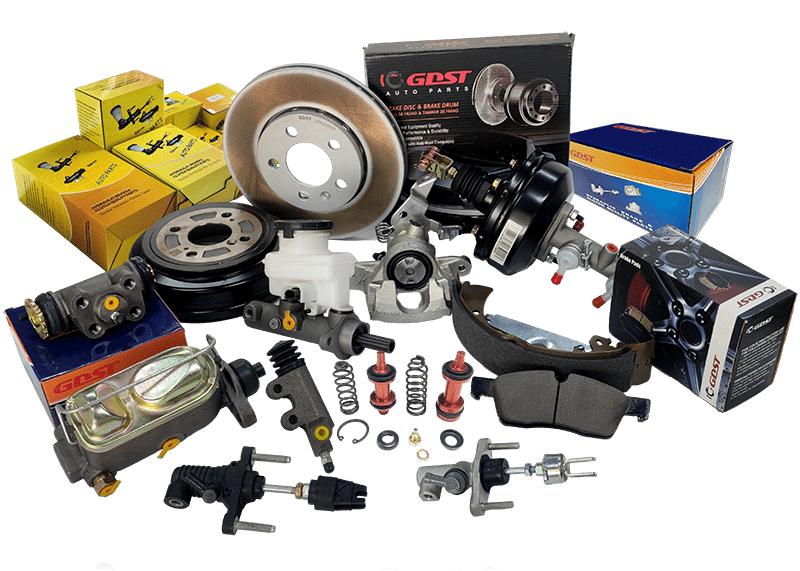
Every importer I talk to eventually asks the same question: "Should I be sourcing OEM brake pads?" It sounds simple. It is not.
Specifying OEM brake pads is less important than verifying the performance standards behind any pad you source. "OEM" describes a supply contract, not a quality level. A certified aftermarket pad with a tested friction formulation and a compliant manufacturing process can match or outperform an OEM-labeled part for your specific market1.
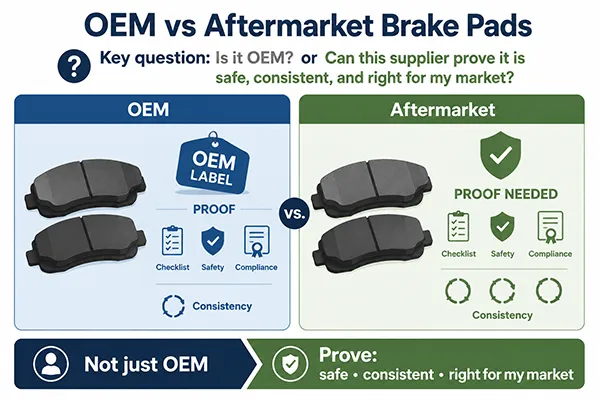
The real question for a professional buyer is not "Is it OEM?" The real question is "Can this supplier prove it is safe, consistent, and right for my market?" Those are two very different conversations. Let me break down why the first question sends buyers down the wrong path, and what the right framework looks like.
Does "OEM" Actually Mean Higher Quality?
Most buyers assume that "OEM" is a quality rating. It is not. When a pad goes through the wrong lens, bad sourcing decisions follow.
"OEM" means a part was supplied to a vehicle manufacturer under a specific contract. It says nothing about whether that exact specification is the right fit for aftermarket use, your region's road conditions, or your customers' vehicles after 80,000 km of wear. The label describes the sales channel, not the friction performance2.
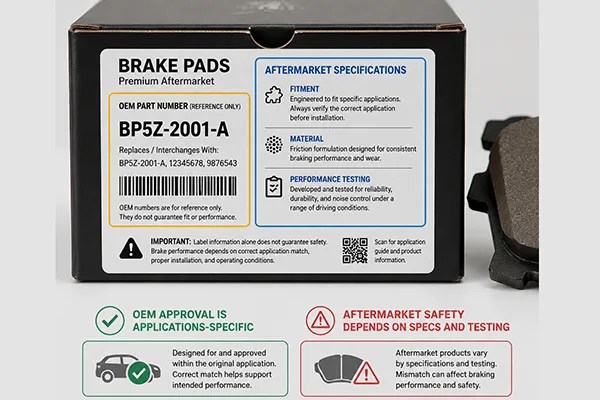
A common question we get from importers in South America is whether a pad with an OEM number on the box is automatically the safer buy. I understand the logic. If a vehicle manufacturer approved it, it must be good. But that approval happened for a specific vehicle, a specific production year, and a specific set of driving conditions. The aftermarket is a different environment entirely.
What Does the OEM Label Actually Tell You?
| What "OEM" Tells You | What "OEM" Does NOT Tell You |
|---|---|
| The part was used in original vehicle assembly | Whether the formulation suits your local climate |
| It met specs at the time of vehicle production | Whether it performs well at high mileage on worn rotors |
| A vehicle manufacturer approved the supplier | Whether the current batch is manufactured to the same standard |
| It fits the original application | Whether a certified aftermarket option offers better value or longevity |
From our perspective as a manufacturer, the critical variables are the friction formulation, the hot pressing process, and the QC steps that follow. None of those are guaranteed by an OEM label on aftermarket packaging. What does guarantee them is a supplier who can show you the data. That means certifications, test reports, and a transparent production process. If a supplier cannot provide those, the OEM label on the box is just a marketing decision.
What Questions Should You Actually Be Asking?
Once you move past the OEM question, the conversation becomes much more useful. Instead of asking "Is it OEM?", I recommend a short checklist of questions that directly control your risk as an importer.
The right sourcing questions are: Does this supplier hold E-mark, DOT, or AMECA certification3 for my target market? What friction formulation is used, and has it been tested for my region's climate and vehicle types? Can the manufacturer show me their IATF 16949-compliant QC process4?
I worked with a purchasing manager from Europe last year who had a clear brief: he needed pads that would clear E-mark requirements for his EU distribution network. He did not ask whether the pads were OEM. He asked for the E-mark certificate and the third-party test reports. That is the right instinct.
A Practical Risk-Control Checklist for Buyers
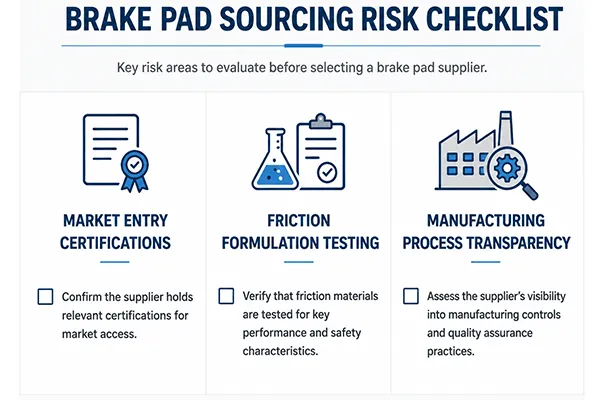
Market entry certifications are the first gate. Without E-mark for Europe, DOT for North America, or AMECA for the US aftermarket, the pads cannot legally enter those markets5 regardless of their quality. This is a binary question. If a supplier cannot produce the certificate, the conversation ends there.
Friction formulation testing is the second question. Ceramic, semi-metallic, and low-metallic formulations behave differently depending on temperature range, vehicle weight, and driving style. A ceramic formulation that works well in a mild European climate may not perform the same way in the high-heat, high-load conditions6 in parts of South America or the Middle East. Ask the manufacturer if they have region-specific formulation data. At GDST, we develop tailored formulations based on the target market, not just the vehicle model. That is a meaningful difference.
Manufacturing process transparency is the third question. The most critical step in brake pad production is hot pressing. Abnormal temperatures or equipment deviations at this stage cause bonding failures7, which show up as noise, vibration, or delamination in the field. Ask your supplier what controls they have at this specific step. If they cannot explain it clearly, that is a red flag.
| Risk Area | Right Question to Ask | Why It Matters |
|---|---|---|
| Market compliance | Do you hold E-mark / DOT / AMECA? | Legal market entry requirement |
| Formulation fit | Is the formula tested for my region's climate? | Performance and customer satisfaction |
| Manufacturing integrity | What is your hot pressing QC process? | Prevents bonding failures and noise complaints |
| Dimensional accuracy | How do you check backing plate size and shim fitment? | Prevents returns and fitment failures |
| System compliance | Are you IATF 16949 certified? | Confirms a structured, auditable QC system |
How Does Formulation Choice Affect Your Business?
Most buyers treat formulation as a purely technical decision and leave it to the supplier. That is a mistake. The formulation choice has direct consequences for your customer relationships and your brand reputation.
Ceramic formulations produce less dust and less noise8, which improves end-customer satisfaction. Semi-metallic formulations handle higher heat loads better9, making them a stronger fit for trucks or heavy-use vehicles. Choosing the wrong formulation for your market means noise complaints, dust on wheels, and customers who do not come back.
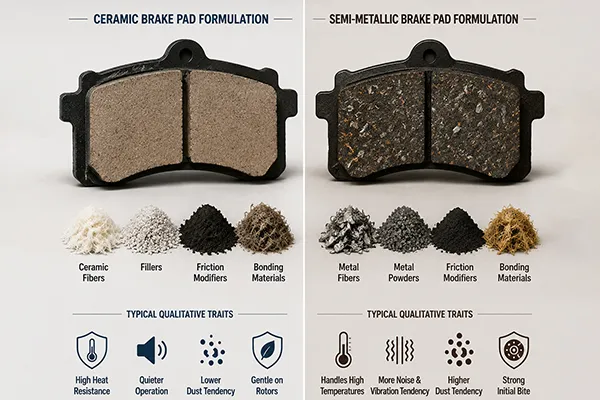
Here is how this plays out in practice. An importer supplying European passenger cars chooses a low-metallic formulation because it is the cheapest option. The pads fit. They pass basic safety checks. But within three months, their repair shop customers are calling about brake dust on alloy wheels and noise during cold starts. The importer's brand takes a hit. They lose accounts. The root cause was not a defective product in a traditional sense. It was a wrong formulation choice for that specific application.
Formulation vs. Application Match
| Formulation Type | Best Application | Key Trade-Off |
|---|---|---|
| Ceramic | Passenger cars, light SUVs, European markets | Higher cost, excellent dust and noise performance |
| Semi-metallic | Trucks, heavy vehicles, high-temperature applications | More rotor wear, better heat dissipation |
| Low-metallic | General passenger use, cost-sensitive markets | Moderate dust, requires careful application matching |
From our production experience, the buyers who get the best long-term results are not the ones who specify the cheapest option. They are the ones who come to us with a clear brief: the vehicle types, the typical driving conditions in their market, and their customers' main complaints about the pads they are currently using. With that information, we can recommend the right formulation and back it up with test data. That conversation produces far better outcomes than simply asking "Can you match this OEM number?"
What Is the Real Risk for an Importer?
Let me be direct about where the actual danger sits for a professional buyer. It is not in choosing aftermarket over OEM. That is a distraction.
The real risk for an importer is sourcing from a supplier with no certifications and no visible quality control process. A bonding failure in the field, a shim that does not fit, or a wear indicator that does not match the vehicle model—these are the failures that damage garage relationships and brand reputations. They come from opaque manufacturing, not from an "aftermarket" label.
I have seen this pattern repeatedly. A buyer switches to a cheaper supplier to protect margins. The first few shipments are fine. Then a bad batch comes through. Maybe the backing plate dimensions are slightly off. Maybe the shim is misaligned. Repair shops notice. They complain to the importer. The importer loses the account. The cost of one bad batch far exceeds any margin saved in the sourcing decision.
Where Quality Failures Actually Come From
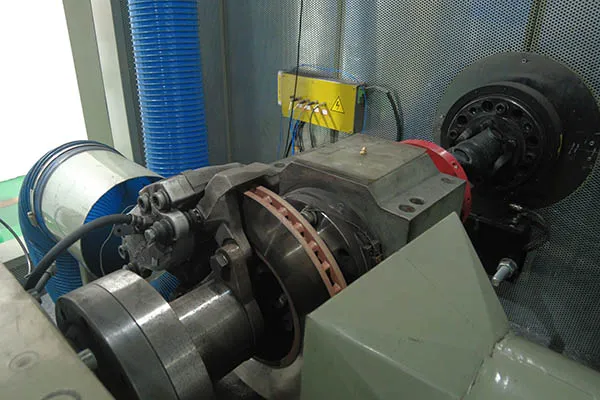
Structural and dimensional errors10 are among the most common failure types we see reported in the market. These include backing plate size errors that prevent proper fitment, shims that are attached incorrectly or misaligned, and wear indicators that are specified for the wrong vehicle model. These are not formulation problems. They are process discipline problems. A manufacturer with a structured QC system—and the equipment to enforce it, such as shear strength testers, compressibility testers, and dynamometer test benches11—catches these before the pads leave the factory.
Bonding failures are the most serious category. They occur when the friction material separates from the backing plate under load or heat12. The root cause is almost always a deviation in the hot pressing phase: wrong temperature, wrong pressure, or equipment that has not been properly maintained. This type of failure is not visible in a simple visual inspection of the finished pad. It only shows up in service. The only way to control this risk is to audit the manufacturer's hot pressing controls directly, or to work with a supplier whose IATF 16949 certification means those controls are already subject to regular third-party audits.
| Failure Type | Root Cause | How to Screen for It |
|---|---|---|
| Bonding failure / delamination | Hot pressing deviation | Ask for IATF 16949 certification and hot press QC records |
| Shim misalignment | Assembly process error | Request dimensional inspection reports |
| Wrong fitment | Backing plate size error | Confirm cross-reference accuracy against your vehicle database |
| Noise and vibration | Wrong formulation or surface finish | Request friction coefficient test data for your application |
| Wear indicator mismatch | Catalog error | Verify model-specific part numbers against OE cross-reference data |
The importer's job is not to become a manufacturing expert. But it is to ask the right questions and to work with suppliers who can answer them with data, not just assurances.
Conclusion
Specifying OEM pads is less important than verifying certifications, matching formulations to your market, and auditing your supplier's manufacturing controls. Get those three things right, and the "OEM" question becomes irrelevant.
"OEM vs Aftermarket Brake Pads: What's the Right Choice?", https://www.autozone.com/diy/brakes/oem-vs-aftermarket-brake-pads. A source could provide data from dynamometer or vehicle testing that compares the friction stability, wear rates, and noise characteristics of certified aftermarket brake pads against their OEM equivalents, demonstrating comparable or superior performance under specific conditions. Evidence role: general_support; source type: paper. Supports: The claim that certified aftermarket brake pads can meet or exceed the performance of OEM pads.. Scope note: The findings may be specific to the brands and part numbers tested and may not be generalizable to all aftermarket products. ↩
"Original equipment manufacturer", https://en.wikipedia.org/wiki/Original_equipment_manufacturer. A source could define OEM parts as components produced by a manufacturer for use in a new vehicle's assembly line, distinguishing this from aftermarket parts sold for repair or replacement. This supports the idea that 'OEM' describes the original supply chain, not necessarily a universal quality standard for all applications. Evidence role: definition; source type: encyclopedia. Supports: The definition of 'Original Equipment Manufacturer' (OEM) in the automotive context.. ↩
"49 CFR Part 393 Subpart C -- Brakes - eCFR", https://www.ecfr.gov/current/title-49/subtitle-B/chapter-III/subchapter-B/part-393/subpart-C. A source from a regulatory body like the UNECE or NHTSA could explain that these marks certify that a product meets minimum legal safety and performance standards for a given market, such as UNECE Regulation 90 (R90) for E-mark in Europe. Evidence role: definition; source type: government. Supports: The nature and purpose of E-mark, DOT, and AMECA certifications for automotive components.. ↩
"IATF 16949 - Wikipedia", https://en.wikipedia.org/wiki/IATF_16949. A source from the International Automotive Task Force (IATF) or the International Organization for Standardization (ISO) could describe IATF 16949 as the global quality management system standard for the automotive industry, focusing on continuous improvement, defect prevention, and reduction of variation and waste in the supply chain. Evidence role: definition; source type: institution. Supports: The definition and significance of the IATF 16949 standard.. ↩
"Interpretation ID: GF007915 - NHTSA", https://www.nhtsa.gov/interpretations/gf007915. A source such as the text of UNECE Regulation 90 could be cited to show that replacement brake linings sold in the EU and other signatory countries must be tested and approved to this standard, making uncertified products illegal for sale. Evidence role: general_support; source type: government. Supports: The legal requirement for brake pads to be certified for sale in specific regions.. Scope note: The specific regulations for DOT and AMECA would require separate sources, as they apply to the North American market. ↩
"Brake fade - Wikipedia", https://en.wikipedia.org/wiki/Brake_fade. A study could present data showing that certain friction materials exhibit a significant drop in friction coefficient (fade) at the higher operating temperatures encountered in hot climates or mountainous terrain, supporting the need for region-specific formulations. Evidence role: case_reference; source type: research. Supports: The claim that brake performance is significantly affected by regional climate and driving conditions.. Scope note: The study may focus on specific vehicle types or formulations, not all of which may be relevant to every importer. ↩
"Reliability improvement of brake pads — Case study", https://www.academia.edu/12517720/Reliability_improvement_of_brake_pads_and_x2014_Case_study. A research paper on the manufacturing of composite friction materials could show that improper temperature, pressure, or curing time during the hot pressing stage leads to incomplete polymerization of the phenolic resin binder, resulting in poor adhesion between the friction material and the backing plate. Evidence role: mechanism; source type: paper. Supports: The link between hot pressing process deviations and bonding failures in brake pads.. ↩
"Brake wear particle emissions: a review - PMC - NIH", https://pmc.ncbi.nlm.nih.gov/articles/PMC4315878/. A technical paper on brake friction materials could explain that ceramic formulations, composed of ceramic fibers and non-ferrous fillers, operate at a frequency beyond human hearing and produce a lighter-colored, less adhesive dust, contributing to lower perceived noise and cleaner wheels compared to semi-metallic pads. Evidence role: mechanism; source type: paper. Supports: The claim that ceramic brake pads tend to produce less audible noise and visible dust.. ↩
"Initial Selection of Disc Brake Pads Material based on the ... - PMC", https://pmc.ncbi.nlm.nih.gov/articles/PMC7078729/. An engineering or materials science resource could explain that the high percentage of steel and other metals in semi-metallic formulations provides high thermal conductivity, allowing heat to be drawn away from the rotor more effectively, which reduces brake fade during heavy or repeated braking. Evidence role: mechanism; source type: education. Supports: The mechanism by which semi-metallic brake pads achieve superior heat dissipation.. ↩
"Why Brake Pad Advice Is A Mess - YouTube",
. An industry report or a technical bulletin from an automotive service organization could document common reasons for brake job comebacks, citing issues like improper fitment due to backing plate dimensional errors or noise caused by incorrectly installed shims as frequent problems originating from manufacturing process errors. Evidence role: general_support; source type: other. Supports: The prevalence of dimensional and assembly errors as a source of brake pad failure.. ↩"Tribological and performance assessment of two wheeler brake ...", https://pmc.ncbi.nlm.nih.gov/articles/PMC12479935/. A source could reference an SAE International standard, such as SAE J840 for shear testing or SAE J2784 for dynamometer testing, to explain that these procedures are designed to verify the integrity of the bond between the friction material and backing plate and to characterize the friction, wear, and noise performance under simulated driving conditions. Evidence role: definition; source type: institution. Supports: The purpose of specific tests like shear strength and dynamometer testing in brake pad quality control.. ↩
"DOT - CrashStats - NHTSA", https://crashstats.nhtsa.dot.gov/#!/PublicationList/11. A safety investigation report from an agency like the National Highway Traffic Safety Administration (NHTSA) could be cited, describing instances where friction material delamination led to a sudden and complete loss of braking ability for the affected wheel, classifying it as a catastrophic failure with high safety risk. Evidence role: expert_consensus; source type: government. Supports: The classification of brake pad delamination as a critical safety failure.. ↩