Most buyers ask me this question expecting a simple answer. But the wrong answer here costs distributors real money in returns, complaints, and damaged shop relationships.
The best brake pad for a slotted rotor depends on the application, not the material name. Semi-metallic pads handle high heat and heavy use well. Ceramic pads run quieter with less dust, making them better for daily passenger cars. The right choice comes from matching the formulation to the vehicle type, climate, and end-user driving style.
When our distributor partners ask us this question, the first thing we ask back is: what vehicles are these going on, and what market are you supplying? That single question changes the answer completely. Let me break down exactly why, and what you need to know before you make a stocking decision.
Why Do Slotted Rotors Change What You Need from a Brake Pad?
Most buyers assume slotted rotors are just a performance upgrade. That assumption leads to the wrong purchasing decision.
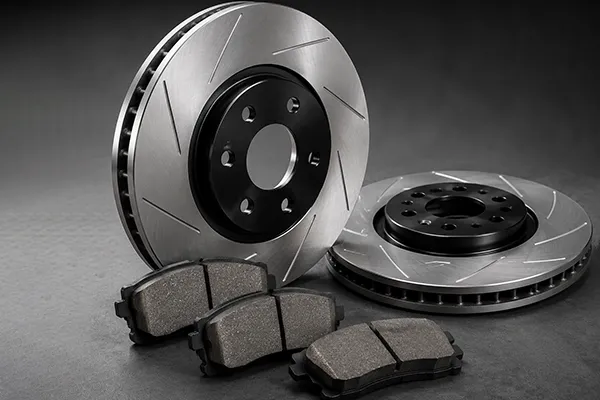
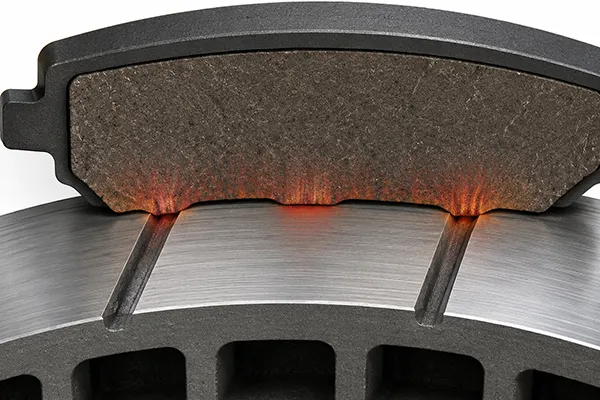
Slotted rotors work by cutting channels across the rotor face. These slots push out gas, water, and brake dust from under the pad during braking1. This keeps the pad surface in contact with the rotor, which improves bite. But it also puts new physical and thermal demands on the pad itself.
Here is what actually changes when a pad runs against a slotted rotor instead of a smooth one.
The pad edge passes over each slot during every rotation. This creates a small but repeated mechanical scraping action across the pad surface. Over thousands of rotations, this wears the pad friction material faster than it would wear on a plain rotor2. A formulation that is already soft or has a low compressive strength will show accelerated edge wear and cracking.
At the same time, the slot channels move heat more efficiently away from the pad-rotor interface. This means surface temperatures during hard braking can climb higher than they would on a standard rotor3. A pad formulation that has poor thermal stability will lose friction consistency at these temperatures. This is what engineers call "fade."4
Here is a simple way to think about the two demands slotted rotors place on a pad:
| Demand from Slotted Rotor | What Fails if the Pad is Wrong |
|---|---|
| Repeated mechanical scraping at slot edges | Premature wear, edge cracking, pad crumble |
| Higher operating surface temperatures | Friction fade, inconsistent brake feel, customer complaints |
| More aggressive debris and gas expulsion | Increased noise if pad material is too hard or mismatched |
So the question is not just "what type of pad." The question is "which formulation holds up under these two specific demands, for this specific vehicle in this specific climate?"
When we review after-sales feedback from our global distributor partners, many warranty claims do not come from a bad product. They come from a product that was fine on its own but wrong for the rotor type and driving conditions it was paired with. This is a sourcing problem, not a manufacturing problem. And it is entirely preventable if you ask the right questions before placing an order.
Semi-Metallic Pads and Slotted Rotors: When Does This Combination Make Sense?
Distributors serving heavy-duty or high-load markets often ask me if semi-metallic is always the safer choice with slotted rotors. The answer is: it depends on who is driving and where.
Semi-metallic pads contain a high percentage of metal fibers and powders5. This gives them strong heat dissipation and consistent friction at higher temperatures. When paired with slotted rotors on trucks, SUVs, or vehicles driven hard in hot climates, this combination handles thermal stress well. But the trade-off is more rotor wear, more brake dust, and higher noise levels.6
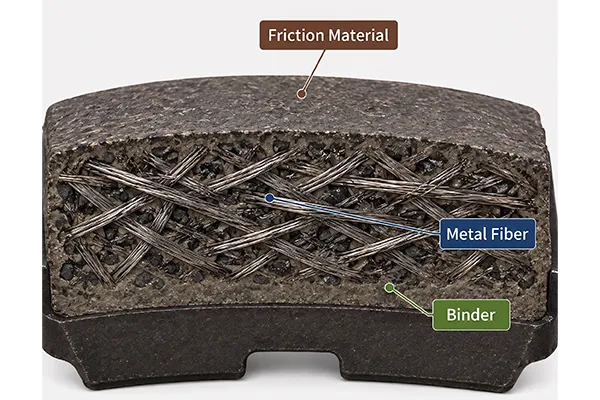
The metal content in the formulation is what drives both the strength and the trade-offs here. Metal fibers give the pad excellent structural integrity. This means the pad surface survives the repeated scraping from the rotor slots without crumbling or developing edge cracks. The high thermal conductivity of the metal content also pulls heat away from the pad faster, which protects the friction material from fade under sustained braking.
But this same metal content is abrasive. Against the sharp edges of rotor slots, a high-metallic formulation creates more friction on the rotor itself. Over time, this accelerates rotor groove wear and can deepen the existing slots. For a distributor supplying independent repair shops, this creates a downstream problem: the customer comes back complaining about rotor noise or uneven wear, and the shop blames the pads.
Here is when semi-metallic with slotted rotors is the right stocking decision, and when it is not:
| Application | Semi-Metallic + Slotted Rotor: Right Choice? |
|---|---|
| Light trucks and commercial vans, heavy loads | Yes. Heat and load demands justify the trade-offs. |
| SUVs in South American or Middle Eastern markets | Yes. High ambient temperatures favor strong heat dissipation. |
| Standard European passenger sedans, daily driving | No. Noise and rotor wear complaints will follow. |
| Korean or Japanese economy cars for urban markets | No. Overkill. The pad-rotor interaction becomes too aggressive. |
When our buyers from South America or Southeast Asia describe their vehicle mix, and that mix includes a significant share of light commercial vehicles or pick-up trucks, semi-metallic formulations are usually where we start the technical conversation. But we always ask about the dominant vehicle type in their catalog. A distributor stocking parts for compact passenger cars in the same market needs a different answer.
Ceramic Pads and Slotted Rotors: What Are You Actually Trading Off?
Ceramic pads have a strong marketing reputation. Many buyers come to us asking for ceramic pads for all their slotted rotor applications because they have heard "ceramic is premium." This is where I have to slow the conversation down.
Ceramic pads use ceramic fibers and non-metallic fillers to achieve a quiet, low-dust braking experience7. On slotted rotors for daily-driver passenger cars, this combination works well. The pad material is gentler on rotor surfaces, produces less visible dust, and generates less noise. The trade-off is reduced high-temperature performance compared to semi-metallic.8
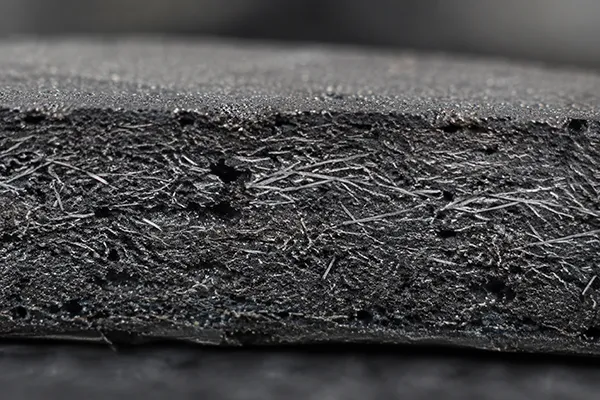
The core advantage of ceramic formulations on slotted rotors is the combination of material hardness and thermal resistance at moderate temperatures. Ceramic fibers are hard enough to survive the repeated edge-scraping from rotor slots without rapid wear. They also tolerate the moderate heat ranges that most passenger car drivers generate during normal urban and highway use. Because ceramic material does not shed metallic particles, brake dust is lighter in color and less visible on wheel surfaces9. For distributors supplying market segments where customers are sensitive to wheel cleanliness and noise, this matters.
But the limitation is real and it is important to communicate it clearly down the supply chain. Ceramic pads reach their thermal ceiling faster than semi-metallic pads do. When an end user with a ceramic-equipped vehicle starts driving in a more demanding way, such as sustained mountain descents, repeated hard stops with a loaded vehicle, or aggressive urban driving in high-ambient-temperature climates, the ceramic formulation can begin to fade. This is not a product defect. It is a formulation operating outside its designed range.
The problem for distributors is that customers rarely describe their driving style accurately. They say "normal driving" and then use the vehicle in ways that stress the pad beyond its range. Here is how we help our buyer partners think about this:
| Market Characteristic | Ceramic Pad Suitability with Slotted Rotors |
|---|---|
| European daily-driver passenger cars, moderate climate | High. Matches the vehicle and usage profile well. |
| Urban markets with frequent stop-start traffic | High. Noise and dust control are priorities here. |
| Hot climate markets with hilly terrain | Medium. Need to confirm formulation's upper thermal threshold. |
| Buyers serving mixed car and light truck catalogs | Low fit for truck SKUs. Separate the vehicle categories. |
One thing we do at GDST is tailor the ceramic formulation itself to the target market. A ceramic formulation for a European climate and a European vehicle braking profile is not the same compound we would use for a buyer serving a Southeast Asian market with similar vehicle models. The resin, ceramic fiber ratio, and filler materials shift based on the expected operating temperatures and the road dust conditions in that market. If a supplier cannot explain this distinction when you ask, that is a signal worth paying attention to.
How Should a B2B Buyer Actually Ask Suppliers About This?
This is the part most sourcing guides skip. Knowing the difference between semi-metallic and ceramic is useful. Knowing how to verify that a supplier's product actually performs as described is what protects your business.
B2B buyers should ask suppliers for friction stability curves, wear rate data, and noise test results at relevant temperature ranges10. A supplier who answers "what is the best pad for slotted rotors" with a single material name, without asking about vehicles, market, and climate, is not giving you technical advice. They are giving you a sales pitch.
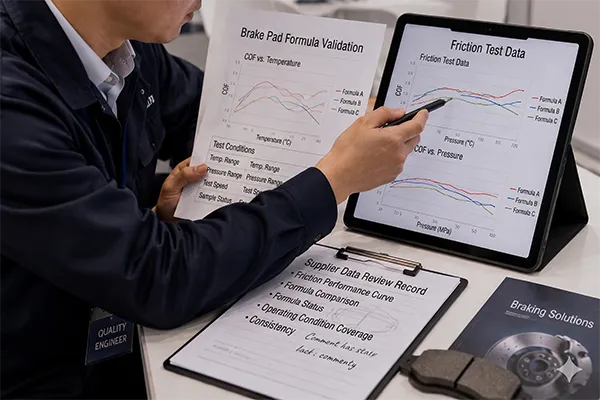
Here is the core problem with supplier conversations at trade shows or over email: most product claims are made at optimal laboratory conditions. Real-world distributor problems come from edge cases and application mismatches. The way to close that gap is to ask suppliers to show you the data, not just state the claim.
When a distributor partner comes to us asking about a specific rotor type, we walk through the following before recommending a formulation:
Vehicle model and weight class. A compact sedan and a mid-size SUV with the same rotor diameter do not put the same load on a pad. Weight matters.
Target market climate. A formulation destined for a North European buyer faces cold, wet conditions with low ambient temperatures. The same pad going to a Middle Eastern market will operate at much higher ambient and surface temperatures. The resin and fiber composition has to account for both the upper and lower thermal range.
Driving profile of end users. Is the dominant use case urban commuting, highway driving, or mixed commercial use? This changes the expected braking frequency and average pad temperature.
Required certifications. For European markets, E-mark is non-negotiable11. For North American markets, DOT and AMECA certifications matter12. If a supplier cannot provide these for the specific formulation they are recommending, you have a market entry problem before you even have a product problem.
Here is a checklist of questions worth putting to any supplier you are evaluating for slotted rotor applications:
| Question to Ask the Supplier | What the Answer Reveals |
|---|---|
| Can you show me friction stability data across 100–400°C? | Whether the formulation actually holds under heat |
| What is the measured wear rate on this formulation? | Whether the pad life claim is based on real data |
| Has this formulation been tested against slotted rotors specifically? | Whether the supplier understands the application |
| Can you adjust the formulation for my target climate? | Whether they manufacture or just trade |
| What certifications does this specific SKU carry? | Whether you can legally sell it in your market |
A supplier who can answer all five of these questions with documentation is worth continuing the conversation with. A supplier who redirects every question back to their catalog or price list is telling you something important about what happens after you place the order.
Conclusion
There is no single best brake pad for slotted rotors. The right choice comes from matching the formulation to the vehicle, the market, and the climate. Ask your supplier for data, not just a material name.
"Are slotted brake rotors dumb? : r/MechanicAdvice - Reddit", https://www.reddit.com/r/MechanicAdvice/comments/1cdwokl/are_slotted_brake_rotors_dumb/. Automotive engineering resources explain that the channels cut into a slotted rotor's face serve to expel hot gases, water, and brake dust that can accumulate between the pad and rotor, which helps to maintain a clean contact surface and consistent braking performance. Evidence role: mechanism; source type: education. Supports: The claim that slots in a brake rotor are designed to evacuate gas, water, and debris from the pad-rotor interface to maintain consistent contact.. ↩
"Do slotted and drilled rotors wear pads more quickly? - Reddit", https://www.reddit.com/r/StupidCarQuestions/comments/1fibnzo/do_slotted_and_drilled_rotors_wear_pads_more/. Studies and technical analyses of brake systems confirm that while slotted rotors improve performance in some areas, they also tend to increase the wear rate of brake pads because the pad material is repeatedly scraped by the leading edges of the slots. Evidence role: general_support; source type: research. Supports: The claim that the edges of the slots on a rotor create a scraping effect that increases the wear rate of the brake pad material compared to a smooth rotor.. ↩
"Are smooth brake rotors better than slotted on high HP cars?", https://www.facebook.com/groups/397922703976553/posts/1802461376856005/. Research on brake system thermodynamics indicates that while slots aid in overall heat dissipation, they can also lead to higher localized peak surface temperatures at the pad interface during aggressive braking due to changes in contact pressure and airflow. Evidence role: mechanism; source type: paper. Supports: The claim that surface temperatures at the pad-rotor interface can be higher with slotted rotors during intense braking.. Scope note: The exact thermal effect can depend heavily on the specific slot design, pad material, and braking conditions. ↩
"Brake fade - Wikipedia", https://en.wikipedia.org/wiki/Brake_fade. Brake fade is a term used in automotive engineering to describe the temporary reduction or loss of braking power that occurs when excessive heat reduces the coefficient of friction between the brake pads and the rotors. Evidence role: definition; source type: encyclopedia. Supports: The definition of brake fade as a loss of braking effectiveness due to a reduction in the friction coefficient between the pad and rotor at high temperatures.. ↩
"What's the Difference Between Ceramic & Metallic Brake Pads?", https://tires.bridgestone.com/en-us/learn/automotive/tire-maintenance/ceramic-vs-metallic-brake-pads. Automotive technology sources define semi-metallic brake pads as friction materials typically containing 30% to 65% metal by weight, including materials like chopped steel wool, iron powder, and copper fibers, which contribute to their thermal conductivity and performance at high temperatures. Evidence role: definition; source type: education. Supports: The claim that semi-metallic brake pads are characterized by a high content of metallic components.. ↩
"What's the Difference Between Ceramic & Metallic Brake Pads?", https://tires.bridgestone.com/en-us/learn/automotive/tire-maintenance/ceramic-vs-metallic-brake-pads. Comparative studies of brake pad materials generally find that while semi-metallic pads offer excellent high-temperature performance, they are also more abrasive, leading to increased rotor wear, and tend to generate more noise and visible dust than ceramic or organic alternatives. Evidence role: general_support; source type: research. Supports: The claim that semi-metallic brake pads tend to produce more noise, dust, and rotor wear compared to other formulations like ceramic.. ↩
"Brake pad - Wikipedia", https://en.wikipedia.org/wiki/Brake_pad. Ceramic brake pads are composed of dense ceramic fibers, non-ferrous filler materials, and bonding agents. This composition is designed to provide stable friction at moderate temperatures while being less abrasive and producing less noise and lighter-colored dust than semi-metallic pads. Evidence role: definition; source type: education. Supports: The claim that ceramic brake pads are formulated with ceramic fibers and non-metallic fillers to reduce noise and dust.. ↩
"Temperature Influence on Brake Pad Friction Coefficient Modelisation", https://pmc.ncbi.nlm.nih.gov/articles/PMC10779514/. Research comparing friction materials shows that while ceramic pads offer many benefits for daily driving, they typically exhibit a lower thermal threshold than semi-metallic formulations, making them more prone to brake fade during sustained, high-energy braking events. Evidence role: general_support; source type: paper. Supports: The claim that ceramic brake pads generally have a lower maximum operating temperature and are more susceptible to fade under extreme heat than semi-metallic pads.. ↩
"Do Ceramic Brake Pads Create the Least Dust? | PowerStop", https://www.powerstop.com/resources/brake-pads-less-dust/. Analysis of brake wear debris shows that dust from ceramic pads is composed of light-colored, non-ferrous particles. Unlike the dark, metallic dust from semi-metallic pads, this dust is less adhesive and its color makes it significantly less noticeable on wheel surfaces. Evidence role: mechanism; source type: research. Supports: The claim that the composition of ceramic brake dust makes it less visible on wheels.. ↩
"[PDF] Compositions, Functions, and Testing of Friction Brake Materials ...", https://info.ornl.gov/sites/publications/Files/Pub57043.pdf. Automotive industry standards, such as those developed by SAE International, outline specific testing procedures for measuring friction performance across temperatures, wear characteristics, and noise output (dynamometer testing), providing a basis for objective supplier evaluation. Evidence role: general_support; source type: institution. Supports: The recommendation that buyers should request standardized test data to verify supplier claims about brake pad performance.. ↩
"ECE Regulation 90 - Wikipedia", https://en.wikipedia.org/wiki/ECE_Regulation_90. The United Nations Economic Commission for Europe (UNECE) Regulation No. 90 mandates that all replacement brake linings and pads sold for use in motor vehicles within its signatory countries must be tested and certified to meet performance standards equivalent to the original equipment, a requirement indicated by an 'E-mark'. Evidence role: definition; source type: government. Supports: The claim that E-mark certification, specifically under UNECE Regulation 90 (R90), is a legal requirement for selling replacement brake pads in Europe.. ↩
"49 CFR Part 393 Subpart C -- Brakes - eCFR", https://www.ecfr.gov/current/title-49/subtitle-B/chapter-III/subchapter-B/part-393/subpart-C. In the United States, brake friction materials must meet standards set by the Department of Transportation (DOT) under the Federal Motor Vehicle Safety Standards (FMVSS). Additionally, the Automotive Manufacturers Equipment Compliance Agency (AMECA) provides an independent certification program that verifies material compliance with various performance standards, which is widely recognized in the aftermarket. Evidence role: definition; source type: institution. Supports: The claim that DOT regulations and AMECA certification are key standards for brake pads in the North American market.. ↩