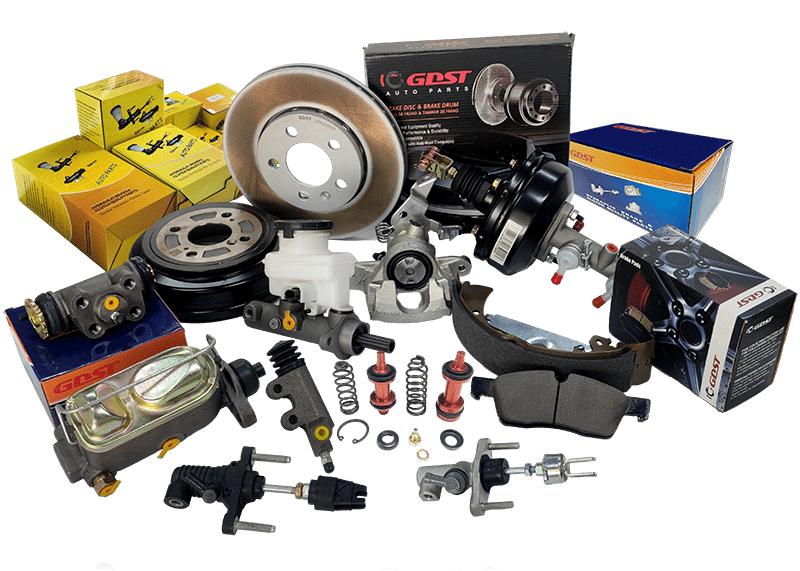
When a brake caliper sticks after replacement, the new part often receives immediate blame. That assumption can increase repeat repair costs, vehicle downtime, and warranty disputes. I recommend a structured diagnosis that separates a genuine caliper defect from incorrect fitment, mechanical binding, trapped hydraulic pressure, or a parking-brake release problem.
A brake caliper may stick after replacement because of restricted pad or guide-pin movement, incorrect installation, a damaged brake hose, residual hydraulic pressure, a binding parking-brake mechanism, or a caliper defect. A qualified technician should identify the affected wheel and test mechanical and hydraulic release before deciding which component is responsible.
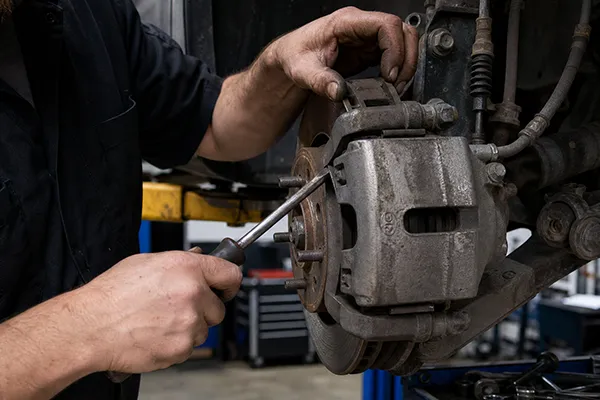
I have found that the order of evidence matters as much as the tests themselves. If a distributor begins with an assumption rather than a verified symptom, it can replace another good part or reject a legitimate claim. The following sequence helps buyers and technical teams make a more defensible decision.
What Should You Confirm When a Brake Caliper Sticks After Replacement?
Heat, odor, pulling, and abnormal pad wear create an understandable sense of urgency. However, none of these signs independently proves why a brake caliper sticks after replacement. I first recommend confirming the complaint, the affected wheel position, and the operating conditions under which the drag appears.
A technician should verify whether the wheel remains mechanically or hydraulically applied after braking. The inspection should record the vehicle application, axle position, temperature pattern, pad condition, wheel resistance, warning lights, and timing of the symptom. This evidence establishes what happened before anyone assigns responsibility to the replacement caliper.
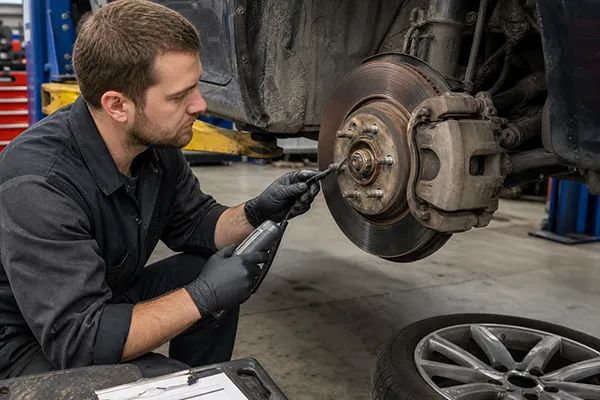
Start with the exact vehicle and wheel position
A statement such as “the new caliper is sticking” does not give a warranty team enough information. I would first request the complete application details:
- Vehicle make, model, year, engine, and trim
- Vehicle identification number when appropriate
- Front or rear axle
- Left or right wheel position
- Caliper part number and OE cross-reference
- Installation date and vehicle mileage
- Whether the symptom started immediately or after road use
- Whether the condition occurs when cold, hot, or after parking-brake use
This information matters because calipers that appear similar can have different piston sizes, bracket offsets, hose connections, mounting dimensions, or parking-brake configurations.1 A cataloging or fitment error can create a functional problem even when the supplied caliper has no manufacturing defect.
Treat symptoms as clues, not conclusions
Common brake-drag symptoms include:
- One wheel running hotter than the opposite wheel
- A burning odor near the wheel
- Vehicle pull during driving or braking
- Reduced fuel economy
- Premature or tapered pad wear
- Wheel resistance after brake application
- Smoke or severe heat in advanced cases
These observations support further investigation, but they do not identify the root cause by themselves.2 For example, a hot wheel can result from pads binding in a corroded bracket, trapped hydraulic pressure, an incorrectly adjusted parking-brake cable, or internal caliper binding.
Temperature comparison can be useful, but the measurement needs context. Driving distance, braking frequency, vehicle load, road grade, and measurement location can all affect the result.3 I recommend recording comparable measurements at both wheels on the same axle rather than relying on touch alone. A qualified technician should perform the inspection because an overheated brake assembly can cause burns and may be unsafe to drive.
Build a basic evidence file
For B2B warranty evaluation, I suggest collecting a small but consistent evidence package.
| Evidence | What it helps establish | What it does not prove alone |
|---|---|---|
| Photos of both axle positions | Installation differences and visible damage | Internal hydraulic condition |
| Pad wear images | Binding, taper, or uneven contact | Whether the caliper caused the wear |
| Temperature comparison | Location and severity of heat | Root cause of the heat |
| Wheel-release observation | Whether drag is present | Mechanical versus hydraulic origin |
| Part and vehicle data | Fitment accuracy | Correct installation |
| Technician findings | On-vehicle test sequence | Manufacturing responsibility without part inspection |
| Returned-part condition | Damage or assembly concerns | Complete vehicle-side history |
In technical-support feedback, I often see disputes become difficult because the removed part arrives without vehicle data or diagnostic notes. A clear initial record protects both parties. It helps a distributor recognize a possible product issue, and it also helps a manufacturer avoid approving another replacement that will not solve the vehicle-side cause.
Could Installation or Mechanical Binding Make a Brake Caliper Stick After Replacement?
Once a technician confirms the drag, installation and mechanical movement deserve attention. New components cannot release correctly if pads bind in the carrier, guide pins cannot slide, hardware is misplaced, or the caliper does not match the application. Replacing the caliper again may leave the same restriction in place.
Yes. Incorrect fitment, corroded pad abutments, damaged brackets, reused or incorrect hardware, restricted guide pins, and installation errors can make a brake caliper stick after replacement. The complete assembly must move freely under operating conditions. A piston that can be pushed back on the bench does not prove that the installed brake assembly releases correctly.
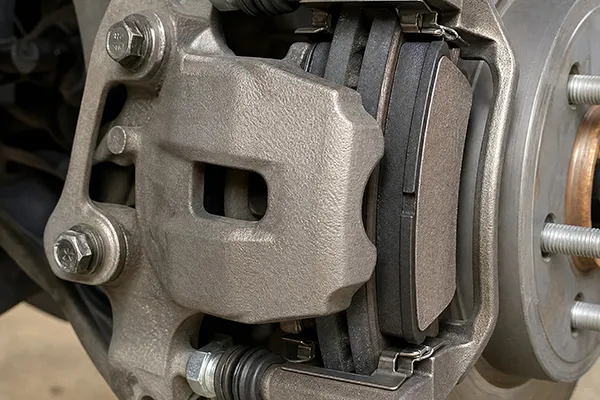
Verify the application before judging the component
I recommend comparing the replacement part with the original part and verified application data. The comparison should include more than the general appearance.
A technician should check:
- Mounting-hole position and spacing
- Bracket offset and rotor alignment
- Piston diameter and quantity
- Bleeder and hose-port locations
- Guide-pin arrangement
- Pad shape and hardware
- Parking-brake lever orientation on rear units
- Electronic parking-brake configuration where applicable
A caliper may bolt onto the vehicle but still be unsuitable for the exact variant. Buyers should therefore verify catalog data, OE references, and supersessions before classifying a complaint as a production defect.
Inspect pad freedom and bracket condition
Pads need sufficient freedom to move in the bracket while remaining correctly supported. Corrosion, paint buildup, burrs, incorrect clips, or distorted hardware can prevent release. Excessive material removal is not an appropriate general solution because it may change pad support or create noise. A qualified technician should compare the condition with the vehicle and component manufacturer’s specifications.
Key inspection points include:
- Pad ears and contact surfaces
- Abutment clips and their orientation
- Rust scale beneath stainless hardware
- Rotor centering within the bracket
- Inner and outer pad wear patterns
- Signs that a pad was forced into place
- Contact marks on the caliper body or wheel
Reusing worn hardware can also undermine a new installation. However, new hardware is not automatically correct. The technician should confirm that every clip, spring, and pin belongs to the specific application.
Evaluate guide pins as a complete system
Floating calipers depend on controlled guide-pin movement.4 A pin can bind because of corrosion, a damaged pin surface, an incorrect boot, unsuitable lubricant, or trapped air behind the pin. Some applications use different upper and lower pins, including pins with damping sleeves. Reversing them may affect movement.
I would ask the technician to evaluate:
- Whether both guide pins move through their intended range
- Whether the boots are seated and undamaged
- Whether the specified lubricant was used
- Whether lubricant has affected rubber components
- Whether the bracket bore contains corrosion or debris
- Whether the pin returns normally after compression
The piston is only one moving element. I have encountered technical-support discussions where piston compression became the only reported test. That evidence is incomplete. A piston may retract during a manual test while pads, pins, or bracket surfaces still prevent the installed assembly from releasing during service.
Can Hydraulic Pressure Cause a Brake Caliper to Stick After Replacement?
Mechanical checks may show that the pads, bracket, and guide pins can move. The wheel may still remain applied because fluid pressure is not returning normally. If a team overlooks that possibility, it may approve repeated caliper replacements while the hose or upstream hydraulic system continues producing the same complaint.
Yes. A restricted flexible hose, contaminated fluid, a blocked port, or unreleased pressure elsewhere in the braking system can keep a sound caliper applied. A qualified technician must determine whether the drag changes when hydraulic pressure is safely released. That distinction helps separate trapped actuation from mechanical binding inside or around the caliper.
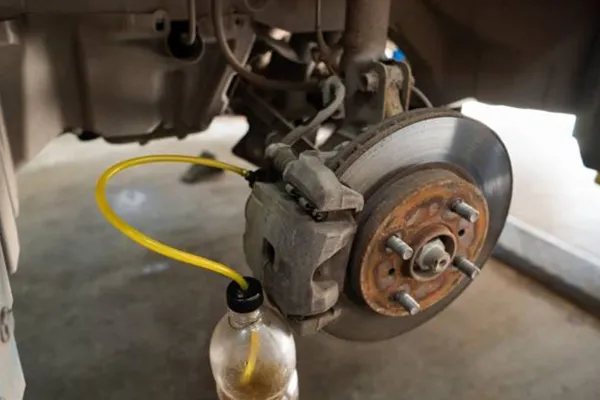
Distinguish retained pressure from physical resistance
The central diagnostic question is whether the brake remains applied because pressure is still acting on the piston or because a component cannot move freely. A qualified technician can use the vehicle manufacturer’s procedures and suitable equipment to evaluate that difference.
I do not recommend treating pressure release as an unconditional remote repair instruction. Brake fluid can damage paint, and opening a hydraulic circuit can introduce air or create a safety risk. The vehicle must be supported correctly, and the brake system may require bleeding and verification before it returns to service.
The evidence should answer questions such as:
- Does the wheel rotate normally before the brake pedal is applied?
- Does drag appear only after pedal application?
- Does the drag increase as the vehicle warms?
- Does pressure remain at one wheel or more than one wheel?
- Does the condition follow the caliper, or remain at the vehicle position?
- Does the hose show twisting, impact, age-related damage, or an internal restriction?
- Are there fault codes or control-system conditions that require manufacturer-specific diagnosis?
Do not judge a brake hose only by its exterior
A flexible brake hose can look acceptable outside while its internal structure restricts return flow.5 The hose may allow pressure to reach the caliper during pedal application but slow or block fluid return afterward.6 This effect can resemble a sticking piston.
An installation can also create a hose problem if the hose is twisted, stretched, routed incorrectly, or contacted by another component. The technician should inspect routing through the full steering and suspension range where applicable.
The location pattern can provide useful clues, although it is not final proof:
| Drag pattern | Possible area to investigate |
|---|---|
| One wheel | Caliper, hose, pad, bracket, or local mechanism |
| Both wheels on one axle | Shared hydraulic or control issue, installation pattern, or coincidental local issues |
| Multiple wheels | Master cylinder, booster adjustment, fluid condition, or control-system concern |
| Rear wheel after parking-brake use | Cable, lever, internal mechanism, actuator, or caliper |
| Drag only when hot | Thermal expansion, restricted return, fitment, or changing mechanical clearance |
Include the upstream brake system
A warranty review should avoid focusing only on the returned caliper. Depending on vehicle design, residual pressure may relate to a master cylinder, brake booster pushrod adjustment, ABS hydraulic control unit, contaminated fluid, or another upstream condition.7
These possibilities require vehicle-specific testing. I recommend using the manufacturer’s service information and qualified professional evaluation rather than making a conclusion from a single remote observation.
Our internal analyses have encountered external hydraulic causes as well as genuine caliper concerns. That experience is why I avoid absolute statements. The finding must come from the evidence sequence, not from a preference to approve or reject a claim.
Can the Parking Brake Make a Rear Brake Caliper Stick After Replacement?
Rear brake complaints need an additional diagnostic branch. A mechanically or electronically actuated parking-brake system can hold the service brake partly applied even when the hydraulic circuit releases.8 If the technician tests only piston movement, the most relevant rear-caliper mechanism may remain unevaluated.
Yes. A seized or incorrectly adjusted cable, a lever that does not return, an internal parking-brake mechanism, or an electronic parking-brake setup issue can make a rear brake caliper stick after replacement. The technician should assess the service-brake and parking-brake functions separately before attributing the drag to the caliper.
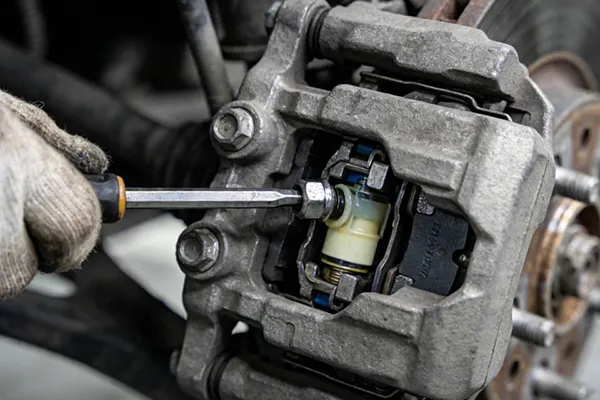
Separate cable input from caliper response
On cable-operated systems, the return problem may originate in the cable, equalizer, lever, spring, or caliper mechanism. The technician should determine whether the caliper lever returns to its specified stop when the parking brake is released.
A cable may bind because of:
- Internal corrosion
- Damaged outer casing
- Water entry
- Incorrect routing
- Excessive adjustment
- Contact with suspension or exhaust parts
- Unequal movement between left and right sides
A lever that remains away from its stop does not automatically prove an internal caliper defect. The cable may still be pulling it. Conversely, a freely moving cable does not eliminate an internal mechanism concern. Each side of the interface needs separate evaluation.
Follow the correct rear-piston procedure
Many rear calipers incorporate a screw-type parking-brake mechanism.9 Their pistons may require a specified rotation and compression procedure. Electronic parking-brake systems may also require a service mode, scan tool, or manufacturer-defined sequence.10
Forcing the piston without the correct procedure can damage the mechanism or create misleading evidence. I recommend that technicians follow the vehicle and caliper service instructions. They should also confirm piston orientation if the pad design uses locating pins or notches.
Important checks can include:
- Correct service-mode activation
- Proper piston retraction method
- Piston notch alignment
- Parking-brake lever return
- Cable adjustment
- Actuator installation and electrical connection
- Relevant diagnostic trouble codes
- Calibration or initialization requirements
Compare both rear wheel positions
A left-to-right comparison can reveal differences in cable travel, lever position, pad wear, actuator sound, or release timing. However, the comparison remains one part of the diagnosis. Both sides could share the same installation issue, and different wear histories can produce different behavior.
For distributors, I suggest requesting photographs of both rear levers in the released position. I would also request a technician’s statement about cable or actuator function. This information is more useful than a general note saying that the piston was “hard to turn.”
When a brake caliper sticks after replacement on a rear application, the warranty file should clearly state whether the complaint occurred after normal pedal braking, parking-brake operation, or both. That small detail can significantly narrow the investigation.
How Should You Inspect the Caliper and Decide Warranty Responsibility?
After vehicle-side checks, the returned part still requires a controlled inspection. A supplier should not reject a claim merely because external causes are possible. Likewise, a buyer should not approve a claim solely because the symptom appeared after installation. Both decisions require traceable evidence.
The final decision should combine vehicle data, installation findings, release tests, and caliper inspection. Genuine manufacturing, assembly, handling, or shipping damage remains possible when a brake caliper sticks after replacement. The inspection should document piston movement, seals, guide components, dimensions, contamination, impact marks, part identity, and parking-brake operation where applicable.
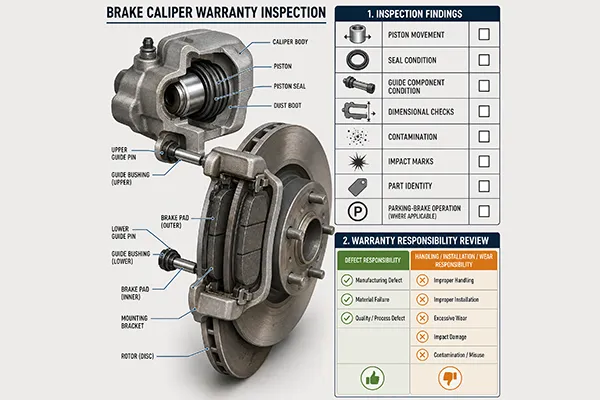
Use a consistent returned-part inspection
Our internal inspection and failure-analysis work supports a category-based approach. I recommend avoiding conclusions such as “installer fault” or “defective caliper” until the available evidence supports one.
A returned-part review can include:
-
Identity verification
The inspector confirms the part number, casting, bracket, axle side, production code, and supplied configuration. -
Shipping and handling examination
The inspector looks for impact damage, broken protective packaging, bent fittings, damaged threads, or missing caps and components. -
External condition review
The inspector documents contamination, corrosion, overheating, fluid exposure, tool marks, and installation contact. -
Mechanical inspection
The inspector assesses guide components, piston behavior, boots, bracket alignment, and parking-brake movement as applicable. -
Dimensional or performance evaluation
The manufacturer uses applicable drawings, specifications, gauges, and controlled test procedures. -
Evidence correlation
The inspection team compares the findings with vehicle-side symptoms and technician notes.
Certifications such as IATF 16949:2016 can indicate that a supplier operates a defined automotive quality-management system.11 However, buyers should verify the certificate’s issuer, validity, scope, and manufacturing location. A certificate does not decide an individual warranty claim.
Classify the finding carefully
A practical claim outcome may fall into one of several categories:
| Finding category | Typical evidence direction | Appropriate next action |
|---|---|---|
| Confirmed product nonconformity | Inspection shows deviation from specification | Approve claim and assess containment |
| Installation or fitment issue | Application or assembly evidence explains restriction | Provide technical feedback and correct catalog or process issue |
| Vehicle hydraulic cause | On-vehicle test shows retained upstream pressure | Direct case to qualified vehicle diagnosis |
| Parking-brake system cause | Cable, actuator, or setup prevents release | Repair and verify the complete rear system |
| Shipping or handling damage | Documented impact or transport-related condition | Review packaging and logistics responsibility |
| Inconclusive | Evidence cannot establish root cause | Request defined additional evidence; avoid unsupported certainty |
If several claims involve the same part number, production period, or symptom pattern, I recommend escalating the issue beyond individual claim handling. The supplier can review traceability records, inspection data, retained samples where available, process changes, and similar field feedback. Buyers can quarantine relevant inventory when evidence supports that precaution.
However, a single complaint should not be presented as a batch defect without supporting evidence. The reverse is also true: a supplier should not use the absence of many complaints to dismiss a well-documented individual nonconformity.
Evaluate the supplier’s response system
Purchasing managers should evaluate more than the initial claim decision. A capable supplier should provide a clear process for:
- Traceability and production-code review
- Technical evidence requests
- Returned-part inspection
- Corrective-action escalation
- Fitment and catalog support
- Packaging-damage investigation
- Communication between sales, engineering, quality, and after-sales teams
I recommend verifying quality documents and asking how the supplier distinguishes isolated returns from possible systematic issues. Buyers should also confirm who pays for testing, freight, replacement stock, and field costs under the warranty agreement. Clear terms reduce disputes when a brake caliper sticks after replacement.
Frequently Asked Questions
Does a hot wheel prove that the new brake caliper is defective?
No. A hot wheel confirms that abnormal friction may be present, but it does not identify the cause. Pad binding, guide-pin restriction, trapped hydraulic pressure, a brake hose, parking-brake operation, or a caliper defect can produce similar heat. A qualified technician should compare wheel positions and test release behavior.
Does an easily compressed piston prove that the caliper is good?
No. Piston compression evaluates only part of the assembly. The pads may bind in the bracket, guide pins may restrict movement, or hydraulic pressure may remain after braking. Rear parking-brake components may also prevent release. I recommend evaluating the complete installed system rather than relying on piston movement alone.
Can a new brake hose cause brake drag?
Yes. A new hose can create a problem if it is incorrect for the application, twisted, damaged, contaminated, or routed improperly. An older reused hose may also have an internal restriction despite appearing normal externally. A qualified technician should evaluate hose condition and hydraulic pressure using approved procedures.
Should a distributor automatically approve a claim when a brake caliper sticks after replacement?
No. Automatic approval may conceal a vehicle-side problem and lead to another failed repair. Automatic rejection can also miss a genuine defect. I recommend requesting application data, installation evidence, release-test findings, and returned-part inspection results before assigning responsibility.
When should a possible batch issue be investigated?
A batch review becomes appropriate when traceable complaints show a recurring part number, production period, failure mode, or inspection finding.12 The supplier should review production and quality records and consider stock containment based on risk. Buyers should not declare a batch defect solely from symptom similarity without supporting evidence.
Conclusion
When a brake caliper sticks after replacement, I recommend following one evidence sequence: confirm the symptom and wheel, verify fitment and mechanical freedom, separate hydraulic pressure from physical binding, evaluate the parking brake, and inspect the returned caliper. This approach protects buyers from false claims while preserving genuine manufacturing defects as a testable possibility. A qualified technician must confirm the vehicle-side cause. If you need support evaluating a caliper claim, OE reference, or recurring product concern, contact GDST Auto Parts for technical and supplier-quality review.
"Additive Manufactured Formula SAE Brake Caliper", https://ideaexchange.uakron.edu/cgi/viewcontent.cgi?article=2738&context=honors_research_projects. Automotive brake-system references identify piston dimensions, mounting geometry, hydraulic connections, and parking-brake design as application-specific caliper characteristics that can affect fit and operation. Evidence role: general_support; source type: education. Supports: Brake-caliper compatibility depends on dimensions and design features such as piston size, mounting geometry, hydraulic connections, and parking-brake configuration.. Scope note: This supports the general importance of exact application matching but does not establish that an incorrect caliper caused any particular vehicle complaint. ↩
".03 Brakes. | Library of Maryland Regulations", https://regs.maryland.gov/us/md/exec/comar/11.14.02.03. Brake-diagnosis literature treats wheel heat, odor, pulling, and uneven pad wear as indicators of abnormal brake friction while recognizing multiple possible mechanical and hydraulic causes. Evidence role: general_support; source type: education. Supports: Common brake-drag symptoms can arise from multiple mechanical, hydraulic, and parking-brake faults.. Scope note: These signs support the presence of a braking problem but do not independently identify the defective component. ↩
"NIU FSAE Brake Rotor Design & Flywheel-Based Test Stand ...", https://huskiecommons.lib.niu.edu/cgi/viewcontent.cgi?article=2619&context=studentengagement-honorscapstones. Experimental studies of vehicle braking show that brake temperature varies with braking duty, vehicle load and speed conditions, road gradient, and the location or method used for temperature measurement. Evidence role: mechanism; source type: paper. Supports: Brake temperature depends on braking energy, vehicle operating conditions, and where and how temperature is measured.. Scope note: The magnitude of each influence varies by vehicle, brake design, test cycle, and measuring instrument. ↩
"BRAKE CALIPER GUIDE PINS", https://beta.centralseminary.edu/uploaded-files/sk9XuQ/5FE099/brake_caliper__guide-pins.pdf. Technical descriptions of floating disc brakes explain that the caliper body moves on guide pins or sliding surfaces so that both pads can clamp the rotor and subsequently release. Evidence role: mechanism; source type: education. Supports: Floating calipers use sliding guides to transmit clamping force and permit movement relative to the rotor.. ↩
"Uneven Front Brake Pad Wear", https://static.nhtsa.gov/odi/tsbs/2015/MC-10114610-9999.pdf. Brake-hose safety and service literature documents that internal deterioration or deformation can obstruct hydraulic flow without necessarily producing a corresponding visible defect on the hose exterior. Evidence role: mechanism; source type: government. Supports: Internal deterioration or deformation of a flexible brake hose can restrict fluid flow even when obvious exterior damage is absent.. Scope note: An externally normal appearance does not prove an internal restriction, and confirmation requires appropriate hydraulic testing. ↩
"7+ Signs: How to Tell if a Caliper is Bad? [Easy Check]", https://bigblue.atlantisuniversity.edu/how-to-tell-if-a-caliper-is-bad/. Automotive hydraulic-diagnosis references describe internally restricted flexible hoses as capable of transmitting pedal-application pressure while impeding the lower-pressure return flow needed for prompt caliper release. Evidence role: mechanism; source type: education. Supports: Internal hose restriction can permit high application pressure to pass while impeding lower-pressure return flow, leaving a brake applied.. Scope note: This mechanism is one possible cause of retained pressure and does not by itself distinguish a hose fault from an upstream hydraulic restriction. ↩
"AUT 151 (A5)", https://www.durhamtech.edu/sites/default/files/course_outlines/AUT151_0.pdf. Brake-system references explain that inadequate master-cylinder compensation, incorrect booster-to-master-cylinder pushrod clearance, or hydraulic-control faults can prevent pressure from fully releasing after pedal application. Evidence role: mechanism; source type: education. Supports: Failure of hydraulic pressure to vent can result from master-cylinder compensation problems, inadequate pushrod clearance, or faults elsewhere in the hydraulic control system.. Scope note: The relevant upstream components and diagnostic procedures vary substantially by vehicle architecture. ↩
"Cal Poly Supermileage Vehicle Braking System", https://digitalcommons.calpoly.edu/cgi/viewcontent.cgi?article=1589&context=mesp. Technical literature on integrated rear parking brakes describes mechanical or electromechanical actuation that can maintain pad force independently of the service-brake hydraulic circuit. Evidence role: mechanism; source type: paper. Supports: Integrated rear-caliper parking-brake mechanisms can apply or retain pad force independently of normal service-brake hydraulic pressure.. Scope note: Parking-brake architecture differs among vehicles, including caliper-integrated, drum-in-hat, cable-operated, and motor-driven systems. ↩
"How to Replace Your Parking Brake: A Step-by-Step Guide", https://imba.missouri.edu/how-to-replace-parking-brake-4102887314.html. Engineering descriptions of integrated rear disc-brake calipers show that many designs use a threaded spindle or screw mechanism to convert parking-brake input into piston movement. Evidence role: mechanism; source type: paper. Supports: Some integrated rear calipers convert parking-brake input through a threaded spindle or screw mechanism acting on the piston.. Scope note: This design is common but not universal; some vehicles use separate parking-brake assemblies or different actuator arrangements. ↩
"Instructional Framework", https://www.azed.gov/sites/default/files/2023/08/AutomotiveTechnologiesIF.pdf. Service literature for electronic parking brakes documents systems in which actuator retraction, maintenance mode, calibration, or initialization must be performed through a scan tool or manufacturer-specified sequence. Evidence role: general_support; source type: education. Supports: Certain electronic parking-brake designs require a diagnostic command or specified service sequence before piston retraction or pad replacement.. Scope note: The required process is model-specific, and not every electronic parking-brake system uses the same tools or sequence. ↩
"IATF 16949", https://en.wikipedia.org/wiki/IATF_16949. IATF and ISO materials describe IATF 16949 as a quality-management-system standard for automotive production and relevant service-part organizations, with certification tied to the scope and site stated on the certificate. Evidence role: definition; source type: institution. Supports: IATF 16949 defines automotive-sector quality-management-system requirements, while a certificate applies to a stated organization, site, and scope.. Scope note: Management-system certification does not certify every individual product or determine the cause of a specific warranty failure. ↩
"ISO 9001 Auditing Practices Group Guidance on:", https://committee.iso.org/files/live/sites/tc176/files/documents/ISO%209001%20Auditing%20Practices%20Group%20docs/Auditing%20General/APG-ReviewNonconformity2015.pdf. Quality-management guidance supports analyzing recurring nonconformities by product identity, production period, failure mode, and traceability data to determine whether systemic corrective action or containment should be considered. Evidence role: general_support; source type: government. Supports: Quality-management practice uses trend analysis, traceability, and recurrence of similar nonconformities to determine whether broader corrective action or containment is warranted.. Scope note: A recurring pattern justifies investigation but does not by itself prove that an entire production batch is defective. ↩