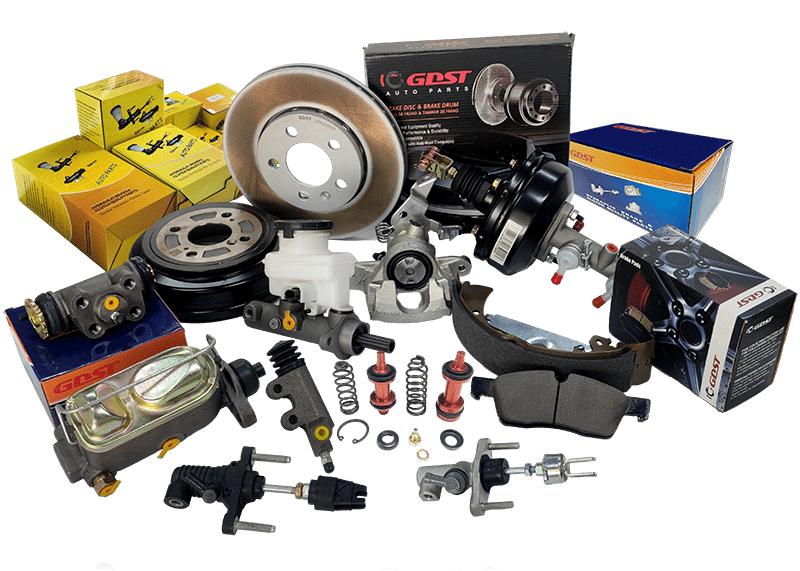
Every week, I get this question from our customers around the world. They want a simple answer. The problem is, the wrong answer will cost them money and reputation.
The short answer: it depends on your market and vehicle application. Ceramic pads suit passenger cars in urban markets where low noise and clean wheels matter most. Semi-metallic pads suit heavy-duty vehicles, trucks, and demanding terrain where heat dissipation and durability come first. Neither is universally better.
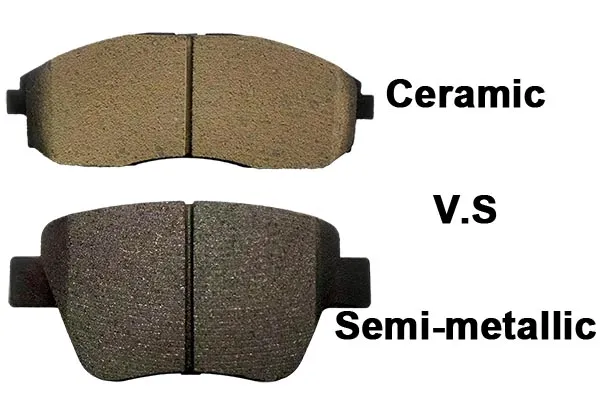
I have spent years helping global auto parts importers make this exact decision. What I have learned is this: the buyers who get it wrong are not uninformed. They just ask the wrong question. They ask, "which material is better?" when they should ask, "what problem am I solving for my customers?" That shift in thinking changes everything. Let me walk you through how we think about this at GDST, and how you can apply it to your own sourcing decisions.
What Actually Makes Semi-Metallic Pads Different?
A common mistake I hear from new buyers is assuming semi-metallic means "lower quality." That is not accurate, and stocking your inventory based on that assumption will hurt you.
Semi-metallic brake pads contain between 30% and 65% metallic fiber content, typically steel wool, iron powder, or copper.1 This metal content gives them a higher capacity to absorb and transfer heat away from the rotor, which means they maintain stable braking performance under heavy or sustained load far better than organic alternatives.
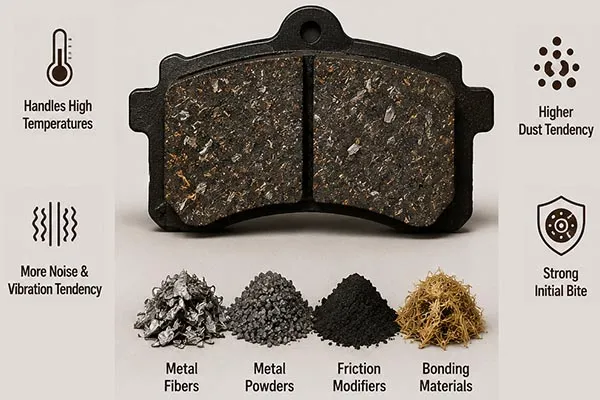
The physics here are straightforward. Metal conducts heat. When a truck descends a mountain road and the driver brakes repeatedly, the rotor temperature can climb sharply. A pad that cannot handle that heat will fade, meaning it loses friction right when the driver needs it most.2 Semi-metallic pads handle this because their metallic content keeps pulling heat away from the friction interface.
Why This Matters for Your Business
| Application | Why Semi-Metallic Works | Business Risk If You Use Ceramic Instead |
|---|---|---|
| Trucks and commercial fleets | High rotor contact pressure demands durable compounds | Premature wear, customer complaints, costly returns |
| Mountainous or rural terrain | Repeated hard braking causes heat buildup | Brake fade risk, liability exposure for your clients |
| SUVs with heavy payload | Heavier vehicles generate more stopping force | Faster pad wear, reduced service intervals |
| Taxi and high-mileage fleets | Constant stop-start urban use with weight loading | Early replacement cycles that destroy your price reputation |
When an importer from a mountainous region asks me which pad to stock, I always ask about their vehicle fleet first. If the answer involves trucks, buses, or pickups with payload, we go semi-metallic. The higher metallic content means longer rotor contact life under stress.3 For your business, that translates directly to fewer warranty claims and fewer complaints from the garages that trust you.
One point I want to be transparent about: semi-metallic pads do produce more dust and can be noisier than ceramics, especially when cold.4 If your market is premium passenger cars with expensive alloy wheels, that is a real problem. Dust stains wheels. Noise triggers complaints. Knowing this upfront lets you match the right product to the right channel, rather than discovering it through returns.
What Actually Makes Ceramic Pads Different?
I work with buyers who serve European and North American passenger car markets. Almost every one of them has asked about ceramic pads, and almost every one of them initially thinks ceramic means fragile or expensive without clear benefit.
Ceramic brake pads use ceramic fibers and filler materials bonded with resin. They are engineered to generate friction at a frequency range that falls outside normal human hearing.5 This is why they produce less audible noise. They also produce finer, lighter dust that does not stick to wheel surfaces as visibly as metallic dust does.6
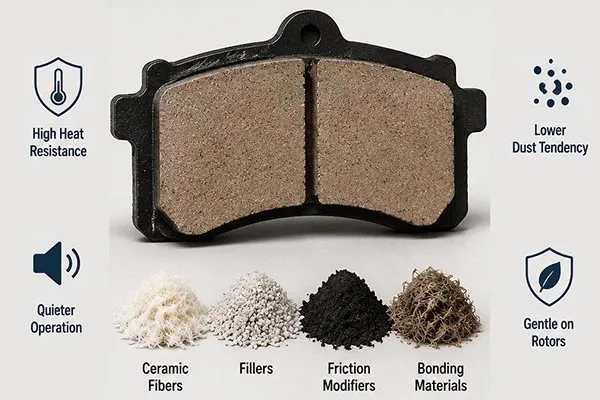
This is not a marketing claim. It is a material science outcome. The ceramic fiber structure vibrates at higher frequencies under braking contact. That vibration is real, but it does not register as a squeal to the driver. For a customer driving a mid-range European sedan in a city, silence and clean wheels are the two things that define whether they think their brakes are good.
Why This Matters for Your Business
| Market Segment | Why Ceramic Works | Business Risk If You Use Semi-Metallic Instead |
|---|---|---|
| European passenger car aftermarket | Alloy wheel cleanliness is a buying criterion | Dust complaints damage your brand in premium channels |
| Urban ride-share or private hire fleets | Driver comfort and interior noise matter | Noise complaints generate negative reviews for operators |
| Luxury or near-luxury vehicle segments | Owners have high expectations for refinement | One noisy pad can lose you a key account |
| Markets where noise regulations apply7 | Compliance is a legal and market entry requirement | Non-compliant products risk being pulled from shelves |
Here is something I tell every importer sourcing for passenger car markets: your garage customers are not just judging braking performance. They are judging the experience. A vehicle owner who hears brake noise six weeks after a pad change will blame the garage. The garage will blame you. That chain of blame is what destroys long-term accounts.
The honest limitation I always share about ceramics is this: they are not the right tool for heavy-duty use. Under sustained high heat, a ceramic pad does not transfer heat as efficiently as a semi-metallic one.8 If a buyer serving a mixed market tries to use ceramic pads across their entire range to simplify their inventory, they will face brake fade complaints from the truck or commercial vehicle side. Simplifying your SKU list is not worth that risk.
How Do You Match the Right Pad to Your Specific Market?
This is where I see the most confusion, and frankly, the most expensive mistakes. Buyers treat this as a product decision when it is actually a market strategy decision.
Match your brake pad formulation to three things: the dominant vehicle type in your market, the typical road and climate conditions your end users face, and the quality expectations of your retail or garage channel. Get all three right, and your product sells itself. Get one wrong, and you will be managing complaints.
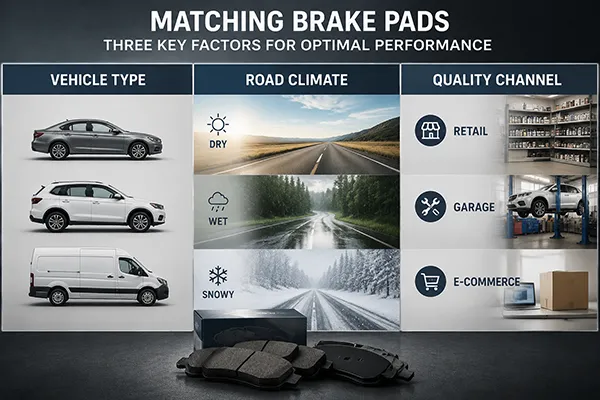
I have worked with clients sourcing for taxi fleets in Southeast Asia. High humidity, stop-start urban traffic, heavy daily mileage.9 A standard ceramic formulation was not the right answer there. We worked with them on a semi-metallic formulation with adjusted fiber ratios to handle the humidity and heat cycle. That is the kind of decision that keeps a buyer's fleet clients renewing orders.
A Practical Framework for Sourcing the Right Pad
| Market Factor | Questions to Ask | Likely Direction |
|---|---|---|
| Vehicle type | Predominantly passenger cars, trucks, or mixed? | Passenger → Ceramic; Trucks/Mixed → Semi-Metallic |
| Terrain and climate | Flat urban roads or mountainous, hot, demanding routes? | Demanding → Semi-Metallic |
| Channel expectations | Premium parts stores or volume fleet operators? | Premium → Ceramic; Fleet/Volume → Semi-Metallic |
| Wheel type | Alloy wheels common? Dust visibility matters? | Alloy-heavy market → Ceramic |
| Noise sensitivity | End market values cabin refinement? | High refinement expectation → Ceramic |
Beyond the vehicle and terrain questions, the formulation quality matters just as much as the material category. A poorly made ceramic pad from a factory without proper testing equipment will underperform a well-made semi-metallic pad from a certified manufacturer. This is why I always advise buyers to look at the supplier's certifications, their testing bench capabilities, and whether they have experience customizing formulations for different regions. E-mark and AMECA certifications are not just paperwork.10 They are evidence that the formulation has been validated against a real standard.
At GDST, every formulation we produce goes through shear strength testing, compressibility testing, and dynamometer bench testing11 before it ships. We can adjust the ceramic fiber percentage, the resin type, or the metallic fiber ratio based on the specific vehicle model range and the climate conditions of the target market. That flexibility is what allows buyers to source a product that actually fits their channel, rather than a generic pad that kind of fits everywhere and excels nowhere.
The MOQ to start is 100 sets per model12, which means buyers can trial a formulation in their market before committing to a large run. That lowers the risk of getting the match wrong on the first order.
Conclusion
There is no universal winner between semi-metallic and ceramic pads. The right choice comes down to your vehicles, your roads, your market, and your customers' expectations. Match those correctly, and you protect your margins and your reputation.
"Brake pad - Wikipedia", https://en.wikipedia.org/wiki/Brake_pad. A source could confirm the typical composition of semi-metallic brake pads, noting that they generally contain between 30% and 65% metal by weight, such as steel, iron, or copper, which is responsible for their thermal conductivity and friction characteristics. Evidence role: definition; source type: paper. Supports: The typical percentage range of metallic content in semi-metallic brake pad formulations.. ↩
"Temperature Influence on Brake Pad Friction Coefficient Modelisation", https://pmc.ncbi.nlm.nih.gov/articles/PMC10779514/. A source could describe the mechanisms of brake fade, explaining that at critical temperatures, the phenolic resins in the pad can vaporize, creating a layer of gas that reduces the coefficient of friction between the pad and the rotor. Evidence role: mechanism; source type: paper. Supports: The physical processes that cause brake fade at high temperatures.. ↩
"What's the Difference Between Ceramic & Metallic Brake Pads?", https://tires.bridgestone.com/en-us/learn/automotive/tire-maintenance/ceramic-vs-metallic-brake-pads. A source could explain that while semi-metallic pads are more abrasive, their superior heat dissipation can prevent the rotor from reaching temperatures that cause thermal cracking or warping, thereby extending the rotor's service life under high-stress conditions compared to pads that allow for heat buildup. Evidence role: mechanism; source type: research. Supports: The relationship between semi-metallic pads, heat management, and rotor wear under heavy-duty conditions.. Scope note: The source would need to clarify that this effect is specific to high-stress scenarios and that under normal conditions, more abrasive pads can increase rotor wear. ↩
"Are semi metallic brake pads really noisy? | BobIsTheOilGuy", https://bobistheoilguy.com/forums/threads/are-semi-metallic-brake-pads-really-noisy.299965/. A source could explain that the ferrous metals in semi-metallic pads produce a dark, adhesive dust through abrasive wear, and their vibration characteristics often fall within the frequency range of audible brake squeal, particularly at lower temperatures before a stable transfer layer is formed on the rotor. Evidence role: mechanism; source type: paper. Supports: The reasons for increased noise and dust from semi-metallic brake pads.. ↩
"Influence of the Additive of Ceramic and Intermetallic Powders on ...", https://pmc.ncbi.nlm.nih.gov/articles/PMC9370007/. A source could provide evidence from tribological and acoustic studies showing that the composition of ceramic brake pads is designed to shift friction-induced vibrations to frequencies above 20 kHz, which is outside the typical range of human hearing. Evidence role: mechanism; source type: research. Supports: The acoustic properties of ceramic brake pads that lead to reduced audible noise.. ↩
"Brake wear particle emissions: a review - PMC - NIH", https://pmc.ncbi.nlm.nih.gov/articles/PMC4315878/. A source could confirm that the dust produced by ceramic pads is typically lighter in color and has different electrostatic properties than the dark, ferrous dust from semi-metallic pads, making it less adhesive and less visible on light-colored alloy wheels. Evidence role: general_support; source type: paper. Supports: The physical and chemical properties of dust from ceramic brake pads.. ↩
"[PDF] Vehicle Noise Levels and Compression Release Engine Braking", https://legislature.vermont.gov/Documents/2026/Workgroups/Senate%20Transportation/Bills/S.66/Public%20Comment/S.66~Mark%20Bevis~Vehicle%20Noise%20and%20Compression%20Release%20Engine%20Braking~2-27-2025.pdf. A source could provide an example of such a regulation, like the UNECE Regulation No. 90 (R90), which includes conformity tests for braking performance but has also been subject to discussions and proposals regarding the inclusion of specific noise performance criteria for aftermarket brake pads. Evidence role: case_reference; source type: government. Supports: The existence and nature of regulations governing brake noise.. Scope note: The source may show that while noise is a major industry concern, formal, universally adopted noise-level regulations for aftermarket pads are still evolving or are part of broader vehicle noise standards rather than pad-specific rules. ↩
"Initial Selection of Disc Brake Pads Material based on the ... - PMC", https://pmc.ncbi.nlm.nih.gov/articles/PMC7078729/. A source could provide data on the thermal conductivity of different brake pad materials, showing that the metallic content in semi-metallic pads gives them higher thermal conductivity compared to ceramic composites, allowing them to transfer heat away from the rotor more effectively. Evidence role: statistic; source type: paper. Supports: The difference in thermal efficiency between ceramic and semi-metallic brake pads.. ↩
"Brake wear particle emissions: a review - PMC - NIH", https://pmc.ncbi.nlm.nih.gov/articles/PMC4315878/. A source could explain that high ambient humidity can lead to moisture absorption by the brake pad's friction material, which can temporarily reduce the coefficient of friction (water fade) and potentially accelerate corrosion of metallic components within the pad, affecting performance and longevity. Evidence role: mechanism; source type: research. Supports: The impact of high humidity on the performance and wear of brake friction materials.. ↩
"Brake Pads Frequently Asked Questions", https://dtsc.ca.gov/scp/brake-pads-frequently-asked-questions/. A source could define these standards, explaining that the E-mark (based on UNECE R90) certifies that aftermarket pads perform within a specified tolerance of the original equipment, while AMECA (Automotive Manufacturers Equipment Compliance Agency, Inc.) provides a voluntary compliance program in the U.S. that validates friction material codes. Evidence role: definition; source type: institution. Supports: The definition and significance of E-mark and AMECA certifications.. ↩
"on scaling of brake test sae j2522 - OpenSIUC", https://opensiuc.lib.siu.edu/theses/2710/. A source, such as one from the Society of Automotive Engineers (SAE), could describe these procedures, explaining that shear tests (e.g., SAE J840) ensure the friction material stays bonded to the backing plate, compressibility tests measure resistance to deformation under pressure, and dynamometer tests (e.g., SAE J2522) simulate real-world braking to evaluate friction, wear, and noise. Evidence role: definition; source type: institution. Supports: The purpose and methodology of standard brake pad quality tests.. ↩
"Investigation of mechanical properties and performance ... - PMC - NIH", https://pmc.ncbi.nlm.nih.gov/articles/PMC12402442/. A source from a manufacturing or trade publication could provide context on typical MOQs for custom-formulated auto parts, indicating whether 100 sets is considered low, average, or high, thereby helping buyers evaluate the offer against industry standards. Evidence role: general_support; source type: other. Supports: The typical minimum order quantities (MOQs) in the auto parts manufacturing industry for custom or private label products.. Scope note: The source would provide general industry context rather than a direct validation of this specific company's offering. ↩