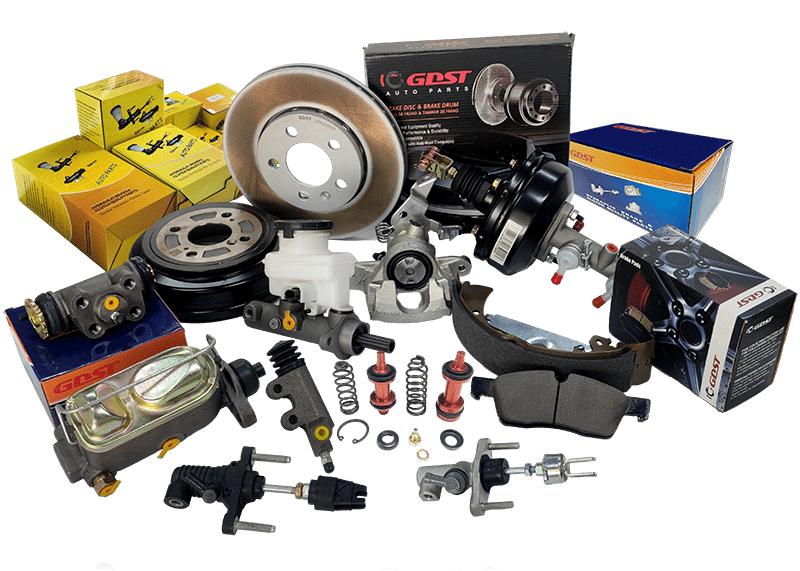
Disc brakes vs drum brakes: which one is actually better? We hear this question weekly from procurement managers and distributors. The problem is that "better" depends on axle position, vehicle weight, driving conditions, and cost structure. The solution is a practical comparison built around real purchasing decisions.
Disc brakes and drum brakes both convert kinetic energy into heat through friction, but they do it differently. Disc brakes dissipate heat faster, resist fade, and recover quickly from water1 — making them preferred for front axles and performance vehicles. Drum brakes cost less to produce, provide strong parking-brake holding force, and offer a self-energizing effect2, which keeps them common on rear axles and commercial vehicles.
Those differences are not just engineering details. They shape product selection, inventory planning, and after-sales risk for every brake parts buyer. Let me walk through how each system works, where each excels, and what that means for your purchasing decisions.
How Disc Brakes and Drum Brakes Work Differently
The first challenge we see in procurement conversations is confusion about the mechanism itself. Buyers often assume both systems operate the same way — just with different shapes. They do not. The mechanical difference defines their performance limits.
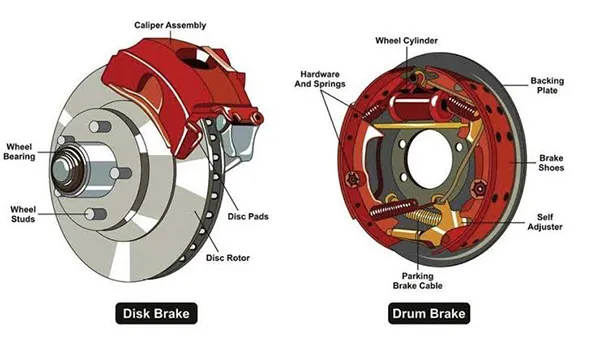
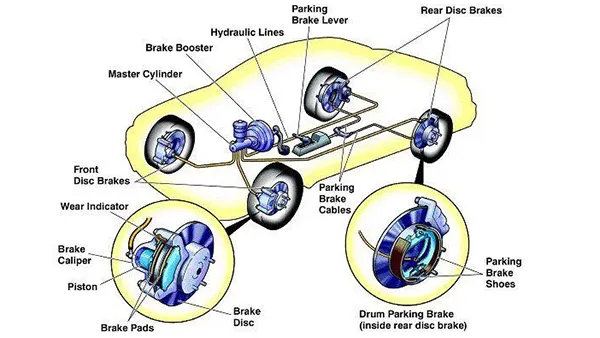
A disc brake uses a caliper to squeeze brake pads against both sides of a rotating disc, or rotor. A drum brake uses wheel cylinders to push brake shoes outward against the inside surface of a drum that rotates with the wheel.3 Clamping versus expanding. That single difference explains most of the performance gap between the two technologies.
The clamping action of disc brakes
Disc brakes apply force from both sides of the rotor. The caliper houses pistons that press the pads evenly, creating a direct, balanced friction pair. Because the rotor is completely exposed, heat escapes easily, and water or dirt is thrown off by centrifugal force. The design also allows for visible inspection. You can measure pad thickness and examine the rotor surface without disassembling the wheel.
The expanding action of drum brakes
Drum brakes apply force from the inside outward. Brake shoes press against the inner surface of the drum, which is enclosed. The drum itself acts as both the friction surface and the heat shield. The main advantage is the self-energizing effect: when the vehicle moves forward, drum rotation pulls the leading shoe into the drum with extra force. That means a small hydraulic input can generate a large braking torque. This is why drum brakes remain effective on heavy vehicles and rear axles.
What this means for manufacturing quality
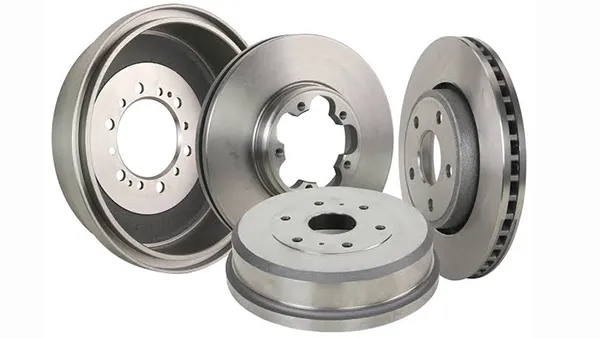
In our factory, we produce brake discs and related components, and the machining challenges differ by structure. Disc rotors require precise surface flatness, run-out control, and balance. A rotor that exceeds run-out tolerances can cause pedal pulsation and uneven pad wear.4 Drums require accurate internal concentricity, which is harder to inspect visually. This is why buyers should not judge brake performance by structure alone. Quality control during machining — surface finish, dimensional tolerances, material hardness — often determines real-world braking behavior more than the disc-versus-drum label.
Disc Brakes vs. Drum Brakes: Key Differences in Heat Dissipation, Stopping Power & Braking Efficiency
Heat is the enemy of brake performance. We say this constantly in customer conversations. A brake system that cannot shed heat will fade, losing friction exactly when the driver needs it most. Heat dissipation is where disc brakes and drum brakes diverge most sharply.
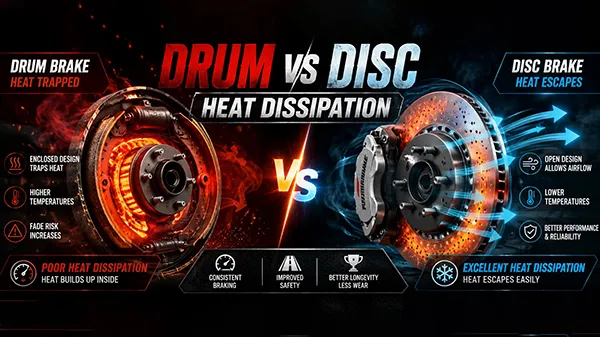
Disc brakes win on heat dissipation because the rotor is exposed to airflow. Drum brakes trap heat inside an enclosed shell, so sustained braking — mountain descents, repeated stops, heavy loads — causes temperatures to climb faster, increasing fade risk.
The fade problem
Brake fade occurs when excessive heat changes the friction material's coefficient of friction.5 On a long downhill run, a heavily loaded vehicle with drum brakes can reach temperatures that cause the brake shoes to glaze or the drum to expand away from the shoes. Pedal travel increases, stopping force drops6, and the driver must rely on engine braking. Disc systems, especially with vented rotors, move heat away more effectively and maintain more consistent pedal feel.
In our production planning, we see this reflected in demand. Customers who supply mountainous markets or towing-heavy segments prioritize disc brake product lines for higher performance applications. The structure is not a status symbol. It is a response to thermal load.
Water recovery and braking consistency
Water also matters. Disc rotors generate centrifugal force that flings water off the friction surface, so pads bite again within a few revolutions. Drum brakes, being enclosed, retain water longer. After driving through deep puddles, drivers may notice reduced braking response until the shoes dry. For regions with heavy seasonal rain, this is a genuine safety consideration — and a factor aftermarket buyers should weigh when building regional product assortments.
| Factor | Disc Brakes | Drum Brakes |
|---|---|---|
| Heat dissipation | Excellent — open rotor, vented options available | Moderate — enclosed drum retains heat |
| Fade resistance | High under repeated or continuous braking | Lower under sustained heavy braking |
| Water recovery | Fast — centrifugal force clears water | Slower — enclosure holds moisture |
| Stopping consistency | Predictable across temperatures | Varies with thermal expansion |
| Parking hold | Needs separate mechanism or electronic parking brake | Strong natural holding force |
Stopping power in context
Stopping power is not a fixed number. It depends on friction material, hydraulic pressure, tire grip, vehicle weight, and brake force distribution between front and rear. A high-quality drum brake can produce more total braking force than a poorly manufactured disc rotor on a specific vehicle. The common statement "disc brakes stop better" is only valid when paired with proper material quality, correct OE dimensions, and matching pad compounds.
From our manufacturing experience, the same brake disc model performs differently depending on the pad grade chosen by the customer. We always recommend verifying the complete friction pair against the vehicle application before finalizing a product order.
Advantages and Disadvantages: Disc Brakes vs. Drum Brakes
Buyers often ask us to declare a winner between disc brakes vs drum brakes. In our experience, the question is incomplete without a second part: "for which axle, vehicle type, and operating condition?" Each structure has legitimate advantages that no honest comparison can ignore.
Disc brakes offer more consistent stopping performance under repeated high-temperature braking, easier maintenance, and lower unsprung weight on the axle. Drum brakes offer lower manufacturing cost, longer brake shoe service life in normal driving, good resistance to harsh environments, and superior parking-brake holding force.
Cost and maintenance reality
For fleet operators and budget-sensitive markets, total cost of ownership matters more than peak performance. Drum brakes generally have fewer visible components, and brake shoes tend to last longer than pads in moderate use because the enclosed design keeps friction material cleaner.7 That is not a judgment of quality. It is a functional result of the structure.
Application-driven selection
An urban delivery van making hundreds of stops per day will stress its brakes constantly. A disc setup on the front axle handles heat and repeat stops better. The same van's rear axle, which carries a large share of load but does a smaller share of braking work, can function well with drum brakes.8 This combination — front disc, rear drum — is one of the most common configurations in the automotive industry.9 It demonstrates that structure selection is a design decision, not a technology hierarchy.
Procurement mistakes we see repeatedly
The most common mistake in our customer inquiries is not choosing between disc and drum. It is choosing without application verification. A distributor once asked us about stocking high-performance drilled brake discs for all their models, assuming disc was "the future." Their actual best-selling vehicle line at that moment was a budget passenger car with rear drum brakes. The right decision was to stock quality drum components for that segment and disc rotors for the front axles.
Selling the wrong structure creates fitment returns, after-sales complaints, and warranty costs that far outweigh the unit-price difference.
Here is a quick decision checklist we use internally:
- Identify the axle position (front, rear, or both).
- Confirm the original vehicle build specification.
- Check target market driving conditions (mountains, rain, heavy traffic).
- Estimate average load and driving intensity.
- Match friction material to the vehicle's brake force distribution.
- Verify supplier production capability for that specific structure.
Why Modern Vehicles Are Switching from Drum to Disc Brakes
There is no question that disc brakes have expanded from performance cars into mainstream passenger vehicles. In our factory, brake disc production volume has grown substantially over two decades. But the phrase "switching" deserves precision. It does not mean drum brakes are disappearing from new cars.
The shift is real, but partial. Many modern passenger vehicles still use drum brakes on the rear axle, especially compact and economy models.10 The industry moves to disc brakes when the engineering case is clear — high-performance models, larger vehicles with heavy towing loads, and vehicle platforms where the manufacturer standardizes disc brakes across the entire range.
What is driving the change
Consumer perception plays a role. Buyers see disc brakes on sports cars and assume any drum brake is outdated. Manufacturers respond to that expectation, especially in markets where "front disc, rear drum" appears on the spec sheet and gets compared by customers.
At the same time, production cost gaps have narrowed. High-volume disc brake manufacturing — including our own 50 production lines with a monthly output of 400,000 units — has made disc rotors more cost-competitive than they were twenty years ago. That cost curve shift, more than any technical breakthrough, explains why disc brakes now appear on entry-level vehicles.
Where drum brakes still make sense
The conversation becomes practical when we look at commercial vehicles and heavy loads. Drum brakes offer a significant advantage in static holding force. A parking brake integrated into the rear drum holds a loaded van or truck reliably on an incline. Some commercial vehicles retain drum brakes on the rear axle even when disc brakes are fitted to the front, because the braking torque distribution does not demand rear discs, and the cost savings matter across a large fleet.
What this means for aftermarket stock planning
For brake parts brands, importers, and wholesalers, the trend is not "disc replaces drum." It is "disc leads sales volume, while drum remains a stable, serviceable segment." In the more than 5,000 brake disc applications we supply, front-axle dominance is clear. But rear drum applications still cover thousands of active vehicle models worldwide.
A balanced inventory that reflects actual vehicle populations in your target market will outperform an emotional bet on "advanced" technology. If you are unsure which structures dominate your region, customer fitment claims and sales history are your best starting points — not generic internet lists.
Frequently Asked Questions
Are drum brakes outdated?
No. Drum brakes remain common on rear axles of passenger cars and on commercial vehicles. They offer lower cost, strong parking-brake holding force, and good resistance to harsh environments. The correct question is whether drum brakes fit the specific vehicle application — not whether they are old technology.
Can I convert drum brakes to disc brakes?
Conversion is possible but not always advisable. You must match the new disc components to the vehicle's original brake force distribution, wheel size, and hydraulic system. Improper conversion can reduce braking stability.11 You should consult a qualified vehicle engineer and use purpose-built conversion kits rather than mixing random parts.
Do disc brakes stop faster than drum brakes?
Under repeated or high-temperature braking, disc brakes generally maintain more consistent stopping performance because they dissipate heat better. Under a single normal stop with quality components, the difference may be small. Actual stopping distance depends on friction material, tire grip, vehicle load, and brake system tuning — not only the brake structure.12
Should I stock disc or drum brakes for my aftermarket business?
Base the decision on your target vehicle population. Check which models use front disc, rear drum, or all-disc configurations in your market. Analyze your sales history for the last 12–24 months. Then build inventory around actual fitment demand rather than a general technology preference.
How can I verify brake disc or drum quality from a supplier?
Ask for dimensional inspection reports, material certificates, and quality system certifications such as IATF16949. Ask whether products are developed according to OE specifications, and how the factory controls run-out, balance, hardness, and surface treatment. Request samples and test them on a representative vehicle or bench setup before committing to large orders.
Conclusion
Disc brakes vs drum brakes is not a simple contest with one winner. Each structure has a legitimate role shaped by axle position, vehicle load, operating conditions, and total cost. Disc brakes excel at heat management and consistent performance. Drum brakes deliver cost efficiency and strong holding force. The smartest procurement approach is to evaluate fitment, usage, and supplier quality first — then stock accordingly. At GDST, we manufacture both brake discs and related components for global aftermarket buyers. If you need help evaluating brake product ranges for your market, contact our team for application guidance.
"Elimination of Brake Fade in Vehicles by Altering ...", https://www.academia.edu/49085187/Elimination_of_Brake_Fade_in_Vehicles_by_Altering_the_Brake_Disc_Size_A_Concept_. Comparative brake-engineering literature generally attributes better cooling, fade resistance, and wet recovery to the exposed friction surfaces of disc brakes; the magnitude of the advantage depends on brake dimensions, ventilation, friction materials, and test conditions. Evidence role: general_support; source type: research. Supports: A neutral engineering source should compare the thermal and wet-performance characteristics of representative disc and drum brake designs.. Scope note: The comparison is characteristic of typical designs and does not establish that every disc brake outperforms every drum brake. ↩
"(PDF) Unit 2 Dics & Drum Brake Operation", https://www.academia.edu/30339135/Unit_2_Dics_and_Drum_Brake_Operation. In a leading-shoe drum brake, friction generated by the rotating drum can pull the shoe farther into contact, augmenting the actuator force and producing the mechanism commonly termed self-energization. Evidence role: mechanism; source type: education. Supports: A mechanical or automotive-engineering source should explain how friction and drum rotation draw a leading shoe into firmer contact with the drum.. Scope note: The amount of self-energization varies with shoe arrangement, direction of rotation, geometry, and coefficient of friction. ↩
"How Do Diesel Hydraulic Brakes Work?", https://www.uti.edu/blog/diesel/hydraulic-brakes. Automotive engineering references describe disc brakes as caliper-operated systems that clamp pads against a rotor and drum brakes as systems in which wheel cylinders force shoes against the drum's inner friction surface. Evidence role: mechanism; source type: education. Supports: An automotive-engineering source should confirm the respective clamping and expanding mechanisms used by conventional hydraulic disc and drum brakes.. ↩
"Cost-Effective Brake Rotor Resurfacing Tool", https://ideaexchange.uakron.edu/context/honors_research_projects/article/3570/viewcontent/D4_Peters_Brake_Rotor_SurfaceTooling_Formal_Report.pdf. Brake-system studies identify excessive lateral run-out as a contributor to nonuniform rotor wear and disc-thickness variation, conditions associated with brake judder and pedal-force fluctuations. Evidence role: mechanism; source type: paper. Supports: Research should establish the relationship among lateral run-out, disc-thickness variation, uneven contact, and brake judder or pedal pulsation.. Scope note: Run-out is one possible cause of pulsation; hub contamination, installation error, thermal distortion, and material variation can produce similar symptoms. ↩
"Temperature Influence on Brake Pad Friction Coefficient ...", https://pmc.ncbi.nlm.nih.gov/articles/PMC10779514/. Tribological research defines brake fade as a temperature-related reduction in braking effectiveness, commonly associated with changes in the friction coefficient and other thermally induced changes at the pad or lining interface. Evidence role: definition; source type: paper. Supports: A tribology or friction-material paper should define fade and document temperature-dependent loss or instability of friction performance.. Scope note: Friction-coefficient change is not the only fade mechanism; fluid boiling, outgassing, and component deformation may also reduce braking performance. ↩
"Development and Analysis of Finned Brake Drum Model ...", https://www.academia.edu/125049400/Development_and_Analysis_of_Finned_Brake_Drum_Model_Using_Solidworks_Simulation. Thermal analyses of drum brakes show that drum heating can increase the effective drum diameter and shoe clearance, requiring greater actuation travel and potentially lowering available braking torque. Evidence role: mechanism; source type: paper. Supports: An engineering study should explain how heating changes drum dimensions and how increased clearance can affect actuator travel and braking torque.. Scope note: The operational effect depends on adjuster design, temperature distribution, drum material, hydraulic capacity, and brake geometry. ↩
"AUTO G140: Automotive Chassis: Brakes", https://catalog.cccd.edu/courses/auto-g140/auto-g140.pdf. Comparative maintenance literature reports that drum-brake linings can have long service intervals in moderate-duty use, with their enclosure providing some protection from road debris. Evidence role: general_support; source type: research. Supports: A comparative wear or maintenance source should document whether drum linings commonly experience lower wear rates or longer service intervals in moderate-duty applications.. Scope note: The enclosure can also retain heat, water, and wear debris, so shoe life is application-specific and cannot be inferred from brake type alone. ↩
"Optimized braking force distribution during a braking-in- ...", https://www.academia.edu/71044594/Optimized_braking_force_distribution_during_a_braking_in_turn_maneuver_for_articulated_vehicles. Vehicle-dynamics texts show that deceleration transfers normal load toward the front axle, generally increasing the front tires' usable braking force and reducing the rear axle's required share. Evidence role: mechanism; source type: education. Supports: A vehicle-dynamics source should explain forward dynamic load transfer during deceleration and its role in front-to-rear brake-force allocation.. Scope note: The distribution varies with wheelbase, center-of-gravity height, payload location, road adhesion, suspension behavior, and electronic brake controls. ↩
"A Preliminary Evaluation of Two Braking Improvements for ...", https://crashstats.nhtsa.dot.gov/Api/Public/ViewPublication/806359. Automotive technical surveys identify the front-disc/rear-drum layout as a long-established configuration in passenger vehicles, combining front-axle thermal capacity with a lower-cost rear brake and integrated parking-brake function. Evidence role: historical_context; source type: institution. Supports: An industry, transport, or technical source should document the widespread use of front discs with rear drums in passenger vehicles, particularly economy and compact models.. Scope note: Its current prevalence differs by market, model year, vehicle class, and the adoption rate of regenerative braking and electronic parking brakes. ↩
"A Preliminary Evaluation of Two Braking Improvements for ...", https://crashstats.nhtsa.dot.gov/Api/Public/ViewPublication/806359. Contemporary vehicle specifications and technology surveys show that rear drum brakes remain in production on some passenger vehicles, particularly compact and cost-sensitive models. Evidence role: historical_context; source type: research. Supports: A current vehicle-technology survey or fleet dataset should show that rear drum brakes remain present in modern passenger-car platforms, especially cost-sensitive segments.. Scope note: Model availability and brake specifications change by country, trim level, powertrain, and production year, so the claim does not establish a universal segment-wide pattern. ↩
"A Test Track Study of Light Vehicle ABS Performance Over ...", https://www.nhtsa.gov/sites/nhtsa.gov/files/nhtsaabst4finalrpt.pdf. Brake-safety standards and vehicle-dynamics literature show that inappropriate front-to-rear brake-force distribution can cause an axle to lock prematurely and impair directional stability during braking. Evidence role: mechanism; source type: government. Supports: A regulatory or vehicle-safety source should explain why altered brake torque, hydraulic pressure, or axle balance can cause premature wheel lock and reduced directional stability.. Scope note: This principle establishes the risk from an improperly engineered conversion but does not show that every correctly designed and validated drum-to-disc conversion is unsafe. ↩
"Air Brake Systems", https://www.nhtsa.gov/sites/nhtsa.dot.gov/files/121_stopping_distance_fr.pdf. Vehicle-dynamics and road-safety sources treat stopping distance as the result of tire-road adhesion, speed, load transfer, vehicle mass, brake condition, and control-system calibration rather than as a function of disc or drum architecture alone. Evidence role: general_support; source type: government. Supports: A road-safety or vehicle-dynamics source should establish that stopping distance depends on available tire-road adhesion, vehicle condition and load, and brake-system performance.. Scope note: Such sources support the multifactor principle but may not quantify the separate contribution of friction-material grade in a particular vehicle. ↩