Quick Summary
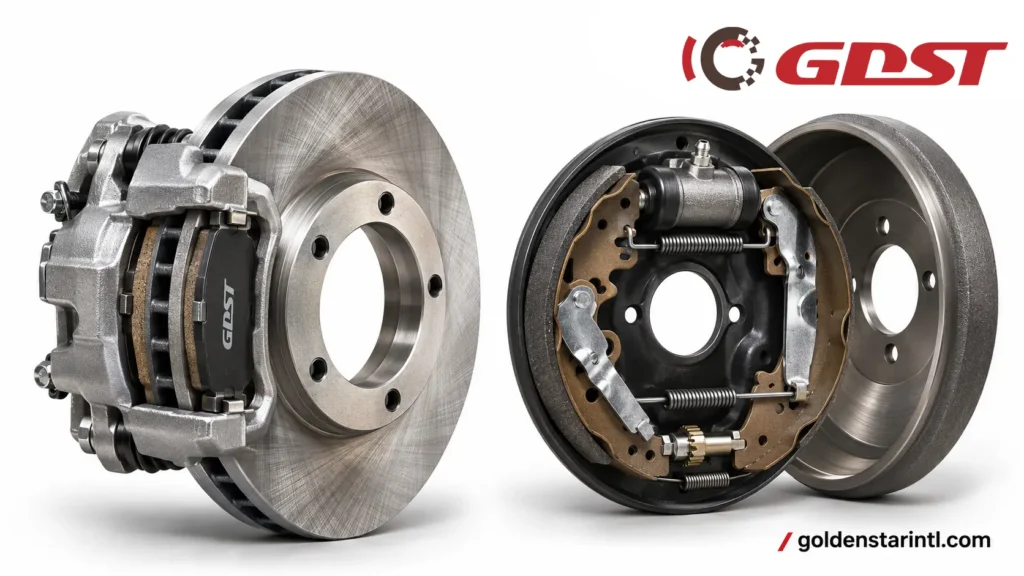
- Brake pads operate in disc brake systems by clamping against a rotating rotor, while brake shoes expand against the inner surface of a rotating drum.
- Some vehicles use both components, combining front disc brakes with rear drum brakes or using separate drum shoes for parking brakes.
- Disc brakes generally offer better heat dissipation, while drum brakes can benefit from a self-energizing effect in certain shoe configurations.
- Brake friction materials are composite formulations containing binders, reinforcing fibers, friction modifiers, and fillers that influence braking performance and wear.
- Friction material wear depends on interacting factors, including temperature, contact pressure, vehicle speed, material properties, and operating conditions.
- Brake fade occurs when braking effectiveness decreases under certain high-temperature conditions, potentially affecting friction stability and braking performance.
- Brake pads and brake shoes have different wear mechanisms, and neither component has a universally longer service life.
- Correct replacement parts must match the vehicle’s braking configuration, OE references, dimensions, friction material requirements, and manufacturer specifications.
Brake pads and brake shoes are two essential friction components used in automotive braking systems. Although both serve the same purpose—slowing down or stopping a vehicle—they have different structures, operating mechanisms, and applications.
Brake pads work with disc brake systems, while brake shoes operate in drum brake systems. Understanding their differences is important for vehicle owners, automotive technicians, parts distributors, and aftermarket buyers.
This guide compares their functions, working principles, friction materials, braking performance, wear characteristics, and replacement requirements, helping readers understand how these components work and how to identify the right replacement parts.
What Are Brake Pads?
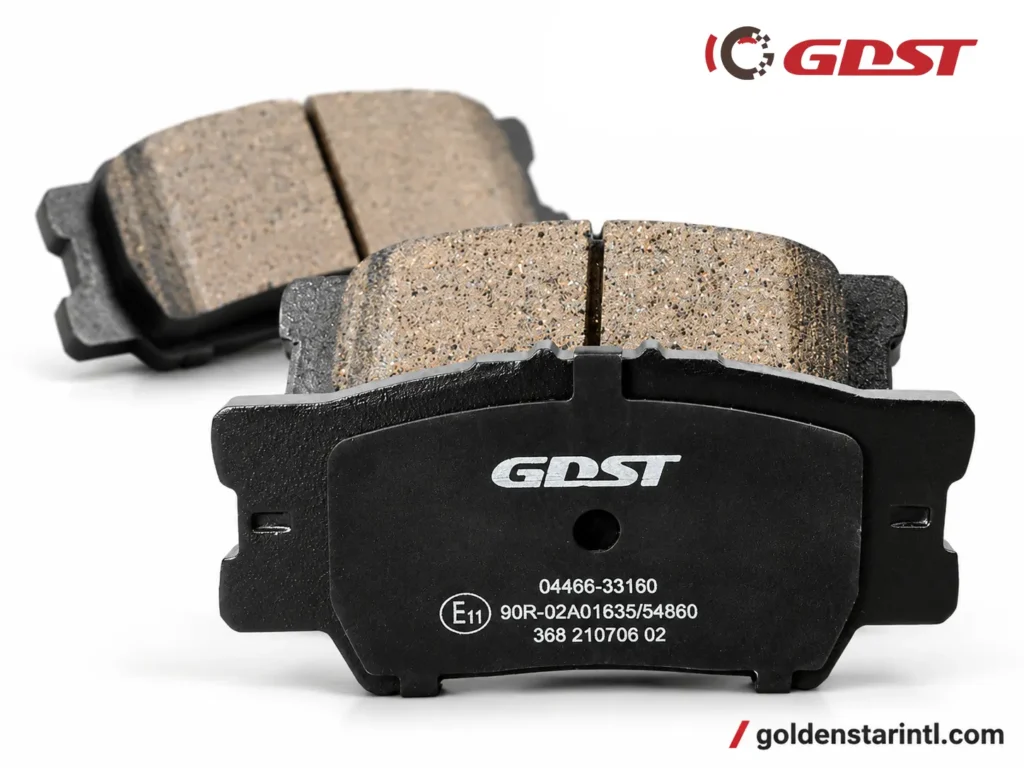
Brake pads are friction components used in disc brake systems. They are installed inside the brake caliper and positioned on opposite sides of a rotating brake disc, commonly called a brake rotor.
A typical brake pad consists of a steel backing plate and a layer of friction material. Depending on its design, it may also include noise-reduction shims, wear indicators, slots, and chamfers.
When the driver presses the brake pedal, hydraulic pressure activates the caliper pistons, pushing the brake pads against the rotor. The resulting friction converts the vehicle’s kinetic energy into heat, reducing wheel speed.
Brake pads are widely used in passenger cars, SUVs, light commercial vehicles, buses, and heavy-duty vehicles equipped with disc brakes.
How Does a Disc Brake System Work?
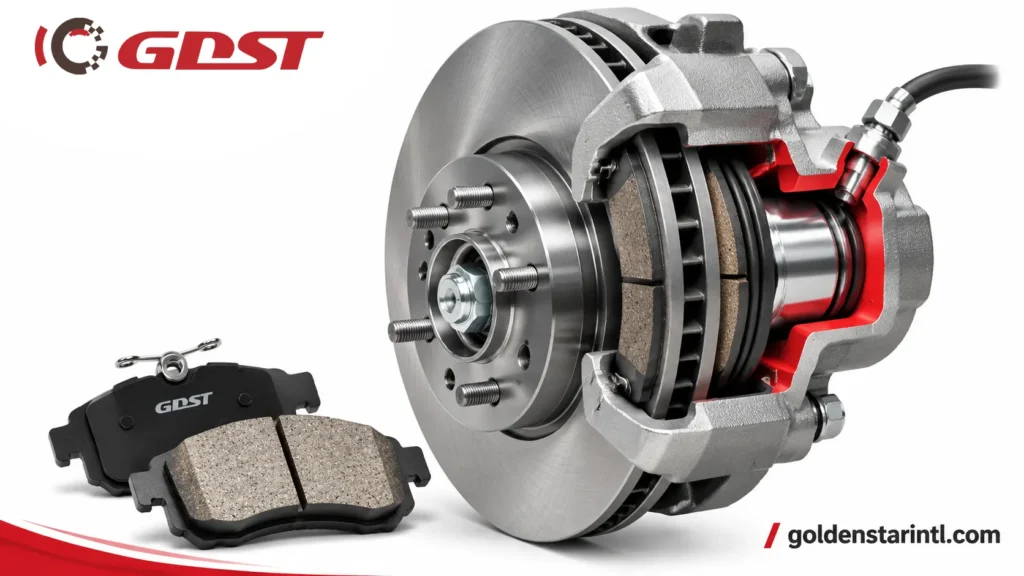
A disc brake system uses hydraulic pressure to push brake pads against a rotating rotor.
Its main components include the brake pedal, master cylinder, brake lines, caliper, brake pads, and brake rotor.
When the driver presses the pedal, hydraulic pressure travels from the master cylinder to the caliper. The caliper pistons then push the pads against both sides of the rotor, generating friction and slowing the wheel.
When the pedal is released, hydraulic pressure decreases and the pads release their clamping force.
The exposed rotor design allows heat to dissipate through surrounding airflow, making disc brakes suitable for applications requiring consistent braking performance and convenient inspection.
What Are Brake Shoes?
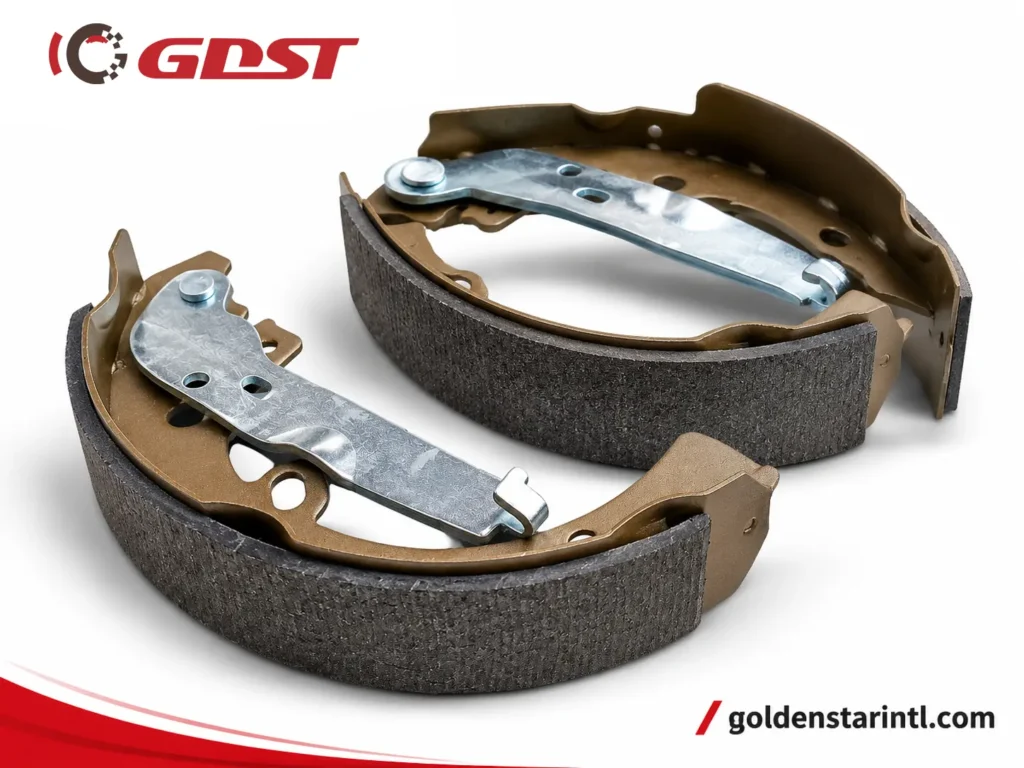
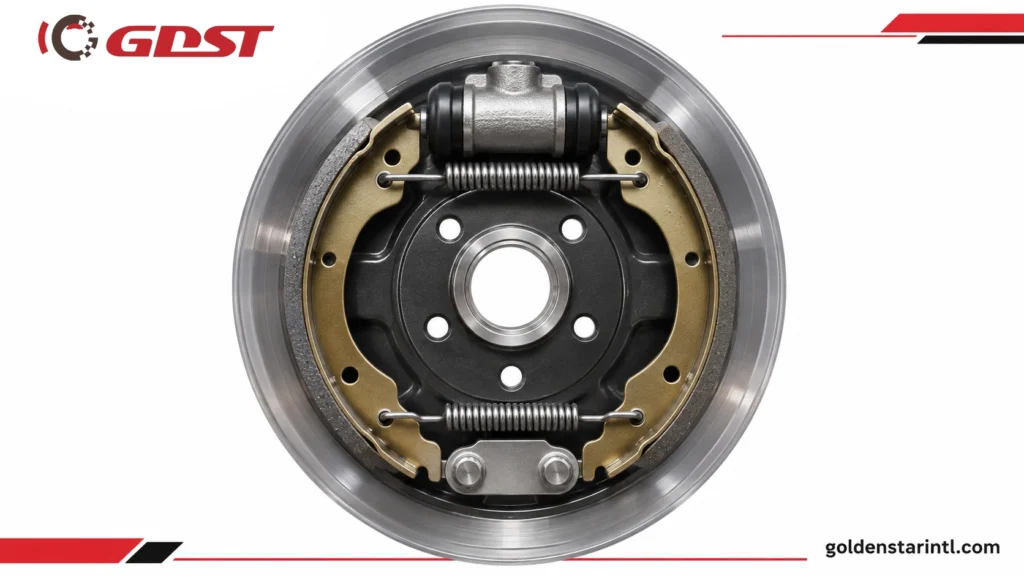
Brake shoes are curved friction-supporting components used in drum brake systems. Unlike brake pads, which clamp against a rotor, brake shoes expand outward and press their friction linings against the inside surface of a rotating brake drum.
A typical brake shoe consists of a curved steel supporting structure and an attached friction lining. The lining generates friction, while the steel shoe provides mechanical support.
Brake shoes are commonly used in rear drum brakes, commercial vehicles, trailers, and various heavy-duty applications.
Their enclosed construction provides some protection from direct exposure to road debris, although heat and contaminants can accumulate inside the drum.
How Does a Drum Brake System Work?
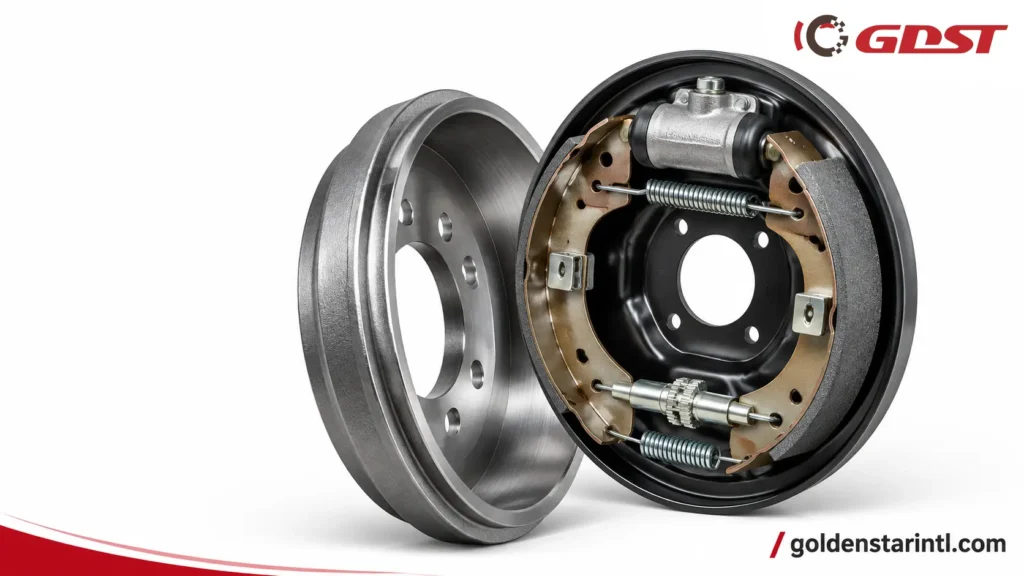
A conventional hydraulic drum brake system operates through hydraulic pressure transmitted from the master cylinder to the wheel cylinder.
When the driver presses the brake pedal, hydraulic pressure reaches the wheel cylinder. Its pistons move outward, pushing the brake shoes against the inside surface of the rotating brake drum.
The contact between the friction linings and drum generates braking torque, reducing the rotational speed of the drum and the connected wheel.
When the driver releases the brake pedal, return springs pull the shoes away from the drum, reducing friction and allowing the wheel to rotate freely.
Some drum brake designs also feature a self-energizing effect, which can increase braking force without requiring a proportional increase in actuator force.
For heavy-duty commercial vehicles, drum brakes may use a different actuation system. A common example is the S-cam air brake system, which uses an air brake chamber, linkage, slack adjuster, and S-cam mechanism to expand the brake shoes against the drum.
Therefore, hydraulic drum brakes used in many passenger vehicles and air-operated drum brakes used in commercial vehicles should not be treated as identical systems.
Brake Pads vs. Brake Shoes: Key Differences
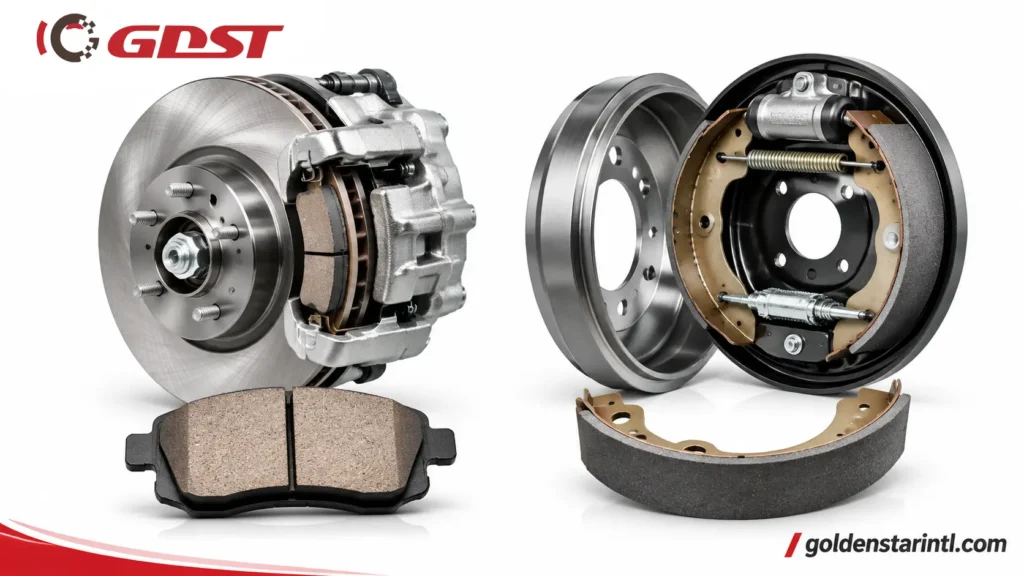
Although brake pads and brake shoes both generate friction to slow a vehicle, their structures, contact surfaces, and working mechanisms are different.
| Comparison | Brake Pads | Brake Shoes |
| Braking system | Disc brake | Drum brake |
| General shape | Relatively flat | Curved or crescent-shaped |
| Main structure | Steel backing plate and friction material | Curved steel supporting structure and friction lining |
| Working surface | Contacts the rotor’s braking faces | Contacts the drum’s inner cylindrical surface |
| Force direction | Clamped inward against the rotor | Expanded outward against the drum |
| Main mating component | Brake rotor | Brake drum |
| Heat dissipation | Generally more efficient | Generally less efficient |
| Environmental exposure | More exposed to road conditions | Enclosed within the drum |
| Inspection | Usually easier | Generally requires drum removal |
| Maintenance | Usually simpler | Includes additional internal hardware and adjustment mechanisms |
| Common applications | Passenger cars, SUVs, buses, and trucks | Rear drum brakes, commercial vehicles, and trailers |
The most important distinction is not simply the shape of the friction component. It is the braking mechanism and supporting assembly in which the component operates.
Brake pads are designed for disc brakes, while brake shoes are designed for drum brakes. They are not interchangeable.
Can a Vehicle Have Both Brake Pads and Brake Shoes?
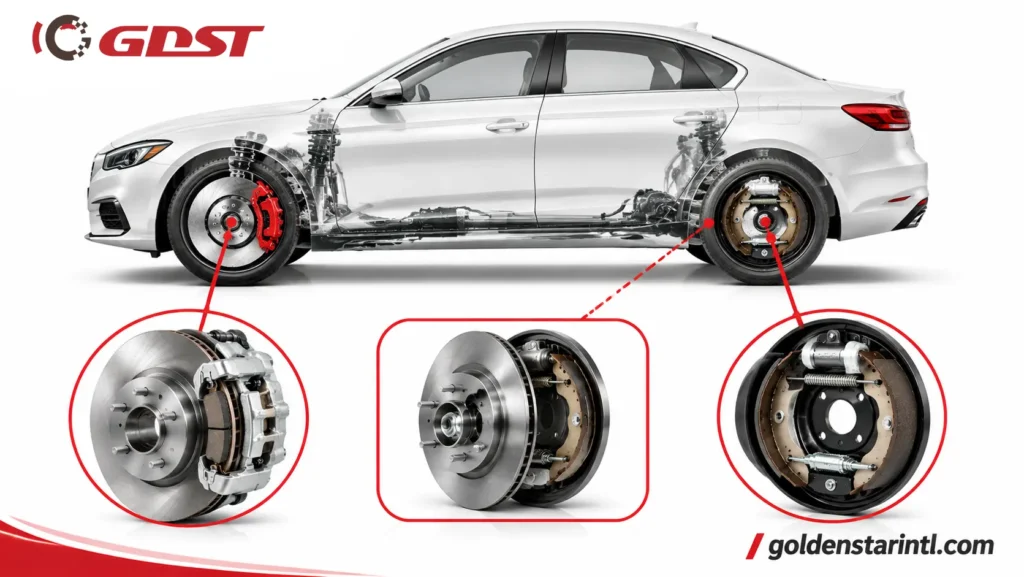
Yes. A vehicle can use both brake pads and brake shoes, depending on its braking configuration.
One common arrangement is front disc brakes combined with rear drum brakes.
During braking, vehicle weight generally transfers toward the front axle because of longitudinal deceleration. This dynamic load transfer influences the braking force that can be supported by the front and rear tires.
However, dynamic axle load transfer should not be confused with a fixed front-to-rear brake force ratio. Actual brake force distribution depends on vehicle design, brake control systems, tire-road adhesion, and operating conditions.
Another configuration is the drum-in-hat parking brake.
Some vehicles equipped with four-wheel disc brakes also contain a small set of brake shoes inside the hat section of the rear brake rotor. These shoes operate against an internal drum surface to provide the mechanical parking brake function.
In this configuration:
- Brake pads provide normal service braking.
- Brake shoes provide the separate mechanical parking brake function.
Therefore, finding both components on the same vehicle does not necessarily indicate an unusual braking arrangement.
Which Provides Better Braking Performance: Disc Brakes or Drum Brakes?
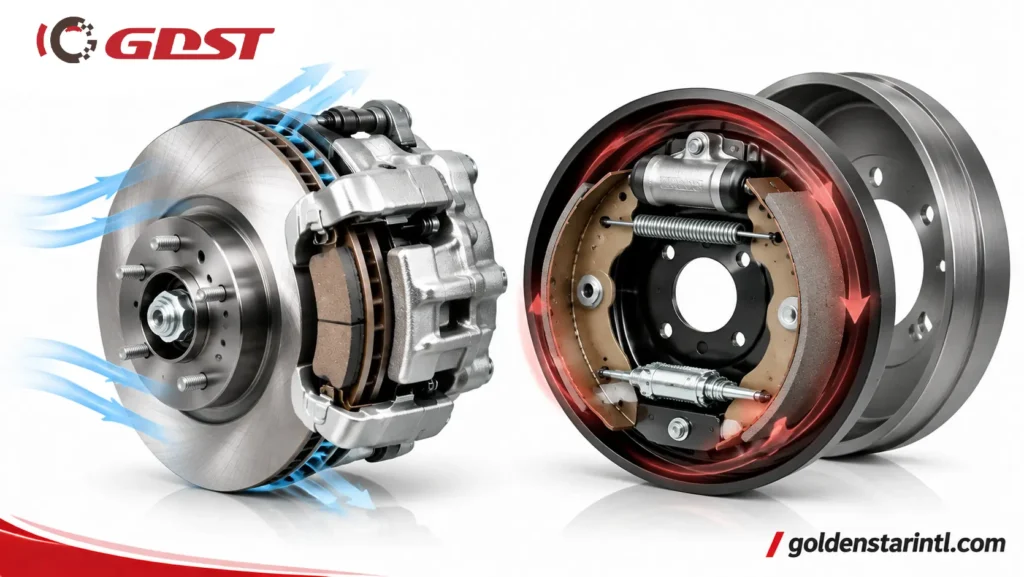
Disc brakes generally offer advantages in heat dissipation and repeated braking performance. However, neither system is universally superior in every vehicle application.
Disc brakes have relatively exposed friction surfaces, allowing heat to escape through surrounding airflow. Ventilated brake rotors can further improve heat transfer through their internal cooling passages.
Drum brakes have a more enclosed construction, which can restrict heat dissipation during repeated heavy braking.
Nevertheless, drum brakes also offer engineering advantages. Their self-energizing characteristics can generate substantial braking torque, while their relatively economical construction makes them suitable for various passenger and commercial vehicle applications.
Newcomb and Millner (1965), in their experimental study Cooling Rates of Brake Drums and Discs, investigated the cooling behavior of brake drums and discs under different operating conditions.
Their experiments found that, for the tested vehicles and corresponding recommended brake sizes, front discs cooled approximately 25% faster than the corresponding drum brakes. The study also demonstrated that cooling rates depend on brake geometry, dimensions, and airflow [3].
This result provides historical experimental evidence of the cooling advantages of disc brakes, but the reported percentage should not be interpreted as a universal performance difference across all modern braking systems.
Actual braking performance depends on several additional factors:
- Vehicle weight and axle load.
- Brake force distribution.
- Tire condition and road surface friction.
- Friction material characteristics.
- Rotor and drum dimensions.
- ABS and electronic brake force distribution systems.
- Operating temperature and braking frequency.
The correct braking configuration should therefore be determined by the vehicle manufacturer’s engineering requirements and intended operating conditions.
How Does the Self-Energizing Effect Work in Drum Brakes?
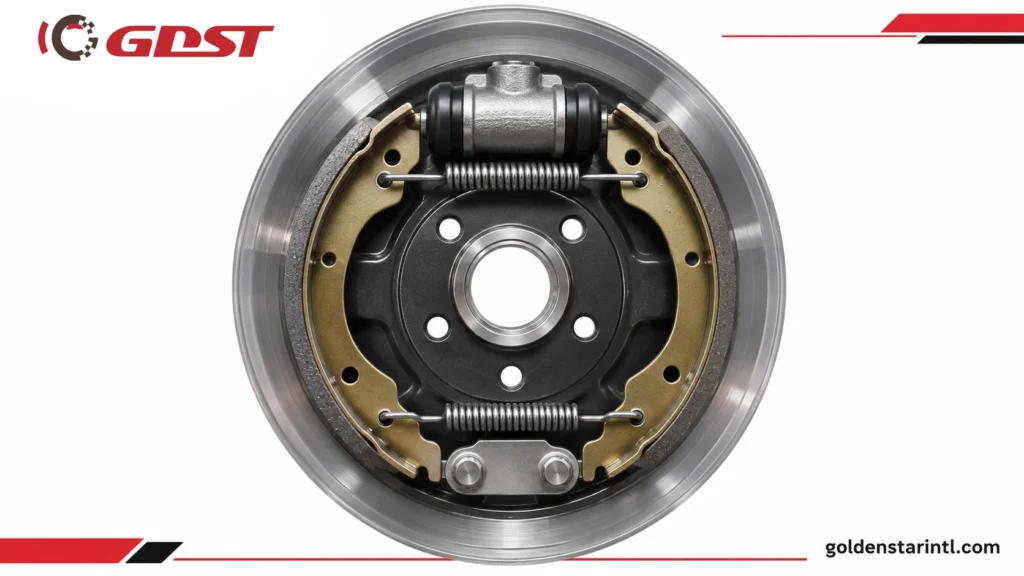
The self-energizing effect is an important mechanical characteristic of certain drum brake designs.
When a rotating drum contacts the brake shoes, friction generates a tangential force along the shoe lining.
Depending on the direction of rotation and shoe geometry, this frictional force can help pull a leading shoe further into contact with the drum.
This increases the shoe’s contact force and can generate additional braking torque.
In conventional leading-and-trailing shoe configurations:
- Leading shoe:Can experience a self-energizing effect, increasing its effective braking contribution.
- Trailing shoe:May experience a de-energizing effect, depending on the direction of rotation and mechanical configuration.
Ramesh and Sundar (2021), in their theoretical study Contributions of Various Non-linearities to the Dynamic Response of an Automotive Drum Brake During Typical Braking, investigated the contact, friction, and kinematic nonlinearities involved in drum brake operation.
Their research specifically examined the self-energizing and de-energizing effects of brake shoes and their influence on braking system dynamics [2].
This explains why drum brakes can generate substantial braking torque with relatively modest actuator force.
However, the self-energizing effect does not mean drum brakes always provide better braking performance than disc brakes. Actual performance depends on shoe geometry, friction coefficient, actuation force, drum dimensions, and overall system design.
Heat Dissipation and Brake Fade: An Important Difference
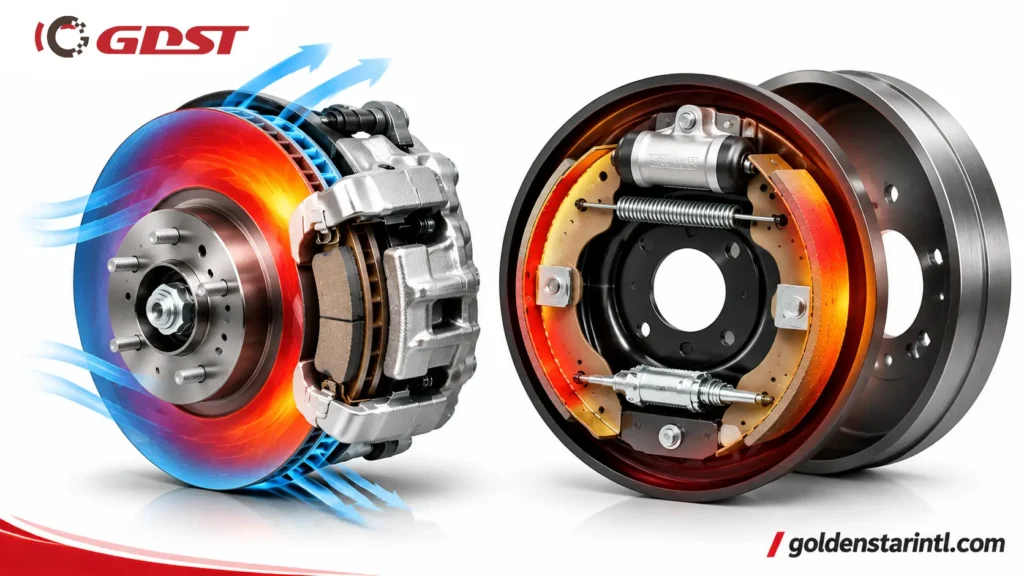
Heat management is one of the most important factors affecting braking performance.
Every time a vehicle slows down, its kinetic energy is converted primarily into heat through friction between the braking surfaces.
If the braking system cannot dissipate heat effectively, excessive temperature can alter the friction characteristics of the braking materials and affect overall braking performance.
This reduction in braking effectiveness under certain high-temperature conditions is commonly known as brake fade.
Brake fade can be influenced by several factors:
- Excessive operating temperature.
- Friction material formulation.
- Repeated heavy braking.
- Contact pressure distribution.
- Brake rotor or drum thermal characteristics.
- Airflow and heat dissipation.
- Friction surface condition.
The composition of friction materials is particularly important because different formulations respond differently to temperature and repeated braking.
Newcomb and Millner’s cooling experiments provide evidence that brake geometry, dimensions, and airflow influence thermal performance [3].
Therefore, brake fade should not be attributed to temperature alone. The friction material, contact interface, and thermal design of the complete braking system all influence its severity.
Brake Friction Materials: Composition and Performance
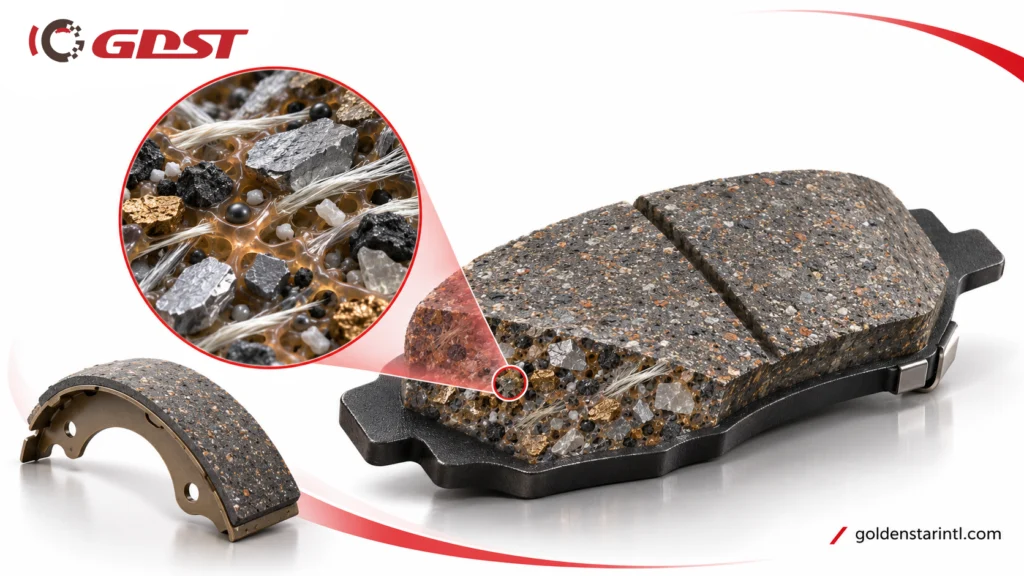
Brake pads and brake shoes use specially engineered friction materials designed to generate predictable braking resistance under different operating conditions.
These materials are not simply rubber or ordinary metal. They are complex composite formulations containing several ingredients that perform different functions.
Chan and Stachowiak (2004), in their review Review of Automotive Brake Friction Materials, examined the composition and performance characteristics of contemporary brake pads and brake shoes, discussing the advantages and disadvantages of different friction material ingredients [1].
A typical friction material formulation may include:
| Material Component | Main Function |
| Binder | Holds the formulation together and provides structural integrity |
| Reinforcing fibers | Improve mechanical strength and support friction performance |
| Friction modifiers | Adjust friction characteristics and influence wear behavior |
| Lubricants | Help control friction and wear |
| Abrasives | Influence friction generation and surface interaction |
| Fillers | Adjust physical properties, processability, and manufacturing cost |
The final performance of a brake friction material depends on the combined formulation rather than any single ingredient.
Common Types of Brake Pad Friction Materials
Several friction material categories are commonly used in automotive aftermarket brake pads.
- Non-Asbestos Organic (NAO) Brake Pads
NAO materials generally contain resin binders, reinforcing fibers, friction modifiers, and fillers.
They are developed to balance friction performance, braking comfort, wear, and noise characteristics.
- Low-Metallic Brake Pads
Low-metallic formulations contain a relatively limited proportion of metallic ingredients.
Depending on the formulation, they can be designed to balance braking response, thermal performance, and wear characteristics.
- Semi-Metallic Brake Pads
Semi-metallic brake pads contain a higher proportion of metallic ingredients, which may include steel fibers and other metal-based components.
They are often developed for applications requiring strong braking response and suitable thermal characteristics.
Noise, rotor wear, and dust characteristics should also be evaluated.
- Ceramic Brake Pads
Ceramic brake pads use ceramic-based ingredients combined with other formulation components.
Depending on the specific formulation, they may provide advantages in noise control, dust characteristics, and braking comfort.
However, ceramic materials are not automatically superior in every braking condition.
Brake Shoe Friction Lining Materials
Brake shoe friction linings also use specially formulated composite materials.
Their composition must be suitable for the operating characteristics of drum brakes, including contact pressure, drum temperature, friction stability, and wear behavior.
The friction material used in a brake shoe should be evaluated according to its intended vehicle application and compatibility with the brake drum.
Why Friction Material Formulation Matters
A reliable brake friction material should be evaluated through multiple performance characteristics:
- Coefficient of friction stability.
- Wear resistance.
- Thermal stability.
- Mechanical and shear strength.
- Noise and vibration characteristics.
- Compatibility with the rotor or drum.
No single friction material category is universally superior. Product performance depends on the complete formulation, manufacturing process, and intended braking application.
How Do Brake Pads and Brake Shoes Wear Differently?
Brake pads and brake shoes experience different contact conditions, which can result in different wear mechanisms.
Brake pads operate against the relatively flat braking surface of a rotating disc rotor.
Brake shoes operate against the curved inner surface of a rotating brake drum.
These differences influence contact pressure distribution, frictional interaction, material deformation, and surface degradation.
Laguna-Camacho et al. (2015), in A Study of the Wear Mechanisms of Disk and Shoe Brake Pads, examined disc and drum friction components after real-world service.
Using scanning electron microscopy (SEM), energy-dispersive X-ray spectroscopy (EDS), and atomic force microscopy (AFM), the researchers identified different surface degradation characteristics.
Their findings included:
- Disc brake pad samples showed sliding wear and three-body abrasive wear, along with the formation of third-body layers and friction films.
- Drum brake shoe samples showed fatigue cracks and surface pits associated with repeated mechanical interactions with the brake drum [4].
This research provides useful evidence that disc and drum friction materials can experience different wear mechanisms.
However, these findings came from specific products and operating conditions. They should not be generalized to every brake pad or brake shoe formulation.
Actual wear mechanisms depend on friction material composition, contact pressure, temperature, operating conditions, and the condition of the mating braking surface.
How Long Do Brake Pads and Brake Shoes Last?
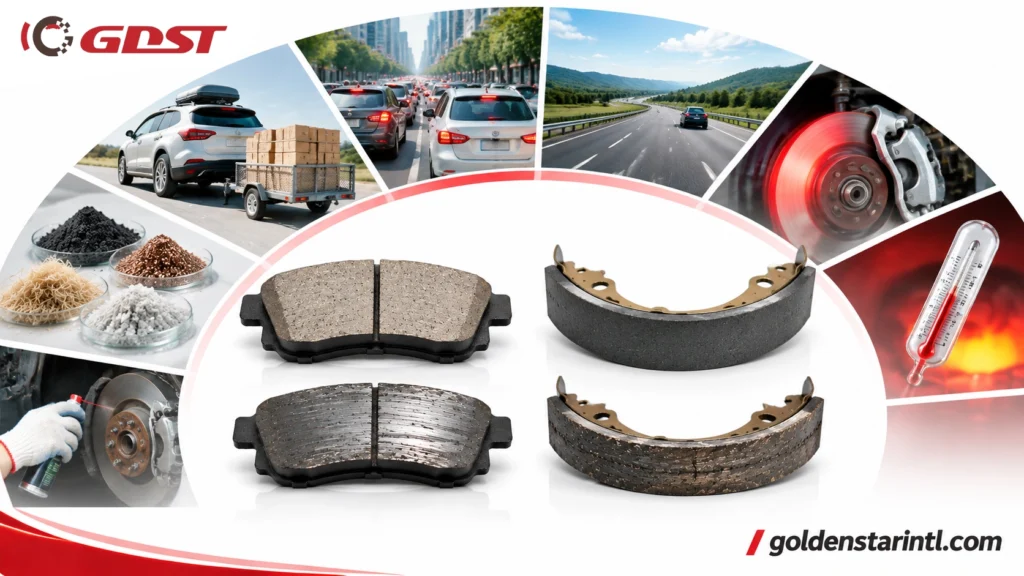
There is no universal replacement interval for brake pads or brake shoes.
Their service life depends on several interacting factors:
- Vehicle weight and axle load.
- Driving habits and braking frequency.
- Traffic conditions.
- Friction material composition.
- Operating temperature.
- Brake rotor or drum condition.
- Brake system adjustment and maintenance.
- Vehicle and braking system design.
Front brake pads often experience a substantial share of the vehicle’s braking workload because braking causes dynamic load transfer toward the front axle.
However, dynamic load transfer does not directly determine actual friction material wear rates.
Electronic brake force distribution, vehicle configuration, regenerative braking, friction material properties, and operating conditions can all influence wear.
Brake shoes may sometimes achieve longer service intervals in certain rear drum brake applications, particularly where they handle a relatively lower proportion of the vehicle’s braking workload.
However, this is not a universal rule.
Laguna-Camacho et al. (2015) demonstrated that disc and drum friction materials can develop different wear patterns after actual service. This supports the importance of considering material characteristics and contact conditions rather than assuming one component always lasts longer [4].
Replacement decisions should be based on actual inspection, remaining friction material thickness, braking performance, and the vehicle manufacturer’s maintenance specifications.
Common Signs That Brake Pads or Brake Shoes Need Replacement
Recognizing abnormal braking symptoms early can help prevent additional damage to the braking system.
Common warning signs include:
- Squealing or Squeaking Noises
High-pitched noises may indicate friction material wear, vibration, contamination, or other brake-related issues.
Some brake pads include mechanical wear indicators that produce noise when the friction material approaches its service limit.
- Grinding Sounds
Grinding noises during braking may indicate severe friction material wear or metal-to-metal contact.
The braking system should be inspected promptly to prevent additional rotor or drum damage.
- Reduced Braking Performance
If the vehicle requires more pedal effort or takes longer to slow down, the braking system should be checked.
- Vehicle Pulling to One Side
Uneven braking force may cause the vehicle to pull toward one side.
Possible causes include uneven friction material wear, sticking calipers, wheel cylinder problems, or hydraulic system faults.
- Brake Pedal Vibration
Pulsation during braking may be associated with rotor or drum runout, thickness variation, uneven wear, or other braking system problems.
- Abnormal Parking Brake Performance
For vehicles using drum brake shoes as part of the parking brake system, excessive lever travel or insufficient holding force may indicate adjustment or component problems.
These symptoms do not automatically identify a defective brake pad or brake shoe. A complete inspection is necessary to determine the underlying cause.
Brake Pad and Brake Shoe Maintenance and Replacement
Proper maintenance is important for both disc and drum braking systems.
For brake pads, technicians should inspect:
- Remaining friction material thickness.
- Uneven or tapered wear.
- Rotor surface condition.
- Caliper piston and guide pin movement.
- Brake pad shims and retaining hardware.
- Wear indicators and electrical sensors, where equipped.
For brake shoes, inspection should include:
- Remaining lining thickness.
- Cracks, separation, or contamination.
- Brake drum diameter and surface condition.
- Wheel cylinder leakage.
- Return springs and retaining hardware.
- Brake shoe adjuster operation.
- Backing plate contact surfaces.
When replacing brake pads or brake shoes, components should generally be replaced in axle sets according to the vehicle manufacturer’s service procedures.
For drum brakes, replacing worn shoes without inspecting the drum, wheel cylinder, springs, and adjustment mechanism may leave underlying problems unresolved.
For disc brakes, installing new pads against a damaged rotor may also compromise braking performance and accelerate uneven wear.
A complete brake inspection should therefore consider the entire braking assembly rather than only the friction component.
Brake Wear Particles: Environmental Impact of Brake Pads and Brake Shoes
Brake friction generates not only heat and mechanical wear but also airborne and non-airborne wear particles.
These particles originate from interactions between friction materials and their mating surfaces during braking.
Brake wear particles are an important category of non-exhaust traffic emissions, alongside tire wear, road surface wear, and other sources.
Grigoratos and Martini (2015), in their review Brake Wear Particle Emissions: A Review, examined the composition, size distribution, emission characteristics, and environmental relevance of particles generated by automotive braking systems [5].
The review reported that, in certain urban studies cited by the authors, brake wear could account for up to:
- 55% by mass of non-exhaust traffic-related PM10 emissions.
- 21% by mass of total traffic-related PM10 emissions.
These figures represent upper values reported in specific studies and should not be interpreted as universal global emission percentages.
Brake wear particle generation can be influenced by:
- Friction material composition.
- Brake rotor or drum material.
- Braking intensity.
- Vehicle speed.
- Contact pressure.
- Operating temperature.
- Frequency of braking.
Understanding these factors is important for the development of more sustainable brake friction materials.
Modern brake material research increasingly focuses on balancing braking performance, wear resistance, durability, and environmental considerations.
Brake Pad vs. Brake Shoe vs. Brake Lining: Are They the Same?
These three terms are closely related but refer to different components.
Brake Pad
A friction component used in a disc brake system. It generally consists of a backing plate and friction material, along with other possible accessories.
Brake Shoe
A curved metal supporting component used in a drum brake system. It holds the friction lining and provides the mechanical structure needed for drum brake operation.
Brake Lining
The friction material attached to a brake shoe. It is the working surface that contacts the inside of the brake drum and generates friction.
In some commercial vehicle applications, brake linings are supplied separately from brake shoes and must be bonded or riveted onto the shoe assembly.
Understanding these distinctions is important when identifying replacement parts, confirming product specifications, and communicating with automotive parts suppliers.
OEM vs. Aftermarket Brake Pads and Brake Shoes: What Should Buyers Consider?
For automotive parts distributors, wholesalers, and aftermarket importers, selecting the correct brake pads or brake shoes involves more than comparing prices.
Several technical and commercial factors should be evaluated.
- OE Number and Vehicle Compatibility
Confirm the original equipment reference, vehicle model, production year, axle position, and braking system configuration.
Do not rely on vehicle brand information alone.
- Product Dimensions and Structure
For brake pads, verify backing plate dimensions, friction material thickness, positioning features, and accessory requirements.
For brake shoes, confirm shoe width, arc dimensions, overall diameter, mounting geometry, and lining specifications.
- Friction Material Requirements
Different markets and vehicle applications may require different friction material formulations.
Buyers should communicate their performance expectations, operating conditions, vehicle applications, and applicable regulatory requirements.
- Manufacturing and Quality Control
A professional supplier should be able to explain its manufacturing processes and quality inspection procedures.
Relevant evaluation factors include:
- Friction coefficient.
- Wear resistance.
- Shear strength.
- Noise and vibration characteristics.
- Thermal performance.
- Dimensional consistency.
- OEM and Private Label Support
For aftermarket distributors and automotive brands, customized packaging, product identification, OE cross-reference support, and consistent batch quality can contribute to long-term business development.
OEM and aftermarket products should be evaluated based on actual technical performance, compatibility, manufacturing quality, and regulatory compliance rather than brand category alone.
Frequently Asked Questions About Brake Pads and Brake Shoes
Q1: Are brake pads and brake shoes the same thing?
No. Brake pads are used in disc brake systems and clamp against a rotating rotor. Brake shoes are used in drum brake systems and expand against the inside surface of a rotating drum.
Q2: Can a vehicle have both brake pads and brake shoes?
Yes. Some vehicles use front disc brakes and rear drum brakes. Others have four-wheel disc brakes with separate drum-in-hat parking brake shoes.
Q3: Which lasts longer, brake pads or brake shoes?
Brake shoes may last longer in certain rear drum brake applications, but actual service life depends on vehicle load, friction material composition, driving conditions, and maintenance.
Q4: Are disc brakes better than drum brakes?
Disc brakes generally offer better heat dissipation and more consistent performance during repeated heavy braking. Drum brakes remain useful because of their economical construction and self-energizing characteristics in certain designs.
Q5: Can brake pads be installed in a drum brake system?
No. Brake pads and brake shoes are designed for different braking mechanisms and cannot be used interchangeably.
Q6: What is the difference between a brake shoe and a brake lining?
A brake shoe is the curved metal supporting structure, while the brake lining is the friction material attached to it.
Q7: Why do some trucks still use drum brakes?
Drum brakes offer relatively economical construction, established engineering designs, and suitable braking performance for many commercial vehicle applications.
Q8: Can I replace only one brake pad or one brake shoe?
Brake friction components are generally replaced in axle sets according to the vehicle manufacturer’s service procedures to maintain balanced braking performance.
Q9: Do brake shoes require more maintenance than brake pads?
Drum brakes generally contain more internal components, including springs, adjusters, and wheel cylinders. Their inspection and maintenance can therefore be more involved.
Q10: How can I choose the correct aftermarket brake pads or brake shoes?
Confirm the OE reference, vehicle application, product dimensions, friction material requirements, and applicable market standards. A technically experienced automotive parts supplier can help verify product compatibility.
Understanding the Difference Helps You Choose the Right Brake Components
Brake pads and brake shoes perform the same essential function, but they belong to different braking systems and operate through different mechanical principles.
Brake pads work with disc brakes, offering efficient heat dissipation and convenient maintenance. Brake shoes work with drum brakes, providing a practical and economical solution for many passenger and commercial vehicle applications.
However, their differences extend beyond installation position and shape. Friction material formulation, contact pressure, heat generation, wear mechanisms, and vehicle operating conditions all influence braking performance and service life.
Engineering research has demonstrated that braking friction is a complex interaction between materials, mechanical contact, and thermal behavior. Therefore, neither brake pads nor brake shoes should be evaluated independently of their complete braking systems.
For automotive parts distributors, wholesalers, and aftermarket buyers, understanding these differences is essential for selecting compatible products and maintaining reliable braking performance.
Explore GDST’s automotive braking product categories:
- GDST Brake Pad Manufacturer
- GDST Brake Shoe Manufacturer
- GDST Brake Disc Manufacturer
- GDST Brake Drum Manufacturer
Contact GDST to discuss OE references, product specifications, and wholesale sourcing requirements.
Academic References
[1] Chan, D., & Stachowiak, G. W. (2004). Review of Automotive Brake Friction Materials. Proceedings of the Institution of Mechanical Engineers, Part D: Journal of Automobile Engineering, 218(9), 953–966.
[2] Ramesh, A., & Sundar, S. (2021). Contributions of Various Non-linearities to the Dynamic Response of an Automotive Drum Brake During Typical Braking: A Theoretical Study. International Journal of Non-Linear Mechanics, 137, 103808.
[3] Newcomb, T. P., & Millner, N. (1965). Cooling Rates of Brake Drums and Discs. Proceedings of the Institution of Mechanical Engineers: Automobile Division, 180(1), 191–205.
[4] Laguna-Camacho, J. R., Juárez-Morales, G., Calderón-Ramón, C., Velázquez-Martínez, V., Hernández-Romero, I., Méndez-Méndez, J. V., & Vite-Torres, M. (2015). A Study of the Wear Mechanisms of Disk and Shoe Brake Pads. Engineering Failure Analysis, 56, 348–359.
[5] Grigoratos, T., & Martini, G. (2015). Brake Wear Particle Emissions: A Review. Environmental Science and Pollution Research, 22, 2491–2504.