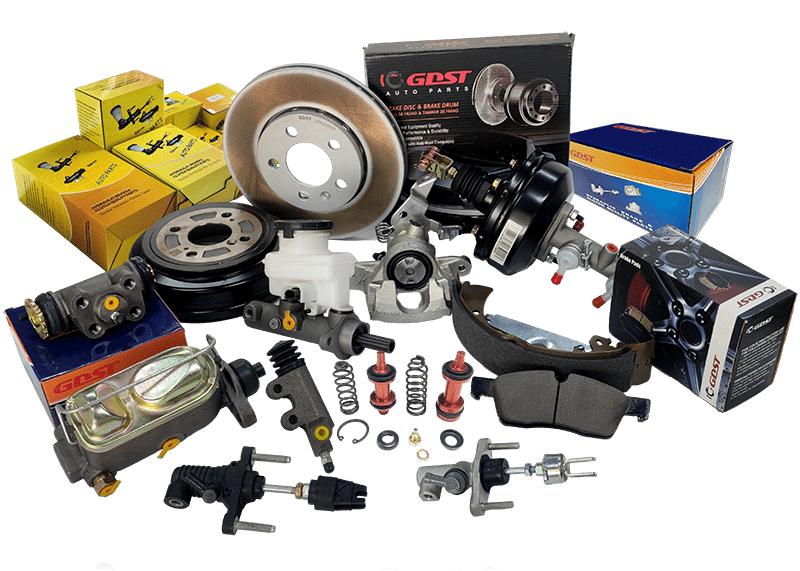
If your last brake pad supplier promised "premium quality" but delivered noise complaints from your garage customers, you already know the real problem. The spec sheet looked fine. The samples felt solid. Then the first bulk shipment arrived.
Low-metallic brake pads are a mid-range friction material category1 that balances stopping power and cost. They suit most passenger car applications in moderate to demanding conditions.2 But "low-metallic" is a formulation category, not a quality guarantee. The right supplier is defined by their process control, not their product label.
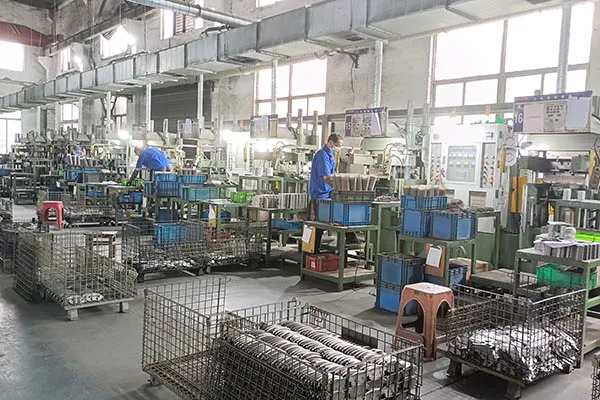
The question is not whether low-metallic pads are good. For many of your target markets, they are the right fit. The real question is whether the manufacturer behind the product has the process discipline to deliver a consistent formulation, batch after batch, across your entire SKU range. That is what this article is about. I will walk you through the key things to verify before you commit to a supplier, based on what we see from buyers who come to us after a bad experience elsewhere.
Is "Low-Metallic" Actually the Right Formulation for Your Market?
Most buyers arrive with a fixed request: "We need low-metallic pads." That is a reasonable starting point. But a manufacturer who just says "yes, we have that" without asking any follow-up questions is not a manufacturer you want to work with.
Low-metallic formulations contain steel fiber at a controlled ratio—typically between 10% and 30% by weight3. This gives the pad strong friction performance under high heat.4 But the right ratio, binder resin type, and friction modifier mix all depend on your target market's conditions. A single spec does not serve all markets equally well.
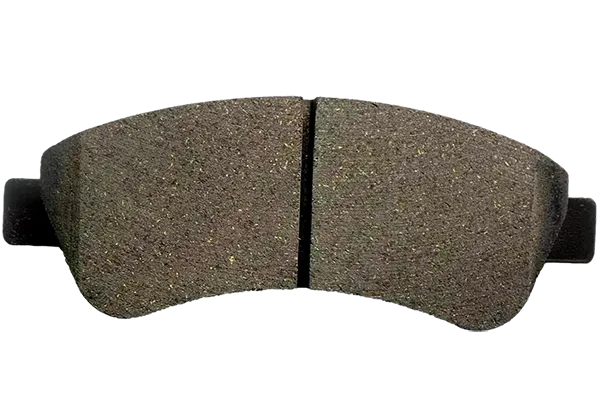
When we first speak with an importer, our technical team always asks three things before recommending a specific formulation: What is the primary vehicle type? What is the climate and road profile of the end market? And what is the price sensitivity of your local garage customers?
These questions are not sales tactics. They are engineering requirements.
Why Market Conditions Drive Formulation Decisions
| Market Condition | Formulation Consideration | What to Ask Your Supplier |
|---|---|---|
| High ambient temperature (e.g., Middle East, Southeast Asia) | Higher heat fade resistance required; binder resin selection is critical | Can they show fade performance data from a Dynamometer test? |
| Wet and cold climate (e.g., Northern Europe) | Consistent cold bite performance under moisture | Do they test initial friction coefficient at low temperatures? |
| Mixed urban/highway (e.g., South America) | Balanced wear rate and noise profile | What is the expected service life per set, and how was it validated? |
| Heavy-duty trucks | Higher steel fiber content, stronger backing plate bonding | Can they provide shear strength test results per batch? |
When we talk to importers from South America, a common concern is noise. The road conditions there create a lot of vibration feedback, and garage customers in that region are very sensitive to squeal5. A low-metallic formulation with a higher steel content will stop the car well, but it may generate more noise under those specific conditions compared to a ceramic blend.
A supplier who does not flag this to you upfront is not protecting your business. They are protecting their sale.
The honest answer is that low-metallic pads do have a noise trade-off compared to full ceramic pads. They also generate more brake dust. What you gain is stronger stopping power in high-heat situations6 and a lower cost per set. For many markets, that trade-off is entirely acceptable. But you need to know it in advance so you can set the right expectations with your own customers.
A credible manufacturer will tell you this directly. If a supplier promises you the stopping power of a racing pad with the silence of a ceramic pad at the price of a budget semi-metallic, that is a red flag.
How Do You Verify That a Supplier Actually Controls Their Process?
You cannot judge a brake pad by looking at it. A pad that appears finished and correctly dimensioned can still have a bonding defect inside the friction material that only shows up after 5,000 km of use. This is why auditing the supplier's process is more important than inspecting the product itself.
The most reliable way to verify a supplier's quality control is to audit their critical manufacturing stages directly, or to review documented evidence from each stage. For brake pads, the three stages that carry the most risk are raw material batching, hot pressing, and final dimensional inspection. Failures at any of these stages cause the most common field complaints: delamination, noise, and improper fitment7.
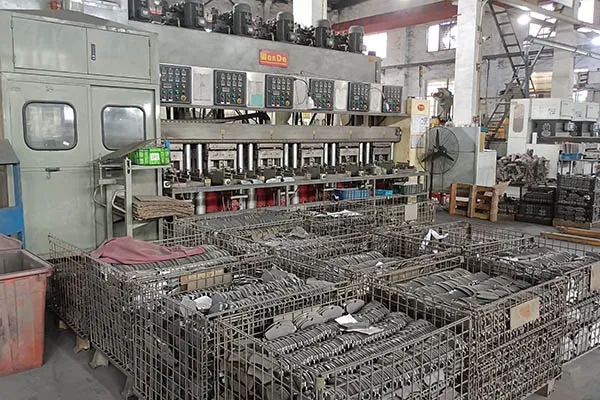
In our factory, the hot pressing stage gets the most scrutiny. This is the step where the friction material and the steel backing plate are bonded under heat and pressure. Temperature deviation of even a few degrees, or a worn mold that is not caught in time, can create a bond that passes a visual check but fails under real braking stress. This is the source of many delamination complaints that buyers report from cheaper suppliers.
What to Look for When You Audit a Brake Pad Manufacturer
Certifications as a baseline, not a finish line. IATF 16949 certification tells you that a quality management system exists. It does not tell you how strictly it is followed.8 Use it as a minimum requirement to screen suppliers, but do not stop there.
In-house testing equipment is non-negotiable. Ask specifically for their equipment list. A serious brake pad manufacturer should have, at minimum:
| Equipment | What It Verifies | Why It Matters to You |
|---|---|---|
| Krauss Friction Testing Machine | Friction coefficient and wear rate under load | Confirms the formulation performs as claimed |
| Dynamometer Test Bench | Real-world braking performance simulation | The closest thing to an actual road test |
| Shear Strength Tester | Bond strength between friction material and backing plate | Directly predicts delamination risk9 |
| Compressibility Tester | Material compressibility under pressure | Affects pedal feel and noise behavior |
| Rockwell Hardness Tester | Friction material hardness consistency | Checks batch-to-batch formulation stability |
If a supplier cannot show you this equipment during a factory visit or video audit, they are likely outsourcing their testing. That means they do not control their own quality data.
Ask for batch-specific test reports, not just catalog specs. A trustworthy supplier can pull a shear strength test report tied to a specific production batch. If they can only give you a generic spec sheet that applies to all their products, they are not running batch-level quality control.
Check their handling of non-conforming products. Ask them directly: what happens when a hot press run shows a temperature anomaly? What is the quarantine process? How are defective backing plates managed before assembly? Their answer will tell you more about their actual process discipline than any certificate on the wall.
What Is the Real Difference Between a Manufacturer and a Trading Company?
This is the question that most directly affects your long-term supply chain stability. Trading companies have an important role in many markets. But if your goal is OEM customization, stable formulations, and direct accountability for quality issues, you need a factory relationship.
A true brake pad manufacturer controls the full production process in-house: from raw material batching through hot pressing, heat treatment, grinding, coating, and packaging. This end-to-end control is what makes consistent quality and flexible customization possible. A trading company that sources from multiple factories cannot guarantee formulation consistency across orders.10
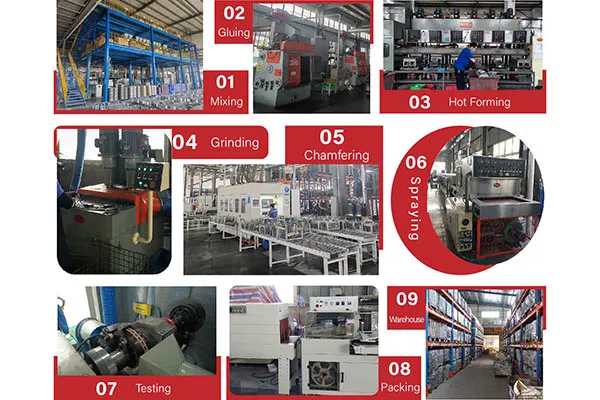
The practical implication for you as a buyer is this: when a quality issue appears in the field six months after your order, a trading company has limited leverage over their source factory to investigate the root cause. A manufacturer can trace the issue back to the specific production batch, the specific raw material lot, and the specific operator log from that hot press run.
How to Distinguish a Real Manufacturer During Sourcing
Ask for the production flow, not the product list. A real manufacturer can walk you through their exact production sequence. Ours goes: Raw Material Batching → Hot Pressing → Heat Treatment → Grinding / Slotting / Chamfering → Coating → Shims and Accessories Assembly → Packaging. Each step has documented parameters and inspection checkpoints. If a supplier hesitates or gives you a vague description of "our production process," that is a signal.
Request a factory audit or a live video walkthrough. This is standard practice for serious B2B buyers. Any legitimate manufacturer will support this. We regularly host audits from European and South American importers, both in-person and via video call. If a supplier resists this request, or delays it repeatedly, do not proceed.
| Verification Request | Manufacturer Response | Trading Company Response |
|---|---|---|
| Factory audit (in-person or video) | Supported; can show production floor in real time | Often difficult; "factory is busy" or similar delay |
| Batch-specific test report | Can produce report tied to specific batch and date | Usually provides generic catalog spec sheet only |
| OEM packaging customization | In-house capability; clear MOQ and lead time | Depends on source factory; less control over terms |
| Formulation adjustment for specific market | Can modify formula; has R&D team to support | Limited or no formulation control |
| Root cause analysis for field complaint | Can trace to specific batch and production log | Limited traceability across multiple source factories |
Check the MOQ structure. A manufacturer with real production capacity and in-house tooling can typically offer lower MOQs than a trading company that is managing margin across multiple vendors. Our minimum is 100 sets per SKU, which is workable for distributors who are testing a new application before scaling. A trading company usually requires higher minimums because they are sourcing across batches from different factories.
Verify export certifications against your target market. For Europe, E-mark is required.11 For North America, DOT compliance matters. For certain Middle Eastern and Southeast Asian markets, other regional standards apply. A manufacturer who exports directly to these markets will have these certifications current and ready to produce. A trading company may have them, but they may also be holding outdated or third-party-sourced documentation that they cannot stand behind in a market audit.
Conclusion
Choosing a low-metallic brake pad supplier means auditing their process discipline, formulation transparency, and full-factory ownership—not just their catalog. The right partner asks the right questions before they quote you a price.
"Brake pad - Wikipedia", https://en.wikipedia.org/wiki/Brake_pad. Automotive engineering sources classify brake pad friction materials into several categories, including non-asbestos organic (NAO), semi-metallic, low-metallic, and ceramic, often positioning low-metallic formulations as a balance between the performance of semi-metallics and the refinement of ceramics. Evidence role: definition; source type: encyclopedia. Supports: The classification of low-metallic brake pads relative to other types like semi-metallic, organic, and ceramic.. ↩
"Difference Between Low-Metallic and Semi-Metallic Brake Pads", https://goldenstarintl.com/whats-the-difference-between-low-metallic-and-semi-metallic-brake-pads/. Technical guides on brake system components often recommend low-metallic pads for a wide range of passenger vehicles, noting their effectiveness in conditions that demand higher friction and heat dissipation than typical non-asbestos organic (NAO) pads can provide. Evidence role: general_support; source type: education. Supports: The typical applications and performance envelope for low-metallic brake pads in passenger vehicles.. Scope note: The definition of 'moderate to demanding' can vary, and suitability depends on specific vehicle weight, driving style, and performance expectations. ↩
"[PDF] Compositions, Functions, and Testing of Friction Brake Materials ...", https://info.ornl.gov/sites/publications/Files/Pub57043.pdf. Research on automotive friction materials characterizes 'low-metallic' formulations as typically containing 10% to 30% metallic fibers by weight, distinguishing them from 'semi-metallic' pads which may contain 30% to 65%. Evidence role: statistic; source type: paper. Supports: The typical percentage range of metallic fibers (like steel or copper) in low-metallic brake pad formulations.. ↩
"Temperature Influence on Brake Pad Friction Coefficient Modelisation", https://pmc.ncbi.nlm.nih.gov/articles/PMC10779514/. Studies in tribology show that metallic components like steel fibers in a friction composite contribute to thermal conductivity, helping to dissipate heat from the friction interface and maintain a stable coefficient of friction during high-temperature braking, a phenomenon known as fade resistance. Evidence role: mechanism; source type: paper. Supports: The role of metallic fibers in maintaining friction stability and dissipating heat at elevated temperatures.. ↩
"[PDF] brake noise - nhtsa", https://static.nhtsa.gov/odi/tsbs/2020/MC-10177624-9999.pdf. Automotive aftermarket industry analysis for Latin American markets has noted that brake noise is a primary driver of customer complaints and comebacks for repair garages, influencing part selection and service procedures in the region. Evidence role: case_reference; source type: other. Supports: Evidence of heightened consumer sensitivity to brake noise (squeal) in South American markets compared to other regions.. Scope note: Finding a direct, quantitative comparison of 'sensitivity' by region may be difficult; support may be qualitative, coming from trade journal articles or market reports. ↩
"Investigation of mechanical properties and performance ... - PMC - NIH", https://pmc.ncbi.nlm.nih.gov/articles/PMC12402442/. Comparative studies of brake friction materials generally find that low-metallic formulations offer a higher coefficient of friction, particularly at elevated temperatures, compared to many ceramic formulations, but this often comes with trade-offs in increased noise (NVH) and brake dust. Evidence role: general_support; source type: paper. Supports: The relative performance characteristics of low-metallic and ceramic brake pad formulations.. Scope note: Performance can vary significantly based on the specific formulation within each category. ↩
"[PDF] Brake Pad Legislative Report", https://dtsc.ca.gov/wp-content/uploads/sites/31/2023/08/Brake-Pad-Legislative-Report-Accessible.pdf. Analyses of warranty data and field complaints in the automotive aftermarket consistently identify noise and vibration (NVH), premature wear, delamination of the friction material from the backing plate, and fitment issues as leading causes of brake pad failure and customer dissatisfaction. Evidence role: statistic; source type: research. Supports: Data or analysis identifying the most frequent reasons for brake pad warranty claims or customer complaints in the field.. Scope note: The exact ranking of 'most common' may vary by market, vehicle type, and data source. ↩
"About – International Automotive Task Force - IATF", https://www.iatfglobaloversight.org/iatf-169492016/about/. The International Automotive Task Force (IATF) defines IATF 16949 as a standard that specifies the requirements for a quality management system (QMS) for organizations in the automotive industry. While certification confirms that a QMS has been implemented and audited against the standard's requirements, ongoing process discipline and culture determine the effectiveness of its day-to-day application. Evidence role: definition; source type: institution. Supports: The scope and purpose of the IATF 16949 standard.. Scope note: The source will describe what the standard is, and the limitation is an inferential conclusion, though a common one in quality management circles. ↩
"Testing Passenger Car Brake Pad Exploitation Time's Impact on the ...", https://pmc.ncbi.nlm.nih.gov/articles/PMC8952483/. Industry standards, such as SAE J840, specify shear strength testing to measure the integrity of the bond between the brake lining and the backing plate. This test is a primary method for assessing the material's resistance to shear forces encountered during braking and is considered a key predictor of its risk for in-service delamination. Evidence role: mechanism; source type: research. Supports: The use of shear strength testing as a key quality control measure to prevent delamination.. ↩
"Challenges in Supply Chain Management", https://business.wisc.edu/news/challenges-in-supply-chain-management/. Guides on international sourcing and supply chain management highlight that while trading companies can simplify logistics, they introduce a layer of abstraction between the buyer and the producer. This can create challenges in ensuring batch-to-batch consistency, especially for products with precise technical specifications like chemical formulations, as the trading company may switch or use multiple suppliers to fulfill orders. Evidence role: general_support; source type: education. Supports: The inherent challenges in maintaining product consistency when sourcing from a trading company that may use multiple, undisclosed factories.. ↩
"ECE Regulation 90 - Wikipedia", https://en.wikipedia.org/wiki/ECE_Regulation_90. The United Nations Economic Commission for Europe (UNECE) Regulation No. 90 (R90) mandates that all replacement brake linings and pads sold for use on vehicles within the European Union and other signatory countries must be tested and certified to meet performance standards equivalent to the original equipment. Compliance is indicated by an 'E-mark' on the product. Evidence role: definition; source type: government. Supports: The legal requirement for E-mark certification for replacement brake linings in the European market.. ↩